S’pore scientists developing treatment to target fluid that fuels cancer in abdominal lining新加坡科学家正在研发一种治疗方法,旨在靶向腹膜癌细胞滋养液。
Singapore scientists develop nanobody treatment targeting ascites to fight peritoneal cancer, with hopes for future clinical trials. Read more at straitstimes.com.
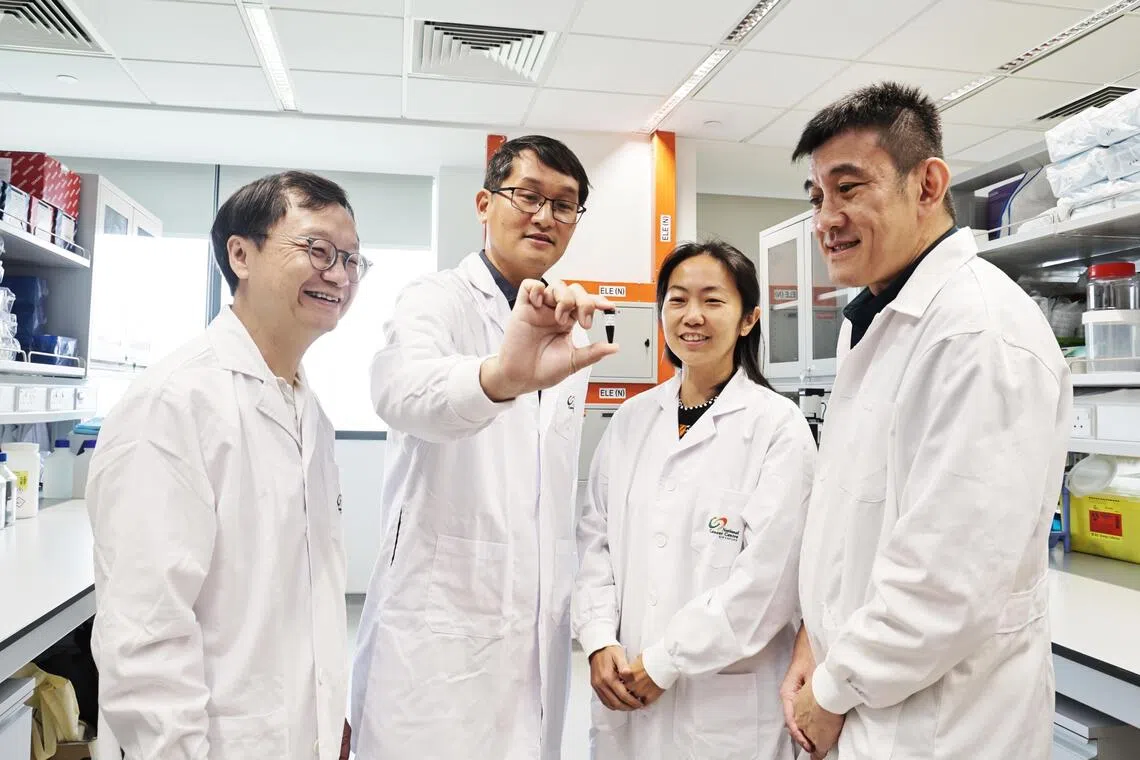
The team of scientist-clinicians who are developing treatment for late-stage peritoneal cancer comprised (from left) Professor Jimmy So of NUS Yong Loo Lin School of Medicine; Johnny Ong, head of the Department of Sarcoma, Peritoneal and Rare Tumours (SPRinT) at the National Cancer Centre Singapore (NCCS); Claramae Chia, a senior consultant with SPRinT; and Tony Lim, chairman of the Division of Pathology at the Singapore General Hospital. STPHOTO KELVIN CHNG
Published Oct 19, 2026, 06:32 PM
Updated Oct 19, 2026, 06:32 PM
Singapore scientists found two proteins, PAI-1 and S100A10, that drive tumour growth in ascites, the fluid linked to peritoneal cancer spread.
They developed a nanobody that cut tumour growth in lab, animal and human tissue tests, with minimal toxicity.
The team now aims for clinical-grade development and a first-in-human trial in about five years, offering hope for patients with few treatment options.
SINGAPORE – Scientists in Singapore have developed an experimental treatment for cancer of the abdominal lining, moving a step closer to extending the average survival rate that is currently under nine months.
Peritoneal cancer is a late-stage condition that occurs when cancer spreads to the abdominal lining from primary sites such as the stomach, colon, breast, or ovaries.
The scientists created a novel nanobody, or a lab-engineered antibody , that could stunt the growth of tumours in animal models and human tissue samples with mild side effects.
The nanobody blocks two proteins found in an abnormal buildup of abdominal fluid inside the peritoneal cavity called ascites, which the team discovered are key drivers of tumour growth in the lining.
The study’s senior author Johnny Ong said: “If you look at all the major cancers in the world, 40% of gastric cancer actually spreads to the peritoneum at some stage, 30% of colorectal cancer, and 70% of ovarian cancer.
“And if you look at the numbers worldwide, more than 1.2 million cases (of peritoneal cancer) are diagnosed each year.”
He added that while it is one of the major presentations of advanced cancer, it currently has few effective treatments.
Ong, who heads the Department of Sarcoma, Peritoneal and Rare Tumours at the Singapore General Hospital and the National Cancer Centre Singapore, said the best treatment today is HIPEC, or hyperthermic intraperitoneal chemotherapy. This specialised two-step treatment combines surgery with heated chemotherapy to target advanced abdominal cancers.
“This method is where ... we surgically remove all the tumours, and then we pour hot chemotherapy drug into the cavity, like bleach, to kill all the tumour cells inside,” Ong said.
However, nine out of 10 patients are typically not suitable for this treatment.
This spurred the team to study what caused the spread of cancer to the protective abdominal membrane as far back as 2016.
The team later found that the ascites contained molecular substances that cancer cells rely on to survive, “dictating how well or how poorly the patient did”, Ong said.
Using the analogy of an apple tree growing beside a pond, he said when a rotten apple drops into the water, it could affect the whole ecosystem like how cancer could affect and spread in the abdominal cavity.
“From here, there was proof of concept that we can target the fluid instead of the tumour cells to prevent the tumour from growing or spreading. What we proposed to do was add ‘agents’ into the water to break off the growth potential of the cancer cells,” he added.
Using the latest molecule profiling technologies, the team analysed proteins and biological pathways across a 397-sample dataset spanning 21 primary cancer types. Two proteins , PAI-1 and S100A10, emerged as key drivers of tumour development in the ascites.
Selecting one protein as the therapeutic target, the scientists focused on developing a nanobody – a newer class of drugs that are small in size, do not provoke the immune system and have lower toxicity risk.
The “Eureka moment”, Ong said, came when the nanobody demonstrated therapeutic efficacy and safety across three model systems: cancer cells grown in the lab, those found in animal models and in samples of advanced abdominal cancer preserved in a jelly-like hydrogel made from hyaluronic acid .
“Across all three, the therapy effectively suppressed tumour growth with minimal toxicity,” he said.
The recent findings were published in September 2026 in Molecular Cancer, a monthly peer-reviewed academic journal in the field of molecular oncology.
Jimmy So, a professor with the Department of Surgery at NUS Medicine, said: “This discovery is particularly encouraging because of its potential to pave the way for an effective therapy for peritoneal metastasis, a common and often deadly complication of many abdominal cancers.”
“We hope this research can ultimately translate into better treatment options and renewed hope for patients facing this difficult condition.”
(Left) Retired accountant Yeow Ser Kiang with her doctor Johnny Ong, head of the Department of Sarcoma, Peritoneal and Rare Tumours (SPRinT) at the National Cancer Centre Singapore. She donated her ascites for the second phase of the study in search for a possible effective treatment. STPHOTO KELVIN CHNG The Straits Times
(Left) Retired accountant Yeow Ser Kiang with her doctor Johnny Ong, head of the Department of Sarcoma, Peritoneal and Rare Tumours (SPRinT) at the National Cancer Centre Singapore. She donated her ascites for the second phase of the study in search for a possible effective treatment. STPHOTO KELVIN CHNG
One such patient is retired accountant Yeow Ser Kiang, 76.
She was diagnosed with stage three ovarian cancer in 2017 and had a hysterectomy to remove her womb and ovaries.
Even though she went through 10 months of chemotherapy, the cancer returned and spread to her peritoneum, forcing her to undergo several operations and rounds of chemotherapy.
Yeow has donated her ascites for the second phase of the research, in which the team is working towards clinical-grade development and a first-in-human clinical trial.
Ong said: “We are developing novel treatment strategies for patients with limited options, with the nanobody as our lead asset. We are hoping to see the first phase of clinical trial in five years.”
致力于研发晚期腹膜癌治疗方案的科学家-临床医生团队成员包括(从左至右):新加坡国立大学杨潞琳医学院的苏志明教授;新加坡国立癌症中心(NCCS)肉瘤、腹膜及罕见肿瘤科(SPRinT)主任王约翰;SPRinT高级顾问谢嘉敏;以及新加坡中央医院病理科主任林东尼。照片由Kelvin Chung拍摄。
发布于 2026 年 10 月 19 日下午 6:32
更新于2026年10月19日下午6:32
新加坡科学家发现了两种蛋白质 PAI-1 和 S100A10,它们会促进腹水中的肿瘤生长,而腹水是与腹膜癌扩散相关的液体。
他们开发了一种纳米抗体,在实验室、动物和人体组织测试中均能抑制肿瘤生长,且毒性极小。
该团队目前的目标是在五年左右的时间里进行临床级别的开发和首次人体试验,为治疗选择有限的患者带来希望。
新加坡——新加坡的科学家们开发出一种治疗腹膜癌的实验性疗法,使目前平均生存期不足九个月的患者人数向延长生存期迈进了一步。
腹膜癌是一种晚期疾病,当癌症从胃、结肠、乳房或卵巢等原发部位扩散到腹膜时就会发生。
科学家们创造了一种新型纳米抗体,或者说是一种实验室合成的抗体,它可以抑制动物模型和人体组织样本中肿瘤的生长,且副作用轻微。
这种纳米抗体可以阻断腹膜腔内异常积聚的腹水(称为腹水)中发现的两种蛋白质,研究团队发现这两种蛋白质是腹膜内肿瘤生长的关键驱动因素。
该研究的资深作者约翰尼·翁表示:“如果你看看世界上所有主要的癌症,就会发现40%的胃癌实际上会在某个阶段扩散到腹膜,30%的结直肠癌和70%的卵巢癌。
“如果你看看全球的数据,就会发现每年有超过 120 万例(腹膜癌)确诊病例。”
他还补充说,虽然这是晚期癌症的主要表现形式之一,但目前有效的治疗方法却很少。
新加坡中央医院和新加坡国家癌症中心肉瘤、腹膜及罕见肿瘤科主任翁医生表示,目前最佳的治疗方法是腹腔热灌注化疗(HIPEC)。这种特殊的两步疗法结合了手术和热化疗,专门用于治疗晚期腹部癌症。
“这种方法就是……我们通过手术切除所有肿瘤,然后将热的化疗药物(就像漂白剂一样)倒入空腔中,杀死里面的所有肿瘤细胞,”翁医生说。
然而,通常情况下,十个患者中有九个不适合这种治疗方法。
早在 2016 年,这促使该团队开始研究是什么原因导致癌症扩散到保护性的腹部膜。
Ong表示,研究团队后来发现腹水中含有癌细胞赖以生存的分子物质,“决定了患者的病情好坏”。
他以生长在池塘边的苹果树为例,说当一个烂苹果掉进水里时,它可能会像癌症在腹腔内扩散一样,影响整个生态系统。
“由此,我们验证了这样一个概念:我们可以靶向肿瘤液而不是肿瘤细胞,从而阻止肿瘤生长或扩散。我们提出的做法是在水中添加‘试剂’,以破坏癌细胞的生长潜力,”他补充道。
研究团队利用最新的分子谱分析技术,分析了涵盖21种原发性癌症类型的397个样本数据集中的蛋白质和生物通路。结果发现,PAI-1和S100A10这两种蛋白质是腹水中肿瘤发展的关键驱动因素。
科学家们选择了一种蛋白质作为治疗靶点,专注于开发纳米抗体——一种新型药物,其体积小,不会刺激免疫系统,毒性风险较低。
Ong表示,“灵光乍现”的时刻到来了,纳米抗体在三种模型系统中展现出了治疗功效和安全性:实验室培养的癌细胞、动物模型中的癌细胞以及保存在由透明质酸制成的凝胶状水凝胶中的晚期腹部癌症样本。
他说:“这三种疗法都能有效抑制肿瘤生长,且毒性极小。”
这项最新研究成果于 2026 年 9 月发表在《分子癌症》杂志上,该杂志是分子肿瘤学领域的一份月刊,经过同行评审。
新加坡国立大学医学院外科系教授苏志明表示:“这一发现尤其令人鼓舞,因为它有可能为腹膜转移的有效治疗铺平道路,腹膜转移是许多腹部癌症常见的、往往致命的并发症。”
“我们希望这项研究最终能够转化为更好的治疗方案,并为面临这种棘手疾病的患者带来新的希望。”
(左)退休会计师叶思强(Yeow Ser Kiang)与她的医生王约翰尼(Johnny Ong)合影,王约翰尼是新加坡国家癌症中心肉瘤、腹膜及罕见肿瘤科(SPRinT)的主任。她捐献了自己的腹水用于该研究的第二阶段,以寻找可能的有效治疗方法。照片由《海峡时报》的KELVIN CHNG拍摄。
(左)退休会计师叶思强(Yeow Ser Kiang)与她的医生王约翰尼(Johnny Ong)合影,王约翰尼是新加坡国家癌症中心肉瘤、腹膜及罕见肿瘤科(SPRinT)的主任。她捐献了自己的腹水用于该研究的第二阶段,以寻找可能的有效治疗方法。照片由Kelvin Chung拍摄。
其中一位病人是76岁的退休会计师叶思强。
2017年,她被诊断出患有三期卵巢癌,并接受了子宫切除术,切除了子宫和卵巢。
尽管她接受了 10 个月的化疗,但癌症还是复发并扩散到了腹膜,迫使她接受了多次手术和多轮化疗。
Yeow捐献了自己的腹水用于第二阶段的研究,该团队正在努力实现临床级别的开发和首次人体临床试验。
Ong表示:“我们正在为治疗选择有限的患者开发新的治疗策略,纳米抗体是我们的主要资产。我们希望在五年内看到第一阶段临床试验。”