‘Customers won’t be happy’: Why cutting salt is a tough sell for Singapore’s hawkers“顾客不会高兴”:为什么减少盐的用量对新加坡小贩来说难以推行
Despite years of efforts to cut sodium intake in Singapore, levels keep rising. Yet hawkers say changing familiar flavours to less salty ones could cost them customers.
Despite years of efforts to cut sodium intake in Singapore, levels keep rising. Yet hawkers say changing familiar flavours to less salty ones could cost them customers.
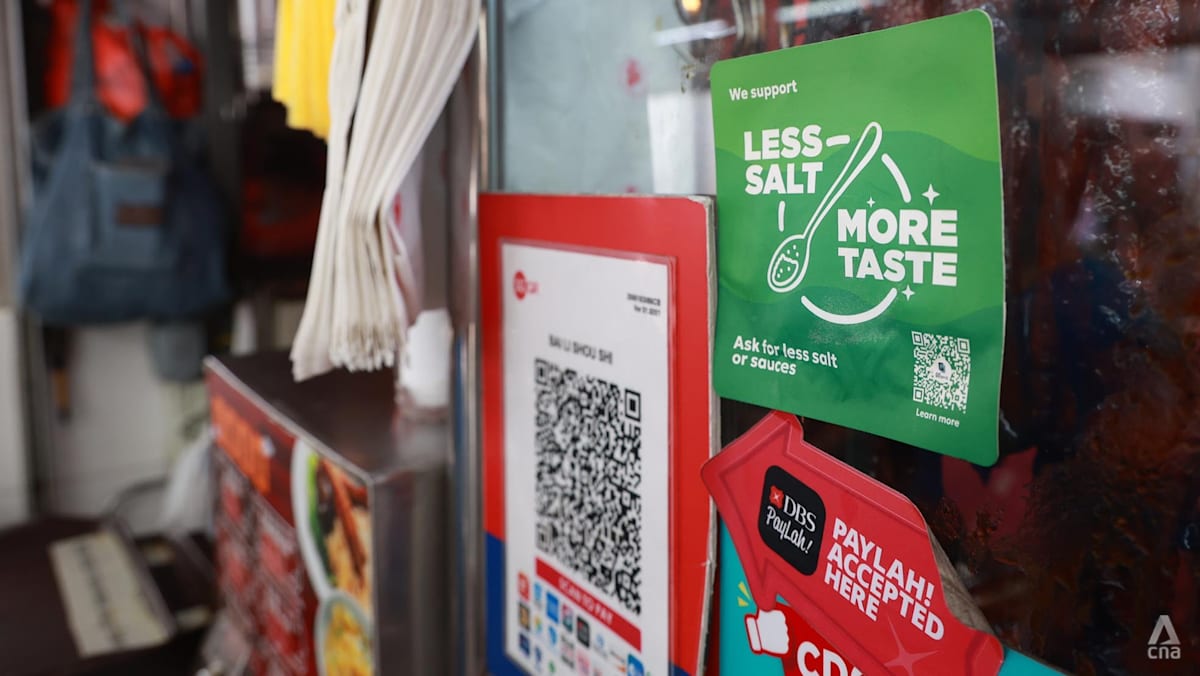
A sign at Ah Kiat Wanton Mee, under the "Less Salt, More Taste" campaign led by the Health Promotion Board (HPB), encouraging diners and hawkers to cut down on sodium. (Photo: CNA/Raj Nadarajan)
This audio is generated by an AI tool.
SINGAPORE: When hawker Ringo Yen tried making his wanton noodle soup less salty, some customers complained that it tasted bland and added more condiments themselves.
"It's so scary, the way they pour the soya sauce (into their food)," said the second-generation hawker, whose family has run Xiang Ji Wanton Mee at Bedok Food Centre for more than 50 years.
Mr Yen's efforts to make his soup less salty over the past two years highlight a challenge facing Singapore's push to reduce sodium consumption: Diners still expect familiar, stronger flavours.
"You must convince the customer first before you convince the hawker. If you do it the other way around, it will not be very effective," he said.
CNA Games Guess Word Crack the word, one row at a time Buzzword Create words using the given letters Mini Sudoku Tiny puzzle, mighty brain teaser Mini Crossword Small grid, big challenge Word Search Spot as many words as you can Show More Show Less Despite years of efforts to promote lower-sodium ingredients, most hawkers CNA spoke to remain reluctant to change their recipes, fearing that altering the taste of their dishes could drive customers away. Their concerns come as Singaporeans are consuming more sodium than before, with food sold outside the home also becoming saltier. Findings from the National Population Health Survey and National Nutrition Survey released earlier this month showed that Singapore adults were consuming more calories and salt despite being more physically active. Nearly all Singapore residents, or 95 per cent, exceeded the recommended daily sodium limit of 2,000mg, equivalent to about one teaspoon of salt. This is up from 88 per cent in 2019. The findings also pointed to eating out as a factor behind the rise in sodium intake. Seven in 10 residents ate out at least once a day in 2025, up from six in 10 in 2019. In response to CNA's queries, the Health Promotion Board (HPB) said analyses of commonly consumed dishes found their sodium content rose by about 20 per cent between 2010 and 2023, and by a further 10 per cent between 2023 and 2025. While HPB has been encouraging food operators to adopt lower-sodium ingredients, take-up among hawkers remains limited. Under the Healthier Ingredient Promotion Programme, introduced in 2024, HPB promoters engage hawkers stall by stall to explain the benefits of cutting sodium, offer lower-sodium ingredients for trial and link interested hawkers with suppliers. As of June this year, HPB had reached out to about 4,000 hawkers across 146 hawker centres and coffeeshops. Of these, only 650 stalls had switched to lower-sodium salt, sauces or seasonings. This was, however, up from just over 300 stalls in December 2024. WHY HAWKERS ARE AFRAID TO CUT SALT For many hawkers, changing a tried-and-tested recipe remains a difficult decision. They told CNA that as they operate on tight margins, they risk a costly gamble by tinkering with familiar recipes. Some who experimented with lower-sodium alternatives eventually returned to their usual ingredients, citing concerns over taste, costs and customer demand. Others said diners are asking for more, not less – extra gravy, more condiments and bolder flavours. Mr Daniel Loh, who runs Japanese fusion stall Ippon Fusion Bowl at Our Tampines Hub Hawker Centre, tried lower-sodium salt provided for free by a HPB vendor but switched back to sea salt after a few rounds. “I still prefer the natural flavour of the sea salt," he said.
Despite years of efforts to promote lower-sodium ingredients, most hawkers CNA spoke to remain reluctant to change their recipes, fearing that altering the taste of their dishes could drive customers away.
Their concerns come as Singaporeans are consuming more sodium than before, with food sold outside the home also becoming saltier.
Findings from the National Population Health Survey and National Nutrition Survey released earlier this month showed that Singapore adults were consuming more calories and salt despite being more physically active.
Nearly all Singapore residents, or 95 per cent, exceeded the recommended daily sodium limit of 2,000mg, equivalent to about one teaspoon of salt. This is up from 88 per cent in 2019.
The findings also pointed to eating out as a factor behind the rise in sodium intake. Seven in 10 residents ate out at least once a day in 2025, up from six in 10 in 2019.
In response to CNA's queries, the Health Promotion Board (HPB) said analyses of commonly consumed dishes found their sodium content rose by about 20 per cent between 2010 and 2023, and by a further 10 per cent between 2023 and 2025.
While HPB has been encouraging food operators to adopt lower-sodium ingredients, take-up among hawkers remains limited.
Under the Healthier Ingredient Promotion Programme, introduced in 2024, HPB promoters engage hawkers stall by stall to explain the benefits of cutting sodium, offer lower-sodium ingredients for trial and link interested hawkers with suppliers.
As of June this year, HPB had reached out to about 4,000 hawkers across 146 hawker centres and coffeeshops.
Of these, only 650 stalls had switched to lower-sodium salt, sauces or seasonings. This was, however, up from just over 300 stalls in December 2024.
WHY HAWKERS ARE AFRAID TO CUT SALT
For many hawkers, changing a tried-and-tested recipe remains a difficult decision.
They told CNA that as they operate on tight margins, they risk a costly gamble by tinkering with familiar recipes.
Some who experimented with lower-sodium alternatives eventually returned to their usual ingredients, citing concerns over taste, costs and customer demand.
Others said diners are asking for more, not less – extra gravy, more condiments and bolder flavours.
Mr Daniel Loh, who runs Japanese fusion stall Ippon Fusion Bowl at Our Tampines Hub Hawker Centre, tried lower-sodium salt provided for free by a HPB vendor but switched back to sea salt after a few rounds.
“I still prefer the natural flavour of the sea salt," he said.
Cost can be another hurdle, hawkers told CNA. Lower-sodium salt costs about S$5 per kg, more than twice the price of regular salt across major retailers.
Mr Loh said maintaining flavour while reducing salt could require more or better ingredients, which would drive up costs.
"Customers are very sensitive to price,” he noted. “So hawkers tend to add more MSG (monosodium glutamate) and salt to enhance the taste and also keep the price low.”
His attempts to introduce two lighter-flavoured vegetable dishes also failed because of weak demand.
"These items just did not work out. Fewer people order (them) and wastage was also a concern for us," he said.
For other hawkers, the bigger worry is changing recipes that have kept customers coming back for generations.
Mr Sam Lee, who runs Hup Lee Wanton Mee at The Marketplace @ 58 along New Upper Changi Road, said he is unlikely to switch despite having been approached by an HPB vendor about alternatives.
"This is a family recipe passed down through generations," said Mr Lee, whose family has been in the business for nearly 50 years. "The concern is that customers won’t be happy if we change the taste.”
Madam Hajjah Roziah Adon, who runs Nur Indah Kitchen at Bedok Food Centre, has cut back on MSG, using garlic, tomatoes and chicken bones to flavour her broth.
Madam Hajjah Roziah Adon of Nur Indah Kitchen, a nasi ayam penyet stall at Bedok Corner Food Centre, amid Health Promotion Board's (HPB) efforts to encourage hawkers to offer lower-sodium dishes. (Photo: CNA/Syamil Sapari)
But she said there are limits to how much she can alter her nasi ayam penyet and roasted chicken rice dishes.
She recalled trying to offer a healthier version of her chicken by baking it instead of frying it, only for the few pieces she prepared to go unsold, with diners complaining that the chicken did not taste as "authentic" as they expected.
SLOW PROGRESS, DESPITE EFFORTS TO CUT SODIUM
Still, some hawkers have found ways to reduce sodium without losing their customers.
For more than a decade, hawker Sin Kok Kin made his wanton noodles much the same way – until a health scare prompted him to rethink the recipe.
After being diagnosed with high blood pressure in 2023, the 47-year-old became more conscious of his diet and wanted to help his many elderly customers in the mature Bedok estate eat more healthily too.
He switched to potassium salt, or K-salt – a lower-sodium alternative to regular table salt – and cut back on oil in his cooking.
Mr Sin, who runs Ah Kiat Wanton Mee at Bedok 538 Market and Food Centre, also began using ingredients such as sugarcane stems and small fresh fish to flavour his soup instead of adding more salt.
Some long-time customers were initially wary, but gradually came around after he explained the changes.
"The biggest challenge was my own mental barrier. I was afraid I wouldn't have any business. But considering my own health, I decided to just do it," said Mr Sin.
"We tried our best to minimise the difference, so that it tasted more or less like the regular version, and they slowly came to accept it."
Mr Sin Kok Kin, who runs a wanton noodle stall in Bedok, started using lower sodium salt for his recipes after discovering he had high blood pressure. (Photo: CNA/Raj Nadarajan)
While individual hawkers may struggle to adjust their recipes, larger food operators have more resources to experiment with lower-sodium alternatives.
Broadway Food Centre (Holdings), a central kitchen supplying sauces and marinades to more than 48 economical rice stalls in coffeeshops, completely replaced regular salt with lower-sodium salt in 2024.
Mr Karl Chun, the firm's central kitchen lead, said it took about three months for the team to recalibrate its recipes, including changing the sauces used in dishes such as prawn paste chicken.
"At an early stage, everybody was still worried because it impacts business if the taste profile wasn't fine-tuned correctly, and consumers are quite picky," said Mr Chun.
But unlike hawkers, larger operators have more time and resources to experiment with recipes, he noted.
HPB acknowledged that hawkers face practical challenges in switching to lower-sodium ingredients, particularly concerns about changing established recipes, customer acceptance and higher costs.
It is helping food operators make changes "progressively" by providing ingredient samples for trials, connecting them with suppliers and encouraging group purchases where feasible.
Workers serving dishes at Tong Luck Economic Rice, a stall at Broadway Coffeeshop in Hougang (Photo: Karl Chun).
A sign at Broadway Coffeeshop in Hougang, showcasing the Health Promotion's "10 Million Healthpoints To Be Won" campaign to encourage lower-sodium eating habits. (Photo: Karl Chun)
CAN DINERS LEARN TO LOVE LESS SALT?
The need to reduce sodium remains pressing. High sodium intake can increase the risk of hypertension, which in turn raises the risk of stroke and heart attack.
Yet sodium is not always obvious to diners.
“Sodium is 'hidden' in savoury foods. People don't associate bread, certain noodles like mee sua and yellow noodles, or biscuits with being salty the way they do with sweet foods and sugar,” said Ms Choo Wan Yee, a senior dietician at Sengkang General Hospital.
With hawkers wary of losing customers, experts say changing consumer preferences will be crucial to reducing sodium intake.
Associate Professor Mary Chong from the National University of Singapore's Saw Swee Hock School of Public Health said tastes can change over time, with consumers having a role in driving this shift by actively requesting lower-sodium options.
"Ultimately, consumers need to advocate and demonstrate the demand for lower sodium," she said.
"If they can normalise that request for less sodium, less salt in their dishes, it can encourage food manufacturers, stall owners to actually join the whole movement."
HPB has launched initiatives such as the "Ask for Less" movement, encouraging diners to request less salt, sauce or gravy when ordering food.
But it recognised that voluntary efforts alone "may not be sufficient".
Together with other government agencies, HPB is reviewing whether stronger policy or regulatory measures are needed to make lower-sodium choices more widely available.
Alongside efforts to encourage diners to choose lower-sodium options, experts suggested that food operators could also make such choices the default.
This could involve gradually reducing sodium in recipes, serving saltier condiments on the side and making healthier choices more visible on menus.
Over time, such measures could help diners adjust to less salty food, they said.
Ms Choo said individuals can "only do so much" when the food environment around them remains high in sodium.
She stressed that successful sodium reduction would require broader changes, rather than relying solely on individual choices.
"Singapore's food culture is built around bold, flavourful food,” said Ms Choo. “That's not a bad thing, but it does mean sodium reduction requires working with the culture, not against it.”
Get our pick of top stories and thought-provoking articles in your inbox
Stay updated with notifications for breaking news and our best stories
Join our channel for the top reads for the day on your preferred chat app
尽管新加坡多年来一直努力降低钠摄入量,但钠含量却持续上升。然而,小贩们表示,将人们熟悉的口味改为低盐口味可能会让他们失去顾客。
在阿吉云吞面店,一块标牌宣传由新加坡健康促进局(HPB)发起的“少盐多味”运动,鼓励食客和小贩减少钠的摄入。(图片:CNA/Raj Nadarajan)
这段音频由人工智能工具生成。
新加坡:小贩颜令国尝试降低云吞面汤的咸度时,一些顾客抱怨味道寡淡,并自行添加了更多调料。
“他们往食物里倒酱油的方式太可怕了,”这位第二代小贩说道,他的家族在勿洛美食中心经营香记云吞面已有 50 多年。
颜先生在过去两年里努力降低汤的咸度,这凸显了新加坡在减少钠摄入量方面面临的挑战:食客仍然期待熟悉的、更浓郁的味道。
“你必须先说服顾客,才能说服小贩。如果反过来,效果不会很好。”他说。
CNA游戏 猜词游戏 逐行破解单词 流行词游戏 用给定的字母组成单词 迷你数独 小谜题,脑力挑战 迷你填字游戏 小方格,大挑战 单词搜索 尽可能多地找出单词 显示更多 显示更少 尽管多年来一直努力推广低钠食材,但CNA采访的大多数小贩仍然不愿改变他们的食谱,担心改变菜肴的味道会赶走顾客。他们的担忧源于新加坡人钠摄入量比以往更高,而且在外购买的食物也变得更咸。本月早些时候发布的《全国人口健康调查》和《全国营养调查》的结果显示,尽管新加坡成年人的身体活动量增加,但他们摄入的卡路里和盐分却更多。几乎所有新加坡居民(95%)的钠摄入量都超过了每日推荐的2000毫克上限,相当于大约一茶匙盐。这一比例高于2019年的88%。调查结果还指出,外出就餐是钠摄入量增加的一个因素。预计到2025年,十分之七的居民每天至少外出就餐一次,高于2019年的十分之六。针对亚洲新闻台(CNA)的询问,新加坡保健促进局(HPB)表示,对常见菜肴的分析发现,其钠含量在2010年至2023年间上升了约20%,在2023年至2025年间又上升了10%。尽管HPB一直鼓励餐饮经营者采用低钠食材,但小贩的接受度仍然有限。根据将于2024年推出的“健康食材推广计划”,HPB的推广人员将逐个摊位与小贩沟通,解释减少钠含量的好处,提供低钠食材供试用,并将感兴趣的小贩与供应商联系起来。截至今年6月,HPB已在146个小贩中心和咖啡店接触了约4000名小贩。其中,只有650个摊位改用了低钠盐、酱料或调味料。不过,这比2024年12月的300多个摊位有所增加。为什么小贩不敢减少盐的用量?对许多小贩来说,改变久经考验的配方仍然是一个艰难的决定。他们告诉亚洲新闻台(CNA),由于利润微薄,随意更改熟悉的配方会让他们面临高昂的风险。一些尝试过低钠替代品的摊贩最终还是回到了他们常用的食材,理由是担心口味、成本和顾客需求。另一些摊贩则表示,食客们想要的是更多,而不是更少——更多的肉汁、更多的调味品和更浓郁的口味。在淡滨尼天地小贩中心经营日式融合菜摊位“Ippon Fusion Bowl”的Daniel Loh先生,曾尝试过卫生促进局(HPB)供应商免费提供的低钠盐,但几次之后又换回了海盐。“我还是更喜欢海盐的天然味道,”他说。
尽管多年来一直努力推广低钠食材,但据 CNA 采访的大多数小贩表示,他们仍然不愿改变食谱,担心改变菜肴的味道会赶走顾客。
他们的担忧源于新加坡人钠摄入量比以前增加,而且在外购买的食物也变得越来越咸。
本月初发布的《全国人口健康调查》和《全国营养调查》结果显示,尽管新加坡成年人的身体活动量增加,但他们摄入的卡路里和盐分却更多。
几乎所有新加坡居民(95%)的钠摄入量都超过了每日建议摄入量2000毫克(约一茶匙盐)的上限。这一比例高于2019年的88%。
研究结果还指出,外出就餐是钠摄入量增加的一个因素。到2025年,十分之七的居民每天至少外出就餐一次,高于2019年的十分之六。
针对亚洲新闻台的询问,健康促进局(HPB)表示,对常见菜肴的分析发现,2010 年至 2023 年间,其钠含量上升了约 20%,2023 年至 2025 年间又上升了 10%。
虽然新加坡保健促进局一直鼓励食品经营者采用低钠食材,但小贩们的接受程度仍然有限。
根据2024年推出的“更健康食材推广计划”,HPB推广人员逐个摊位与小贩交流,解释减少钠的好处,提供低钠食材供试用,并将有兴趣的小贩与供应商联系起来。
截至今年6月,HPB已与146个小贩中心和咖啡店的约4000名小贩进行了接触。
其中,只有650个摊位改用低钠盐、酱料或调味料。不过,这比2024年12月的300多个摊位有所增加。
为什么小贩不敢减少盐的用量
对于许多小贩来说,改变经过实践检验的配方仍然是一个艰难的决定。
他们告诉 CNA,由于利润微薄,对熟悉的配方进行改动会冒着代价高昂的风险。
一些尝试过低钠替代品的人最终还是回到了他们常用的原料,理由是担心口味、成本和顾客需求。
另一些人则表示,食客们要求更多,而不是更少——更多的肉汁、更多的调味品和更浓郁的口味。
在淡滨尼天地小贩中心经营日式融合菜摊 Ippon Fusion Bowl 的 Daniel Loh 先生尝试了 HPB 供应商免费提供的低钠盐,但几轮之后又换回了海盐。
“我还是更喜欢海盐的天然味道,”他说。
小贩们告诉亚洲新闻台,成本可能是另一个障碍。低钠盐的价格约为每公斤5新元,是各大零售商普通食盐价格的两倍多。
罗先生表示,在减少盐分的同时保持口味可能需要更多或更好的食材,这将推高成本。
他指出:“顾客对价格非常敏感。因此,小贩往往会添加更多的味精和盐来增强口感,同时也能保持价格低廉。”
他尝试推出的两道口味较清淡的蔬菜菜肴也因需求疲软而失败。
他说:“这些产品销量不佳。订购的人越来越少,而且浪费也是我们担心的问题。”
对于其他小贩来说,更大的担忧是改变那些让顾客世代光顾的食谱。
在樟宜新上路58号市场经营合利云吞面的李先生表示,尽管有健康促进局的供应商联系他询问其他选择,但他不太可能更换供应商。
“这是代代相传的家族秘方,”李先生说,他家经营这门生意已有近50年历史。“我们担心如果改变口味,顾客会不满意。”
在勿洛美食中心经营 Nur Indah Kitchen 的 Hajjah Roziah Adon 女士减少了味精的用量,改用大蒜、西红柿和鸡骨来给汤调味。
Nur Indah Kitchen 的 Hajjah Roziah Adon 女士,Nur Indah Kitchen 是勿洛角熟食中心的 ayam penyet 摊位,健康促进委员会 (HPB) 努力鼓励小贩提供低钠菜肴。 (照片:CNA/Syamil Sapari)
但她说,她能对印尼炸鸡饭和烤鸡饭这道菜进行多少改动是有限的。
她回忆说,她曾尝试用烘烤而不是油炸的方式来制作更健康的鸡肉,但她准备的几块鸡肉却卖不出去,食客们抱怨说鸡肉的味道没有他们预期的那么“正宗”。
尽管努力减少钠的摄入量,但进展缓慢。
不过,一些小贩已经找到了在不流失顾客的情况下减少钠含量的方法。
十多年来,小贩辛国坚一直用几乎相同的方法制作云吞面——直到一次健康危机促使他重新思考配方。
2023年,这位47岁的男子被诊断出患有高血压,之后他更加注重自己的饮食,并希望帮助他在成熟的勿洛住宅区的许多老年顾客也吃得更健康。
他改用钾盐(K盐),这是一种钠含量低于普通食盐的替代品,并且减少了烹饪中的用油量。
在勿洛 538 巴刹与熟食中心经营阿杰云吞面的辛先生也开始使用甘蔗茎和新鲜小鱼等食材来给汤调味,而不是添加更多的盐。
一些老顾客起初有些犹豫,但在他解释了这些变化之后,逐渐接受了。
“最大的挑战是我自己的心理障碍。我害怕自己做不成生意。但考虑到自己的健康状况,我决定放手一搏,”辛先生说。
“我们尽力将差异降到最低,使其味道与普通版本大致相同,他们也慢慢接受了。”
在勿洛经营云吞面摊的沈国健先生发现自己患有高血压后,开始在制作云吞面时使用低钠盐。(图片:CNA/Raj Nadarajan)
虽然个体小贩可能难以调整配方,但大型食品经营者有更多资源来尝试低钠替代品。
百老汇美食中心(控股)是一家中央厨房,为咖啡店中 48 多个经济型米饭摊位供应酱料和腌料。该中心于 2024 年完全用低钠盐取代了普通食盐。
该公司中央厨房负责人卡尔·春先生表示,团队花了大约三个月的时间重新调整菜谱,包括改变虾酱鸡等菜肴中使用的酱汁。
Chun先生说:“在早期阶段,大家都很担心,因为如果口味没有正确调整,就会影响生意,而消费者又很挑剔。”
但他指出,与小贩不同,规模较大的经营者有更多的时间和资源来尝试新的食谱。
HPB承认,小贩在改用低钠食材方面面临实际挑战,特别是对改变既定配方、顾客接受度和更高成本的担忧。
它通过提供原料样品进行试验、将他们与供应商联系起来以及在可行的情况下鼓励团购,帮助食品经营者“逐步”做出改变。
在后港百老汇咖啡店的“同乐经济饭”摊位上,工作人员正在上菜(照片:Karl Chun)。
后港百老汇咖啡店的一块标牌,展示了新加坡保健促进局“赢取1000万健康积分”的活动,旨在鼓励人们养成低钠饮食习惯。(图片:Karl Chun)
食客们能学会少吃盐吗?
减少钠摄入量的需求依然迫切。高钠摄入会增加高血压的风险,而高血压反过来又会增加中风和心脏病发作的风险。
然而,食客并不总是能明显感觉到钠的存在。
“钠‘隐藏’在咸味食物中。人们不会像把甜食和糖与咸味联系起来那样,把面包、某些面条(如面线和黄面)或饼干与咸味联系起来,”盛港综合医院高级营养师朱婉仪女士说。
专家表示,由于小贩担心失去顾客,改变消费者的偏好对于减少钠的摄入量至关重要。
新加坡国立大学苏瑞福公共卫生学院副教授玛丽·张表示,人们的口味会随着时间而改变,消费者可以通过积极要求低钠食品来推动这种转变。
“归根结底,消费者需要倡导并展现对低钠产品的需求,”她说。
“如果他们能够将减少菜肴中钠、少盐的要求正常化,就能鼓励食品生产商和摊主真正加入到这场运动中来。”
新加坡保健促进局 (HPB) 发起了“少放盐”运动等举措,鼓励食客在点餐时要求少放盐、酱汁或肉汁。
但它也认识到,仅靠自愿努力“可能还不够”。
HPB 与其他政府机构一起审查是否需要更强有力的政策或监管措施,以使低钠食品的选择更加普及。
除了鼓励食客选择低钠食品外,专家还建议食品经营者可以将此类选择设为默认选项。
这可能包括逐步减少食谱中的钠含量,将咸味调料作为配菜,并在菜单上更醒目地展示更健康的选择。
他们表示,随着时间的推移,这些措施可以帮助食客适应低盐食物。
Choo女士表示,当周围的食物环境钠含量仍然很高时,个人“能做的也有限”。
她强调,成功减少钠的摄入量需要更广泛的改变,而不能仅仅依靠个人的选择。
“新加坡的饮食文化以口味浓郁、风味十足的食物为特色,”朱女士说。“这并非坏事,但这确实意味着减少钠的摄入需要顺应这种文化,而不是与之对抗。”
订阅我们的邮件,即可获取精选热点新闻和引人深思的文章。
订阅通知,第一时间获取突发新闻和精彩报道。
加入我们的频道,即可在您常用的聊天应用上获取当日热门文章。