France prepares for space wars in ‘AsterX’ European exercise法国在“AsterX”欧洲演习中为太空战争做准备
Participants from France and 15 partner countries trained for everything from jammed space communications to hostile satellites.
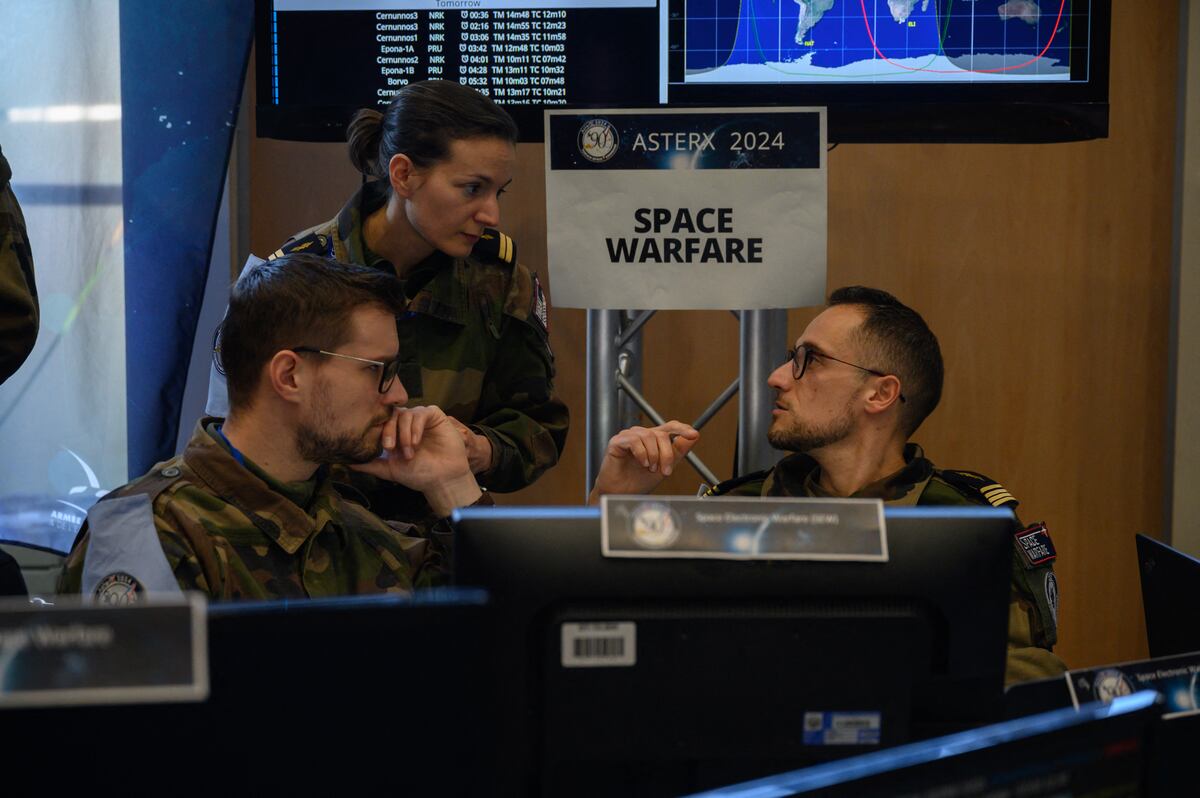
TOULOUSE — In silent orbit around Earth, a potentially hostile satellite approaches an allied communication node, intentions unknown.
French Space Command has determined the move is deliberate, and intelligence shows the enemy spacecraft is equipped with a robotic arm that would allow it to de-orbit the friendly asset. The French-led blue team moves a “patroller” satellite into a protective position – a capability France is working on, but now lacks – to block any hostile action by the U.S.-led red team.
While fictional, the scenario played out March 7 during Europe’s largest space wargames is credible and based on real capabilities, said Colonel Mathieu Bernabé, who is leading the exercise. During the event called AsterX 2024 , some 190 participants from France and 15 partner countries are training for everything from jammed space communications to hostile satellites maneuvering to take out friendly orbiters.
“This type of exercise is absolutely essential for our operators, but also our processes, training for what we call operational readiness, so we’re ready to fight a real war,” General Philippe Adam, the commander of France’s space command, said during a presentation of the exercise in Toulouse in south-west France. “It’s as realistic as an exercise scenario can be, obviously – inspired by a lot of things you’ve probably recognized.”
Adam said “unfriendly behavior” by Russian satellites, with uncoordinated and unannounced approaches, happens “all the time,” in all orbits.
Space is becoming more dangerous, and militarization is on the rise, Adam said. Earth orbits have become busier, with increased competition between commercial players and states, while satellites are becoming a lot more capable and maneuverable.
Space-based systems have become an integral part of military operations, from communication to ballistic-missile detection, navigation, planning and targeting. Meanwhile, the value of the space economy rose 8% to $546 billion in 2022, according to the non-profit Space Foundation .
French President Emmanuel Macron created a military space command in 2019, with the goal of boosting the country’s awareness of the security situation in space, and to better protect its satellites . France had 91 satellites in orbit in February 2023, the most of any European Union country, according to data published by Statista.
AsterX is “absolutely essential” for ramping up French Space Command, which doesn’t have operational status yet, though it’s performing operations, Adam said. The command is expected to pass an initial stage of operational qualification when it moves into new headquarters in Toulouse next year, and targets full operational capability by 2030.
France is organizing the AsterX wargames for the fourth year, pitting the French-led blue team against the fictional country of Mercure, an adversary trying to destabilize the nation of Arnland. What’s new this year is that the red team, with “significant” space resources, is played by U.S. Space Force personnel, the first time a foreign nation plays the role of adversary.
The exercise simulates more than 4,000 objects in orbit, spinning around in simulated space already days before the exercise, and with the blue and red teams not fully aware of the spatial capacities of their adversary. The knowledge gaps create an intellectual challenge, and the red team being played by the U.S. results in a non-deterministic scenario, Bernabé said.
“AsterX is a laboratory in which you’re confronted with situations, where you experiment with solutions, and get feedback,” Bernabé said. “The challenge is to train how to manage a space situation, but backed up by an inter-army and multi-domain environment, which also means cyber or informational, so this scenario provides for conditions that enable us to play the full spectrum.”
Americans playing the red team provides an additional element of surprise to the exercise, according to Bernabé.
The exercise runs through to March 15 and will include 14 different types of threats and 23 events, within the scenario of a gradually worsening crisis, headed towards high-intensity warfare. Adam said a crisis situation is a useful exercise, as there’s “a lot of ambiguity” to be resolved, while a high-intensity scenario is in some ways simpler because “anything goes.”
A worst-case scenario for orbital conflict would be generalized war with a completely uninhibited enemy attacking satellites “quite indiscriminately,” according to Adam.
“Then we’re going to be losing satellites all over the place, we’re going to lose resources, we’re going to create debris, and then it’s a bit of a snowball effect,” Adam said. Failure to quickly stop such an adversary would create “a problem that will last for decades. Once you’ve created debris everywhere, some orbits become completely inoperable.
”So yes, a generalized conflict in space would be very, very bad news.”
Through the exercise, France also seek to develop a common culture of space operations with its allies and partners, under realistic threat conditions. In addition to the U.S., countries participating in AsterX include the U.K., Japan and South Korea, as well as a number of EU partners.
“We understand each other better after this exercise, in the nature of the responses we can provide, since we’ve experimented with things together,” Bernabé said.
Interoperability challenges between countries’ space forces are “extremely numerous,” including distinct vocabulary for the same things and different procedures and policies, according to Adam.French Space Command targets about 500 personnel in 2025, from around 350 now, according to Adam. He said partners such as Japan, Germany and Italy are creating commands similar in size, between 300 and 600 personnel, adding that human resources are “a tremendous problem” for everyone.
Those goals compare to around 13,900 staff for the U.S. Space Force at the end of December. France doesn’t have the ambition of creating anything similar, which would require “being rich like an American,” the general said.
In addition to the new Toulouse headquarters, the main priority for France is to get patroller satellites into orbit, according to Adam. He said the country also needs to strengthen the terrestrial part of its space capabilities, and needs more space-surveillance sensors.
He said the country’s Yoda agile satellite demonstrator , which has been held up by a lack of launch slots , may become operational “in the next few months,” with operational space-patrol capacity following within one to two years.
“These are not very big satellites, they’re not very complicated satellites,” Adam said. “What’s most complicated is knowing how to use them.”And that’s what France is preparing for with AsterX.
Rudy Ruitenberg is a Europe correspondent for Defense News. He started his career at Bloomberg News and has experience reporting on technology, commodity markets and politics.
图卢兹——一颗可能怀有敌意的卫星在地球周围静默运行,接近一个盟军通信节点,其意图不明。
法国航天司令部已确认此举系蓄意为之,情报显示敌方航天器配备有机械臂,可使其脱离友方轨道。由法国领导的蓝队将一颗“巡逻”卫星部署到防护位置——法国正在研发但目前尚不具备此项能力——以阻止由美国领导的红队的任何敌对行动。
指挥此次演习的马蒂厄·贝尔纳贝上校表示,虽然3月7日在欧洲规模最大的太空战争演习中演练的场景是虚构的,但却是可信的,并且基于真实的太空能力。此次名为“AsterX 2024”的演习中,来自法国和15个伙伴国家的约190名参与者正在训练应对各种情况,包括太空通信干扰以及敌方卫星机动攻击友方轨道飞行器等。
“这类演习对我们的操作人员、流程以及所谓的作战准备训练都至关重要,这样我们才能做好打真仗的准备,”法国航天司令部司令菲利普·亚当将军在法国西南部城市图卢兹举行的演习介绍会上说道。“显然,这次演习尽可能地贴近实战——灵感来源于你们可能已经了解的许多事情。”
亚当表示,俄罗斯卫星的“不友好行为”,即未经协调和事先通知的接近,在所有轨道上“时有发生”。
亚当说,太空正变得越来越危险,军事化程度也在不断提高。地球轨道变得越来越繁忙,商业公司和国家之间的竞争日益激烈,而卫星的功能和机动性也大大增强。
从通信到弹道导弹探测、导航、规划和目标定位,天基系统已成为军事行动不可或缺的一部分。与此同时,据非营利组织太空基金会统计,2022年太空经济价值增长8%,达到5460亿美元。
法国总统埃马纽埃尔·马克龙于2019年创建了军事航天司令部,旨在提高法国对太空安全形势的认识,并更好地保护其卫星。根据Statista发布的数据,截至2023年2月,法国共有91颗卫星在轨运行,是欧盟国家中最多的。
亚当表示,AsterX对于提升法国航天司令部的能力“至关重要”。该司令部目前尚未具备作战能力,但已开始执行任务。预计明年迁入位于图卢兹的新总部后,该司令部将完成初步的作战资格认证,并计划在2030年之前实现全面作战能力。
法国第四次举办AsterX太空战争演习,由法国领导的蓝队将与虚构的敌对国家Mercure展开对抗,Mercure试图破坏Arnland的稳定。今年的新变化是,拥有“大量”太空资源的红队由美国太空部队人员扮演,这是外国首次在演习中扮演敌对国家的角色。
此次演习模拟了4000多个轨道物体在模拟空间中旋转,这些物体在演习开始前几天就已经在模拟空间中运行。蓝队和红队对对方的空间能力并不完全了解。贝尔纳贝表示,这种信息差距造成了智力上的挑战,而由美国扮演的红队则导致了演习场景的不确定性。
“AsterX 就像一个实验室,在这里你会遇到各种情况,尝试不同的解决方案,并获得反馈,”贝尔纳贝说。“挑战在于训练如何应对太空环境,同时还要在跨军种和多域环境下进行,这也包括网络或信息领域,因此,这种演练方式为我们提供了能够应对各种情况的条件。”
贝尔纳贝表示,美国人扮演红队,为演习增添了额外的出其不意的元素。
此次演习将持续到3月15日,涵盖14种不同类型的威胁和23个事件,模拟危机逐渐恶化并最终演变为高强度战争的情景。亚当表示,危机情境下的演习很有意义,因为其中存在“很多不确定因素”需要解决;而高强度战争情景在某些方面则更为简单,因为“任何事情都有可能发生”。
亚当认为,轨道冲突最糟糕的情况是全面战争,敌方完全不受约束地“不分青红皂白”地攻击卫星。
“那样的话,我们的卫星就会到处坠落,资源也会白白浪费,太空垃圾也会堆积如山,然后就会像滚雪球一样越滚越大,”亚当说道。如果不能迅速阻止这样的对手,将会造成“持续数十年的问题。一旦太空垃圾遍布各处,一些轨道就会完全无法运行。”
“所以,太空全面冲突绝对是非常非常糟糕的消息。”
通过此次演习,法国还希望在真实的威胁环境下,与盟友和伙伴建立共同的太空行动文化。除美国外,参加“阿斯特尔X”演习的国家还包括英国、日本和韩国,以及一些欧盟伙伴国。
“经过这次练习,我们对彼此有了更深的了解,也更了解我们能够提供的反应,因为我们一起尝试过各种方法,”贝尔纳贝说。
据亚当称,各国太空部队之间的互操作性挑战“极其众多”,包括对同一事物使用不同的术语,以及程序和政策的差异。他还表示,法国太空司令部计划到2025年将人员规模从目前的约350人增加到约500人。亚当指出,日本、德国和意大利等伙伴国也在建立规模相近的司令部,人员规模在300至600人之间,并补充说,人力资源对所有人来说都是“一个巨大的难题”。
这些目标与美国太空军截至12月底约13900人的规模相比,显得微不足道。这位将军表示,法国没有建立类似规模太空军的雄心,因为这需要“像美国人一样富有”。
据亚当称,除了新建图卢兹总部外,法国的首要任务是将巡逻卫星送入轨道。他还表示,法国还需要加强其地面空间能力,并需要更多的空间监视传感器。
他表示,该国的“尤达”敏捷卫星演示器由于缺乏发射机会而一直处于停滞状态,可能在“未来几个月内”投入使用,而太空巡逻能力将在1到2年内实现。
“这些卫星体积不大,结构也不复杂,”亚当说。“最复杂的是如何使用它们。”而这正是法国正通过AsterX项目做准备。
鲁迪·鲁伊滕贝格是《防务新闻》的欧洲记者。他的职业生涯始于彭博新闻社,拥有报道科技、大宗商品市场和政治方面的经验。