Pentagon weighs force posture, costs of rebuilding Middle East bases五角大楼正在权衡兵力部署和重建中东基地的成本
“We're meeting with CENTCOM and doing the assessments right now from an installation perspective. Part of this is what will the global posture be in the future, and what does that require us to have?” a senior defense official told reporters today.
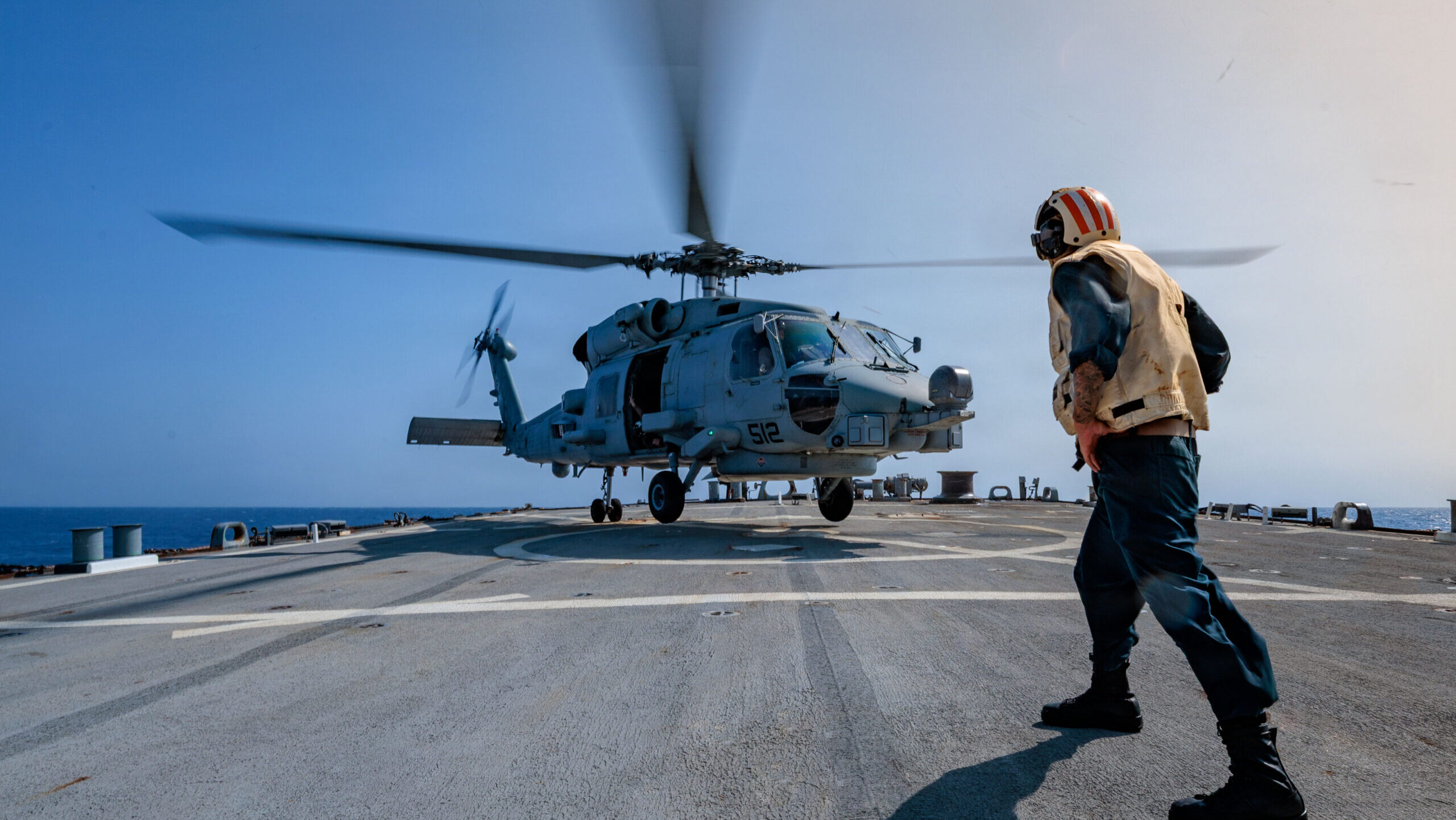
An MH-60R Seahawk lands on the flight deck aboard Arleigh Burke-class guided-missile destroyer USS Gonzalez (DDG 66), Oct. 18, 2026. Gonzalez is deployed to the U.S. 5th Fleet area of operations to support maritime security and stability in the Middle East. (US Navy photo)
WASHINGTON — As Pentagon leaders remain tightlipped about the extent of damage to US bases in the Middle East, a senior US defense official said the administration is weighing possible force posture changes against costs as it decides which installations to rebuild.
“We’re meeting with CENTCOM [US Central Command] and doing the assessments right now from an installation perspective,” the senior defense official told reporters today at a Defense Writers Group breakfast. “Part of this is what will the global posture be in the future, and what does that require us to have?
The official added that the department is taking a strategic approach to investments, prioritizing where its presence is needed most.
After the United States and Israel attacked Iran in February, Tehran and its proxies began targeting US bases in the region — including Al Udeid Air Base in Qatar, where strikes rendered the Pentagon’s Combined Air Operations Center (COAC) inoperable , as well as other installations in Saudi Arabia and Jordan.
The US Navy’s Fifth Fleet was previously headquartered at Naval Support Activity Bahrain. But in an interview with The Epoch Times , Acting Navy Secretary Hung Cao acknowledged that “they blew the hell out of Bahrain.” Chief of Naval Operations Adm. Daryl Caudle separately said the Navy would not be using Naval Support Activity Bahrain “anytime soon.”
Pentagon leaders have provided lawmakers with cost estimates for the war with Iran, but those figures have not included a complete account of the costs associated with repairing US bases in the region. Earlier this week, members of the Senate Armed Services Committee called on the department to publicly disclose the total cost of the war in Iran, including damage to those US installations.
The senior defense official said they did not have a cost estimate readily available but that the department was taking a strategic approach to repairs. “It’s part of the reason we want to build a new base differently … nothing’s a sanctuary anymore,” the official said.
“The idea that we still have two oceans that keep any bad things from happening to us, that’s no longer a thing, so we’ve got to think differently. … The installation is the weapon system, and I have to have a mindset that I treat it like it’s a weapon system, not just a piece of real estate,” the official later added.
The proliferation of drones and cruise missiles presents another challenge, forcing the Pentagon to consider not only how to harden bases overseas but also how to protect installations on the US mainland, including through a diverse array of defense systems.
“I can’t pour four [feet] of concrete over everything, so I have to have a different approach, investments and strategies that we want to have in terms of how we make bases resilient, how I make them defensible, how I protect our people — all of that are things that we’re working on right now to come up with a different strategy,” the senior defense official said.
Part of that effort involves strengthening protection at individual bases, as well as working with the Golden Dome team to prioritize which locations to protect first and keep “risk as low as possible.”
Breaking Defense Video
Drones take over AUSA, plus the Army’s plan to bring in new vendors
Hegseth talks autonomy at AUSA, a key show focus
Army doubles down on autonomy, stakes out Indo-Pacific role: AUSA Day 2
Telle talks ‘manufacturing rodeo,’ supply chain ‘weak links’: AUSA Day 1
New leaders, new drone command: What we expect from AUSA 2026
Unpacking Boeing’s F/A-XX win, plus a report from wartime Ukraine
How Hegseth envisions a new Autonomous Warfare Command
What Europe’s military air fleets will look like in 30 years
Riyadh gets closer to F-35s, Damascus presses sovereignty and an expert take on Iran
Drone-hunting on the border, plus turmoil at an Air Force think tank
2026年10月18日,一架MH-60R“海鹰”直升机降落在阿利·伯克级导弹驱逐舰“冈萨雷斯”号(DDG 66)的飞行甲板上。“冈萨雷斯”号部署在美国第五舰队作战区域,以支持中东地区的海上安全与稳定。(美国海军照片)
华盛顿——尽管五角大楼领导人对美国在中东的军事基地受损程度仍保持缄默,但一位美国高级国防官员表示,政府正在权衡可能的兵力部署变化与成本,以决定重建哪些设施。
这位高级国防官员今天在国防记者协会早餐会上告诉记者:“我们正在与美国中央司令部会面,并从设施的角度进行评估。其中一部分内容是未来的全球态势会是什么样的,以及这需要我们具备哪些条件?”
该官员补充说,该部门正在采取战略性投资方法,优先考虑最需要其投入的领域。
2 月美国和以色列袭击伊朗后,德黑兰及其代理人开始袭击该地区的美国基地,包括卡塔尔的乌代德空军基地(袭击导致五角大楼联合空中作战中心 (COAC) 无法运作),以及沙特阿拉伯和约旦的其他设施。
美国海军第五舰队此前总部设在巴林海军支援基地。但代理海军部长洪曹在接受《大纪元时报》采访时承认,“他们把巴林炸得一塌糊涂”。海军作战部长达里尔·考德尔海军上将也表示,海军“近期”不会再使用巴林海军支援基地。
五角大楼领导人已向国会议员提供了伊朗战争的成本估算,但这些数字并未包含修复该地区美军基地的全部费用。本周早些时候,参议院军事委员会成员呼吁国防部公开伊朗战争的总成本,包括对美军设施造成的损失。
这位高级国防官员表示,他们目前还没有现成的成本估算,但国防部正在采取战略性方法进行维修。“这也是我们希望以不同方式建造新基地的部分原因……如今已不再是安全的避难所了,”这位官员说道。
“认为我们仍然有两大洋可以保护我们免受任何坏事发生的想法已经过时了,所以我们必须改变思路。……这个设施本身就是武器系统,我必须把它当作武器系统来对待,而不仅仅是一块地产,”这位官员后来补充道。
无人机和巡航导弹的扩散带来了另一个挑战,迫使五角大楼不仅要考虑如何加强海外基地的防御,还要考虑如何保护美国本土的设施,包括通过各种防御系统。
这位高级国防官员表示:“我不可能在所有地方都浇上四英尺厚的混凝土,所以我必须采取不同的方法、投资和策略,来增强基地的韧性,使其能够防御,保护我们的人民——所有这些都是我们现在正在努力制定不同策略的事情。”
这项工作的一部分包括加强各个基地的保护,以及与金顶团队合作,确定优先保护哪些地点,并将“风险降至最低”。
突破性防御视频
无人机主导了美国陆军协会(AUSA)的会议,此外,陆军还计划引入新的供应商。
Hegseth 在 AUSA 大会上谈到了自主性,这是本次大会的一个重点议题。
陆军加倍强调自主性,明确印太地区角色:AUSA第二天
特勒谈“制造业乱象”、供应链“薄弱环节”:AUSA第一天
新领导人,新无人机指挥部:我们对 AUSA 2026 的期待
深入剖析波音F/A-XX的竞标结果,以及来自战时乌克兰的报道
赫格塞斯设想的新型自主作战指挥部
30年后欧洲军用空军机队会是什么样子
利雅得距离F-35战机更近一步,大马士革强调主权,以及专家对伊朗的看法
边境无人机猎杀行动,以及空军智库的动荡