Australia marks missile, cyber ‘firsts’ in exercise with Indonesia澳大利亚在与印度尼西亚的联合演习中取得导弹和网络领域的“第一”
The Keris Woomera exercise comes during a busy month for Australia's military, as forces participate in drills from Singapore to Japan.
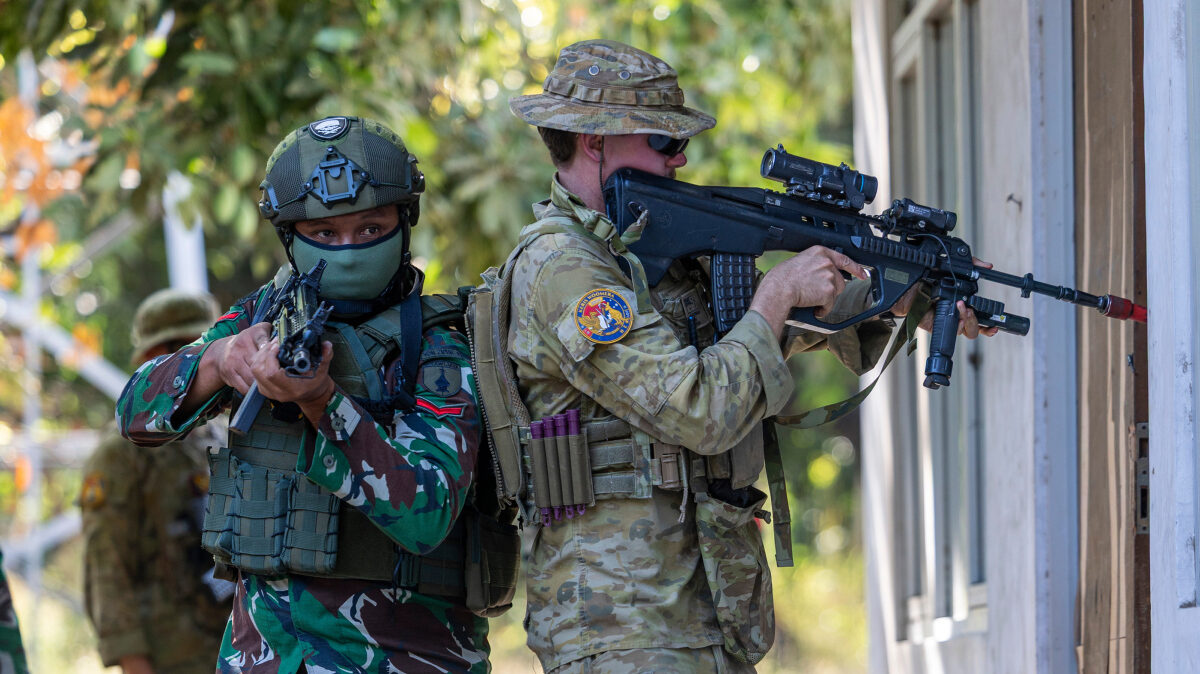
Australian Army and Indonesian Armed Forces Engineers conduct urban clearance training during Exercise Keris Woomera 26 at Pusat Latihan Pertempuran Marinir 5, Indonesia. (Photo: Australian Department of Defence)
SINGAPORE — Australia and Indonesia have concluded a bilatera l defense exercise that involved thousands of personnel and included a number of “firsts” for Canberra — the latest in what an analyst said were a series of trust-building and integration exercises between the nations.
Exercise Keris Woomera took place between 12 and 20 October in and around the eastern part of Indonesia’s most populous island of Java, and saw approximately 1,000 Australian personnel take part alongside their Indonesian counterparts. The Australian Department of Defence called Keris Woomera “the largest overseas training activity for the Australian Defence Force (ADF) for the year.”
“The exercise e nables the Tentara Nasional Indonesia (TNI) to conduct high-end joint training with the ADF [Australian Defence Force], contributing to their own capacity to deter military coercion and defend Indonesian sovereignty,” the ADF said on its website .
It added that the exercise would “ensure ADF can deter a potential adversary’s attempts to project power against Australia, and be prepared to protect Australia and its maritime approaches.”
The ADF said the exercise played host to several firsts, including the “first time the high mobility artillery rocket system (HIMARS) deployed and fired overseas, the first deployment of a RAAF 4 Squadron aircraft into South-East Asia since World War II and the first time Australia conducted cyber integration training with Indonesia.”
“By operating side-by-side, this year’s iteration has shown how Australia and Indonesia can integrate to address shared security challenges and positively impact how we respond to a rapidly evolving strategic environment.
‘Increasingly Frequent Exercises’
The exercise comes just months after both countries signed the Australia-Indonesia Treaty on Common Security in February which, among other things, reaffirms the relationship between both countries and a desire “to contribute to regional security and stability”
Fauzan Malufti, a researcher at the Jakarta-based Ce ntre for Strategic and International Studies (CSIS), said that “Keris Woomera is part of a wider series of increasingly frequent exercises between the TNI and ADF, which will help build trust and familiarity at both the unit and leadership levels.”
He told Breaking Defense that the exercis e was expected to be confidence building for both sides and improve the interoperability.
“The exercise helps TNI and ADF better understand each other’s procedures, communications, planning, and command systems so they can operate together better, especially in combat scenarios,” he added.
This year’s iteration of the exercise was the second in the series since the inaugural event in 2024, and Malufti said he believes that the Australians would like to see the exercise scale up in complexity as the regional security situation becomes more “challenging.”
He pointed out that Indonesia’s capabilities and other political considerations might nevertheless see it reluctant to widen the scope of future exercises, noting that Indonesia’s commitment to non-alignment might result in it not wanting to be seen as leaning towards any particular country.
“TNI capacity is another factor, as engagement with other foreign militaries is also increasing, while the TNI’s growing involvement in domestic non-defense activities continues to consume a huge number of resources and leadership attention”, he said.
Australia’s involvement in Keris Woomera comes amidst a busy October for its interactions with regional militaries. A detachment of its Lockheed Martin F-35 Lighting II fifth-generation fighters are currently deployed to Singapore as part of a contingent taking part in the Five Power Defence Arrangements exercis e called Bersama Lima together with the militaries of Malaysia, New Zealand, Singapore and the United Kingdom.
Another 300-strong contingent from the ADF is also currently in Japan participating in Exercise Keen Sword , where it is sending a frigate and a Boeing P-8A Poseidon multi-mission anti-submarine aircraft alongside the forces of Japan, the US and six other nations
Breaking Defense Video
Army’s tech chief talks autonomy, acquisition and the future of drones
Drones take over AUSA, plus the Army’s plan to bring in new vendors
Hegseth talks autonomy at AUSA, a key show focus
Army doubles down on autonomy, stakes out Indo-Pacific role: AUSA Day 2
Telle talks ‘manufacturing rodeo,’ supply chain ‘weak links’: AUSA Day 1
New leaders, new drone command: What we expect from AUSA 2026
Unpacking Boeing’s F/A-XX win, plus a report from wartime Ukraine
How Hegseth envisions a new Autonomous Warfare Command
What Europe’s military air fleets will look like in 30 years
Riyadh gets closer to F-35s, Damascus presses sovereignty and an expert take on Iran
澳大利亚陆军和印度尼西亚武装部队工程师在印度尼西亚 Pusat Latihan Pertempuran Marinir 5 举行的 Keris Womera 26 演习期间进行城市清理训练。 (图片:澳大利亚国防部)
新加坡——澳大利亚和印度尼西亚结束了一项双边防务演习,该演习涉及数千名人员,并对堪培拉而言具有多项“首次”意义——一位分析人士称,这是两国之间一系列建立信任和一体化演习中的最新一次。
“克里斯·伍默拉”联合军演于10月12日至20日在印度尼西亚人口最多的爪哇岛东部及其周边地区举行,约有1000名澳大利亚人员与印尼同行共同参与。澳大利亚国防部称“克里斯·伍默拉”是“澳大利亚国防军(ADF)当年规模最大的海外训练活动”。
“此次演习使印尼国民军(TNI)能够与澳大利亚国防军(ADF)进行高端联合训练,从而增强其自身威慑军事胁迫和捍卫印尼主权的能力,”澳大利亚国防军在其网站上表示。
声明还补充说,此次演习将“确保澳大利亚国防军能够阻止潜在对手向澳大利亚投射力量的企图,并做好保护澳大利亚及其海上通道的准备”。
澳大利亚国防军表示,此次演习创造了多项第一,包括“高机动性火箭炮系统(HIMARS)首次在海外部署和发射,澳大利亚皇家空军第4中队飞机自二战以来首次部署到东南亚,以及澳大利亚首次与印度尼西亚进行网络一体化训练”。
“通过并肩作战,今年的会议表明,澳大利亚和印度尼西亚可以如何整合资源,应对共同的安全挑战,并对我们应对快速变化的战略环境产生积极影响。
“日益频繁的锻炼”
此次演习距离两国于2月份签署《澳大利亚-印度尼西亚共同安全条约》仅数月之隔。该条约除其他内容外,重申了两国之间的关系以及“为地区安全与稳定做出贡献”的愿望。
雅加达战略与国际研究中心 (CSIS) 的研究员 Fauzan Malufti 表示,“Keris Woomera 是印尼国民军 (TNI) 和澳大利亚国防军 (ADF) 之间日益频繁的一系列演习的一部分,这将有助于在部队和领导层层面建立信任和熟悉度。”
他告诉《防务新闻》,此次演习有望增强双方的信心,并提高互操作性。
“此次演习有助于印尼国民军和澳大利亚国防军更好地了解彼此的程序、通信、计划和指挥系统,以便更好地协同作战,尤其是在战斗场景中,”他补充道。
今年的演习是自 2024 年首次举行以来的第二次,马卢夫蒂表示,他相信随着地区安全形势变得更加“具有挑战性”,澳大利亚人希望看到演习的复杂程度不断提高。
他指出,尽管如此,印尼的能力和其他政治因素可能使其不愿扩大未来演习的范围,并指出印尼奉行不结盟政策,可能使其不希望被视为倾向于任何特定国家。
他说:“印尼国民军的能力是另一个因素,因为与其他外国军队的接触也在增加,而印尼国民军越来越多地参与国内非国防活动,这继续消耗了大量资源和领导层的注意力。”
澳大利亚参与“克里斯·伍默拉”演习之际,正值其与地区各国军队互动频繁的10月份。目前,澳大利亚一支洛克希德·马丁F-35“闪电II”第五代战斗机分遣队已部署在新加坡,作为参与“五国联防安排”(Bersama Lima)演习的特遣队的一部分,该演习的参与国还包括马来西亚、新西兰、新加坡和英国的军队。
澳大利亚国防军另有300名官兵目前也在日本参加“利剑”演习,他们将派出一艘护卫舰和一架波音P-8A“海神”多用途反潜巡逻机,与日本、美国和其他六个国家的军队一同参演。
突破性防御视频
陆军技术主管谈无人机的自主性、采购和未来
无人机主导了美国陆军协会(AUSA)的会议,此外,陆军还计划引入新的供应商。
Hegseth 在 AUSA 大会上谈到了自主性,这是本次大会的一个重点议题。
陆军加倍强调自主性,明确印太地区角色:AUSA第二天
特勒谈“制造业乱象”、供应链“薄弱环节”:AUSA 第一天
新领导人,新无人机指挥部:我们对 AUSA 2026 的期待
深入剖析波音F/A-XX的竞标结果,以及来自战时乌克兰的报道
赫格塞斯设想的新型自主作战指挥部
30年后欧洲军用空军机队会是什么样子
利雅得距离F-35战机更近一步,大马士革强调主权,以及专家对伊朗的看法