Military power rising as power of diplomacy falling, diplomats, crisis monitors, allies say外交官、危机观察员和盟友表示,军事力量正在崛起,而外交力量正在衰落。
America is abandoning the rules, and the allies, it once kept safe.
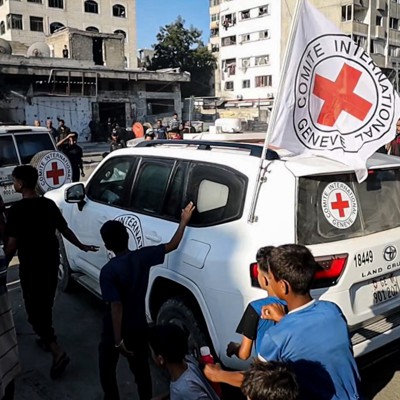
Hamas members hand over some of the 20 Israeli hostages to International Committee of the Red Cross teams as part of a ceasefire and hostage-prisoner exchange agreement between Hamas and Israel on October 13, 2025 in Gaza. Khames Alrefi / Anadolu via Getty Images
America is abandoning the rules, and the allies, it once kept safe.
International Relations
DOHA, Qatar– International norms and humanitarian law are losing influence just as new military capabilities are becoming easier to access—a central theme of two days of talks among diplomats, government officials and humanitarian workers here.
“Conflicts are now a first resort in many cases. Diplomacy and dialog are being delegitimized,” said Pierre Krähenbühl, director-general of the International Committee of the Red Cross .
Krähenbühl was far from alone in his assessment at the Global Security Forum, hosted in this Gulf capital by the Soufan Center and the Qatar International Academy for Security Studies. Officials from Europe and the Middle East, as well as former senior intelligence officials from Australia and Britain, questioned the durability of the alliance structure that the United States and its Western allies put in place after World War II.
"The war in Lebanon today and on Lebanon shows that there are countries, Israel is a case in point, that do not need alliances, for they are engaged in an offensive war, and alliances in today's world are largely defensive,” said Deputy Prime Minister Tarek Mitri of Lebanon, which remains partly occupied by Israeli forces.
But that breakdown isn't happening on its own. Sir John Sawers, former chief of Britain's MI6 intelligence agency, pointed to the United States' declining commitment to its traditional security guarantees, even as the 8-month-old U.S.-Israeli war against Iran has exposed American partners in the Gulf to new threats.
Saudi Arabia, Qatar, and the United Arab Emirates are reconsidering their security relationships with Washington, Sawers said.
“The United States was the guarantor of their security. And what of course these countries have experienced in the last six months is the attacks on them have been provoked by a U.S-instituted war of choice against Iran."
Europe is confronting similar questions as the Russian campaign against NATO grows more brazen and sophisticated . Sawers said America is eroding the international system it helped establish: one of the challenges to the rules-based order is “the United States losing confidence in the system which they designed and which has benefited America enormously.”
Sawers disputed the idea that Europe is rearming simply because of pressure by Donald Trump.
"The reason we're increasing money on defense now isn't because President Trump is telling us to do so. It's because the threat from Russia is much greater than it was before. And the reliability of the United States is less than it was before,” he said.The conference’s host country, Qatar, has found that its longtime efforts to play international mediator no longer keep it safe. The capital came under attack by Israel in 2025, and six months later by Iran .
“It was a surprise because it's the first time that a mediator has been attacked. This never happened,” said Sheikh Saoud bin Abdulrahman Al Thani, Qatar's deputy prime minister and minister of state for defense affairs..
Al Thani identified three threats to Qatar: attacks on its sovereignty, disruptions to energy flows from Gulf Cooperation Council countries, and the spillover of regional conflicts.
Tom Barrack, U.S. special envoy for Syria and Iraq, said the United States remained committed to diplomacy and proposed a path out of the regional violence beginning with a ceasefire, reopening the Strait of Hormuz, and easing economic pressure on the Iranian people. But he cautioned against expecting any agreement to resolve the underlying conflict quickly.
"What we know in the Middle East is there's no such thing as a deal. There's no event. This process is going to continue,” said Barrack, a billionaire financier who served as a go-between from candidate Trump to Gulf princes during the 2016 campaign.Nick Warner, former director-general of Australia's Office of National Intelligence and former ambassador to Iran, put the issue more bluntly: "And the answer to how does the war with Iran end is: it doesn't."
NEXT STORY: Trump appointees asked a federal cybersecurity agency to secretly hack a voting machine
2025年10月13日,在加沙地带,哈马斯成员将部分以色列人质(约20人质)移交给红十字国际委员会,这是哈马斯与以色列达成的停火和人质交换协议的一部分。图片来源:Khames Alrefi / Anadolu via Getty Images
美国正在抛弃它曾经维护的规则和盟友。
国际关系
卡塔尔多哈——国际规范和人道主义法的影响力正在减弱,而新的军事能力却越来越容易获得——这是外交官、政府官员和人道主义工作者在此举行的为期两天会谈的核心主题。
“在许多情况下,冲突现在成了首选手段。外交和对话正在失去合法性,”红十字国际委员会总干事皮埃尔·克雷恩比尔说。
在由苏凡中心和卡塔尔国际安全研究学院联合主办、于海湾首都卡塔尔举行的全球安全论坛上,克雷恩比尔的观点并非孤例。来自欧洲和中东的官员,以及澳大利亚和英国的前高级情报官员,都对美国及其西方盟友在二战后建立的联盟结构的持久性提出了质疑。
“黎巴嫩如今的战争以及围绕黎巴嫩的战争表明,有些国家,比如以色列,不需要结盟,因为它们正在进行进攻性战争,而当今世界的联盟大多是防御性的,”黎巴嫩副总理塔里克·米特里说道。黎巴嫩目前仍有部分地区被以色列军队占领。
但这种破裂并非孤立发生的。英国军情六处前处长约翰·索尔斯爵士指出,美国对其传统安全保障的承诺正在减弱,与此同时,持续八个月的美以对伊朗战争已使美国在海湾地区的伙伴面临新的威胁。
萨沃斯表示,沙特阿拉伯、卡塔尔和阿拉伯联合酋长国正在重新考虑与华盛顿的安全关系。
“美国曾是这些国家安全的保障者。而这些国家在过去六个月里所经历的,当然是这些袭击是由美国挑起的针对伊朗的战争所引发的。”
随着俄罗斯针对北约的行动愈发肆无忌惮和老练,欧洲也面临着类似的问题。索尔斯表示,美国正在侵蚀它一手建立的国际体系:对基于规则的国际秩序的挑战之一是“美国对其一手设计、并使其受益匪浅的体系失去了信心”。
索尔斯反驳了欧洲重新武装仅仅是因为受到唐纳德·特朗普施压的说法。
“我们现在增加国防开支,并非因为特朗普总统要求这样做,而是因为来自俄罗斯的威胁比以前大得多,而美国的可靠性也比以前下降了。”他说道。此次会议的东道国卡塔尔发现,其长期以来扮演的国际调解人角色已无法保障自身安全。卡塔尔首都于2025年遭到以色列袭击,六个月后又遭到伊朗袭击。
“这令人震惊,因为这是调解员首次遭到袭击。这种情况以前从未发生过,”卡塔尔副首相兼国防事务国务大臣谢赫·萨乌德·本·阿卜杜勒拉赫曼·阿勒萨尼说道。
阿勒萨尼指出卡塔尔面临三大威胁:对其主权的攻击、来自海湾合作委员会国家的能源供应中断以及地区冲突的蔓延。
美国叙利亚和伊拉克问题特使汤姆·巴拉克表示,美国仍然致力于外交途径,并提出了一条摆脱地区暴力冲突的方案,首先是停火、重新开放霍尔木兹海峡,以及减轻对伊朗人民的经济压力。但他同时告诫,不要指望任何协议都能迅速解决根本冲突。
“我们都知道,中东根本不存在什么协议,也没有什么会结束的。这个过程还将继续,”巴拉克说道。这位亿万富翁金融家曾在2016年总统竞选期间担任候选人特朗普与海湾王子之间的中间人。澳大利亚国家情报局前局长、前驻伊朗大使尼克·华纳则更加直言不讳地指出:“至于伊朗战争如何结束,答案是:它不会结束。”
下一篇报道:特朗普任命的官员要求联邦网络安全机构秘密入侵一台投票机