Air Force needs 1,509 combat-ready jets by 2035, service tells Congress空军向国会表示,到2035年,空军需要1509架可作战的战机。
Lt. Gen. David Tabor also confirmed reporting that the Air Force is considering a new build F-16, but said that decision wasn't "urgent."
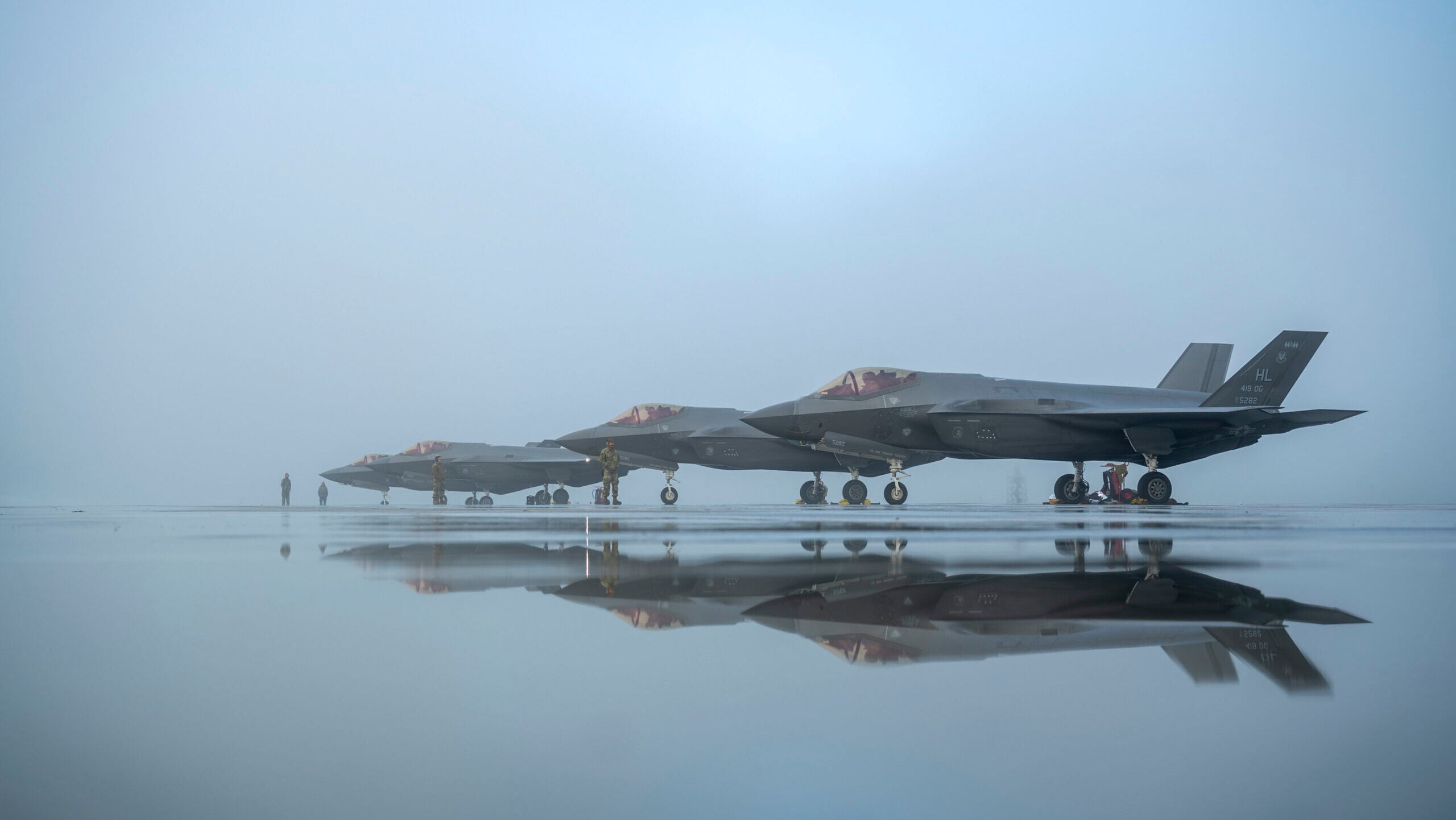
Airmen assigned to the 34th Fighter Squadron and Fighter Generation Squadron perform pre-flight checks on F-35A Lightning IIs during an agile combat employment exercise at Mountain Home Air Force Base, Idaho, March 28, 2024. (U.S. Air Force photo by Airman Keagan Lee)
WASHINGTON — The US Air Force predicts it’ll need 1,509 combat-ready fighter jets by 2035 to cover a “moderate risk” operational profile, according to a senior officer and a new report reviewed by Breaking Defense.
The figure is likely a jump of dozens of aircraft from last year’s estimates, based on significant increases in a parallel “low risk” calculation.
The new figures are laid out in the congressionally mandated report dated August 2026 and sent to lawmakers as part of an unclassified update to a similar study issued last year. Along with revising fighter totals, this year’s analysis covering fiscal year 2026 makes a renewed case for changing how combat-ready fighters are counted, citing lessons from the war against Iran .
In its fighter force structure report this year, the Air Force found that 1,723 combat-ready aircraft are needed to reach a low-risk operational profile by 2035 — scores more airframes than a prediction from just last year of 1,558. This year’s report also finds that the Air Force will need 1,509 aircraft to achieve medium risk.
That medium risk projection is likely the most relevant one, according to Air Force Lt. Gen. David Tabor, who said officials “generally don’t plan to low risk.” Speaking to a small group of reporters at the Pentagon on Tuesday, Tabor said officials instead aim for “a moderate level of risk.”
The report’s detailed fighter projections “give[s] the public and the media and Congress confidence that we’re not making this up,” said Tabor, the Air Force’s deputy chief of staff for plans and programs.
“We are looking at the long term, and we’re setting a chart to get there, and we can’t get there on our own,” he added.
Weaponizing the supply chain for a liquid-fueled howitzer-fired munition that flies 150 km
The goal of such weaponization is to tie warfighter needs to the RDT&E cycle.
The general emphasized that exact figures in the report are somewhat “debatable” since analysis is constantly refreshed. It’s also unclear how much of an increase this year’s medium risk count of 1,509 aircraft is since the last prediction, as last year’s report did not include figures for a medium-risk operational profile.
Even as moving targets, however, the figures will likely run into the wall that is reliable congressional funding. Historically, the service has struggled to fund fighter procurement at levels it desires amid competing priorities like modernizing its nuclear arsenal and budget fights on Capitol Hill. And by rejecting certain divestments, lawmakers often require the Air Force to keep certain aircraft around longer than military officials plan, requiring them to spend more money on maintaining aging platforms.
“Without the TOA [total obligation authority], the money available, we’re not going to be able to do this,” Tabor said bluntly.
The Air Force’s FY27 budget shows some of those challenges. The Air Force included funds for 24 F-15EXs and an identical number of F-35s in its base budget, but is banking on reconciliation to provide an additional 14 F-35s. That reconciliation bill is now in doubt .
Tabor said options like shifting other money around in the base budget could be on the table if reconciliation fails to pass, but emphasized alternatives are not desirable.
“The baseline premise is we need it all,” he said.
RELATED: With reconciliation uncertain, Pentagon eyeing plan to retool FY27 priorities with Congress
Additionally, achieving a fleet of 1,509 aircraft relies on industry’s ability to deliver, which is not guaranteed. The report notes that modernization setbacks for the Lockheed Martin F-35 have driven delays, while production struggles have postponed deliveries for Boeing’s F-15EX. Spokespeople for Boeing and Lockheed did not respond to a request for comment by press time.
Tabor noted that multi-year procurement negotiations for fighter aircraft are underway. Should those longer-term agreements materialize, the general said they’d provide an important, predictive demand signal for industry.
“I personally think that yes, that is a good incentive for them to actually see the money into the future and not be beholden to this kind of erratic appropriation process” he said. “It would be great if we can get on that path.”
While the F-35, F-15EX and eventually the sixth-generation F-47 will be key platforms to boost the Air Force’s fighter inventory, the service is also weighing other options including a new-build F-16.
As previously reported by multiple media outlets , Tabor confirmed that the Air Force is weighing whether to buy a new F-16 to recapitalize older aircraft. Still, he said a final decision is not “urgent” and could be made in the coming years.
“It is something that we’re talking about, and so the way I describe it is that there is a spectrum of capability that we might want to replace the F-16s with,” Tabor said. “We want to be in a position that when we make this decision, that we can show our homework and be proud of it.”
In the meantime, the past year has seen a dramatic shift in the Air Force’s fighter outlook. One key change is a plan to more than double the F-15EX fleet. Another is to extend the use of a small number of A-10 squadrons out to the end of the decade. The platform has since seen combat in the Middle East under Operation Epic Fury.
Air Force platforms, like several F-15s, have been among the 81 airframes damaged or lost during the Iran conflict, according to a count by the Congressional Research Service. The new Air Force report says that despite those losses, the service still retains a total of 212 F-15Es in different versions.
Tabor asserted the fresh analysis in the report, including revised figures, was not driven by Epic Fury, reasoning that work predated the start of the conflict.
“The analysis takes some amount of time and to be fair, it should be something that we’re constantly looking at,” he said. “It really was just a refresh of the numbers and the combatant command requirements that they were articulating.”
Arithmetic Arguments
Though Tabor said the changes in aircraft figures were not driven by the conflict in Iran, some of the report’s arguments for how the fleet is counted are.
The service maintains in the report that its preferred metric of a Combat Coded Total Aircraft Inventory (CC TAI) is “fundamentally more accurate” than the Primary Mission Aircraft Inventory (PMAI) measurement preferred by Congress.
Lawmakers have set a PMAI floor of 1,145 tactical aircraft , a requirement the Air Force does not currently meet. Counting aircraft using the CC TAI method — which adds backup and attrition reserve aircraft along with the PMAI — would reflect a greater inventory, as the charts below from the report show.
The report contends that PMAI does not accurately reflect the Air Force’s true combat capacity, since backup and attrition reserve aircraft will also be called upon in wartime — as aircraft were in Epic Fury. Additionally, the report says CC TAI more accurately reflects consequences of peer conflict, since the Iran conflict showed “sustainment challenges and losses” from more intensive combat operations.
“Combat coded total aircraft inventory is a much more kind of honest look at what I think Congress and, frankly, the American people care about, which is combat capability as opposed to the primary mission aircraft inventory,” Tabor said.
Critics of the CC TAI method assert that the accounting method can leave the Air Force shortchanged since PMAI aircraft are funded at different rates than backup and attrition reserve jets, according to Air & Space Forces Magazine .
The Air Force’s target of 1,509 jets by 2035 is measured using the CC TAI figure. Tabor said officials are still in talks with Congress about changing the metric.
“We’ve been having a lot of conversations with Congress about that language. I think that it’s a transition. It won’t be a flip of the switch that changes it, but we think we’re in a pretty good position on that,” he said.
Breaking Defense Video
Army’s tech chief talks autonomy, acquisition and the future of drones
Drones take over AUSA, plus the Army’s plan to bring in new vendors
Hegseth talks autonomy at AUSA, a key show focus
Army doubles down on autonomy, stakes out Indo-Pacific role: AUSA Day 2
Telle talks ‘manufacturing rodeo,’ supply chain ‘weak links’: AUSA Day 1
New leaders, new drone command: What we expect from AUSA 2026
Unpacking Boeing’s F/A-XX win, plus a report from wartime Ukraine
How Hegseth envisions a new Autonomous Warfare Command
What Europe’s military air fleets will look like in 30 years
Riyadh gets closer to F-35s, Damascus presses sovereignty and an expert take on Iran
2024年3月28日,在爱达荷州芒廷霍姆空军基地举行的敏捷作战运用演习中,隶属于第34战斗机中队和战斗机生成中队的空军人员正在对F-35A“闪电II”战斗机进行飞行前检查。(美国空军照片,摄影:空军士兵基根·李)
华盛顿——据一位高级军官和《防务新闻》审阅的一份新报告显示,美国空军预测,到 2035 年,它将需要 1509 架可随时投入战斗的战斗机,以应对“中等风险”的作战需求。
根据平行进行的“低风险”计算结果显示,飞机数量大幅增加,因此这一数字可能比去年的估计值增加了几十架。
这些新数据列于国会授权撰写的2026年8月报告中,该报告作为去年发布的类似研究的非机密更新版,已发送给立法者。除了修订战斗机总数外,今年涵盖2026财年的分析报告还再次提出改变战备战斗机数量统计方式的必要性,并援引了对伊朗战争的经验教训。
美国空军在今年的战斗机部队结构报告中指出,到2035年,要达到低风险作战目标,需要1723架具备作战能力的飞机——比去年预测的1558架多出许多架。今年的报告还指出,要达到中等风险作战目标,空军需要1509架飞机。
空军中将戴维·塔博尔表示,中等风险预测可能是最相关的,他说官员们“通常不会制定低风险计划”。周二在五角大楼对一小群记者发表讲话时,塔博尔说,官员们的目标是“中等风险水平”。
空军计划与项目副参谋长塔博尔表示,该报告详细的战斗机预测“让公众、媒体和国会相信我们没有捏造事实”。
“我们着眼于长远,并制定了实现目标的路线图,而我们单凭自身之力是无法实现这一目标的,”他补充道。
将供应链武器化,用于生产射程达150公里的液体燃料榴弹炮弹药
这种武器化的目标是将作战人员的需求与研发、测试和评估周期联系起来。
这位将军强调,报告中的具体数字在某种程度上“值得商榷”,因为分析工作一直在不断更新。此外,今年1509架中等风险飞机的数量较上次预测增加了多少也尚不清楚,因为去年的报告并未包含中等风险运行状况的数据。
然而,即便这些数字会不断变化,它们最终很可能还是会受到国会拨款可靠性的限制。历史上,空军一直难以在满足自身需求的战斗机采购资金方面投入足够的资金,因为其他优先事项还包括核武库现代化以及国会山的预算之争。此外,议员们否决某些撤资提案,往往迫使空军延长某些飞机的服役时间,超出军方的预期,从而导致空军在维护老旧机型上花费更多资金。
“如果没有TOA(全面义务授权),没有可用的资金,我们就无法做到这一点,”塔博尔直言不讳地说。
空军2027财年预算体现了其中的一些挑战。空军在其基本预算中列入了24架F-15EX和相同数量的F-35的采购资金,但寄希望于预算协调法案能够额外提供14架F-35。然而,这项预算协调法案目前前景不明。
塔博尔表示,如果预算协调未能通过,可能会考虑在基本预算中调整其他资金等方案,但他强调,这些替代方案并不可取。
他说:“基本前提是我们需要这一切。”
相关报道:由于和解前景不明朗,五角大楼正考虑与国会协商调整2027财年优先事项。
此外,实现1509架飞机的机队规模取决于业界的交付能力,而这并非有保障。报告指出,洛克希德·马丁公司F-35的现代化改造受阻导致了交付延误,而波音公司F-15EX的生产困境也推迟了交付。截至发稿时,波音公司和洛克希德·马丁公司的发言人均未回复置评请求。
塔博尔指出,战斗机多年采购谈判正在进行中。这位将军表示,如果这些长期协议最终达成,将为业界提供重要的预测性需求信号。
“我个人认为,这确实是一个很好的激励措施,能让他们真正看到资金的未来用途,而不是受制于这种不稳定的拨款流程,”他说。“如果我们能走上这条路,那就太好了。”
虽然 F-35、F-15EX 以及最终的第六代 F-47 将是提升空军战斗机库存的关键平台,但空军也在考虑其他选择,包括新制造的 F-16。
正如多家媒体此前报道,塔博尔证实,空军正在考虑是否购买新型F-16战斗机以更新老旧机型。但他表示,最终决定并不“紧迫”,可能会在未来几年内做出。
“这是我们正在讨论的问题,我的描述是,我们可能希望用一系列不同性能的战机来取代F-16战机,”塔博尔说。“我们希望在做出决定时,能够拿出我们充分的准备,并为此感到自豪。”
与此同时,过去一年空军的战斗机战略发生了巨大转变。其中一项关键变化是计划将F-15EX机队规模扩大一倍以上。另一项变化是将少量A-10攻击机中队的服役期限延长至本十年末。该平台已在“史诗狂怒行动”中参与了中东地区的实战。
据美国国会研究服务处统计,包括多架F-15在内的空军平台,在伊朗冲突中损失或受损的81架飞机中,也包括一些F-15战机。空军最新报告指出,尽管有这些损失,空军目前仍拥有212架不同型号的F-15E战机。
塔博尔断言,报告中的新分析(包括修订后的数据)并非由 Epic Fury 推动,理由是这项工作是在冲突开始之前进行的。
他说:“分析需要一些时间,公平地说,我们应该持续关注这项工作。这实际上只是对数据和作战司令部提出的要求进行一次更新。”
算术论证
尽管塔博尔表示飞机数量的变化并非由伊朗冲突所致,但报告中关于机队统计方式的一些论点却是受伊朗冲突影响。
该部门在报告中坚持认为,其首选的“作战编码飞机总库存 (CC TAI)”指标比国会首选的“主要任务飞机库存 (PMAI)”指标“从根本上来说更准确”。
立法者设定了至少1145架战术飞机的最低库存标准,而空军目前尚未达到这一要求。如果采用CC TAI方法(该方法在PMAI的基础上增加了备用和损耗储备飞机),则库存量会更高,如下方报告中的图表所示。
该报告指出,PMAI并不能准确反映空军的真实作战能力,因为战时也会启用备用和损耗储备飞机——正如“史诗狂怒”演习中所展现的那样。此外,报告还指出,CC TAI更能准确反映势均力敌冲突的后果,因为伊朗冲突展现了更密集作战行动带来的“后勤保障挑战和损失”。
“作战编码的飞机总库存更能真实反映国会以及坦率地说,美国人民所关心的,那就是作战能力,而不是主要任务飞机库存,”塔博尔说。
据《空军与太空部队杂志》报道,CC TAI 方法的批评者断言,这种会计方法可能会让空军蒙受损失,因为 PMAI 飞机的资金投入与备用和损耗储备喷气机的资金投入不同。
空军设定的到2035年拥有1509架战机的目标,是按照CC TAI(战机数量指数)来衡量的。塔博尔表示,官员们仍在与国会商讨修改这一衡量标准。
“我们一直在与国会就这一措辞进行多次讨论。我认为这是一个过渡过程。这不会像拨动开关那样立刻改变,但我们认为我们在这方面处于相当有利的地位,”他说。
突破性防御视频
陆军技术主管谈无人机的自主性、采购和未来
无人机主导了美国陆军协会(AUSA)的会议,此外,陆军还计划引入新的供应商。
Hegseth 在 AUSA 大会上谈到了自主性,这是本次大会的一个重点议题。
陆军加倍强调自主性,明确印太地区角色:AUSA第二天
特勒谈“制造业乱象”、供应链“薄弱环节”:AUSA 第一天
新领导人,新无人机指挥部:我们对 AUSA 2026 的期待
深入剖析波音F/A-XX的竞标结果,以及来自战时乌克兰的报道
赫格塞斯设想的新型自主作战指挥部
30年后欧洲军用空军机队会是什么样子
利雅得距离F-35战机更近一步,大马士革强调主权,以及专家对伊朗的看法