The president who threatened to end a civilization is supposed to guarantee Ukraine’s survival这位曾扬言要终结一个文明的总统,如今却要保障乌克兰的生存。
Trump's Iran war has diverted diplomats and drained interceptor stockpiles — just as his envoys were supposed to deliver security guarantees to Kyiv.
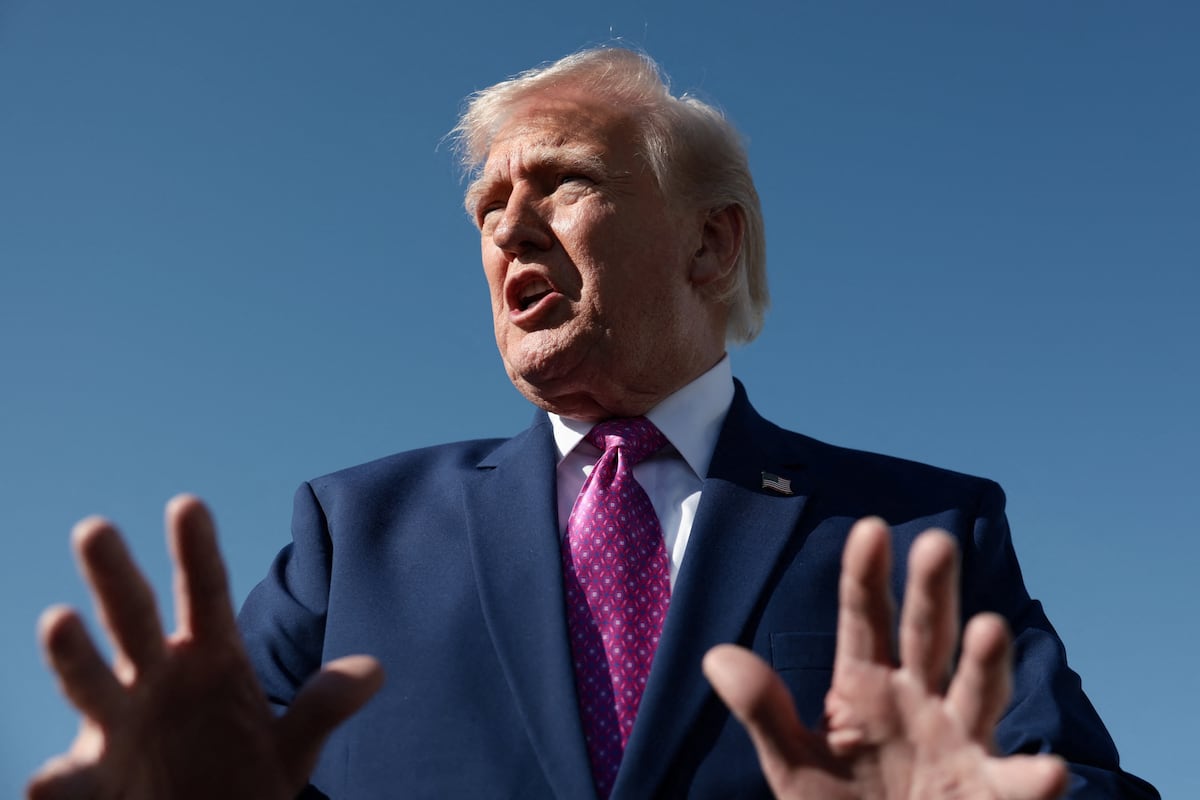
KYIV, Ukraine — On Tuesday, the president of the United States sent a message to the world. The man whose military is supposed to guarantee the survival of a 35-nation coalition in Ukraine posted on Truth Social that “a whole civilization will die tonight” if Iran did not reopen the Strait of Hormuz by his 8 p.m. deadline.
He promised to bomb every bridge and power plant in the country. Not as a warning. As an ultimatum, with a countdown, posted for the world to read along with the 93 million people he profanely threatened to annihilate.
The next day, civilians in Tehran were standing on the infrastructure he had threatened to destroy. Mothers, students, old men — they linked arms across overpasses, formed human chains around bridges and power plants, shielding them with their bodies, an NBC News video showed.
Asked whether he was concerned about war crimes, Trump told reporters he was “not at all.”
Retired American military officers said the threats themselves were likely war crimes — and that Trump had handed prosecutors a ready-made record. “He’s essentially self-incriminating,” one retired senior officer told reporters, per The Guardian .
Legal experts noted that threatening to systematically destroy civilian power plants and bridges, regardless of whether the strikes occur, can itself constitute evidence of criminal intent under the laws of armed conflict, according to The New York Times .
At the same time, White House envoys, billionaire Steve Witkoff and Trump’s son-in-law, Jared Kushner, were supposed to fly to Ukraine after Orthodox Easter this weekend carrying new security guarantees but were rerouted to Pakistan instead, for talks in Islamabad the same weekend the Kyiv visit was planned.
The administration was starting a war with one hand and promising to end one with the other. The same president who threatened to destroy civilian infrastructure in Iran on Tuesday is supposed to guarantee that no one destroys Ukrainian civilian infrastructure ever again.
“Is the U.S. going to provide Ukraine something like mutual security assistance? I don’t think so,” Ed Arnold, a senior research fellow at the Royal United Services Institute and a former British military officer, told Military Times.
“And even if they did, do the Ukrainians believe in it? And pretty critically — does Putin believe in it?”
A Ukrainian serviceman appears in a dugout with ammunition before firing toward Russian troops at a front-line position in the Zaporizhzhia region, Ukraine, April 9, 2026. (Stringer/Reuters)
Moscow already had an answer.
“The Americans have a lot of other things to deal with, if you know what I mean,” Kremlin spokesman Dmitry Peskov said, according to the Kyiv Independent .
“The primary movers in these so-called peace talks — the Americans — are now busy with other things,” a senior European diplomat told Military Times, speaking on condition of anonymity to discuss sensitive security assessments.
And they took the interceptors with them. The U.S. military burned through more than 800 Patriot missiles in the Middle East in three days — more than Ukraine has received in the entire war — while the production line makes roughly 600 a year.
The White House has since suspended Patriot export sales globally because of supply constraints, according to The Atlantic .
Meanwhile, the administration rolled back Russian oil sanctions — the same restrictions that had been slowly strangling Moscow’s ability to finance the war — just as the Iran conflict sent crude past $100 a barrel, opening a window for Russia to sell at wartime prices with no cap and no consequences.
“Just this easing by America could provide Russia with around $10 billion for the war,” Ukrainian President Volodymyr Zelenskyy said alongside French President Emmanuel Macron in Paris. “This certainly does not help peace,” according to Al Jazeera .
The sanctions rollback did not just weaken Ukraine’s position at the table — it actively financed the war Ukraine was supposed to be negotiating its way out of.
“This is throwing a massive lifeline to Putin,” the senior diplomat said.
Kyiv has fought harder anyway.
Its forces have recaptured more than 480 square kilometers in the southeast since January, pushing the ballistic missile interception rate toward 95%, and sent long-range strikes deeper inside Russia than at any point in the war — and for every short- to medium-range missile Russia fired in, Ukraine was sending more out.
Its forces achieved a drone advantage over Russia in what the Institute for the Study of War called a possible first in combat history, striking oil ports from the Baltic to the Black Sea.
But the Iran war has made those capabilities impossible to ignore. As Tehran launched waves of drones and missiles across the Middle East, nations scrambling to respond found themselves watching Ukrainian-developed systems do what their own could not — handing Zelenskyy leverage overnight that years of diplomacy never had.
Ukraine’s long-range drones have knocked out an estimated 40% of Russia’s oil export capacity, around 2 million barrels per day offline, in one of the most severe oil supply disruptions in the modern history of Russia, according to Reuters .
Washington did not celebrate any of it. The administration told Kyiv to stop striking, and the same week, Vice President JD Vance flew to Budapest to campaign for Hungarian autocrat Viktor Orbán — Putin’s closest partner in the EU — while accusing European allies of election interference .
Zelenskyy confirmed that allies had sent Ukraine “signals” about scaling back strikes on Russia’s oil sector, per Reuters. The State Department formally warned Kyiv’s ambassador to quit the attacks.
“Having severed most support to Ukraine, undermined the trust of its allies and made clear that it will avoid applying any serious pressure on Russia, Washington is rapidly bleeding leverage,” Arnold wrote in a recent RUSI analysis .
But the Iran war may have had the opposite effect on Ukraine’s standing, Arnold told Military Times. The country Washington is pressuring to stop fighting has just demonstrated that its technology works and America’s deterrence does not.
In the space of weeks, Washington has eased the sanctions squeezing Russia’s war budget, told Kyiv to stop the strikes crippling its oil exports and conditioned security guarantees on surrendering territory Ukrainian soldiers are still holding — a sequence that, to the allies watching it unfold, has looked less like negotiation than an attempt to dismantle Ukraine’s leverage piece by piece.
The war in Iran, the peace deal in Ukraine, stability in the Far East — all of it seems to run through one man in the White House, the senior diplomat said, who does not seem to worry about the long-term consequences of his global actions.
“You’ve pushed a domino in the dark,” he said.
“You have no idea which other dominos are lined up, who’s in the line of fall, what you’re going to face as a consequence — because you looked at this problem in complete isolation.”
乌克兰基辅——周二,美国总统向世界发出警告。这位本应由其军队保障驻乌克兰35国联军安全的总统,在Truth Social网站上发帖称,如果伊朗不在他设定的晚上8点最后期限前重新开放霍尔木兹海峡,“一个文明今晚将灭亡”。
他扬言要炸毁全国每一座桥梁和发电厂。这不是警告,而是最后通牒,附带倒计时,公之于众,让全世界都看到,同时还要向他扬言要毁灭的9300万人民宣告这一威胁。
第二天,德黑兰的平民百姓就站在了他曾威胁要摧毁的基础设施上。母亲、学生、老人——他们手挽着手,在立交桥上围成人链,在桥梁和发电厂周围形成人墙,用自己的身体保护着它们,NBC新闻的一段视频显示了这一幕。
当被问及是否对战争罪行感到担忧时,特朗普告诉记者他“一点也不担心”。
美国退役军官表示,这些威胁本身很可能构成战争罪,而且特朗普已经向检察官提供了现成的证据。“他基本上是在自证其罪,”一位退役高级军官告诉《卫报》,
据《纽约时报》报道,法律专家指出,威胁要系统性地摧毁民用发电厂和桥梁,无论袭击是否发生,本身就可能构成武装冲突法规定的犯罪意图的证据。
与此同时,白宫特使、亿万富翁史蒂夫·威特科夫和特朗普的女婿贾里德·库什纳原定于本周末东正教复活节后飞往乌克兰,带来新的安全保障,但却被改道前往巴基斯坦,在原定访问基辅的同一周末在伊斯兰堡举行会谈。
本届政府一手发动战争,一手承诺结束战争。这位总统周二还威胁要摧毁伊朗的民用基础设施,如今却要保证乌克兰的民用基础设施永远不会再遭到破坏。
“美国会向乌克兰提供类似共同安全援助之类的东西吗?我不这么认为,”皇家联合军种研究所高级研究员、前英国军官埃德·阿诺德告诉《军事时报》。
“即便他们真的相信,乌克兰人自己相信吗?更重要的是——普京自己相信吗?”
2026年4月9日,在乌克兰扎波罗热州的前线阵地,一名乌克兰士兵出现在一个掩体中,携带弹药,准备向俄军开火。(路透社/特约摄影师)
莫斯科早有应对之策。
据《基辅独立报》报道,克里姆林宫发言人德米特里·佩斯科夫表示:“美国人还有很多其他事情要处理,你明白我的意思吧。”
一位欧洲高级外交官在匿名接受《军事时报》采访时表示:“这些所谓的和平谈判的主要推动者——美国人——现在正忙于其他事情。”他匿名接受采访是为了讨论敏感的安全评估。
他们还带走了拦截导弹。美军在三天内就在中东地区消耗了800多枚“爱国者”导弹——比乌克兰在整个战争中获得的导弹数量还要多——而该导弹生产线每年大约只能生产600枚。
据《大西洋月刊》报道,由于供应受限,白宫已暂停在全球范围内出口“爱国者”导弹系统。
与此同时,就在伊朗冲突导致原油价格突破每桶 100 美元之际,美国政府取消了对俄罗斯的石油制裁——正是这些制裁一直在慢慢扼杀莫斯科为战争筹集资金的能力——这为俄罗斯以战时价格出售石油打开了一扇窗,而且没有上限,也没有后果。
乌克兰总统泽连斯基在巴黎与法国总统马克龙会晤时表示:“仅美国这一缓和措施就可能为俄罗斯提供约100亿美元的战争资金。”半岛电视台报道称:“这无疑无助于和平。”
取消制裁不仅削弱了乌克兰在谈判桌上的地位,而且还积极资助了乌克兰本应通过谈判摆脱的战争。
这位高级外交官说:“这无疑是给普京提供了一条巨大的生命线。”
基辅的抵抗更加顽强。
自 1 月以来,乌克兰军队已在东南部夺回超过 480 平方公里的土地,使弹道导弹拦截率接近 95%,并且比战争中的任何时候都更深入地打击了俄罗斯境内的远程目标——而且,俄罗斯每发射一枚短程到中程导弹,乌克兰就会发射更多。
其部队在无人机方面取得了对俄罗斯的优势,战争研究所称之为战争史上的一次可能史无前例的壮举,他们袭击了从波罗的海到黑海的石油港口。
但伊朗战争使得这些能力不容忽视。随着德黑兰向中东地区发射一波又一波的无人机和导弹,各国争相应对,却发现乌克兰研发的系统做到了他们自己的系统做不到的事情——一夜之间,泽连斯基获得了多年外交努力都未能获得的筹码。
据路透社报道,乌克兰远程无人机已使俄罗斯约 40% 的石油出口能力瘫痪,每天约有 200 万桶石油停产,这是俄罗斯现代史上最严重的石油供应中断事件之一。
华盛顿方面并未对此表示庆祝。美国政府要求基辅停止罢工,就在同一周,副总统约翰·万斯飞往布达佩斯,为匈牙利独裁者维克托·欧尔班(普京在欧盟最亲密的伙伴)助选,同时指责欧洲盟友干预选举。
据路透社报道,泽连斯基证实,盟友已向乌克兰发出“信号”,要求其减少对俄罗斯石油行业的袭击。美国国务院已正式警告乌克兰驻俄大使停止袭击。
阿诺德在最近的一份皇家联合军种研究所(RUSI)分析报告中写道:“华盛顿切断了对乌克兰的大部分支持,破坏了盟友的信任,并明确表示将避免对俄罗斯施加任何严重的压力,因此其影响力正在迅速丧失。”
但阿诺德告诉《军事时报》,伊朗战争可能对乌克兰的地位产生了相反的影响。华盛顿正施压要求其停止战争的国家刚刚证明,其技术有效,而美国的威慑却无效。
在短短几周内,华盛顿放松了对俄罗斯战争预算的制裁,要求基辅停止破坏其石油出口的空袭,并将安全保障与乌克兰军队仍然占领的领土的交出挂钩——在观察事态发展的盟友看来,这一系列举动与其说是谈判,不如说是试图一点一点地瓦解乌克兰的筹码。
这位资深外交官表示,伊朗战争、乌克兰和平协议、远东地区的稳定——所有这些似乎都与白宫里的一个人息息相关,而这个人似乎并不担心他的全球行动的长期后果。
“你就像在黑暗中推倒了一张多米诺骨牌,”他说。
“你根本不知道还有哪些多米诺骨牌排成一排,谁会倒下,你会面临什么后果——因为你完全孤立地看待这个问题。”