Turkey pushes for larger role in Europe’s defense as Trump questions NATO土耳其力求在欧洲防务中发挥更大作用,而特朗普则质疑北约。
Shutting out Ankara from EU defense initiatives would cause more damage than the U.S. pulling troops from the continent, warned Turkey's defense minister.
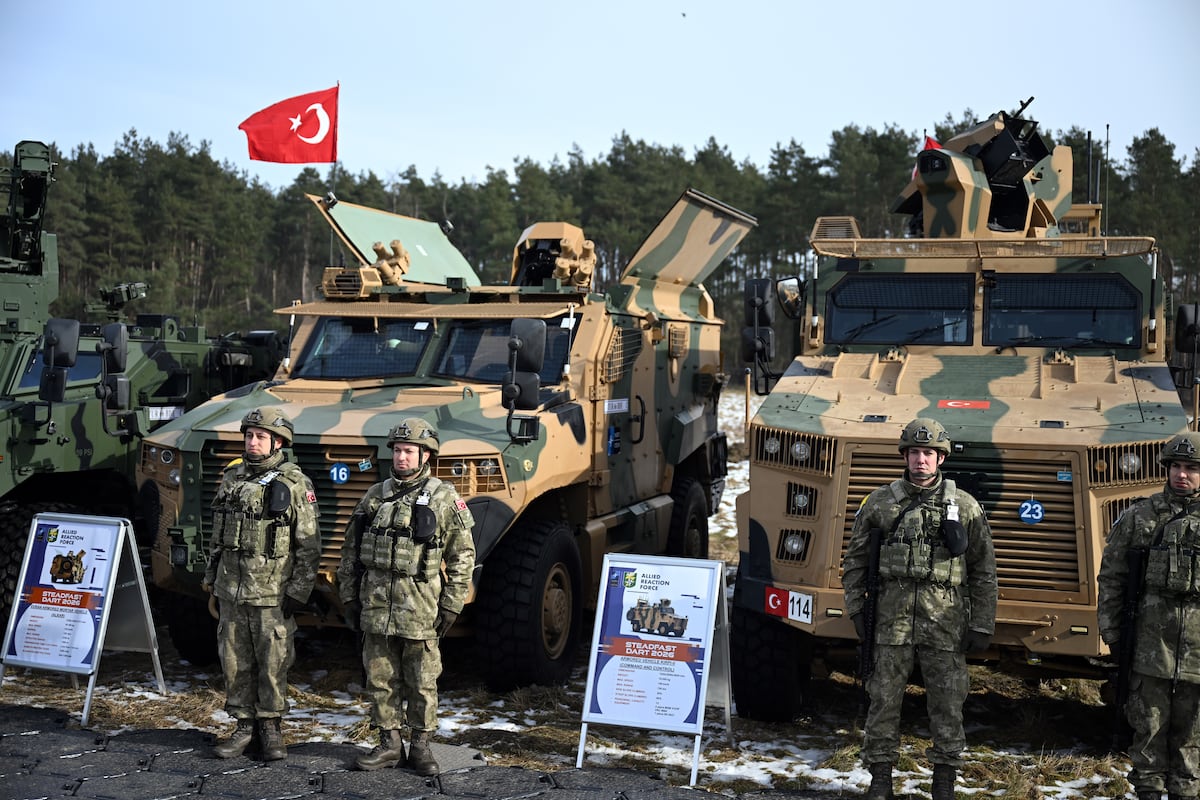
ISTANBUL — As the United States under President Donald Trump rethinks its security guarantees to Europe , Turkey is making the case for closer integration into the continent’s defense architecture.
Speaking at a conference marking the 74th anniversary of Turkey’s entry to NATO, Defense Minister Yaşar Güler criticized the European Union’s reluctance to fully open its defense initiatives to Ankara.
Turkey is a member of NATO but not the EU, which means two sets of rules govern — and in many cases limit — cooperation with members of the bloc.
“Otherwise, we assess that such an approach by the European Union would cause more harm to Europe’s security and resilience than the reduction of U.S. forces in Europe,” Güler said, voicing Ankara’s clearest warnings yet against EU defense initiatives that marginalize non-member allies such as Turkey.
“Turkey is no longer a flank country on NATO’s southeastern periphery,” Güler said April 9 at a conference organized by the Presidency of Communications and the SETA Foundation. “It is a central ally capable of generating security across the entire European theater.”
Güler’s remarks, delivered ahead of the 2026 NATO Summit in Ankara this summer, offer a window into Turkey’s proclaimed place within the alliance as well as Ankara’s assessment of a rapidly transforming international security landscape.
He announced that Turkey will assume command of NATO’s Allied Reaction Force from 2028 to 2030.
“Turkey has become one of the few NATO allies capable of contributing across multiple operational domains with meaningful scale,” said Serhat Güvenç, a professor of international relations at Kadir Has University in Istanbul.
He noted that countries on NATO’s eastern flank including Poland, Romania, the Baltic states and Nordic allies, increasingly recognize Turkey’s value, as Europe seeks to bolster deterrence against Russia while managing instability to its south.
Ankara argues it can offer Europe a large standing military, extensive combat experience, strategic geography bridging Europe and the Middle East, and a defense industrial base capable of rapidly producing drones, munitions, armored vehicles and naval platforms.
As Turkey itself faces an increasingly complex threat environment, the government’s focus on Europe is not driven solely by a desire for recognition or influence. In Ankara’s view, a weakened NATO or fragmented European defense posture could leave Turkey more strategically exposed at a time of rising regional instability.
Retired Brig. Gen. Hüseyin Fazla, president of the Ankara-based think tank STRASAM and a former Air Force pilot, said Turkey’s operational contributions and industrial capacity have strengthened its case for deeper integration into European defense planning.
“In recent years, the ground Turkey has covered in its defense industry is compelling European capitals to cooperate with Ankara,” he said. Military-tech contributions flowing through the alliance’s formal defense planning processes have been prominent enough to be recognized by top NATO commanders, he added.
However, Turkey’s defense integration via EU channels faces significant political obstacles.
For example, the bloc’s PESCO framework and the multibillion-dollar European Defence Fund operate on unanimity, giving Greece and the Greek Cypriot Administration a veto over Turkish participation.
Turkey applied to join the Military Mobility project , one of PESCO’s more operationally focused initiatives. The application stalled due to objections from Athens and Nicosia.
“Greece and Cyprus view Turkey’s integration into EU defense architecture not as a contribution to their own security, but as the collapse of their strategy for balancing Turkey within the EU,” said Fazla. “For them, one of the implicit purposes of EU defense cooperation is already to provide deterrence against Turkey in the Eastern Mediterranean.”
The second barrier is political culture, as much of Western Europe — particularly France and Germany — remains resistant to formally acknowledging Turkey as a central strategic partner, Fazla said.
“For Western Europe and the Brussels bureaucracy, Turkey is seen not as an organic member of the European family, but as a vital geopolitical actor that needs to be managed, balanced, and cooperated with, when necessary,” he told Defense News.
“There is an irrationality here,” said Güvenç. “Part of Europe refuses to set aside its cultural and civilizational objections even when a matter like collective security is at stake. Even if such a risk exists — and it does — they appear willing to take it rather than engage Turkey on its own terms.”
Countries on Europe’s eastern flank — like the Baltics, Poland, Romania and Bulgaria — that most acutely feel a Russian threat tend to view Turkey’s military and industrial capacity as vital, he noted.
Then, there is the Russia question.
While Turkey keeps its political and economic ties with Moscow open and maintains bilateral relations, Ankara also needs NATO’s defensive umbrella and contributes to the development of plans aimed at containing Russian military adventurism, according to Güvenç.
“This is not cynicism,” he said, but the behavior of a country managing a genuinely exposed position.
To Turkey’s southeast, Iran’s expanding ballistic missile capabilities represent a direct threat that Ankara has been careful not to acknowledge publicly even during the U.S. and Israeli-led Operation Epic Fury.
The Kürecik radar installation in central Turkey provides ballistic missile early warning coverage significantly deeper than Romania-based alternatives, said Fazla.
“Without Kürecik, European ballistic missile defense against Iranian missiles would start from Romania,” Fazla noted. “Starting from Turkey provides substantially earlier warning and interception opportunity. No European country can simply substitute for that.”
Growing tensions with Israel and increasingly hostile rhetoric from some senior Israeli officials have also factored into Turkish security planning.
“Turkey understands that as a member of NATO with an Article 5 commitment, its deterrence is far stronger than anything Turkey could achieve alone,” Güvenç said, referring to the alliance’s mutual-defense clause.
He added that the approximately 50 American nuclear weapons said to be stored at Incirlik Air Base function as a concrete security guarantee — making Turkey an extremely difficult target for any actor.
Güler, the defense minister, said he hopes for something of a foundational pledge to that end from the Ankara gathering of alliance leaders.
“In order for the future NATO to be able to provide a multi-dimensional security ecosystem, our expectation from the Ankara Summit is, first and foremost, that allies reaffirm their commitment to Article 5,” he said.
For Ankara, the strategic logic is straightforward: if Europe is preparing for a future with less American support, then both Europe and Turkey will need each other more.
Cem Devrim Yaylali is a Turkey correspondent for Defense News. He is a keen photographer of military ships and has a passion for writing about naval and defense issues. He was born in Paris, France, and resides in Istanbul, Turkey. He is married with one son.
伊斯坦布尔——在唐纳德·特朗普总统领导下的美国重新思考其对欧洲的安全保障之际,土耳其正在争取更紧密地融入欧洲大陆的防御体系。
在纪念土耳其加入北约 74 周年的会议上,国防部长亚沙尔·居莱尔批评欧盟不愿向安卡拉全面开放其防务倡议。
土耳其是北约成员国,但不是欧盟成员国,这意味着两套规则约束着土耳其与欧盟成员国的合作,并且在许多情况下限制了双方的合作。
“否则,我们认为欧盟的这种做法对欧洲的安全和韧性造成的损害将比减少美国在欧洲的驻军更大,”居莱尔说道,这是安卡拉迄今为止对欧盟将土耳其等非成员国盟友边缘化的防务举措发出的最明确的警告。
“土耳其不再是北约东南边缘的侧翼国家,”居莱尔4月9日在通信总统府和SETA基金会联合举办的会议上表示,“它已成为一个核心盟友,能够为整个欧洲地区创造安全。”
居莱尔在今年夏天于安卡拉举行的 2026 年北约峰会前发表的讲话,让我们得以了解土耳其在北约内部宣称的地位,以及安卡拉对快速变化的国际安全格局的评估。
他宣布,土耳其将于 2028 年至 2030 年期间接管北约盟军快速反应部队的指挥权。
“土耳其已成为少数几个能够在多个作战领域做出有意义规模贡献的北约盟国之一,”伊斯坦布尔卡迪尔哈斯大学国际关系教授塞尔哈特·居文奇说。
他指出,北约东翼国家,包括波兰、罗马尼亚、波罗的海国家和北欧盟国,越来越认识到土耳其的价值,因为欧洲在寻求加强对俄罗斯的威慑的同时,也在努力控制其南部的不稳定局势。
安卡拉方面认为,它可以为欧洲提供庞大的常备军、丰富的作战经验、连接欧洲和中东的战略地理位置,以及能够快速生产无人机、弹药、装甲车和海军平台的国防工业基地。
鉴于土耳其自身面临的威胁环境日益复杂,土耳其政府对欧洲的关注并非仅仅出于寻求认可或影响力。安卡拉方面认为,北约实力削弱或欧洲防务体系分裂,可能使土耳其在地区局势日益动荡之际,面临更大的战略风险。
安卡拉智库 STRASAM 主席、退役准将侯赛因·法兹拉 (Hüseyin Fazla) 曾是空军飞行员,他表示,土耳其的作战贡献和工业能力增强了其更深入融入欧洲防务规划的理由。
他表示:“近年来,土耳其在国防工业领域取得的成就正促使欧洲各国首都与安卡拉开展合作。”他还补充说,土耳其通过北约正式的国防规划流程提供的军事技术贡献已足够显著,并得到了北约高级指挥官的认可。
然而,土耳其通过欧盟渠道融入国防体系面临着巨大的政治障碍。
例如,欧盟的永久结构性合作框架和数十亿美元的欧洲防务基金均以一致同意的方式运作,这使得希腊和塞浦路斯希族政权对土耳其的参与拥有否决权。
土耳其申请加入“军事机动项目”,这是“永久性结构化合作”(PESCO)中更侧重于作战行动的举措之一。但由于雅典和尼科西亚的反对,该申请陷入停滞。
法兹拉表示:“希腊和塞浦路斯认为,土耳其融入欧盟防务体系并非有利于自身安全,而是导致其在欧盟内部制衡土耳其的战略崩溃。对他们而言,欧盟防务合作的隐含目的之一,就是在东地中海地区对土耳其形成威慑。”
法兹拉表示,第二个障碍是政治文化,因为西欧大部分地区——特别是法国和德国——仍然不愿正式承认土耳其是核心战略伙伴。
“对于西欧和布鲁塞尔的官僚机构而言,土耳其并非被视为欧洲大家庭的有机成员,而是一个重要的地缘政治行为体,需要在必要时对其进行管控、平衡和合作,”他告诉《防务新闻》。
“这里存在一种非理性,”居文奇说。“欧洲部分国家即使在集体安全这样重要的事情上,也拒绝放下其文化和文明上的抵触情绪。即使存在这样的风险——而且确实存在——他们似乎也宁愿承担这种风险,也不愿按照土耳其的条件与其进行对话。”
他指出,欧洲东翼的国家——如波罗的海三国、波兰、罗马尼亚和保加利亚——对俄罗斯的威胁感受最为强烈,这些国家往往将土耳其的军事和工业能力视为至关重要的。
然后,还有俄罗斯问题。
居文奇表示,虽然土耳其与莫斯科保持着开放的政治和经济联系,并维持着双边关系,但安卡拉也需要北约的防御保护伞,并为制定旨在遏制俄罗斯军事冒险主义的计划做出了贡献。
“这不是愤世嫉俗,”他说,“而是一个国家在真正面临严峻挑战时应有的行为。”
在土耳其东南部,伊朗不断增强的弹道导弹能力构成了直接威胁,即使在美国和以色列领导的“史诗狂怒行动”期间,安卡拉也一直小心翼翼地避免公开承认这一威胁。
法兹拉表示,位于土耳其中部的库雷吉克雷达站提供的弹道导弹预警覆盖范围比罗马尼亚的同类设施要深得多。
“如果没有库雷奇克,欧洲针对伊朗导弹的弹道导弹防御将从罗马尼亚开始,”法兹拉指出。“从土耳其开始可以提供更早的预警和拦截机会。任何欧洲国家都无法简单地替代这一点。”
与以色列日益紧张的关系以及一些以色列高级官员日益敌对的言论也影响了土耳其的安全规划。
“土耳其明白,作为北约成员国,并承担着第五条规定的义务,其威慑力远比土耳其单独行动所能取得的要强大得多,”居文奇说道,他指的是北约的共同防御条款。
他还补充说,据称储存在因吉尔利克空军基地的约 50 枚美国核武器构成了具体的安全保障,使土耳其成为任何行为体都难以攻克的目标。
国防部长居莱尔表示,他希望安卡拉联盟领导人会议能够为此做出某种基础性承诺。
他说:“为了使未来的北约能够提供一个多维度的安全生态系统,我们对安卡拉峰会的期望首先是,盟国重申对第五条的承诺。”
对安卡拉而言,战略逻辑很简单:如果欧洲正在为未来美国支持减少做准备,那么欧洲和土耳其都将更加需要彼此。
杰姆·德夫里姆·亚伊拉利是《防务新闻》驻土耳其记者。他热衷于拍摄军舰,并对海军和国防议题充满热情。他出生于法国巴黎,现居土耳其伊斯坦布尔。他已婚,育有一子。