US-Iran peace talks end without deal as delegations leave Pakistan美伊和平谈判无果而终,双方代表团离开巴基斯坦
Each side blamed the other for the failure of the 21-hour negotiations to end fighting that has killed thousands and roiled the global economy.
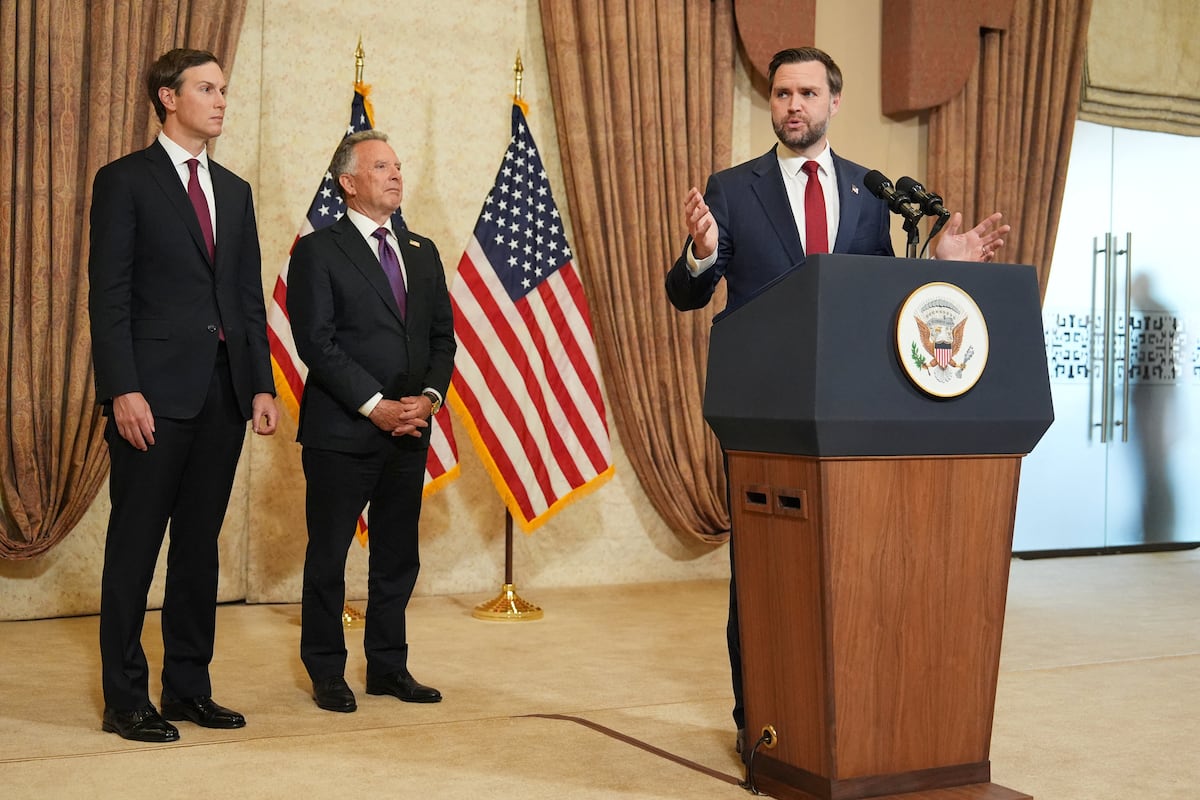
The U.S. and Iran failed to reach an agreement to end their war despite marathon talks that concluded on Sunday in the Pakistani capital Islamabad, jeopardizing a fragile ceasefire .
Each side blamed the other for the failure of the 21-hour negotiations to end fighting that has killed thousands , roiled the global economy and sent oil prices soaring since it began more than six weeks ago.
“The bad news is that we have not reached an agreement, and I think that’s bad news for Iran much more than it’s bad news for the United States of America ,” said Vice President JD Vance, the head of the U.S. delegation.
“So we go back to the United States having not come to an agreement. We’ve made very clear what our red lines are.”
Iran’s Parliamentary Speaker Mohammad Baqer Qalibaf, who led his country’s delegation along with Foreign Minister Abbas Araqchi, blamed the U.S. for not winning Iran’s trust despite his team offering “forward-looking initiatives.”
“The U.S. has understood Iran’s logic and principles and it’s time for them to decide whether they can earn our trust or not,” Qalibaf said on X.
Both the U.S. and Iranian delegations have now left Islamabad to return home, Pakistani sources told Reuters.
The talks, after a ceasefire earlier in the week, were the first direct U.S.-Iranian meeting in more than a decade and the highest-level discussions since the 1979 Islamic Revolution.
Vance said Iran had chosen not to accept American terms, including not to build nuclear weapons.
“We need to see an affirmative commitment that they will not seek a nuclear weapon and they will not seek the tools that would enable them to quickly achieve a nuclear weapon,” he said.
“That is the core goal of the president of the United States, and that’s what we’ve tried to achieve through these negotiations.”
Iran’s semi-official Tasnim news agency said “excessive” U.S. demands had hindered reaching an agreement. Other Iranian media said there was agreement on a number of issues but that the Strait of Hormuz and Iran’s nuclear program were the main points of difference.
Cargo ships in the Gulf, near the Strait of Hormuz, as seen from the UAE, March 11, 2026. (Reuters)
Pakistan’s Foreign Minister Ishaq Dar said it was “imperative” to preserve the two-week ceasefire that was agreed last Tuesday as the sides attempt to wind down a war that began on February 28 with air strikes by the U.S. and Israel on Iran.
Israeli security cabinet minister Zeev Elkin told Army Radio that more talks were still an option, but added: “The Iranians are playing with fire.”
In his brief press conference, Vance did not mention reopening the Strait of Hormuz, a choke point for about 20% of global energy supplies that Iran has blocked since the war began.
Vance said he had spoken with President Donald Trump as many as a dozen times during the talks. But even as the negotiations continued, Trump said on Saturday that a deal was not entirely necessary.
“We’re negotiating. Whether we make a deal or not makes no difference to me, because we’ve won,” he told reporters.
Even as the talks were taking place, U.S. ally Israel continued bombing Tehran-backed Hezbollah militants in Lebanon, insisting that that conflict was not part of the Iran-U.S. ceasefire. Iran says the fighting in Lebanon must stop.
The Israeli military said it struck Hezbollah rocket launchers overnight into Sunday and black smoke could be seen rising in the southern suburbs of the Lebanese capital Beirut on Sunday.
In Israeli villages near the border, air raid sirens sounded, warning of incoming rocket fire from Lebanon.
Tehran is demanding control of the Strait of Hormuz, payment of war reparations and a ceasefire across the region, including in Lebanon, according to Iranian state TV and officials, as well as the release of its frozen assets abroad.
Tehran also wants to collect transit fees in the Strait of Hormuz.
Despite the differences in Islamabad, three supertankers fully laden with oil passed through the Strait of Hormuz on Saturday, shipping data showed, in what appeared to be the first vessels to exit the Gulf since the ceasefire deal.
Hundreds of tankers are still stuck in the Gulf, waiting to exit during the two-week ceasefire period.
Trump’s stated goals have shifted, but as a minimum he wants free passage for global shipping through the strait and the crippling of Iran’s nuclear enrichment program to ensure it cannot produce an atomic bomb.
Tehran has long denied seeking to build a nuclear weapon.
尽管美伊两国在巴基斯坦首都伊斯兰堡举行了马拉松式会谈,并于周日结束,但双方仍未能达成结束战争的协议,这危及了脆弱的停火协议。
双方都指责对方导致21小时的谈判失败,未能结束这场已造成数千人死亡、扰乱全球经济、并导致油价飙升的冲突。这场冲突始于六周多前。
“坏消息是我们还没有达成协议,我认为这对伊朗来说比对美国来说更糟糕,”美国代表团团长、副总统JD Vance说道。
“所以我们回到美国,但仍然没有达成协议。我们已经非常明确地表明了我们的底线。”
伊朗议会议长穆罕默德·巴格尔·卡利巴夫率领伊朗代表团与外交部长阿巴斯·阿拉格奇一同访问美国,他指责美国未能赢得伊朗的信任,尽管他的团队提出了“具有前瞻性的倡议”。
“美国已经了解了伊朗的逻辑和原则,现在是他们决定能否赢得我们信任的时候了,”卡利巴夫在X上说道。
巴基斯坦消息人士告诉路透社,美国和伊朗代表团目前都已离开伊斯兰堡返回各自国家。
本周早些时候达成停火协议后举行的会谈,是十多年来美伊之间的首次直接会晤,也是自 1979 年伊斯兰革命以来最高级别的会谈。
万斯表示,伊朗选择不接受美国的条件,包括不制造核武器。
他说:“我们需要看到他们做出明确的承诺,即他们不会寻求核武器,也不会寻求能够让他们迅速获得核武器的工具。”
“这是美国总统的核心目标,也是我们通过这些谈判努力实现的目标。”
伊朗半官方的塔斯尼姆通讯社称,美国提出的“过分”要求阻碍了协议的达成。其他伊朗媒体则表示,双方在一些问题上达成了一致,但霍尔木兹海峡和伊朗核计划是主要分歧点。
2026年3月11日,从阿联酋拍摄的霍尔木兹海峡附近海湾的货船。(路透社)
巴基斯坦外交部长伊沙克·达尔表示,双方试图结束这场始于2月28日美国和以色列对伊朗发动空袭的战争,因此,维护上周二达成的为期两周的停火协议“至关重要”。
以色列安全内阁部长泽夫·埃尔金在接受以色列陆军电台采访时表示,继续谈判仍然是一个选项,但他补充说:“伊朗人是在玩火。”
在简短的新闻发布会上,万斯没有提及重新开放霍尔木兹海峡。霍尔木兹海峡是全球约 20% 能源供应的咽喉要道,自战争开始以来,伊朗一直封锁着这条海峡。
万斯表示,在谈判期间,他曾与唐纳德·特朗普总统通话多达十几次。但即便谈判仍在继续,特朗普周六却表示,达成协议并非完全必要。
“我们正在谈判。无论最终能否达成协议,对我来说都无关紧要,因为我们已经赢了,”他告诉记者。
就在会谈进行的同时,美国的盟友以色列继续轰炸黎巴嫩境内受伊朗支持的真主党武装分子,并坚称这场冲突不属于伊朗与美国停火协议的范畴。伊朗则表示,黎巴嫩的战斗必须停止。
以色列军方称,他们在周日凌晨袭击了真主党火箭发射器,周日黎巴嫩首都贝鲁特南部郊区可以看到黑烟升起。
在靠近边境的以色列村庄,空袭警报响起,警告黎巴嫩方面即将发射火箭弹。
据伊朗国家电视台和官员称,德黑兰要求控制霍尔木兹海峡,支付战争赔款,并在包括黎巴嫩在内的整个地区实现停火,同时还要求解冻其在海外被冻结的资产。
德黑兰还想收取霍尔木兹海峡的过境费。
尽管伊斯兰堡方面存在分歧,但航运数据显示,周六有三艘满载石油的超级油轮通过了霍尔木兹海峡,这似乎是自停火协议达成以来首批离开海湾的船只。
数百艘油轮仍滞留在海湾,等待在为期两周的停火期内离开。
特朗普的既定目标已经发生了变化,但他至少希望全球航运能够自由通过海峡,并削弱伊朗的核浓缩计划,以确保其无法制造原子弹。
德黑兰一直否认寻求制造核武器。