Army unit experimenting with small drones for ‘tailored cyber effects’陆军部队正在试验小型无人机,以产生“定制化网络效应”。
The Army is testing drone-mounted cyber and electronic warfare capabilities as it works to determine the standard-issue equipment for its 11th Cyber Battalion and a forthcoming second battalion.
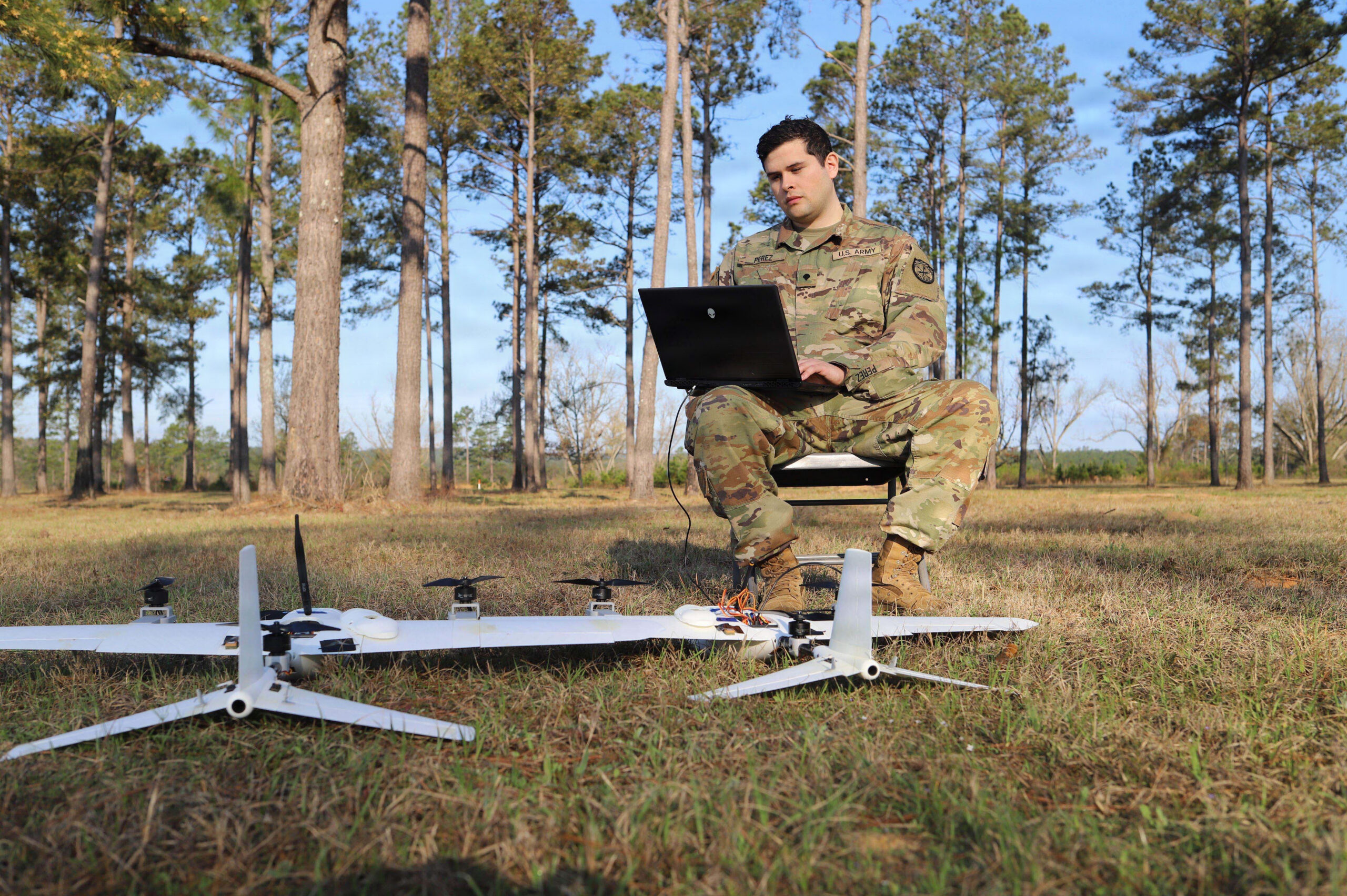
Developers from the Hardware Section of CSD-Maryland (Cyber Solutions Development), 780th Military Intelligence Brigade (Cyber), recently collaborated with developers from the 11th Cyber Warfare Battalion’s CSD-Tactical on a project to increase the Army’s drone warfare capabilities. U.S. Army photos contributed by CSD-Maryland, Operations Support Element, 780th Military Intelligence Brigade (Cyber)
WASHINGTON — As the Army continues to determine the standard issue equipment for the 11th Cyber Battalion, it is experimenting with drones capable of delivering “tailored cyber effects” and jamming, according to an acquisition official.
The Army is testing its Radiofrequency Delivery Effects Platform (RDEP) on small drones, using a mix of government-developed and commercial-off-the-shelf payloads to deliv er “non-kinetic effects” at the tactical edge, Col. David Bergmann, project manager for cyber warfare, told Breaking Defense. While Bergmann didn’t specify, those are typically jamming capabilities as well as gaining access to Wi-Fi systems, to name a few.
RDEP is a hardware and software capability that allows operators to load exploits onto cards and deliver digital bullets to blind or gain access to adversary systems. The Army is exploring how the system and other payloads can support real-time spectrum monitoring and tailored cyber effects — extending the reach of tactical cyber operations while minimizing unintended impacts on friendly systems, Bergmann said during an interview at the Association of the US Army’s annual conference last week.
The efforts are part of continued experimentation to determine the right mix of equipment, capabilities and platforms for the 11th Cyber Battalion and forthcoming 12th Cyber Battalion. Bergmann assumed the brand new role of project manager in July, leading an acquisition office that combines the Army’s offensive and defensive cyber efforts.
The 11th Cyber Battalion was established in 2022 , building on the Army’s earlier 915th Cyber Warfare Battalion , which dates to 2019. The unit conducts tactical-level cyber operations, primarily through radio-frequency, electronic warfare and information operations, with operators working alongside ground forces. Its Expeditionary Cyber Teams (ECTs) are scalable units that can support traditional Army formations with these non-kinetic capabilities by request.
The Army plans to establish the 12th Cyber Battalion in the coming months as a replica of the 11th, increasing the service’s capacity to conduct these operations.
The 11th Cyber Battalion does not yet have an established program of record for its standard issue equipment, and the Army is continuing to experiment with different capabilities and configurations before deciding what will enter production.
Precision at scale: APKWS counters the threat
APKWS® laser‑guidance kit provides reliable precision‑guided munitions across missions and platforms, delivered quickly to meet evolving operational demands.
Bergmann said the Army is gathering feedback from 11th on what capabilities its drones need to support — including offensive cyber, radio-frequency and other effects.
After providing an initial prototype for teams to test, Army Cyber Command is developing a draft of the kits, he added.
“How many of these different things does the ECT need? How much of this capability does the 11th need from a cyber perspective, how much EW capability [do] they need? Where do those overlap, and what makes the best sense to outfit the ECTs that are deployed forward,” he said, describing the questions driving the effort.
The Army has leveraged existing program-of-record gear within their experiments, such as the Terrestrial Layer System Manpack, a backpack-based system that can sense and jam signals, as well as the RDEP. But the service still needs to determine which capabilities and form factors make the most sense for the 11th and its ECTs.
The Army is looking at dismounted systems, platform-based and drone-mounted payloads capable of delivering cyber and jamming effects. The service must also determine which vehicles each battalion will use, what individual ECTs will be expected to do and how much of each capability they will need.
“We’re really trying to give the commander the flexibility to have and employ which of those capabilities he or she needs,” Bergmann said.
ECTs from the 11th have been deploying on a rotating basis to support operations at the southern border over the last year, providing lessons to inform the Army’s equipment decisions. Those experiences have helped assess requirements for ground-based and man-portable capabilities, as well as the types of drones and payloads the teams need, Bergmann said.
“This next year we have not made decision on what we’re going to go into production with. We’re still doing prototypes across the various different form factors,” Bergmann said. “We have some opportunities in the next year that we’re going to get with [the 11th] to get more feedback on that.”
Breaking Defense Video
Army’s tech chief talks autonomy, acquisition and the future of drones
Drones take over AUSA, plus the Army’s plan to bring in new vendors
Hegseth talks autonomy at AUSA, a key show focus
Army doubles down on autonomy, stakes out Indo-Pacific role: AUSA Day 2
Telle talks ‘manufacturing rodeo,’ supply chain ‘weak links’: AUSA Day 1
New leaders, new drone command: What we expect from AUSA 2026
Unpacking Boeing’s F/A-XX win, plus a report from wartime Ukraine
How Hegseth envisions a new Autonomous Warfare Command
What Europe’s military air fleets will look like in 30 years
Riyadh gets closer to F-35s, Damascus presses sovereignty and an expert take on Iran
来自第780军事情报旅(网络)网络解决方案开发部(CSD-Maryland)硬件部门的开发人员最近与第11网络战营战术网络解决方案开发部(CSD-Tactical)的开发人员合作,开展了一个旨在提升陆军无人机作战能力的项目。美国陆军照片由第780军事情报旅(网络)网络解决方案开发部(CSD-Maryland)作战支援分队提供。
华盛顿——据一位采购官员称,随着陆军继续确定第 11 网络营的标准装备,它正在试验能够提供“定制网络效果”和干扰的无人机。
陆军正在小型无人机上测试其射频投放效应平台(RDEP),该平台采用政府自主研发和商用现成有效载荷相结合的方式,在战术前沿投放“非动能效应”。网络战项目经理大卫·伯格曼上校告诉《防务新闻》,虽然伯格曼没有具体说明,但这些效应通常包括干扰能力以及入侵Wi-Fi系统等。
RDEP 是一种软硬件结合的系统,它允许操作人员将漏洞利用程序加载到卡片上,并投放数字弹丸,从而瘫痪或入侵敌方系统。陆军正在探索如何利用该系统和其他有效载荷来支持实时频谱监控和定制化网络效应,从而在最大限度减少对友方系统意外影响的同时,扩大战术网络作战的范围。伯格曼上周在美国陆军协会年会上接受采访时表示。
这些努力是持续试验的一部分,旨在为第11网络营和即将成立的第12网络营确定合适的装备、能力和平台组合。伯格曼于7月就任项目经理这一全新职位,领导一个整合陆军进攻性和防御性网络力量的采购办公室。
第11网络营成立于2022年,其前身是成立于2019年的陆军第915网络战营。该营主要通过射频、电子战和信息作战开展战术级网络作战,作战人员与地面部队协同作战。其远征网络小组(ECT)是可扩展的作战单位,可根据需求为传统陆军部队提供这些非动能作战能力。
陆军计划在未来几个月内建立第 12 网络营,作为第 11 网络营的复制品,以提高陆军执行此类行动的能力。
第 11 网络营尚未制定标准装备的正式编制计划,陆军仍在对不同的功能和配置进行试验,然后再决定哪些装备将投入生产。
规模化精准控制:APKWS 应对威胁
APKWS® 激光制导套件可在各种任务和平台上提供可靠的精确制导弹药,并可快速交付以满足不断变化的作战需求。
伯格曼表示,陆军正在收集第11师的反馈意见,了解其无人机需要支持哪些能力——包括进攻性网络、射频和其他效果。
他补充说,在向各团队提供初步原型进行测试后,陆军网络司令部正在制定工具包草案。
“电子战部队需要多少种不同的能力?第11师从网络角度需要多少能力?他们需要多少电子战能力?这些能力有哪些重叠之处?如何才能最合理地装备前沿部署的电子战部队?”他这样描述推动这项工作的根本原因。
陆军在其试验中充分利用了现有的项目记录装备,例如陆地层系统单兵背包(一种能够感知和干扰信号的背包式系统)以及研发工程装备(RDEP)。但陆军仍需确定哪些功能和外形尺寸最适合第11步兵师及其电子通信技术部队(ECT)。
陆军正在研究能够实施网络攻击和干扰作战的单兵作战系统、平台式有效载荷以及无人机搭载的有效载荷。陆军还必须确定每个营将使用哪些车辆,各个电子通信终端(ECT)需要执行哪些任务,以及每种能力需要多少。
“我们真的想让指挥官能够灵活地拥有和运用他或她需要的这些能力,”伯格曼说。
过去一年,第11特种作战司令部的特种作战小组轮流部署到南部边境支援行动,为陆军的装备决策提供经验教训。伯格曼表示,这些经验有助于评估地面和便携式作战能力的需求,以及各小组所需的无人机类型和有效载荷。
“明年我们还没有决定哪些产品要投入生产。我们仍在对各种不同外形尺寸的产品进行原型制作,”伯格曼说。“明年我们有机会通过[第11款产品]获得更多反馈。”
突破性防御视频
陆军技术主管谈无人机的自主性、采购和未来
无人机主导了美国陆军协会(AUSA)的会议,此外,陆军还计划引入新的供应商。
Hegseth 在 AUSA 大会上谈到了自主性,这是本次大会的一个重点议题。
陆军加倍强调自主性,明确印太地区角色:AUSA第二天
特勒谈“制造业乱象”、供应链“薄弱环节”:AUSA 第一天
新领导人,新无人机指挥部:我们对 AUSA 2026 的期待
深入剖析波音F/A-XX的竞标结果,以及来自战时乌克兰的报道
赫格塞斯设想的新型自主作战指挥部
30年后欧洲军用空军机队会是什么样子
利雅得距离F-35战机更近一步,大马士革强调主权,以及专家对伊朗的看法