Construction Of Iran’s “Eagle 44” Underground Airbase Hasn’t Stopped Despite War尽管战乱不断,伊朗“鹰44”地下空军基地的建设仍未停止。
Satellite imagery depicts new taxiway construction and cleared wreckage after strikes at a remote Iranian airbase with underground hangars and tunnels to protect fighters, drones, and missiles.
新闻视频
Published Oct 22, 2026 10:11 AM EDT
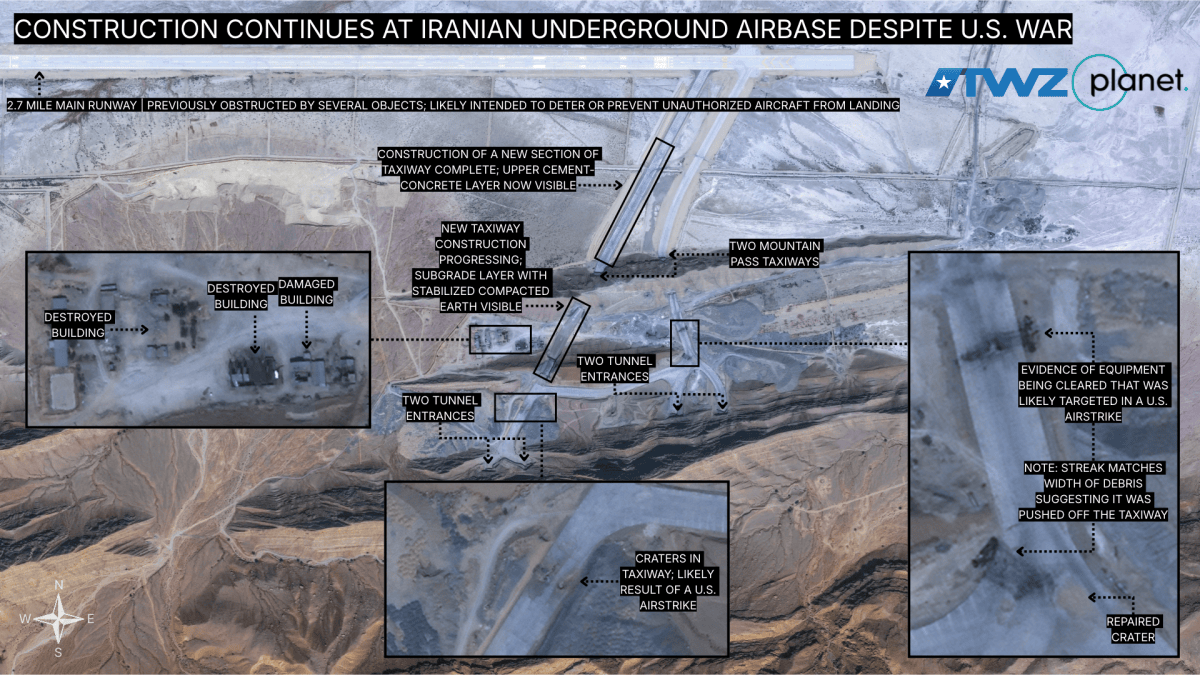
ANNOTATED GRAPHIC OF IRAN'S EAGLE 44 AIRBASE. PHOTO © 2026 PLANET LABS INC. ALL RIGHTS RESERVED. REPRINTED WITH PERMISSION.
Iran is rebuilding Eagle 44, a hardened underground airbase carved into the side of a mountain that can shelter fighter aircraft, drones, and potentially cruise and ballistic missiles, despite the remote facility absorbing at least three rounds of airstrikes this year. High-resolution satellite imagery captured by Planet Labs in late September and reviewed by TWZ shows a new section of taxiway completed, several support buildings still destroyed or damaged, wrecked equipment cleared off the pavement, and obstacles that were placed to obstruct the runway now removed. Construction is ongoing at a time when the Pentagon and Trump administration maintain there is little remaining of the Iranian air force for such a facility to protect.
Graphic depicting key areas of interest at Eagle 44. Photo © 2026 Planet Labs Inc. All rights reserved. Reprinted with permission. TWZ/IAN ELLIS-JONES
Eagle 44, also called ‘Oghab 44’ after the 44th anniversary of the 1979 revolution, was unveiled by Iranian state media in February 2023 when senior officials visited what was described as the country’s newest underground airbase. Islamic Republic of Iran Air Force (IRIAF) F-4D/E Phantom IIs , armed with AGM-65 Maverick air-to-ground missiles, laser and electro-optically guided bombs, unguided ‘dumb’ bombs, as well as domestically produced anti-ship missiles, were shown using the facility in the footage. The IRIAF had roughly 60 examples in service at the time, its most numerous combat jet by some margin, though how many remain today, and are actually operational, is unknown. In addition to the Phantoms, one-way attack drones were also seen in the background.
F-4 Phantom at Eagle 44. Photo: Iranian State Media
Another view of an F-4 Phantom at Eagle 44. Photo: Iranian State Media
The IRIAF, rather than the Islamic Revolutionary Guard Corps (IRGC) Aerospace Force, operates the base, which is located in Hormozgan province and sits in the foothills of the Zagros Mountains, approximately 100 miles northwest of the Strait of Hormuz. Iranian state media described it as “one of the army’s most important air force bases, with fighters equipped with long-range cruise missiles and built in the depths of the Earth.” Then-Chief of Staff of the Armed Forces Maj. Gen. Mohammad Bagheri, who was present at the unveiling, warned that “any attack on Iran from our enemies, including Israel, will see a response from our many air force bases including Eagle 44.” He was eliminated in the opening strikes of the Twelve-Day War, which Israel dubbed Operation Rising Lion , in June 2025.
Location of Eagle 44 airbase in southern Iran. Photo: Google Earth
Work on the cavernous underground tunnel complex began in 2013. Construction of a 2.7-mile main runway, situated on the northern side of the base on a valley floor below the mountain range, started roughly eight years later. Two taxiways run through a smaller ridge connecting the runway to four entrances to the primary tunnel complex, where the jets and weapons are stored, although only one taxiway is currently operational.
Timelapse of Eagle 44 from February to October 2026. Video © 2026 Planet Labs Inc. All rights reserved. Reprinted with permission.
The promotional video released in 2023 revealed at least one internal blast door, as well as branches from the main tunnel to revetment areas to park fighters and drones. A support compound of several buildings is on the west side of the base, next to the unfinished taxiway. The purpose of each structure is unclear, but a functioning airbase requires maintenance and repair facilities, crew quarters, reserves of fuel and munitions, security and force protection assets, and infrastructure to coordinate air traffic control and command and control functions.
Video released by Iranian state media in February 2023 reportedly showing the inside of the tunnel complex at Eagle 44.
The United States kicked off Operation Epic Fury alongside Israel on February 28, launching a massive wave of strikes against Iran from the west and south. Eagle 44 is located within striking distance of the munitions carried by air wings embarked on U.S. Navy aircraft carriers operating in the northern Arabian Sea and missiles fired by the guided-missile destroyers that escort them, as well as Air Force tactical and strategic aircraft and Army assets in the region . However, low-resolution images reviewed by TWZ through March 16 indicated that while the base was targeted, little damage was visible.
HIMARS fired during OEF. CENTCOM photo
B-1B fuels for OEF mission. USAF photo
Super Hornets launch during OEF. Navy photo
Guided-missile destroyer USS Spruance fires a Tomahawk Land Attack Missile (TLAM) in support of Operation Epic Fury (OEF). U.S. Navy photo
As the U.S. and Israel continued the relentless air campaign over the next several weeks, the base was targeted again at the end of March, with greater effect, according to a report from The New York Times . High-resolution images the paper reviewed revealed impact craters on the taxiways near the tunnel entrances, one building leveled, and small mounds placed along the runway, presumably to prevent enemy aircraft from landing. Battle damage assessments suggested the strikes were intended to cut the underground caverns off from the runway, trapping whatever was inside and preventing takeoff. The report did not state whether U.S. or Israeli aircraft carried out the attack, and Israeli officials declined to comment. However, the U.S. was primarily responsible for pressuring Iran’s southern flank, while the Israelis attacked the western front.
After the fragile April ceasefire collapsed and the U.S. imposed a second blockade, U.S. Central Command (CENTCOM), based out of MacDill Air Force Base in Tampa, Florida, and responsible for executing day-to-day operations of the war, launched multiple strikes across Iran on July 15, and Eagle 44 was hit for at least a third time. An analysis published by Soar Atlas , a satellite imagery provider, identified four aimpoints on July 16, with cratered taxiways and damage to additional infrastructure. According to that analysis, the structures targeted were related to the base’s construction unit, but TWZ has not independently verified this claim. The Pentagon and CENTCOM have not specifically named Eagle 44 in any press briefing or release, and Iran has not acknowledged the base was struck.
United States Navy forces on station in mid-July 2026 when the second blockade began and strikes resumed. TWZ/IAN ELLIS-JONES
The Planet Labs satellite imagery from September 29, obtained exclusively by TWZ , indicates that Iran began reconstruction after the July attacks and that the effort is ongoing.
The main runway, previously blocked by obstacles meant to deter and prevent unauthorized aircraft from landing, is now clear. On the western taxiway (marked in red below), a new section leading into the ridge ‘pass-through’ is complete, with its finished upper cement-concrete layer visible. On the other side of the pass, construction of the next segment is underway, with a subgrade layer of stabilized, compacted dirt laid down but not yet paved (orange). Farther south, in front of the western tunnel entrances, impact craters (blue) are still visible. When finished, the second taxiway will provide a direct link between the western hangars and the runway, allowing additional aircraft to move freely without sharing a single taxiway, a major bottleneck for higher operational tempos and more complex sortie launches and recoveries. A second functional taxiway and tunnel would also provide critical redundancy if the other is hit.
Annotated zoomed-in shot of Eagle 44. Photo © 2026 Planet Labs Inc. All rights reserved. Reprinted with permission.
On the primary eastern taxiway, two dark streaks (green) that appeared following the strikes in July run off the edge of the pavement, likely debris left by equipment that was struck and removed. Notably, the streak marks match the width of the debris, suggesting the wreckage was bulldozed or pushed off the taxiway to reopen it. There is no sign of the equipment being recovered, only that it was cleared out of the way.
In the main support compound (yellow) next to the western taxiway, two buildings are clearly destroyed and a third is damaged. They have not been rebuilt yet, which is consistent with previous reporting from The Times and Soar Atlas that the attacks degraded construction capabilities, and suggests the regime may be focused on completing and repairing the taxiways rather than the installations.
Annotated key areas of interest at Eagle 44. Photo © 2026 Planet Labs Inc. All rights reserved. Reprinted with permission.
The four entrances to the main tunnel complex (white), arranged in two pairs less than half a mile apart at the end of each taxiway on the southern part of the base, appear to be intact, although the angle makes it unclear whether they are open or sealed. What’s inside the mountain, and how many fighters remain in Iran’s inventory, is unknown. Regardless of the status of the fighter fleet, as we noted earlier, the base can also store drones and could be packed with cruise or ballistic missiles.
The U.S. and Israel have a range of bunker buster bombs that could be used in an attempt to collapse the tunnel entrances, a major choke point for any underground weapons storage site. While not destroying what is being held within, doing so would block anything inside from leaving — and being used — for a period of time. Additionally, the pass-through tunnels make for easy targets, and hitting them would keep fixed-wing aircraft from reaching the runway. No impact points on the mountain itself or damage to the portals inside are apparent, but they could have been sealed and hit further in, which may not be highly visible via satellite imagery. Reaching the main storage caverns themselves would likely be far harder. Larger bunker buster in the U.S. inventory include the GBU-57 Massive Ordnance Penetrator (MOP) guided munition, which could be capable of reaching deeper into the main site, but these are very limited in number and can only be delivered by the Air Force’s B-2A Spirit stealth bombers. It’s highly unlikely the U.S. would expend such resources on a site like this over many others of higher strategic importance.
Eagle 44 is not the only base that Iran is fixing during the lull in hostilities. By the end of May, Iran had cleared 50 of 69 tunnel entrances struck at 18 underground facilities, including some “missile cities,” according to a report by CNN − and that number is likely higher now. Planet Labs, Airbus, and Vantor imagery reviewed by The Wall Street Journal in July showed rebuilt entrances near Kangavar, fresh excavation at Dezful, and repairs near Kermanshah. “They have very impressive industrialization and reconstruction capabilities,” Israeli Brig. Gen. Ran Kochav told the paper. “They refilled their stockpiles,” he added.
A Western official told Bloomberg earlier this month that Iran “remains well-stocked with ballistic missiles and some anti-ship missiles, and can quickly add more,” and a U.S. official posited in May that “the Iranians have exceeded all timelines the IC [Intelligence Community] had for reconstitution.” Both assessments are at odds with what the White House and Pentagon have repeatedly claimed. Secretary Pete Hegseth stated in April that Iran’s air force was “wiped out” and its missile program was “functionally destroyed; launchers, production facilities, and existing stockpiles depleted and decimated,” while acknowledging a week later that the regime was “digging out” launchers, missiles, and bombed facilities but had “no ability to replenish offensive or defensive capabilities.” In May, CENTCOM Commander Adm. Brad Cooper told Congress, “Before Operation Epic Fury, the Iranian Air Force flew between 30 and 100 sorties each day; today that number is zero.” More recently, at a campaign rally in Kansas on Monday, U.S. President Donald Trump said , “They have no air force… their 229 beautiful fighter jets are now scattered all over the runways, the beautiful runways of the Islamic Republic of Iran.”
Video released by Iranian state media in May 2022 showing a different underground missile and drone complex.
At the very least, strikes on Eagle 44 cratered the taxiways and degraded support infrastructure, which likely put at least some of whatever airpower is stored there, if any, out of action. But even after enduring months of war and extreme economic pressure due to the ongoing U.S. blockade and sanctions, as well as dealing with damage across the country, Tehran continues to prioritize construction on the remote base. That fact alone could put it back on the target list if the U.S. and Israel launch another operation. But above all else, it points to how important this facility is to the regime, for whatever reason.
Contact the author: ian@twz.com or @ianellisjones
Comments couldn’t be loaded. Please refresh the page.
发布于美国东部时间2026年10月22日上午10:11
伊朗鹰44空军基地示意图(附注释)。照片© 2026 PLANET LABS INC. 保留所有权利。经许可转载。
伊朗正在重建“鹰44”空军基地。这座坚固的地下空军基地依山而建,可容纳战斗机、无人机,甚至巡航导弹和弹道导弹。尽管该偏远设施今年至少遭受了三次空袭,但重建工作仍在继续。由Planet Labs于9月下旬拍摄并经TWZ审核的高分辨率卫星图像显示,一条新的滑行道已竣工,但一些辅助建筑仍被摧毁或损坏,路面上的损毁设备已被清理,原本用于阻碍跑道的障碍物也已被移除。与此同时,五角大楼和特朗普政府坚称,伊朗空军已所剩无几,无需如此规模的设施来保护。
图示鹰44号天文台的主要研究区域。图片© 2026 Planet Labs Inc. 保留所有权利。经许可转载。TWZ/IAN ELLIS-JONES
2023年2月,伊朗国家媒体公布了“鹰44”(Eagle 44),又称“奥加布44”(Oghab 44),以纪念1979年伊朗革命44周年。当时,伊朗高级官员参观了这座被誉为该国最新地下空军基地的设施。视频显示,伊朗伊斯兰共和国空军(IRIAF)的F-4D/E“鬼怪II”战斗机正在使用该设施,这些战斗机配备了AGM-65“小牛”空地导弹、激光制导和光电制导炸弹、非制导“哑弹”以及国产反舰导弹。当时,伊朗空军拥有约60架“鬼怪II”战斗机,是其数量最多的作战飞机,但如今究竟有多少架仍在服役,以及是否仍在作战,目前尚不清楚。除了“鬼怪”战斗机外,视频背景中还出现了单向攻击无人机。
F-4“鬼怪”战斗机在鹰44号航站楼。图片来源:伊朗国家媒体
这是在 Eagle 44 空军基地拍摄的另一架 F-4“鬼怪”战斗机的照片。照片来源:伊朗国家媒体
伊朗空军(IRIAF)而非伊斯兰革命卫队(IRGC)空天军负责运营该基地。该基地位于霍尔木兹甘省,坐落在扎格罗斯山脉山麓,距霍尔木兹海峡西北约100英里。伊朗国家媒体称其为“军队最重要的空军基地之一,配备远程巡航导弹的战斗机,建于地底深处”。时任伊朗武装部队总参谋长穆罕默德·巴盖里少将出席了揭幕仪式,并警告说:“任何敌人,包括以色列,对伊朗的攻击,都将遭到我们众多空军基地的回应,其中包括‘鹰44’基地。” 他在2025年6月爆发的“十二日战争”(以色列称之为“雄狮崛起行动”)的首次空袭中丧生。
伊朗南部鹰44空军基地位置。图片来源:谷歌地球
这座巨大的地下隧道综合体的建设始于2013年。一条长2.7英里的主跑道位于基地北侧山脉下方的谷底,大约八年后开始建设。两条滑行道穿过一条较小的山脊,将跑道与通往主隧道综合体的四个入口连接起来,战机和武器就存放在那里,不过目前只有一条滑行道投入使用。
2026年2月至10月期间,Eagle 44卫星的延时摄影。视频版权所有 © 2026 Planet Labs Inc.,保留所有权利。经许可转载。
2023年发布的宣传视频显示,基地内至少有一扇内部防爆门,以及从主隧道通往掩体区域的分支通道,用于停放战斗机和无人机。基地西侧,毗邻未完工的滑行道,是一处由多栋建筑组成的后勤保障区。每栋建筑的具体用途尚不明确,但一个运转正常的空军基地需要维护和修理设施、机组人员宿舍、燃料和弹药储备、安保和部队防护设施,以及用于协调空中交通管制和指挥控制功能的基础设施。
据报道,伊朗国家媒体于 2023 年 2 月发布的视频显示了 Eagle 44 隧道群的内部情况。
2月28日,美国与以色列联合发起“史诗狂怒行动”,从伊朗西部和南部发动大规模空袭。“鹰44”基地位于美国海军航母舰载机联队所携带弹药、护航导弹驱逐舰所发射导弹以及该地区空军战术和战略飞机和陆军装备的打击范围内。然而,TWZ网站截至3月16日查阅的低分辨率图像显示,尽管该基地遭到袭击,但几乎没有明显损坏。
在“持久自由行动”期间发射的HIMARS火箭炮。中央司令部照片
B-1B轰炸机为“持久自由行动”提供燃料。美国空军照片
在“持久自由行动”期间,超级大黄蜂战机起飞。海军照片
导弹驱逐舰“斯普鲁恩斯”号发射一枚战斧陆攻导弹(TLAM),支援“史诗狂怒行动”(OEF)。美国海军照片
在接下来的几周里,美国和以色列持续对伊朗进行空袭。据《纽约时报》报道,3月底,该基地再次遭到袭击,且破坏程度更大。该报审阅的高分辨率图像显示,隧道入口附近的滑行道上布满了弹坑,一栋建筑被夷为平地,跑道沿线还堆放着一些小土堆,据推测是为了阻止敌机降落。战损评估表明,此次空袭的目的是切断地下洞穴与跑道的联系,将洞穴内的物体困住,从而阻止飞机起飞。报道没有说明此次袭击是由美国还是以色列的飞机实施的,以色列官员也拒绝置评。不过,美国主要负责向伊朗南部施压,而以色列则负责攻击西部战线。
在脆弱的四月停火协议破裂、美国实施第二次封锁后,负责执行战争日常行动的美国中央司令部(CENTCOM,总部设在佛罗里达州坦帕市麦克迪尔空军基地)于7月15日对伊朗发动了多次空袭,Eagle 44基地至少第三次遭到袭击。卫星图像提供商Soar Atlas发布的一份分析报告显示,7月16日Eagle 44基地被击中四个目标,滑行道被炸出弹坑,其他基础设施也遭到破坏。该分析报告称,被击中的建筑与基地的建筑部门有关,但TWZ尚未独立核实这一说法。五角大楼和中央司令部在任何新闻发布会或声明中均未明确提及Eagle 44基地,伊朗方面也未承认该基地遭到袭击。
2026年7月中旬,第二次封锁开始,空袭再次发生,美国海军部队驻守在指定区域。TWZ/IAN ELLIS-JONES
TWZ独家获得的Planet Labs卫星图像显示,伊朗在7月袭击事件后开始重建,并且重建工作仍在进行中。
此前被障碍物阻挡的主跑道现已畅通,这些障碍物旨在阻止未经授权的飞机降落。在西侧滑行道(下图红色标记处),通往山脊“通道”的新路段已完工,其上层水泥混凝土已铺设完毕。通道另一侧,下一段的建设正在进行中,已铺设稳定压实的土层,但尚未铺设路面(橙色标记处)。更南边,在西侧隧道入口前,仍然可以看到撞击坑(蓝色标记处)。建成后,第二条滑行道将直接连接西侧机库和跑道,使更多飞机能够自由移动,无需共用一条滑行道,从而避免因共用滑行道而造成的瓶颈,提高运行节奏,并简化更复杂的起降作业。此外,第二条功能齐全的滑行道和隧道还能在其中一条滑行道和隧道遭到撞击时提供关键的冗余保障。
鹰44号的放大注释照片。照片© 2026 Planet Labs Inc. 保留所有权利。经许可转载。
在东侧主滑行道上,7月份撞击事件后出现的两条深色条纹(绿色)延伸至路面边缘,很可能是被撞击后移走的设备碎片。值得注意的是,条纹的宽度与碎片宽度相符,表明残骸曾被推土机推开或移出滑行道以便重新开放。没有迹象表明设备被回收,只显示已被移走。
在西侧滑行道旁的主保障区(黄色区域),两栋建筑明显被毁,第三栋建筑受损。这些建筑尚未重建,这与《泰晤士报》和Soar Atlas此前的报道一致,即袭击削弱了当地的建设能力,并表明该政权可能将重点放在滑行道的修缮和维护上,而不是其他设施的重建。
鹰44号望远镜重点关注区域的标注。照片© 2026 Planet Labs Inc. 保留所有权利。经许可转载。
主隧道群(白色)的四个入口,分两组排列在基地南侧每条滑行道的尽头,彼此相距不到半英里,看起来完好无损,但由于角度问题,无法确定它们是开放的还是封闭的。山体内部究竟有什么,以及伊朗目前还剩下多少战斗机,目前尚不得而知。无论战斗机部队的状况如何,正如我们之前提到的,该基地还可以存放无人机,并且可能储存着大量的巡航导弹或弹道导弹。
美国和以色列拥有一系列钻地炸弹,可用于炸毁隧道入口——这是任何地下武器库的关键咽喉要道。虽然这种炸弹不会摧毁内部储存的武器,但可以阻止内部武器在一段时间内离开并被使用。此外,这些通道隧道本身就是易击目标,击中它们会阻止固定翼飞机抵达跑道。目前山体本身没有明显的撞击点,隧道入口也没有损坏,但这些入口可能已被封堵,并被击中更深处,而这些位置可能难以通过卫星图像清晰显示。要抵达主储存洞穴本身则可能更加困难。美国库存中还有一种更大的钻地炸弹,例如GBU-57巨型穿透弹(MOP),这种制导炸弹能够深入主储存洞穴,但数量非常有限,而且只能由空军的B-2A“幽灵”隐形轰炸机投放。美国不太可能将如此多的资源投入到这样一个具有更高战略意义的地点,而不是其他许多地点。
在战事间歇期,伊朗修复的基地不止“鹰44”一个。据美国有线电视新闻网(CNN)报道,截至5月底,伊朗已清理了18个地下设施(包括一些“导弹城”)中69个被炸毁的隧道入口中的50个,而现在这个数字可能更高。《华尔街日报》7月份审阅的Planet Labs、空客和Vantor公司的卫星图像显示,坎加瓦尔附近有重建的入口,德兹富勒有新的挖掘工作,克尔曼沙赫附近也有修复工作。以色列准将兰·科查夫告诉该报:“他们的工业化和重建能力非常惊人。”他还补充说:“他们已经补充了库存。”
一位西方官员本月初告诉彭博社,伊朗“仍然拥有充足的弹道导弹和一些反舰导弹,并且可以迅速增加更多导弹”。一位美国官员在5月份也表示,“伊朗已经超过了情报界为重建导弹系统设定的所有时间表”。这两种评估都与白宫和五角大楼一再声称的说法相悖。国防部长皮特·赫格塞斯在4月份表示,伊朗空军已被“摧毁”,其导弹计划“实际上已被摧毁;发射装置、生产设施和现有库存已被耗尽和摧毁”。然而一周后,他又承认伊朗政权正在“挖掘”被炸毁的发射装置、导弹和设施,但“没有能力补充进攻或防御能力”。5月份,中央司令部司令布拉德·库珀海军上将告诉国会,“在‘史诗狂怒行动’之前,伊朗空军每天出动30到100架次;而现在这个数字是零。”最近,美国总统唐纳德·特朗普周一在堪萨斯州的一次竞选集会上说:“他们没有空军……他们229架漂亮的战斗机现在散落在伊朗伊斯兰共和国美丽的跑道上。”
伊朗国家媒体于 2022 年 5 月发布的视频显示了另一个地下导弹和无人机综合设施。
至少,对鹰44号基地的袭击摧毁了滑行道并破坏了后勤保障设施,这很可能使那里储存的部分空中力量(如果有的话)失去作用。但即便经历了数月的战争和持续的美国封锁与制裁带来的巨大经济压力,以及应对全国各地的破坏,德黑兰仍然优先考虑在这个偏远基地进行建设。仅凭这一点,如果美国和以色列再次发动军事行动,它就可能再次成为攻击目标。但最重要的是,这表明无论出于何种原因,该设施对伊朗政权来说都至关重要。
联系作者:ian@twz.com 或 @ianellisjones
评论加载失败,请刷新页面。