Qatari Barzan unveils aerial drones, unmanned surface vessels at Milipol 2026卡塔尔巴尔赞公司在2026年国际防务展(Milipol 2026)上推出空中无人机和无人水面舰艇
“This is a significant achievement, particularly as we continue to expand Qatar’s domestic defence and security capabilities in a year where we have had to rise to a number of regional challenges,” the company said in a statement.
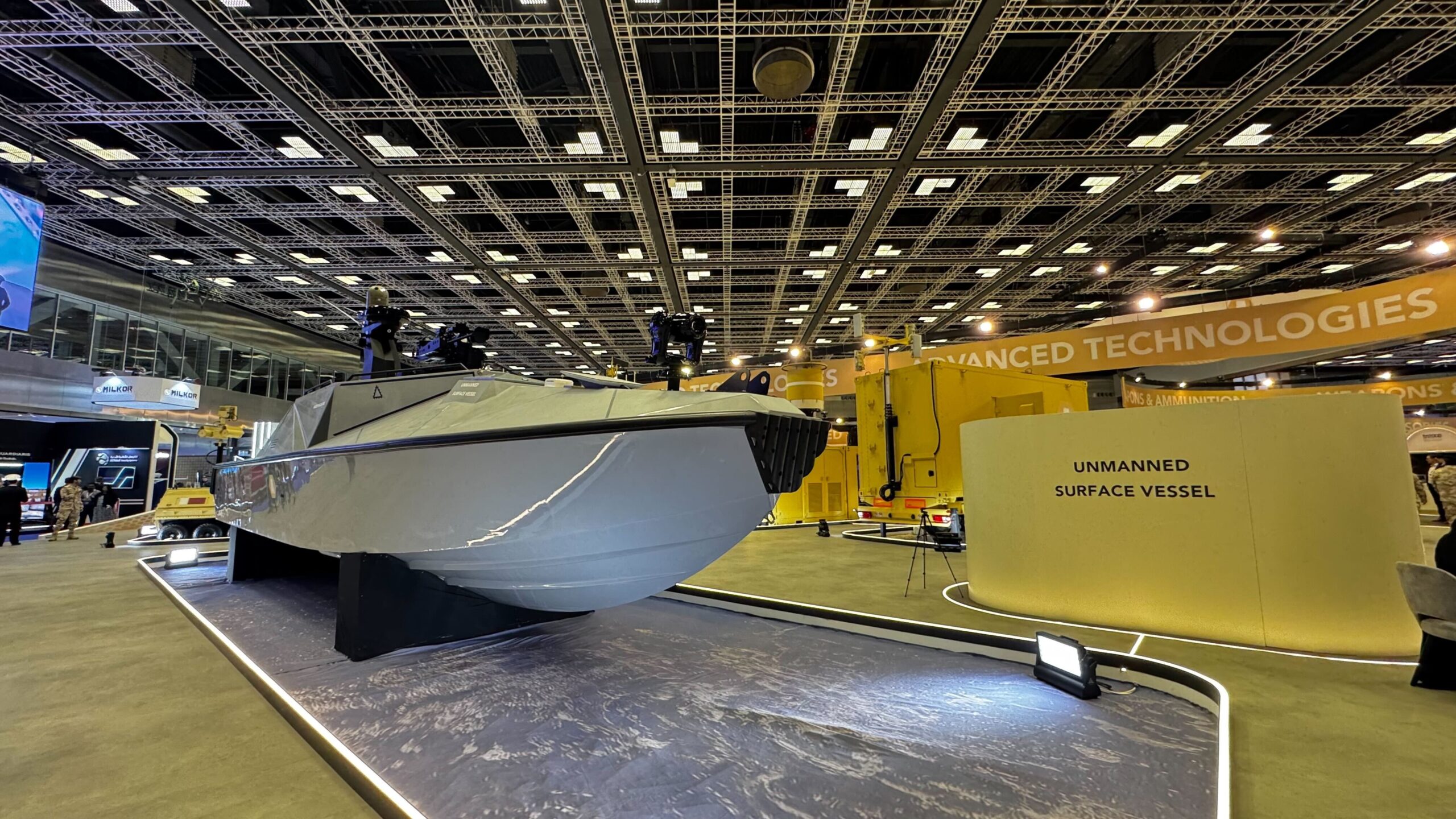
Barzan Holdings' unmanned surface vessel unveiled at DIMDEX 2026 (Breaking Defense/ Agnes Helou)
BEIRUT — As Qatar steps up efforts to expand its domestic defense industry, the state-owned company Barzan Holdings unveiled more than a dozen defense platforms at the Milipol exhibition this week.
The new systems include first-person-view (FPV) drones, vertical take-off and landing (VTOL) uncrewed aerial vehicles, unmanned surface vessels and electronic warfare platforms. At Milipol 2026, held Oct. 20-22 in Doha, Barzan also announced a joint venture with Ukrainian company Carmine Sky to develop a layered air defense capability designed to counter emerging aerial threats, according to the company.
The announcement underscores the country’s push to grow its defense industry under the “Made in Qatar” initiative, as the Gulf state faces growing pressure to strengthen its ability to protect critical infrastructure and counter aerial threats following Iranian missile and drone attacks.
“This is a significant achievement, particularly as we continue to expand Qatar’s domestic defence and security capabilities in a year where we have had to rise to a number of regional challenges,” the company said in a statement.
According to information provided by the firm, Barzan displayed several FPV and VTOL drones for the first time, including:
FPV Drone-15 inch: A tactical reconnaissance quadcopter with a payload capacity of up to 4 kilograms (8.8 pounds), a range of 20 kilometers and an endurance of up to 20 minutes.
FPV Drone-10 inch: A tactical reconnaissance quadcopter capable of carrying up to 2.5 kilograms (5.5 pounds), with a range of 15 kilometers (9.3 miles) and an endurance of 12 minutes at full payload.
FPV Drone-7 inch: A rapid-deployment quadcopter capable carrying 1.5 kilograms (3.3 pounds), with a range of 15 kilometers (9.3 miles) and an endurance of up to 15 minutes.
H Silent ISR Quadcopter: A multirotor drone equipped with an electro-optical and infra red gimbal. It features an endurance of up to 40 minutes and a datalink range of 40 kilometers (24.8 miles), and is designed for surveillance, border security and critical infrastructure protection.
ISR VTOL-400: A vertical take-off and landing UAV with a 4 kilogram (8.8 pounds) payload capacity, datalink range of 40 kilometers (24.8 miles), maximum operating altitude of 10,000 feet and speed of 110 kilometers per hour (68.3 miles per hour).
Barzan also unveiled two unmanned surface vessels during the exhibition. The first, the Rasid USV, is an unmanned jet ski-style watercraft capable of performing surveillance missions. The second, the Barzan Conversion Solution, is a coast guard vessel that can operate either manned or unmanned.
In the communications sector, Barzan introduced Secure Comms VPN and Secure Comms CHAT, designed to support secure communications and protect users’ privacy, according to the statement.
The Qatari firm has also joined forces with Ukrainian Carmine Sky and formed a joint venture to establish a “Full-Cycle Air Defence” capability, aimed at meeting sovereign and national security requirements and protecting critical assets, according to Barzan.
The announcement comes as Gulf states and the wider Middle East grapple with the fallout from the war involving Iran, the United States and Israel. Like other Gulf states , Qatar was targeted by Iranian missiles and drones, and it was the only Gulf state struck by an Israeli raid in September 2025.
The joint venture will allow Doha to leverage Ukraine’s expertise to deliver an integrated, layered air defense architecture that combines detection, identification and neutralization capabilities, Barzan said. The system is expected to counter a range of unmanned aerial vehicles — from FPV drones to jet-powered UAVs — and incorporate radar, radio-frequency sensors, electronic warfare systems and hard-kill platforms.
Breaking Defense Video
Army’s tech chief talks autonomy, acquisition and the future of drones
Drones take over AUSA, plus the Army’s plan to bring in new vendors
Hegseth talks autonomy at AUSA, a key show focus
Army doubles down on autonomy, stakes out Indo-Pacific role: AUSA Day 2
Telle talks ‘manufacturing rodeo,’ supply chain ‘weak links’: AUSA Day 1
New leaders, new drone command: What we expect from AUSA 2026
Unpacking Boeing’s F/A-XX win, plus a report from wartime Ukraine
How Hegseth envisions a new Autonomous Warfare Command
What Europe’s military air fleets will look like in 30 years
Riyadh gets closer to F-35s, Damascus presses sovereignty and an expert take on Iran
Barzan Holdings 的无人水面舰艇在 2026 年 DIMDEX 防务展上亮相(Breaking Defense/ Agnes Helou)
贝鲁特——随着卡塔尔加大力度扩大其国内国防工业,国有企业巴尔赞控股公司本周在米兰国际防务展上推出了十几个国防平台。
这些新系统包括第一人称视角(FPV)无人机、垂直起降(VTOL)无人机、无人水面舰艇和电子战平台。据该公司称,在10月20日至22日于多哈举行的2026年国际防务展(Milipol 2026)上,巴尔赞公司还宣布与乌克兰卡迈恩天空公司(Carmine Sky)成立合资企业,共同开发旨在应对新兴空中威胁的多层次防空能力。
该声明凸显了卡塔尔在“卡塔尔制造”倡议下大力发展国防工业的决心。此前,伊朗的导弹和无人机袭击给这个海湾国家带来了越来越大的压力,迫使其加强保护关键基础设施和应对空中威胁的能力。
该公司在一份声明中表示:“这是一项重大成就,尤其是在我们今年不得不应对诸多地区挑战,并继续扩大卡塔尔国内国防和安全能力之际。”
据该公司提供的信息,Barzan首次展示了多款FPV和VTOL无人机,其中包括:
FPV 无人机-15 英寸:一款战术侦察四轴飞行器,有效载荷高达 4 公斤(8.8 磅),飞行范围达 20 公里,续航时间长达 20 分钟。
FPV 无人机-10 英寸:一款战术侦察四轴飞行器,可携带高达 2.5 公斤(5.5 磅)的有效载荷,飞行范围为 15 公里(9.3 英里),满载续航时间为 12 分钟。
FPV 无人机-7 英寸:一款可快速部署的四轴飞行器,能够携带 1.5 公斤(3.3 磅)的货物,飞行范围为 15 公里(9.3 英里),续航时间长达 15 分钟。
H型静音ISR四旋翼无人机:这是一款配备光电和红外云台的多旋翼无人机。其续航时间长达40分钟,数据链路范围达40公里(24.8英里),专为监视、边境安全和关键基础设施保护而设计。
ISR VTOL-400:一款垂直起降无人机,有效载荷能力为 4 公斤(8.8 磅),数据链范围为 40 公里(24.8 英里),最大运行高度为 10,000 英尺,速度为每小时 110 公里(每小时 68.3 英里)。
巴尔赞公司在展会上还推出了两款无人水面艇。第一款是Rasid USV,是一款类似喷气式滑水艇的无人水上交通工具,能够执行监视任务。第二款是巴尔赞转换解决方案,是一款海岸警卫队舰艇,既可有人驾驶也可无人驾驶。
声明称,在通信领域,Barzan 推出了 Secure Comms VPN 和 Secure Comms CHAT,旨在支持安全通信并保护用户隐私。
据巴尔赞称,这家卡塔尔公司还与乌克兰卡明天空公司联手成立了一家合资企业,旨在建立“全周期防空”能力,以满足主权和国家安全需求并保护关键资产。
这项声明发布之际,海湾国家和更广泛的中东地区正努力应对伊朗、美国和以色列之间战争的后续影响。与其他海湾国家一样,卡塔尔也曾遭到伊朗导弹和无人机的袭击,并且是2025年9月唯一遭到以色列空袭的海湾国家。
巴尔赞表示,合资企业将使多哈能够利用乌克兰的专业技术,构建一个集探测、识别和摧毁能力于一体的一体化多层防空体系。该系统预计将对抗包括第一人称视角无人机和喷气式无人机在内的多种无人机,并整合雷达、射频传感器、电子战系统和硬杀伤平台。
突破性防御视频
陆军技术主管谈无人机的自主性、采购和未来
无人机主导了美国陆军协会(AUSA)的会议,此外,陆军还计划引入新的供应商。
Hegseth 在 AUSA 大会上谈到了自主性,这是本次大会的一个重点议题。
陆军加倍强调自主性,明确印太地区角色:AUSA第二天
特勒谈“制造业乱象”、供应链“薄弱环节”:AUSA第一天
新领导人,新无人机指挥部:我们对 AUSA 2026 的期待
深入剖析波音F/A-XX的中标,以及来自战时乌克兰的报道
赫格塞斯设想的新型自主作战指挥部
30年后欧洲军用空军机队会是什么样子
利雅得距离F-35战机更近一步,大马士革强调主权,以及专家对伊朗的看法