Denmark To Buy Anthem Munitions, Joint Strike Missiles In Dual Long-Range Strike Push丹麦将购买“圣歌”弹药和联合打击导弹,以加强其远程打击能力。
The ground- and air-launched weapons will give Denmark all-new options for striking deep behind enemy lines as NATO reinforces its Baltic flank.
新闻视频
Published Oct 23, 2026 12:59 PM EDT
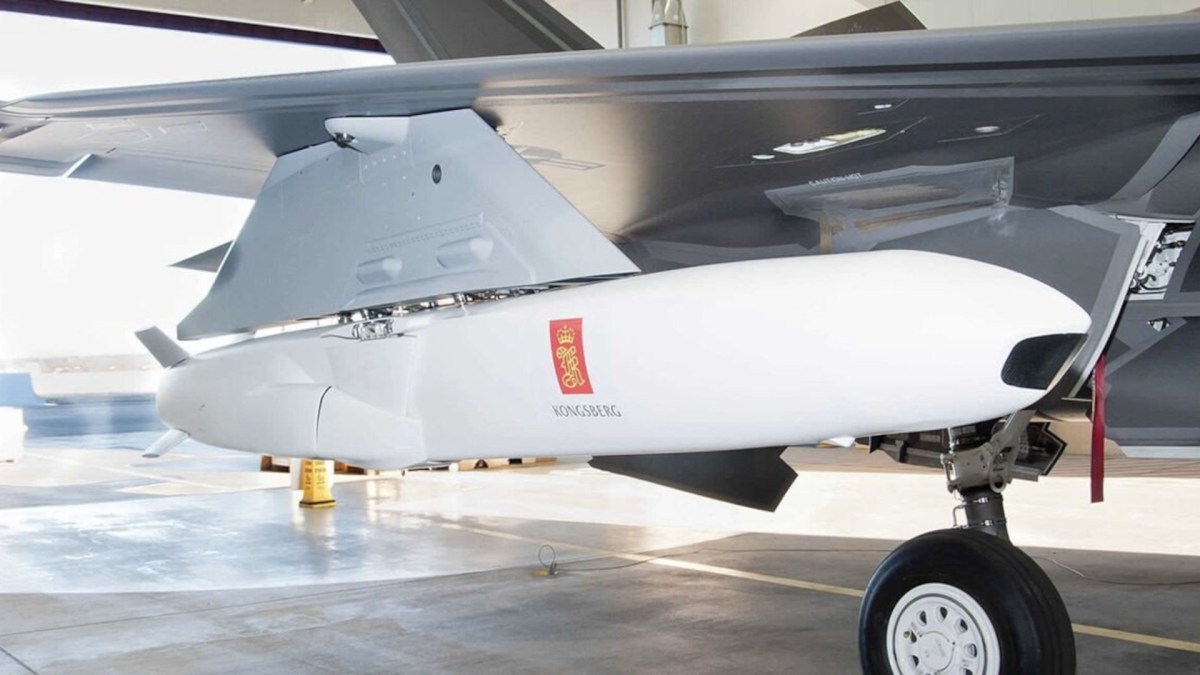
A stock image of a Joint Strike Missile under the wing of an F-35. Kongsberg
Denmark is set to acquire Anthem long-range strike weapons from U.S.-based defense startup Covenant, as well as Joint Strike Missile (JSM) cruise missiles from Norway’s Kongsberg Defense & Aerospace. The twin-track approach by the Nordic NATO member will give it all-new options for launching long-range strikes from the ground and air. Furthermore, Denmark’s move reflects a broader European push to acquire longer-range strike options , especially by NATO allies seeking to deter Russia .
Danish Defense Minister Jeppe Bruus announced the planned purchases yesterday. He said the new weapons would strengthen Denmark’s ability to respond to an attack and strike targets “behind enemy lines,” according to Reuters . Copenhagen has not disclosed the number of missiles involved, the value of the purchases, or expected delivery dates.
A stock picture of Covenant’s Anthem long-range strike weapon. Covenant
“We’re in a serious and deteriorating security situation, and that is why we are building up the defense and strengthening our combat power,” Bruus told reporters . The planned acquisitions are a “strong signal that we have the ability to strike back,” he added , without explicitly naming any particular adversary.
The Danish government did say last year that it would pursue new long-range offensive precision weapons, in general, in response to the growing security concerns in Europe amid Russia’s ongoing war against Ukraine. Bruus’ announcement comes amid a new surge in geopolitical friction between Russia and members of the NATO alliance .
A stock picture of a Joint Strike Missile (JSM), seen here being loaded onto a US Air Force F-16 Viper during a test in 2018. USAF
The two new acquisitions will provide Denmark with important complementary strike options. Anthem is a ground-launched weapon, while JSM is designed to be air-launched, including by stealthy F-35 fighters just like those in Danish Air Force service today. Together, the weapons are set to expand the range of platforms from which Denmark can deliver stand-off precision strikes and give its armed forces additional options for attacking high-value military targets.
A Royal Danish Air Force F-35A takes off for a Red Flag-Nellis 24-2 mission at Nellis AFB, Nevada, on March 13, 2024. U.S. Air Force photo by William R. Lewis William Lewis
Anthem is being developed by Covenant, a U.S.-based defense company that has also outlined plans to establish missile production in Germany and Israel. The system’s selection by Denmark gives the company an important European customer as NATO members seek to expand their inventories of long-range weapons.
Covenant’s Anthem is in a category of munitions that increasingly blurs the line between long-range kamikaze drones and traditional cruise missiles. It is designed to offer a lower-cost, longer-range strike capability that can be produced more easily and at greater scale than many existing systems. Covenant has not publicly disclosed the weapon’s range. Still-unconfirmed reports put it at roughly 740 miles (1,200 kilometers). It is also said to carry a warhead weighing more than 200 kilograms (441 pounds). It also uses a solid rocket motor to provide an initial boost at launch before transitioning to a heavy-fuel jet engine for cruise flight.
Currently, it is unclear how exactly Anthem is launched. It has already undergone testing with the U.S. Army , and images from those trials show the weapons being handled on the ground using a tricycle undercarriage. This may point to rocket-assisted takeoffs from runways.
A Covenant cruise missile is prepared for a live-fire demonstration at the Africa Multidomain Training and Experimentation Center in Tan-Tan, Morocco, August 5, 2026. U.S. Army photo by Capt. Jordan Beagle
Last month, Covenant announced it had already conducted more than 200 test flights of Anthem and had secured roughly $150 million in orders. It also disclosed that an unidentified international customer was expected to begin receiving German-built weapons before the end of this year. This may well be Denmark, though there could also be other customers that have yet to emerge publicly. Meanwhile, U.S. Army deliveries are expected in 2027, under an accelerated qualification contract.
Anthem reflects a broader push, globally, for new long-range strike weapons that can be manufactured rapidly and in large quantities , potentially trading some of the performance and sophistication of more expensive, ‘exquisite’ weapons for affordability, scalability, and mass availability. Recent conflicts in the Middle East , as well as the war in Ukraine , have underscored the challenges of bolstering stockpiles of critical munitions and replenishing them during prolonged fighting.
JSM, developed by Kongsberg in cooperation with U.S. defense contractor Raytheon, is a traditional air-launched cruise missile capable of being employed against targets on land and at sea. It is capable of being carried internally and externally on the A and C variants of the F-35. The design has also been fit-checked for external carriage on a variety of other tactical jets. As already mentioned, JSM will provide an entirely new stand-off precision-strike option for Denmark’s F-35As. These are the only tactical jets in Danish service today following the retirement of the country’s F-16 Vipers in January.
Pictures showing work on integrating the Joint Strike Missile on all three variants of the F-35 Joint Strike Fighter, as well as the F-16. Kongsberg
Kongsberg has identified Denmark as the seventh country to select JSM , although the final contract scope and value remain subject to negotiations. JSM is an enlarged derivative of the surface-launched Naval Strike Missile (NSM), which has also seen growing worldwide sales in recent years, including to the U.S. military . Since 2025, Denmark has also been fielding NSM on its Iver Huitfeldt class frigates and as part of a ground-based coastal defense system.
Since JSM is designed to be air-launched its maximum range is dependent in part on the altitude at which the missile is released, as well as the speed of the aircraft carrying it. Kongsberg has said in the past the missile can fly out to a range of more than 300 nautical miles, but also that its reach is significantly cut back when it is employed in its low-altitude penetration mode.
A briefing slide with various details about the JSM’s capabilities. Kongsberg
The JSM carries a 260-pound warhead and uses a combination of GPS, inertial navigation (INS), and terrain mapping to guide it toward its target. The terrain-mapping capability provides an additional means of navigation, helping the missile maintain its course even in environments where GPS connectivity is degraded or unavailable.
The missile switches over to an imaging infrared seeker to provide precise target discrimination during the terminal phase of flight. Because the seeker operates passively, it does not rely on emitting radiofrequency signals, reducing the risk of detection and making it immune to conventional radiofrequency jamming. The agile JSM’s overall design also includes reduced-signature features to help limit its detectability and improve its survivability on the way to the target.
A U.S. Air Force F-35A releases a Joint Strike Missile (JSM) during a test. Norwegian Defense Materiel Agency
A two-way datalink also allows the missile to receive updated targeting information while en route, or to be redirected toward an entirely different target during the mid-course phase of flight.
The dual purchases build on a broader Danish effort to field new options for holding targets at extended ranges at risk. Denmark previously operated eight M270 Multiple Launch Rocket Systems (MLRS), but retired them in 2004. The country is now introducing Israel’s PULS rocket artillery system , which can employ different rocket and missile types depending on the mission. Presently, the Danish military looks to be fielding PULS just with artillery rockets.
In terms of Denmark’s current and future ground-based capabilities, PULS – which stands for Precise and Universal Launch System – and Anthem will serve different. In Danish service, PULS provides a flexible rocket artillery capability, while Anthem will offer a cruise-missile-like option for longer-range precision attacks.
The acquisition of JSM also reflects the importance of Denmark’s F-35 fleet to its future combat capability. Air-launched weapons offer mobility and flexibility, but their employment depends on available aircraft. In this context, Denmark’s planned expansion of its F-35 fleet from 27 to 43 aircraft, announced in October 2025 , will provide a larger platform base for its emerging long-range strike capability.
There could be some overlap here between Denmark’s growing array of air- and ground-based strike capabilities, as well. Dutch F-35As demonstrated their ability to provide targeting data to PULS launchers during a NATO exercise last year. A ground-launched weapon like Anthem also provides an alternative long-range strike option that does not require a fighter to carry it aloft, creating additional operational flexibility.
For Denmark, acquiring JSMs and Anthems also offers the appeal of adding a capable higher-end munition alongside a more affordable, readily available long-range strike weapon. Reuters has reported that Covenant expects Anthem to eventually cost in the mid-six-figure range, although a final unit price has not been disclosed. Meanwhile, the JSM has a reported unit cost of approximately $2.8 million .
As mentioned, the announcement of the Anthem and JSM purchase is fully in line with prior statements from the government in Copenhagen about acquiring new long-range strike options. Danish Prime Minister Mette Frederiksen previously urged the military to accelerate procurement across the board after years of comparatively limited defense spending.
Danish Prime Minister Mette Frederiksen meets conscripts during a visit to Air Base Karup, the main air base of the Royal Danish Air Force, in Jutland, Denmark on March 7, 2024. (Photo by Mikkel Berg Pedersen / Ritzau Scanpix / AFP) / Denmark OUT MIKKEL BERG PEDERSEN
The long-range strike acquisitions also fit into a broader NATO effort to strengthen deterrence across the Baltic region and the alliance’s northeastern flank.
Denmark occupies a strategically important position linking the Baltic Sea to the North Sea, while its forces contribute to NATO’s regional presence and reinforcement plans. The ability to strike targets deep behind enemy lines will provide a new ability for Denmark to threaten an adversary’s military infrastructure, command facilities, and other critical targets.
Denmark is far from alone in pursuing new long-range strike capabilities. In September, Latvia moved to acquire Anduril’s Barracuda family of long-range strike missiles , building on its earlier order for Army Tactical Missile System (ATACMS) short-range ballistic missiles. Poland is expanding its own layered strike capabilities , while France, Germany, Italy, Poland, Sweden and the United Kingdom are working on the European Long-Range Strike Approach (ELSA) initiative to accelerate the development and procurement of next-generation weapons. The efforts reflect a wider shift across Europe toward restoring deep-strike capabilities that have been relatively scarce among NATO’s European members since the end of the Cold War.
All of this is happening while the Baltic states, in particular, increasingly voice their concerns that Russia could seek to exploit vulnerabilities along NATO’s northeastern flank. Estonia, Latvia, and Lithuania have all warned about the risks posed by Russian force expansion, airspace incursions, sabotage, and other potential provocations. In response, NATO has stepped up its regional posture through initiatives, including Operation Eastern Sentry .
Danish Defense Minister Jeppe Bruus (right) speaks with military personnel during a visit to the Antenna Park in Nuuk, Greenland, on August 26, 2026. Photo by Thomas Traasdahl / Ritzau Scanpix / AFP THOMAS TRAASDAHL
The news about Denmark’s new long-range strike plans has already drawn a heated reaction from Moscow. Russia’s embassy in Copenhagen accused Denmark of pursuing confrontation with Russia and warned of “inevitable disastrous consequences,” Reuters reported .
Many details about the planned Anthem and JSM acquisitions still remain to be learned. However, the announcement yesterday is a clear signal of Copenhagen’s intention to give its armed forces a more substantial ability to threaten targets at distance, and reflects still-growing trends elsewhere in Europe.
Contact the author: thomas@thewarzone.com
Comments couldn’t be loaded. Please refresh the page.
发布于美国东部时间2026年10月23日下午12:59
一张F-35战斗机机翼下挂载联合攻击导弹的库存图片。康斯伯格
丹麦计划从美国国防初创公司Covenant采购“圣歌”(Anthem)远程打击武器,并从挪威康斯伯格防务与航空航天公司采购“联合打击导弹”(JSM)巡航导弹。这一北欧北约成员国的双管齐下策略将为其提供全新的地面和空中远程打击选项。此外,丹麦此举也反映了欧洲各国,特别是北约盟国,为遏制俄罗斯而寻求获取远程打击能力的更广泛趋势。
丹麦国防大臣杰佩·布鲁斯昨日宣布了这项采购计划。据路透社报道,他表示,这些新型武器将增强丹麦应对袭击和打击“敌后”目标的能力。哥本哈根方面尚未透露导弹数量、采购金额或预计交付日期。
一张星盟远程打击武器“圣歌”的示意图。星盟
布鲁斯告诉记者:“我们正面临严峻且不断恶化的安全形势,因此我们正在加强防御并强化作战能力。” 他补充说,计划中的采购行动“强烈表明我们有能力进行反击”,但他没有明确指出任何特定对手。
丹麦政府去年曾表示,鉴于俄罗斯持续对乌克兰发动战争,欧洲安全形势日益严峻,丹麦将寻求研发新型远程进攻性精确武器。布鲁斯的声明正值俄罗斯与北约成员国之间的地缘政治摩擦再度升级之际。
这是一张联合攻击导弹(JSM)的示意图,图中所示为2018年美国空军F-16“蝰蛇”战斗机在测试期间装载该导弹的场景。
这两款新装备将为丹麦提供重要的互补打击选项。“圣歌”(Anthem)是一款陆基导弹,而“联合战略导弹”(JSM)则设计用于空射,包括由丹麦空军现役的F-35隐形战斗机发射。这两款武器将拓展丹麦进行防区外精确打击的平台范围,并为其武装部队提供更多攻击高价值军事目标的手段。
2024年3月13日,一架丹麦皇家空军的F-35A战斗机从内华达州内利斯空军基地起飞,执行“红旗-内利斯24-2”军演任务。美国空军照片,摄影:威廉·R·刘易斯
“圣歌”导弹系统由总部位于美国的国防公司Covenant研发,该公司还计划在德国和以色列建立导弹生产基地。丹麦选择该系统,使该公司获得了一位重要的欧洲客户,因为北约成员国正在寻求扩大其远程武器储备。
Covenant公司的“圣歌”(Anthem)导弹属于一种新型弹药,它模糊了远程自杀式无人机和传统巡航导弹之间的界限。该导弹旨在提供成本更低、射程更远的打击能力,并且比许多现有系统更容易大规模生产。Covenant公司尚未公开该武器的射程。未经证实的报道称其射程约为740英里(1200公里)。据说它还携带一枚超过200公斤(441磅)的弹头。此外,它使用固体火箭发动机在发射时提供初始推力,然后在巡航飞行时切换到重燃料喷气发动机。
目前尚不清楚“圣歌”导弹的具体发射方式。它已在美国陆军进行过测试,测试图片显示该导弹使用三轮起落架在地面进行操作。这可能意味着它采用火箭助推器从跑道起飞。
2026年8月5日,在摩洛哥坦坦的非洲多域训练与试验中心,一枚“盟约”巡航导弹正准备进行实弹演示。美国陆军上尉乔丹·比格尔摄
上个月,Covenant公司宣布其“圣歌”(Anthem)导弹已完成200多次试飞,并已获得约1.5亿美元的订单。该公司还透露,一位身份不明的国际客户预计将于今年年底前开始接收德国制造的武器。这很可能是丹麦,但也可能存在其他尚未公开的客户。与此同时,根据一项加速认证合同,美国陆军预计将于2027年开始接收该型导弹。
“圣歌”导弹反映了全球范围内对新型远程打击武器的更广泛需求,这些武器能够快速、大规模生产,可能以牺牲部分性能和精密度为代价,换取价格低廉、可扩展性和大规模可用性,而这些性能和精密度通常是更昂贵、更“精良”的武器所不具备的。近期中东冲突以及乌克兰战争凸显了在长期战斗中加强关键弹药储备和补充弹药所面临的挑战。
JSM导弹由康斯伯格公司与美国国防承包商雷神公司合作研制,是一款传统的空射巡航导弹,可用于打击陆地和海上目标。它既可内置挂载于F-35 A型,也可外挂于F-35 C型。该导弹的设计也已通过适配性测试,可用于多种其他战术喷气式飞机的外挂。如前所述,JSM导弹将为丹麦的F-35A战斗机提供一种全新的防区外精确打击选项。今年1月,丹麦的F-16“蝰蛇”战斗机退役后,F-35A成为丹麦目前唯一在役的战术喷气式飞机。
图片展示了将联合攻击导弹集成到F-35联合攻击战斗机所有三种型号以及F-16战斗机上的工作。(康斯伯格)
康斯伯格公司已确认丹麦为第七个选择JSM导弹的国家,但最终合同范围和金额仍需谈判。JSM是水面发射型海军打击导弹(NSM)的改进型,近年来NSM的全球销量持续增长,包括对美国军方的销售。自2025年以来,丹麦已在其伊弗·休特费尔特级护卫舰上以及陆基海岸防御系统中部署了NSM导弹。
由于JSM导弹设计为空射,其最大射程部分取决于导弹的发射高度以及运载飞机的速度。康斯伯格公司过去曾表示,该导弹的射程可超过300海里,但同时也指出,当采用低空突防模式时,其射程会显著缩短。
一份包含JSM各项性能细节的简报幻灯片。康斯伯格
JSM导弹携带260磅重的弹头,并结合全球定位系统(GPS)、惯性导航(INS)和地形测绘技术来引导其飞向目标。地形测绘能力提供了一种额外的导航手段,即使在GPS信号减弱或失效的环境下,也能帮助导弹保持航向。
该导弹在飞行末段切换至成像红外导引头,以实现精确目标识别。由于该导引头采用被动式工作,无需发射射频信号,从而降低了被探测的风险,并使其免受传统射频干扰。此外,该型灵活的联合导弹系统(JSM)的整体设计还包含降低特征信号的功能,以进一步降低其被探测的可能性,并提高其在飞向目标途中的生存能力。
美国空军一架F-35A战斗机在测试中发射了一枚联合打击导弹(JSM)。挪威国防物资局
双向数据链还允许导弹在飞行途中接收更新的目标信息,或者在飞行中段阶段被重新定向到完全不同的目标。
这两项采购是丹麦为应对远距离目标威胁而采取的更广泛举措的一部分。丹麦此前曾装备8套M270多管火箭炮系统(MLRS),但已于2004年退役。该国目前正在引进以色列的PULS火箭炮系统,该系统可根据任务需要使用不同类型的火箭弹和导弹。目前,丹麦军方似乎只部署了配备火箭弹的PULS系统。
就丹麦当前和未来的地面作战能力而言,PULS(精确通用发射系统)和“圣歌”导弹将发挥不同的作用。在丹麦军队中,PULS 提供灵活的火箭炮作战能力,而“圣歌”导弹则提供类似巡航导弹的远程精确打击选项。
丹麦采购联合打击导弹也体现了其F-35机队对其未来作战能力的重要性。空射武器具有机动性和灵活性,但其运用取决于可用飞机的数量。在此背景下,丹麦于2025年10月宣布计划将其F-35机队规模从27架扩充至43架,这将为其正在发展中的远程打击能力提供更大的平台基础。
丹麦日益丰富的空基和地基打击能力之间可能存在一些重叠之处。去年,荷兰的F-35A战机在北约演习中展示了其向PULS发射器提供目标数据的能力。像“圣歌”(Anthem)这样的地基发射武器也提供了一种无需战斗机携带的远程打击选择,从而提高了作战灵活性。
对丹麦而言,采购JSM和Anthem导弹的吸引力在于,它既能提供一种性能更优的高端弹药,又能提供一种价格更实惠、易于获取的远程打击武器。路透社报道称,Covenant公司预计Anthem导弹的最终成本将在六位数中段,但最终单价尚未公布。与此同时,据报道JSM导弹的单价约为280万美元。
如前所述,丹麦宣布采购“圣歌”导弹和联合打击导弹完全符合哥本哈根政府此前关于获取新型远程打击手段的声明。丹麦首相梅特·弗雷德里克森此前曾敦促军方在多年国防开支相对有限之后,加快全面采购。
2024 年 3 月 7 日,丹麦首相梅特·弗雷德里克森 (Mette Frederiksen) 在访问位于丹麦日德兰半岛的丹麦皇家空军主要空军基地卡鲁普空军基地时会见了应征入伍的士兵。(摄影:Mikkel Berg Pedersen / Ritzau Scanpix / 法新社)/丹麦 OUT MIKKEL BERG PEDERSEN
远程打击武器的采购也符合北约加强波罗的海地区和联盟东北翼威慑力的更广泛努力。
丹麦占据连接波罗的海和北海的战略要地,其军队对北约的区域存在和增援计划至关重要。深入敌后打击目标的能力将赋予丹麦威胁敌方军事基础设施、指挥设施和其他关键目标的新手段。
丹麦并非唯一一个致力于发展新型远程打击能力的国家。今年9月,拉脱维亚订购了安杜里尔公司的“梭鱼”系列远程打击导弹,此前该国已订购了陆军战术导弹系统(ATACMS)短程弹道导弹。波兰正在扩展其多层次打击能力,而法国、德国、意大利、波兰、瑞典和英国正在共同推进“欧洲远程打击方案”(ELSA)倡议,以加速下一代武器的研发和采购。这些努力反映出欧洲正在发生更广泛的转变,即恢复自冷战结束以来北约欧洲成员国相对匮乏的纵深打击能力。
与此同时,波罗的海三国,尤其是爱沙尼亚、拉脱维亚和立陶宛,日益表达了对俄罗斯可能利用北约东北翼薄弱环节的担忧。爱沙尼亚、拉脱维亚和立陶宛都已就俄罗斯军力扩张、侵犯领空、破坏活动和其他潜在挑衅行为所带来的风险发出警告。作为回应,北约已通过包括“东方哨兵行动”在内的一系列举措,加强了其区域部署。
2026年8月26日,丹麦国防大臣杰佩·布鲁斯(右)在格陵兰岛努克的安特纳公园访问期间与军方人员交谈。照片由托马斯·特拉斯达尔/里扎乌扫描图片社/法新社提供。
丹麦新的远程打击计划一经公布,便已引起莫斯科的强烈反应。据路透社报道,俄罗斯驻哥本哈根大使馆指责丹麦此举意在与俄罗斯对抗,并警告称这将“不可避免地造成灾难性后果”。
关于计划采购“圣歌”(Anthem)和联合战略导弹系统(JSM)的诸多细节仍有待了解。然而,昨日的公告清晰地表明了哥本哈根意图增强其武装部队远程威胁目标的能力,同时也反映了欧洲其他地区日益增长的趋势。
联系作者:thomas@thewarzone.com
评论加载失败,请刷新页面。