Britain’s Final Plan To Kill Argentina’s Super Étendards Attack Jets英国消灭阿根廷超级军旗攻击机的最终计划
Britain's last bid to destroy Argentina’s fleet threatening Exocet anti-ship missile-armed combat jets during the Falklands War. The last British bid to destroy Argentina’s Exocet-armed jets was still in rehearsal a day after the fighting ended.
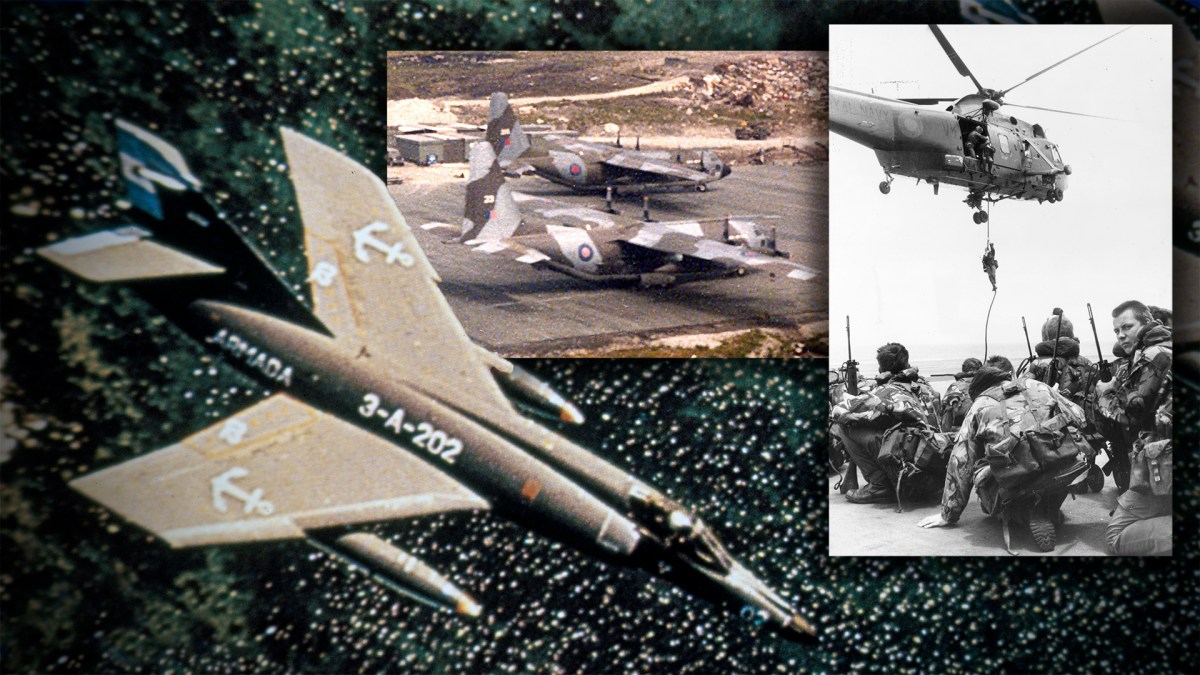
Published Oct 26, 2026 5:11 PM EDT
Hulton-Deutsch Collection/Corbis via Getty Images, UPI/Bettmann Archive/Getty Images, Dennis Gooch/Getty Images
No single Argentine capability shaped British planning during the 1982 South Atlantic conflict more than the pairing of the Dassault Super Étendard strike fighter and its deadly AM39 Exocet anti-ship missile. Against that threat, the British launched a series of special forces operations, all with the same objective: kill the Argentine pilots and destroy their aircraft and missiles before they could be used again. Together, the strike fighter and missile pairing had proven to be the biggest threat to the Royal Navy task force that had been sent to recapture the islands.
Two Super Étendards of the Argentine Navy in flight around the time of the Falklands War in 1982. Photo by UPI/Bettmann Archive/Getty Images
Five Super Étendard aircraft and five AM39 Exocet missiles had been delivered to Argentina before a French embargo took hold. The jets were flown by the Argentine Navy’s 2nd Naval Fighter and Attack Squadron out of Río Grande, on Tierra del Fuego, a region at South America’s southernmost tip, shared by Chile and Argentina. The Super Étendard/Exocet combination had already cost the British the destroyer HMS Sheffield on May 4 and the container ship Atlantic Conveyor on May 25.
A casualty from HMS Sheffield being rushed to the sick bay on board the aircraft carrier HMS Hermes . Crown Copyright
The special forces operations were broken down into four phases — named PLUM DUFF, MIKADO, KETTLEDRUM, and IMPI — the last of which is the least well-documented, and the focus of this article.
PLUM DUFF was the insertion phase and was a reconnaissance mission. On May 16, an RAF Hercules airdropped eight special forces troops onto RFA Fort Austin to form a recce party. On the night of May 17/18, a Sea King HC4 , ZA290, lifted off from the aircraft carrier HMS Invincible for a one-way flight to Tierra del Fuego, where the men were to observe Río Grande and report back. The patrol was set down far from the objective and never completed the reconnaissance; the helicopter crew flew on into Chile, where the aircraft was deliberately burnt to try and hide the evidence, while they tried to evade capture.
Commandos being lifted from the decks of HMS Hermes and HMS Invincible to be transferred by Sea King helicopters to other ships while the two aircraft carriers forge ahead to the Falkland Islands from Ascension Island, leaving the marines ready to move at short notice. Photo by Fox Photos/Getty Images
MIKADO was the planned attack phase, and it depended on that missing intelligence. Two Hercules were to air-land up to 70 men of B Squadron, 22 Special Air Service (SAS), directly on Río Grande — the air operation order of May 19 also named Río Gallegos, further up the Argentine coast, as an alternative. The men would destroy the Super Étendards and their Exocets on the ground, kill the pilots, and then withdraw overland into Chile. Commander Task Force 317, at Northwood, accepted from the outset that the mission could well cost both Hercules.
Lieutenant Juan José “Tierno” Rodríguez Mariani in Super Étendard 3-A-203, preparing to take off from Río Grande on May 23, 1982; note the ground power unit still connected. Armada Argentina
The aircrew did not refuse the task, but they were blunt about what it demanded: formation landing by two heavy transports on a possibly heavily defended, icy military runway, with a probable 20-knot tailwind, at night and on passive night-vision goggles in minimum light levels, with intelligence that was inadequate to support any air-land option at all. The RAF planning team recommended an airdrop as the better way to maintain a covert posture, and the Senior Air Staff Officer at Headquarters 38 Group warned the Air Commander to watch for overambitious schemes coming out of the SAS .
The U.K. Ministry of Defense formally cancelled MIKADO on June 4.
KETTLEDRUM was planned as the third of the set. It was aimed at Puerto Deseado, Santa Cruz Province of Argentina, and would have inserted a Special Boat Service party (SBS, the Royal Marines’ special forces unit) from the submarine HMS Onyx — a boat that will reappear before the end of this story.
None of the three was executed as planned.
The Oberon class submarine HMS Onyx on the surface off Ascension Island. HMS Onyx was the only diesel-electric British submarine to serve in the conflict, and its ability to operate silently close inshore enabled it to play an important role. At Ascension Island, Onyx boarded SAS and SBS special forces personnel and supported them during a series of operations. Imperial War Museums via Getty Images
Less well-known is that the cancellation of MIKADO produced a fourth project: Operation IMPI, named after a Zulu fighting force .
Cancelling MIKADO did not mean the wider operation was over. Also on June 4, the U.K. Ministry of Defense tasked CTF 317 to produce a new plan for special forces to destroy the combat effectiveness of the Super Étendards.
CTF 317’s staff went to work on what became IMPI. The planning document, Ops 1/3, is dated June 14 — the day of the Argentine surrender in the islands. In broad terms, the objective was to be attacked by special forces arriving both by air and by sea.
That much has been known, in fragments.
Teniente de Naviro (Lieutenant Commander) Alfredo Astiz signing the Instrument of Surrender on behalf of his Argentine forces at Leith, on the island of South Georgia, on board HMS Plymouth . Crown Copyright
What has not been published until now is the fact that the operation had already been resourced.
At 2240Z on June 12, Maj. Gen. Jeremy Moore, commanding the land forces as CTG 317.1, signalled Rear Admiral Sandy Woodward’s battle group (CTG 317.8), with Admiral Sir John Fieldhouse at Northwood (CTF 317) and Commodore Michael Clapp’s amphibious group (CTG 317.0) as information addressees. The message called for B Squadron, 22 SAS, to be made available for operations as soon as possible: cover was needed against rapid developments of an unfavorable nature in West Falkland (Gran Malvina), and the theatre’s existing special forces assets were fully absorbed supporting the battle for Stanley — and IMPI. Operation IMPI, Moore noted in passing, was by then self-sufficient.
Maj. Gen. Sir Jeremy Moore Mc, Commander, Land Forces Falkland Islands Conflict. Photo by Avalon/Getty Images
Examining two lines of routine signal traffic settles several things at once. Forty-eight hours before the surrender, IMPI was not a staff study but an operation that had been resourced, and that was enough to consume the theatre’s special forces and justify calling a fresh SAS squadron forward. It is also the only contemporary, operational-level reference to IMPI released so far: everything else comes from a narrative written years afterwards.
As that later narrative describes it, the concept behind IMPI was much leaner than MIKADO. Against two Hercules and 70 men, the air element of IMPI rested on a single RAF Hercules.
Overflying Stanley Airfield in November 1983, with two RAF Hercules aircraft present. Getty Images
The aircraft was to fly from Ascension Island, refuel in flight, and then track east of the Falkland Islands and south of Cape Horn before making a low-level approach below Argentine radar cover for a night landing of special forces at the airfields codenamed San Jose and Arco Iris. Other special forces would have been inserted by sea. That air element, as will be seen, is the most questionable part of the entire file.
The routing is worth attention, because it rules out the intuitive picture of a direct run south from Ascension. Instead, the aircraft would have entered from the least-covered and least-expected direction, coming around the bottom of the continent rather than from the northeast.
A schematic map of the planned Operation IMPI. via author
The precise identities of San Jose and Arco Iris are not established in the declassified record.
The most likely reading is that they stand for Río Grande and Río Gallegos — the airfields at which the planned navigation ended, and the two named in MIKADO’s air operation order a month earlier. For a document circulating through restricted channels, encrypting the names of the two targets was an elementary precaution, although it should be noted that an operational order would more commonly have designated them simply as Target One and Target Two.
None of this rules out Chilean participation in other phases of the operation; if anything, it suggests it’s more likely. The narrative survives inside a folder classified Top Secret and restricted to the Chief of the Air Staff, whose declared subject is cooperation with Chile. That setting contrasts with the earlier stage of the planning, when mounting and recovering a special forces insertion from a Chilean airfield was considered and expressly discounted on political grounds — much as the use of an Antarctic strip was discounted after the New Zealand High Commission advised that the Antarctic winter precluded safe trans-polar flight.
The maritime half of IMPI can be traced in the records of those who were there.
Navigational support for the final phase was to come from the nuclear attack submarine HMS Conqueror . On June 9, 1982, Conqueror was off Bahía Camarones, working as an advanced picket and hunting targets of opportunity that ventured outside the 12-nautical-mile limit of Argentine territorial waters, with authority to sink any civilian vessel judged to be running to the Falklands/Malvinas; that same morning the sub had in fact entered Argentine territorial waters trying to locate the Argentine Navy’s Task Group 79.2.
Nuclear attack submarine HMS Conqueror returning to port. via author
That day, Conqueror received preparatory information on IMPI. The sub’s task was to come to periscope depth and act as a radio beacon, giving the Hercules a radio reference against which to refine a navigation that, low and at night, allowed no error. The resulting picture is an odd one: a nuclear submarine deployed on interdiction off the Patagonian coast, turned into a navigation aid for a transport aircraft.
The insertion itself fell to HMS Onyx , the Oberon class diesel-electric boat that had already taken part in Operation KETTLEDRUM and the only conventional submarine Britain deployed to the South Atlantic. On June 14, at 0815Z, lying in San Carlos Water, Onyx embarked a party of 10 men from B Squadron, 22 SAS and the SBS for the mission. The timing matches Moore’s signal of two days earlier almost exactly.
The plan called for the submarine to surface some two nautical miles offshore at night. The troops would close the beach in Gemini inflatables and destroy the objective — aircraft and missiles, if any were there — using anti-tank weapons and demolition charges.
What happened next illustrates the inertia of military machinery. The Argentine surrender in the islands came on that same June 14, hours after the party had gone aboard Onyx . Even so, preparations did not stop at once: on June 15 the embarked troops carried out practice landings from a Gemini. That does not mean IMPI was ever executed — it was not — but it does show that with the strategic outcome already settled, the machine was still rehearsing.
HMS Onyx operating with special forces. via author
The British record closes the matter with administrative dryness: the surrender of the Argentine forces in the Falkland Islands and the cessation of hostile activity by Argentine aircraft resulted in the operation being cancelled.
The air part of the mission is another matter entirely and is where IMPI becomes more uncertain.
The only link between IMPI and an aircraft is a single paragraph in an RAF historical narrative. The folder that holds it was opened on April 18, 1986 — four years after the war — as an eyes-only briefing file for the Chief of the Air Staff, and the pages appear to be a working draft rather than a finished submission, carrying pencil amendments throughout.
Had a Hercules been earmarked, there is no doubt which unit would have provided it. The Special Forces Flight that runs through the whole chapter — five crews, commanded by a squadron leader, exercising regularly with SAS and SBS Sections — appears with its squadron number blanked out, yet the number surfaces a few paragraphs later, where two of its crews are described training on the probe-fitted Hercules C1P. The unit was No. 47 Squadron, RAF, home-based at Lyneham, and it would keep the special forces air support role for decades afterward.
The men who were at Ascension with that detachment, however, say they had nothing to do with it. Reliable sources with direct knowledge of the flight’s activity state that they never saw the codeword at the time, had never heard of the operation until this file surfaced, and consider it inconceivable that a special forces Hercules and crew could have been earmarked for a mission of this kind without the flight — a community of five crews that has stayed in touch ever since — learning of it at some point in the intervening four decades. By June 14, at most one aerial-refueling-qualified special forces crew was at Wideawake.
That skepticism is reinforced by the way the same narrative handles events those crews lived through. Its account of their own work-up does not survive contact with their logbooks.
For example, a practice infiltration into RAF Laarbruch in Germany that the narrative describes as successful had in fact been detected; the Hercules was notionally shot down about two miles out on the approach. The ramp toes (attachable extension plates located at the very end of the rear cargo ramp) it describes as droppable at 20 to 30 knots were never meant to be lowered with the aircraft moving, which would have been unsafe and risked the airframe. There are other anomalies, too.
West Falklands seen from the ramp of an RAF Hercules. Donald Morrison/Getty Images
A document that misstates the squadron’s own exercises is thin evidence on which to place that squadron over Tierra del Fuego.
What is not in question is what the Special Forces Flight could have done, had it been asked.
By mid-May the flight had two crews qualified in air-to-air refueling — one deployed to Ascension, the other held in the United Kingdom to train the others — flying Hercules C1s fitted with probes and, where the task required it, additional fuel tanks in the fuselage. It had rehearsed stream landings and rapid offloads, parachute insertion below radar cover to a pinpoint coastal feature, as well as flying on ANVIS goggles at 250 feet over sea and land. The goggles themselves were fitted to the crews’ helmets by RAE Farnborough specialists in a single day in mid-April. The reach was demonstrated on May 16, when the sortie that dropped the PLUM DUFF party stayed airborne for 24 hours and five minutes, with Victor tankers refueling some 1,800 miles from Ascension. Almost none of it was routine: nearly everything the force did during the conflict was improvised, at speed, in a matter of weeks.
A picture taken on May 24, 1982, at Wideawake Airfield on Ascension Island, showing an RAF Victor tanker prepared for air-to-air refuelling tasks. Photo by AFP
What never had an answer — not for MIKADO, and not for whatever IMPI intended — was the other end of the problem. Putting men ashore deep inside Argentine territory was the solvable half. Getting an aircraft and its passengers out again after a direct action, from a strip in range of the Argentine Air Force, was not.
All of the above is reconstructed from lateral references: the RAF’s narrative in file AIR 20/13036 at the National Archives, unit records, submarine logs, operational signal traffic, and the accounts of participants.
The specific file — the one holding the complete plan with its annexes, the identification of the airfields and the execution sequence — remains closed. It is DEFE 71/980, titled Operation Corporate (Falklands Conflict): Operation IMPI , retained at the National Archives at Kew with no announced opening date. Until it is released, the air element of IMPI cannot be settled either way.
Forty-four years after the conflict, the last British special operation of the war is still, in essence, a document the British state is not prepared to show. That is not a trivial detail: the files touching on cooperation with Chile have consistently been the most reluctantly opened of all.
The folder holding the outline plan for Operation IMPI. National Archives
What remains is an operation of two halves. One of them is solid: a resourced plan, declared self-sufficient on June 12, with a nuclear submarine briefed to act as a beacon, 10 men of the SAS and the SBS embarked in a conventional submarine in San Carlos on the morning of the surrender, and rehearsals continuing the following day. The other half — a lone Hercules coming round Cape Horn to land on a codenamed strip — rests on one paragraph of a flawed staff narrative and is rejected by the only men who could have flown it.
Either way, the obsession is the same.
Between June 4 and June 14, 1982, while the final battle for Port Stanley/Puerto Argentino was being fought and the Argentine land campaign was collapsing, part of the British planning effort was still revolving around five French-built aircraft, their 10 aircrew, and their missiles. That the plan carries the date of the surrender itself, that it was still being rehearsed the following day, and that it remains classified today says a good deal about how far the British were prepared to go to destroy the Super Étendards and their Exocets.
Contact the editor: thomas@thewarzone.com
Mariano Sciaroni holds a master’s degree in Strategy and Geopolitics as well as a postgraduate diploma in Contemporary Military History, both earned at the Argentine Army’s Military Academy. Sciaroni has published five books and numerous articles on military and naval history. He is also an active member of the Argentine Institute of Military History and serves as a sub-lieutenant in the Argentine Army Reserve (Army Aviation Reserve Squadron). You can find out more about his books here .
Comments couldn’t be loaded. Please refresh the page.
发布于美国东部时间2026年10月26日下午5:11
Hulton-Deutsch Collection/Corbis via Getty Images, UPI/Bettmann Archive/Getty Images, Dennis Gooch/Getty Images
在1982年南大西洋冲突中,阿根廷的哪项能力比达索超级军旗攻击战斗机及其致命的AM39飞鱼反舰导弹的组合对英国的作战计划影响更大?为了应对这一威胁,英国发动了一系列特种部队行动,所有行动的目标都只有一个:击毙阿根廷飞行员,并在他们的飞机和导弹再次投入使用前将其摧毁。事实证明,攻击战斗机和导弹的组合对奉命夺回岛屿的英国皇家海军特遣部队构成了最大的威胁。
1982年福克兰群岛战争前后,阿根廷海军的两架超级军旗战斗机正在飞行。图片来源:UPI/Bettmann Archive/Getty Images
在法国实施禁运之前,阿根廷已收到五架超级军旗战斗机和五枚AM39飞鱼导弹。这些战机由阿根廷海军第二海军战斗机和攻击机中队驾驶,驻扎在火地岛的里奥格兰德岛。火地岛位于南美洲最南端,是智利和阿根廷的共同领土。超级军旗/飞鱼导弹的组合此前已导致英国损失惨重,5月4日击沉了英国驱逐舰“谢菲尔德”号,5月25日又击沉了集装箱船“大西洋运输者”号。
一名来自“谢菲尔德”号巡洋舰的伤员被紧急送往“赫尔墨斯”号航空母舰上的医务室。(英国皇家版权所有)
特种部队行动分为四个阶段——分别命名为 PLUM DUFF、MIKADO、KETTLEDRUM 和 IMPI——其中最后一个阶段的记录最少,也是本文的重点。
“李子布丁行动”是渗透阶段,也是一次侦察任务。5月16日,一架英国皇家空军的C-130大力神运输机将八名特种部队士兵空投到皇家辅助舰队“奥斯汀堡”号上,组成侦察小队。5月17/18日夜间,一架编号为ZA290的“海王”HC4直升机从“无敌”号航空母舰起飞,执行前往火地岛的单程飞行任务,目的是观察格兰德河并汇报情况。然而,这支巡逻队降落在远离目标的地方,侦察任务也未能完成;直升机机组人员继续飞往智利,并在那里故意焚毁了飞机以掩盖证据,同时试图躲避抓捕。
突击队员们从“赫尔墨斯”号和“无敌”号航空母舰的甲板上被吊起,由“海王”直升机转移到其他舰艇上。与此同时,这两艘航母正从阿森松岛驶往福克兰群岛,海军陆战队则做好了随时行动的准备。(图片来源:Fox Photos/Getty Images)
“米卡多”行动是计划中的攻击阶段,而这一切都取决于那份缺失的情报。两架大力神运输机将第22特种空勤团(SAS)B中队的70名队员空投至格兰德河(Río Grande)——5月19日的空战命令中还列出了位于阿根廷海岸更北的加列戈斯河(Río Gallegos)作为备选地点。这些队员将摧毁地面上的超级军旗战斗机及其飞鱼导弹,击毙飞行员,然后经陆路撤回智利。驻扎在诺斯伍德的第317特遣部队指挥官从一开始就意识到,这次任务很可能会损失两架大力神运输机。
1982年5月23日,胡安·何塞·“蒂尔诺”·罗德里格斯·马里亚尼中尉驾驶着超级军旗3-A-203号飞机,准备从里奥格兰德机场起飞;请注意地面电源装置仍连接着。阿根廷海军
机组人员并未拒绝这项任务,但他们直言不讳地指出了任务的艰巨性:两架重型运输机要在夜间,在光线极暗的情况下,借助被动式夜视镜,在一条可能防守严密、结冰的军用跑道上进行编队着陆,而且很可能还要应对20节的顺风,情报不足以支持任何空地着陆方案。英国皇家空军计划小组建议采用空投的方式,以更好地保持隐蔽态势。第38集团军司令部的高级空军参谋也警告空军指挥官,要警惕特种空勤团(SAS)提出的过于雄心勃勃的计划。
英国国防部于6月4日正式取消了“米卡多”演习。
“KETTLEDRUM”行动原计划作为该系列行动的第三项。其目标是阿根廷圣克鲁斯省的德塞阿多港,行动中将派遣一支来自“缟玛瑙”号潜艇的特种舟艇部队(SBS,英国皇家海军陆战队的特种部队)小队进入该港口——这艘潜艇在故事结尾之前还会再次出现。
这三起事件均未按计划执行。
奥伯龙级潜艇“缟玛瑙”号在阿森松岛附近海域浮出水面。“缟玛瑙”号是二战期间唯一一艘服役的英国柴电潜艇,其近岸静默作战能力使其发挥了重要作用。在阿森松岛,该潜艇搭载了英国特种空勤团(SAS)和特种舟艇部队(SBS)人员,并在一系列行动中为他们提供支援。(图片来源:帝国战争博物馆/Getty Images)
鲜为人知的是,MIKADO 的取消催生了第四个项目:以祖鲁战斗部队命名的 IMPI 行动。
取消“米卡多”行动并不意味着整个行动就此结束。同样在6月4日,英国国防部责成第317特遣部队制定一项新的特种部队计划,以削弱“超级军旗”特种部队的战斗力。
CTF 317 的工作人员开始着手制定后来被称为“国际海事防御计划”(IMPI)的方案。计划文件“Ops 1/3”的日期是6月14日——阿根廷在岛上投降的那一天。简而言之,该计划的目标是由特种部队通过空袭和海路同时发起攻击。
这一点此前已零星为人所知。
海军中校阿尔弗雷多·阿斯蒂斯在南乔治亚岛利斯港的普利茅斯号军舰上代表阿根廷军队签署投降书。版权所有
此前尚未公布的事实是,此次行动的资源早已到位。
6月12日22时40分(世界协调时),陆军部队指挥官杰里米·摩尔少将(指挥第317.1特遣队)向桑迪·伍德沃德海军少将的战斗群(第317.8特遣队)、约翰·菲尔德豪斯海军上将(指挥第317特遣队)以及迈克尔·克拉普准将的两栖作战群(第317.0特遣队)发出信息。信息要求第22特种空勤团B中队尽快投入作战:西福克兰群岛(格兰马尔维纳岛)局势迅速恶化,需要支援;而该战区现有的特种部队力量已全部投入到斯坦利战役和“国际海战”(IMPI)行动中。摩尔少将顺便提到,“国际海战”行动当时已具备自给自足的能力。
杰里米·摩尔少将(Sir Jeremy Moore Mc),陆军司令,福克兰群岛冲突。图片来源:Avalon/Getty Images
对两条例行信号通信线路的分析可以同时澄清几个问题。在投降前48小时,IMPI并非一项参谋研究,而是一项已获得资源支持的行动,这足以消耗战区特种部队的全部力量,并足以证明调派一支新的SAS中队前往前线的合理性。这也是迄今为止唯一一份公开的、与IMPI相关的同期作战层面的记录:其他所有信息均来自多年后撰写的叙述。
正如后来的叙述所述,IMPI 的设计理念比 MIKADO 更为精简。IMPI 的空中力量仅依靠一架英国皇家空军的大力神运输机,而 MIKADO 则拥有两架大力神运输机和 70 名士兵。
1983年11月,两架英国皇家空军大力神运输机飞越斯坦利机场。(图片来源:Getty Images)
这架飞机原计划从阿森松岛起飞,空中加油后,飞越福克兰群岛以东、合恩角以南,然后低空接近阿根廷雷达覆盖范围之外的机场,在夜间将特种部队部署到代号为“圣何塞”和“彩虹”的机场。其他特种部队则将通过海路部署。正如后文所述,这部分空中部署是整个计划中最令人质疑的部分。
这条航线值得关注,因为它否定了人们通常认为的从阿森松岛直接向南飞行的设想。相反,飞机将从一个最难追踪、最出人意料的方向进入,绕过大陆南端,而不是从东北方向。
IMPI行动计划示意图。(作者提供)
解密记录中并未确定圣何塞和阿科伊里斯的确切身份。
最有可能的解读是,它们分别代表里奥格兰德(Río Grande)和里奥加列戈斯(Río Gallegos)——计划导航的终点机场,也是一个月前“天皇”(MIKADO)空中作战命令中提到的两个目标。对于一份通过限制渠道传阅的文件而言,对这两个目标的名称进行加密是一种基本的预防措施,尽管值得注意的是,作战命令通常会将它们简单地称为“目标一”和“目标二”。
这并不排除智利参与行动其他阶段的可能性;恰恰相反,这表明智利参与的可能性更大。这份文件保存在一个绝密文件夹中,仅限空军参谋长查阅,其公开的主题是与智利的合作。这种情况与计划的早期阶段形成鲜明对比。在早期阶段,曾考虑过从智利机场发起和撤离特种部队,但出于政治原因明确否决了这一方案——就像新西兰高级专员公署告知南极冬季不适宜安全跨极飞行后,使用南极机场的方案也被否决一样。
IMPI 的海事部分可以从当时在那里工作的人的记录中追溯到。
最后阶段的导航支援将由核动力攻击潜艇“征服者”号提供。1982年6月9日,“征服者”号在卡马罗内斯湾附近海域执行先遣警戒任务,搜寻任何冒险驶出阿根廷12海里领海范围的目标,并有权击沉任何被判定驶往福克兰群岛/马尔维纳斯群岛的民用船只;当天上午,该潜艇实际上已进入阿根廷领海,试图定位阿根廷海军第79.2特遣舰队。
核动力攻击潜艇“征服者”号返回港口。(图片来自作者)
那天,“征服者”号潜艇收到了关于IMPI行动的初步情报。这艘潜艇的任务是下潜至潜望镜深度,充当无线电信标,为“大力神”运输机提供无线电参考,以便其在夜间低空航行时进行精确导航,确保零误差。最终呈现的景象颇为奇特:一艘原本部署在巴塔哥尼亚海岸执行拦截任务的核潜艇,竟然变成了运输机的导航辅助设备。
这次渗透行动的任务落在了“缟玛瑙”号潜艇上,这艘奥伯龙级柴电潜艇此前已参与过“壶铃行动”,也是英国部署到南大西洋的唯一一艘常规潜艇。6月14日08:15(世界协调时),停泊在圣卡洛斯水域的“缟玛瑙”号搭载了来自B中队、第22特种空勤团和特种舟艇部队的10名队员执行此次任务。时间与摩尔两天前发出的信号几乎完全吻合。
计划要求潜艇在夜间浮出水面,距离海岸约两海里。部队将乘坐双子座充气艇封锁海滩,并使用反坦克武器和爆破炸药摧毁目标——如果有的话,包括飞机和导弹。
接下来发生的事情体现了军事机器的惯性。阿根廷在岛屿上的投降发生在6月14日,就在代表团登上“缟玛瑙”号航母几个小时之后。即便如此,准备工作并没有立即停止:6月15日,船上的部队乘坐“双子星”运输机进行了登陆演习。这并不意味着“岛屿入侵计划”(IMPI)最终得以实施——事实上并没有——但这确实表明,尽管战略结果已经确定,但军事机器仍在继续演练。
“缟玛瑙”号潜艇与特种部队协同作战。(作者注)
英国的记录以枯燥乏味的行政方式结束了此事:阿根廷军队在福克兰群岛投降,阿根廷飞机停止敌对活动,导致行动取消。
任务的空中部分完全是另一回事,也是 IMPI 变得更加不确定的地方。
IMPI与飞机之间唯一的联系是英国皇家空军历史叙述中的一个段落。存放该段落的文件夹于1986年4月18日——二战结束四年后——作为仅供空军参谋长查阅的简报文件打开,文件内容似乎是工作草稿而非最终稿,到处可见铅笔修改的痕迹。
如果当时指定了大力神运输机,毫无疑问会由哪个部队提供。贯穿整章的特种部队飞行队——由一名中队长指挥,下辖五个机组,定期与英国特种空勤团(SAS)和英国特种舟艇部队(SBS)分队进行联合训练——其中队编号被涂黑,但几段之后,当描述该飞行队的两个机组正在使用配备探杆的大力神C1P运输机进行训练时,编号便出现了。该部队是英国皇家空军第47中队,驻扎在莱纳姆空军基地,并在之后的几十年里一直承担着特种部队空中支援的任务。
然而,当时随该分遣队驻扎在阿森松岛的人员却声称与此事毫无关系。直接了解该飞行行动的可靠消息来源表示,他们当时从未见过代号,直到这份文件出现之前也从未听说过这项行动。他们认为,如果该飞行队——一个由五个机组组成的、此后一直保持联系的团体——在过去四十年间没有得知此事,那么一架特种部队的C-130“大力神”运输机及其机组人员就不可能被指定执行此类任务。到6月14日,最多只有一支具备空中加油资格的特种部队机组人员驻扎在威德阿韦克。
这种怀疑态度因同一叙述对这些船员亲身经历事件的处理方式而更加强烈。它对他们自身准备工作的描述并未在他们的航海日志中得到保留。
例如,文中描述的对德国拉尔布鲁赫皇家空军基地的一次成功渗透演习实际上已被侦测到;大力神运输机在接近基地约两英里处被击落。文中提到的可在20至30节速度下放下的坡道脚踏板(位于后货舱坡道末端的可拆卸延伸板)原本就不应该在飞机移动时放下,这样做既不安全,也会危及机身。此外,还有其他一些疑点。
从英国皇家空军大力神运输机的舷梯上看到的西福克兰群岛。图片来源:Donald Morrison/Getty Images
一份歪曲该中队自身演习的文件,不足以作为将该中队部署在火地岛上空的证据。
毫无疑问的是,如果被要求这样做,特种部队飞行队能做些什么。
到五月中旬,该飞行队已拥有两组具备空中加油资格的机组——一组部署到阿森松岛,另一组留在英国训练其他机组——他们驾驶着配备探管的大力神C1运输机,并在任务需要时于机身加装额外的油箱。他们演练了滑翔着陆和快速卸载,在雷达掩护下跳伞降落到精确的海岸目标,以及在海陆空250英尺高度佩戴ANVIS夜视镜飞行。这些夜视镜由皇家航空研究院范堡罗分部的专家在四月中旬的一天内安装到机组人员的头盔上。5月16日,该飞行队展示了其作战能力,当时投放“李子布丁”小队的飞行任务在空中持续飞行了24小时5分钟,由维克托加油机在距离阿森松岛约1800英里处进行空中加油。几乎所有行动都非同寻常:该部队在冲突期间的几乎所有行动都是在短短几周内迅速临时制定的。
这张照片拍摄于1982年5月24日,地点是阿森松岛的怀德阿韦克机场,照片显示一架英国皇家空军的维克托加油机正在准备执行空中加油任务。照片由法新社提供。
始终没有答案的,无论是MIKADO行动还是IMPI的计划,都是如此——那就是问题的另一面。让人员深入阿根廷领土登陆是可以解决的一半。但如何在阿根廷空军射程范围内的简易机场,在直接行动后将飞机及其乘客安全撤离,却是无法解决的难题。
以上所有内容均根据横向参考资料重建:英国皇家空军在国家档案馆 AIR 20/13036 号文件中的叙述、部队记录、潜艇日志、作战信号通信以及参与者的陈述。
这份包含完整计划及其附件、机场识别信息和执行顺序的具体文件——编号为DEFE 71/980,题为“企业行动(福克兰群岛冲突):IMPI行动”,目前保存在邱园国家档案馆,尚未公布开放日期。在文件公开之前,IMPI行动的空中部分尚无法定论。
战争结束44年后,英国在战争中执行的最后一次特别行动,其文件实质上仍然是一份英国政府不愿公开的文件。这并非无关紧要:涉及与智利合作的文件,历来都是最不愿公开的。
存放“IMPI行动”概要计划的文件夹。国家档案馆
剩下的行动分为两部分。其中一部分是稳妥的:一份资源充足的计划,于6月12日宣布可自给自足,一艘核潜艇被指定为信号艇,10名SAS和SBS队员在投降当天早上登上了一艘停泊在圣卡洛斯的常规潜艇,并在第二天继续进行演练。另一部分——一架C-130“大力神”运输机绕过合恩角,降落在一条代号为“C”的跑道上——却仅仅基于一份存在缺陷的参谋部叙述中的一段话,而且被唯一有能力驾驶这架飞机的飞行员否决了。
无论如何,痴迷的本质是一样的。
1982年6月4日至14日,在斯坦利港/阿根廷港的最后战役打响、阿根廷陆上战役走向崩溃之际,英国的部分作战计划仍然围绕着五架法国制造的飞机、十名机组人员以及它们的导弹展开。该计划不仅记录了阿根廷投降的日期,而且在第二天仍在进行演练,至今仍属机密,这充分说明了英国为了摧毁阿根廷的超级军旗战斗机及其配备的飞鱼导弹,究竟不惜采取何种极端手段。
联系编辑:thomas@thewarzone.com
马里亚诺·夏罗尼拥有阿根廷陆军军事学院颁发的战略与地缘政治学硕士学位以及当代军事史研究生文凭。他已出版五部著作和大量关于军事史和海军史的文章。他还是阿根廷军事史研究所的活跃成员,并在阿根廷陆军预备役(陆军航空预备役中队)担任少尉。您可以在这里了解更多关于他著作的信息。
评论加载失败,请刷新页面。