Death to the swivel chair: How the Army, INDOPACOM bridge comms with allies终结转椅:陆军、印太司令部如何与盟友进行桥梁沟通
Army leaders test out new connectivity, and tech, in recent exercises.
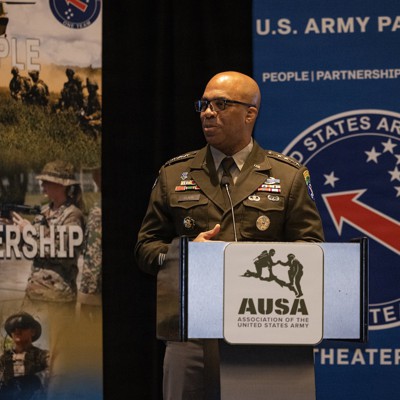
Gen. Ronald Clark, the commander of U.S. Army Pacific, speaks in Washington, D.C., on October 14, 2026. U.S. Army / Staff Sgt. Jared Simmons
Army leaders test out new connectivity, and tech, in recent exercises.
International Relations
WASHINGTON— After years of frustration, Army leaders are starting to see progress on upgraded networks designed to make it easier to communicate with allies and partners in the Pacific in the event of a conflict with China.
“When I arrived at [U.S. Army Pacific Command], we had an exercise in Japan—and I'd only been in command a month. It was a trilateral exercise between the U.S., Japan, and Australia. And we literally couldn't pass voice data to each other. We couldn't create a common operating picture without physically putting icons into this system,” Gen. Ronald Clark, commander of U.S. Army Pacific, told reporters earlier this month.
“It was so frustrating to me because I just left working in the Pentagon where I had literally attended both the signing ceremonies for AUKUS…sharing our most sensitive defense technology. But we are using basically a swivel chair to have a conversation with regard to land forces.”
In recent years, the Army has been building and testing the telecommunications pipelines that allies and partner militaries would rely on in a war with China. U.S. Indo-Pacific Command has a broader Pacific Mission Network, previously known as the INDOPACOM Mission Network, which is used on a more strategic or operational level.
Earlier this year, the U.S., Australia, and Japan used the Pacific Mission Network during the large-scale Balikatan exercise to get a “real-time picture of participating forces across the entire training area,” an Army spokesperson told Defense One .
Months later, the nations reconvened for Yama Sakura 91, an annual military exercise with Japan and Australia that ended Sept. 10.
“Yama Sakura 91 demonstrated the live sharing of simulated information in a command post exercise, while Balikatan 26 demonstrated the live sharing of real-time information across a physical training environment and multiple echelons,” the Army said.
That network, which connects dozens of nations, was the linchpin for USARPAC to test whether it could share and see the same information as allies and partners.
“The [mission partner] enclaves work, so we're able to pass and share data in a way that we had not been before,” Clark said, at the Association of the U.S. Army’s annual conference, calling the network an “important and critical innovation” that addressed years of frustrations.
That means commanders can more easily send “target-quality data” and share a “common operational picture” without needing to swivel between workstations.
For example, Maj. Gen. Bernard Harrington, who leads the Army’s Multi-Domain Command-Pacific and 7th Infantry Division, can gather information on “land-based long-range precision fires, sensors, space capability, [electronic warfare], cyber” and then share it with Pacific Fleet Commander Adm. Stephen Koehler, who led the exercise, and “can then integrate that [data] into a joint context in the fight,” Clark said.
The progress on the Pacific Mission Network comes as the Army looks to add more tech and sources of data—mostly drones—to its forces. That means being able to see, control, and learn from devices and the information they collect will become increasingly important on the battlefield.
Seventh ID recently finished an exercise called Bayonet Quest near Lake Huron, Mich., in which it was able to coordinate high-altitude balloons, and aerial and maritime drones, using a shared data connection, Harrington told reporters.
“We used multiple [unmanned aerial systems], multiple [unmanned surface vessels], long-range, one-way attack, and a high-altitude balloon,” he said. The division also collected and analyzed data from all of those systems using a single data layer.
During the exercise, which ended Oct. 6, the Army was also able to orchestrate the drones and coordinate simulated attacks with an “adaptive and agentic” command-and-control system.
“We were able to pull in a vast amount of data, make sense of it quickly, and then task those systems through a large language model, reducing the need for soldiers on individual ground control stations,” Harrington said in a statement to Defense One .
The exercise showed how unmanned systems could be used in the Pacific, particularly from different locations, which could help keep soldiers safe, he said.
The exercise wrapped earlier this month, but the division plans to keep training with the concept and employ it in future exercises with allies and partners.
NEXT STORY: Add ‘post-AI’ encryption to your to-do list
2026年10月14日,美国太平洋陆军司令罗纳德·克拉克将军在华盛顿特区发表讲话。(美国陆军/参谋军士贾里德·西蒙斯摄)
陆军领导人在最近的演习中测试了新的连接方式和技术。
国际关系
华盛顿——经过多年的挫败,陆军领导人开始看到升级网络方面取得进展,这些网络旨在使在与中国发生冲突时更容易与太平洋地区的盟友和伙伴进行沟通。
“我刚到[美国太平洋陆军司令部]时,我们在日本举行了一次演习——而我上任才一个月。这是一次美日澳三国联合演习。我们根本无法互相传递语音数据。如果不把图标实物输入系统,我们就无法创建共同作战图,”美国太平洋陆军司令罗纳德·克拉克将军本月初告诉记者。
“这让我非常沮丧,因为我刚离开五角大楼,在那里我亲身参与了AUKUS项目的签约仪式……分享我们最敏感的国防技术。但现在,我们却只能坐在转椅上,就陆军问题进行简单的对话。”
近年来,美国陆军一直在建设和测试盟国及伙伴国军队在与中国发生战争时赖以生存的电信线路。美国印太司令部拥有一个范围更广的太平洋任务网络(Pacific Mission Network),该网络此前被称为印太司令部任务网络(INDOPACOM Mission Network),其应用层面更为战略性或作战性。
据美国陆军发言人向Defense One透露,今年早些时候,美国、澳大利亚和日本在大规模的“肩并肩”联合军演期间利用太平洋任务网络,获得了“整个训练区域内参演部队的实时情况”。
几个月后,这些国家再次集结,参加了“山樱91”年度联合军事演习,该演习于9月10日结束,演习对象包括日本和澳大利亚。
“山樱91演习展示了在指挥所演习中模拟信息的实时共享,而肩并肩26演习则展示了在物理训练环境和多个层级中实时信息的实时共享,”陆军表示。
该网络连接数十个国家,是美国陆军太平洋司令部测试其能否与盟友和伙伴共享和查看相同信息的关键所在。
克拉克在美国陆军协会年会上表示:“(任务伙伴)飞地运行良好,因此我们能够以以前从未有过的方式传递和共享数据。”他称该网络是一项“重要且关键的创新”,解决了多年来的挫败感。
这意味着指挥官可以更轻松地发送“目标质量数据”并共享“通用作战图”,而无需在工作站之间来回切换。
例如,领导陆军多域司令部-太平洋和第7步兵师的伯纳德·哈灵顿少将可以收集有关“陆基远程精确火力、传感器、太空能力、[电子战]、网络”的信息,然后与领导此次演习的太平洋舰队司令斯蒂芬·科勒海军上将共享这些信息,“然后可以将这些[数据]整合到联合作战环境中,”克拉克说。
随着美国陆军寻求为其部队增添更多技术和数据来源(主要是无人机),太平洋任务网络项目也取得了进展。这意味着,在战场上,能够观察、控制这些设备及其收集的信息并从中学习将变得越来越重要。
哈灵顿告诉记者,第七步兵师最近在密歇根州休伦湖附近完成了一项名为“刺刀探索”的演习,在演习中,他们能够利用共享数据连接协调高空气球、空中无人机和海上无人机。
他说:“我们使用了多套无人机系统、多艘无人水面舰艇、远程单向攻击手段以及一个高空气球。”该部门还利用单一数据层收集并分析了来自所有这些系统的数据。
在 10 月 6 日结束的演习中,陆军还能够通过“自适应和智能”的指挥控制系统来指挥无人机并协调模拟攻击。
哈灵顿在接受Defense One采访时表示:“我们能够获取大量数据,快速理解数据,然后通过大型语言模型向这些系统分配任务,从而减少了对单个地面控制站士兵的需求。”
他说,这次演习展示了如何在太平洋地区使用无人系统,特别是从不同地点使用,这有助于保障士兵的安全。
该演习于本月初结束,但该师计划继续进行相关训练,并将在未来与盟友和伙伴的演习中运用该理念。
下一篇:将“后人工智能”加密技术添加到您的待办事项清单中