US Army queries industry’s ability to build 21,000 Infantry Squad Vehicles美国陆军质疑工业界是否有能力制造21000辆步兵班组车辆
The U.S. Army published a market survey Monday in an effort to learn whether the defense industrial base could deliver 9,000 ISV-9s and about 12,000 ISV-Us.
Share on Facebook (Opens in new window) Facebook
Share on X (Opens in new window) X
Share on Bluesky (Opens in new window) Bluesky
Share on Reddit (Opens in new window) Reddit
Share on LinkedIn (Opens in new window) LinkedIn
Share using Native tools Share Copied to clipboard
Share on Mail (Opens in new window) Mail
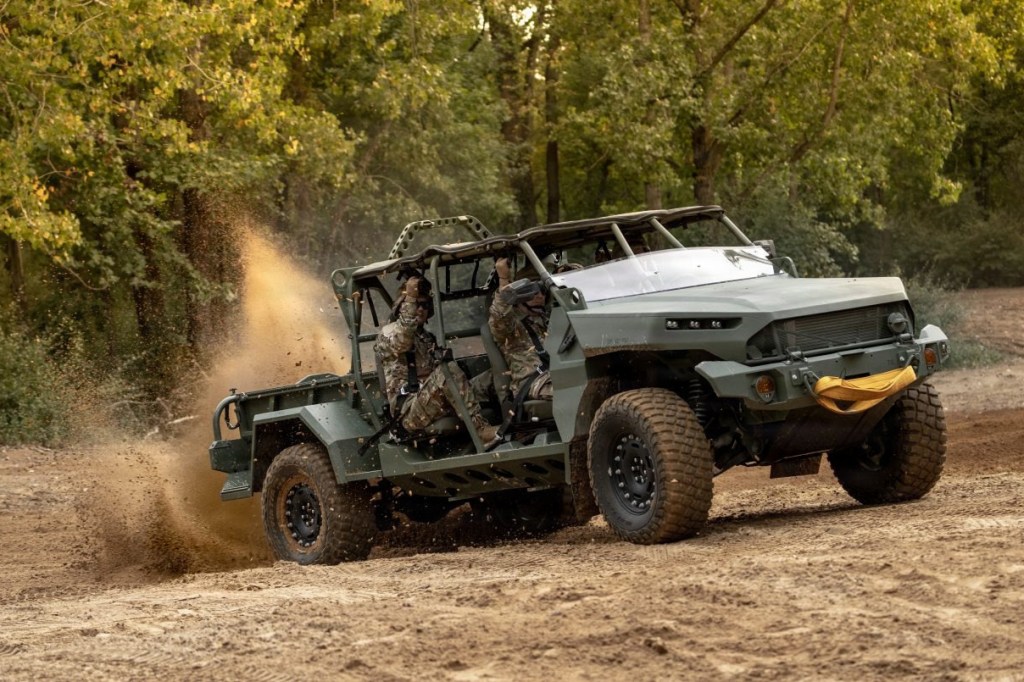
An Infantry Squad Vehicle—Utility that underwent testing in August by U.S. Army DEVCOM Ground Vehicle Systems Center engineers. (Jennifer DeHaan/U.S. Army)
The U.S. Army is asking whether the defense industrial base can deliver and support nearly 21,000 Infantry Squad Vehicles .
An Army market survey published Monday focuses on two ISV versions: the ISV-9, which carries nine passengers, and the ISV-Utility, which carries five passengers plus a utility bed to haul cargo.
“The estimated total requirement is for 20,787 vehicles (9,003 ISV-9 and 11,784 ISV-U), subject to fund availability and requirements from the U.S. Army, other sister services and potential Foreign Military Sales (FMS) customers,” the survey said.
“To ensure the most streamlined, competitive, and cost-effective approach, the government is utilizing the results of this market survey to determine the feasibility of several procurement pathways.”
The ISV, from GM Defense, is based on General Motors’s commercial Colorado and Silverado pickups. GM Defense was awarded a $697.7 million contract modification last month for engineering changes to the ISV-U and the ISV-U Utility Winch Kit, bringing the cumulative value to $915.6 million.
GM Defense announced Oct. 12 that the Army expanded orders for the ISV from an initial 649 to nearly 12,000.
In the market survey, contractors are asked to provide the Army with manufacturing cost estimates based on “varying annual production volumes (e.g., 100, 500, 1,000, and 1,500+ units per year) to evaluate economy-of-scale thresholds.”
The survey also includes a timeline that begins in fiscal 2028 with an acquisition of 106 vehicles. The acquisition continues to fiscal 2036, with the Army receiving around 2,000 to 2,100 vehicles per year.
The survey also listed numerous technical specifications. The ISV-9 and ISV-U will have a maximum vehicle curb weight of 5,200 pounds, plus an operational payload of 5,000 pounds for the ISV-9 and a payload capacity of 5,000 pounds for the ISV-U. Both versions will have a gross vehicle weight rating of up to 10,200 pounds, the survey said.
Both vehicles require baseline military modifications, including blackout lights, 24V electrical systems, main power disconnect, run-flat tires, the ability to ford both salt and fresh water, MIL-STD-814/MIL-STD-209K life and tie-down provisions, 24V NATO slave receptacles on the front and rear bumper, an integrated winch and Military Petroleum, Oils, and Lubricants (POL) compatibility.”
The ISV-9 and ISV-U will have full rollover protection for their passengers. The ISV-U will also have a winch, a 4,000-watt inverter with multiple electrical outlets, towing capacity of up to 6,500 pounds and the capability to carry “non-ambulatory patients as a kit.”
The vehicles should be capable of traveling up to 55 miles per hour on good paved roads and 17 miles per hour cross country.
“Both the ISV-9 and ISV-U shall be capable of traversing longitudinal grades up to 60% and must reliably meet stringent mobility profile requirements across improved, secondary, and un-improved surfaces (trails and cross-country) without fatiguing the occupants when the platform is operating at GVW [gross vehicle weight],” the Army said.
分享至 Facebook(在新窗口中打开) Facebook
分享至 X(在新窗口中打开)X
在 Bluesky 上分享(在新窗口中打开)Bluesky
分享到 Reddit(在新窗口中打开)
在领英上分享(在新窗口中打开)领英
使用原生工具分享 已复制到剪贴板
分享至邮件(在新窗口中打开)邮件
这是一款步兵班组多用途车辆,于8月份由美国陆军研发司令部地面车辆系统中心工程师进行了测试。(Jennifer DeHaan/美国陆军)
美国陆军正在询问国防工业基地是否能够交付和支持近 21,000 辆步兵班组车辆。
周一发布的一份陆军市场调查报告重点关注了两种 ISV 版本:ISV-9,可搭载 9 名乘客;以及 ISV-Utility,可搭载 5 名乘客,外加一个用于运输货物的货厢。
调查显示,“预计总需求量为 20,787 辆(9,003 辆 ISV-9 和 11,784 辆 ISV-U),具体数量取决于资金可用性以及美国陆军、其他兄弟军种和潜在的对外军售 (FMS) 客户的需求。”
“为了确保采用最精简、最具竞争力和最具成本效益的方法,政府正在利用此次市场调查的结果来确定几种采购途径的可行性。”
ISV是通用汽车防务部门的产品,基于通用汽车的商用皮卡Colorado和Silverado打造。上个月,通用汽车防务部门获得了一份价值6.977亿美元的合同修订,用于对ISV-U及其配套的ISV-U多用途绞盘套件进行工程改进,使合同总价值达到9.156亿美元。
通用汽车防务公司于 10 月 12 日宣布,陆军已将 ISV 的订单从最初的 649 辆增加到近 12,000 辆。
在市场调查中,承包商被要求根据“不同的年产量(例如,每年 100、500、1,000 和 1,500 件以上)”向陆军提供制造成本估算,以评估规模经济阈值。
该调查还包括一份时间表,从2028财年开始,采购106辆车辆。采购工作将持续到2036财年,陆军每年将接收约2000至2100辆车辆。
该调查还列出了多项技术规格。ISV-9 和 ISV-U 的最大整备质量均为 5,200 磅,其中 ISV-9 的有效载荷为 5,000 磅,ISV-U 的有效载荷能力也为 5,000 磅。调查显示,两款车型的总质量额定值最高可达 10,200 磅。
这两款车辆都需要进行基本的军事改装,包括遮光灯、24V 电气系统、主电源断路器、防爆轮胎、能够涉水通过盐水和淡水、符合 MIL-STD-814/MIL-STD-209K 标准的寿命和系固装置、前后保险杠上的 24V NATO 从属插座、集成绞盘以及兼容军用石油、油类和润滑剂 (POL)。
ISV-9 和 ISV-U 将为乘客提供全面的翻滚保护。ISV-U 还将配备绞盘、带多个电源插座的 4000 瓦逆变器、高达 6500 磅的牵引能力,以及“以套件形式运送行动不便的病人”的能力。
这些车辆在路况良好的铺装道路上应能以每小时 55 英里的速度行驶,在越野路段应能以每小时 17 英里的速度行驶。
“ISV-9 和 ISV-U 都应能够穿越坡度高达 60% 的纵向坡道,并且必须在各种路面(小径和越野路段)上可靠地满足严格的机动性要求,同时在车辆总重 (GVW) 下运行时,不会使乘员感到疲劳,”陆军表示。