The Army’s last SFAB helped broker a ceasefire in southeast Asia陆军最后一支特种部队援助旅帮助促成了东南亚的停火。
The service’s only remaining train-advise-assist unit is working to counter Chinese influence in the Indo-Pacific theater.
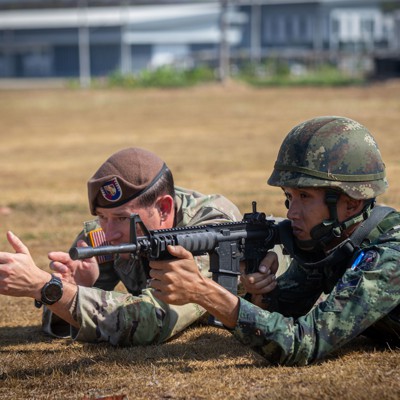
A member of the U.S. Army's 5th Security Force Assistance Brigade instructs a soldier with the 112th Royal Thai Army Striker Battalion on Jan. 15, 2023, in Ko Chan, Thailand. Spc. Aleksander Fomin / 5th Security Force Assistance Brigade
The service’s only remaining train-advise-assist unit is working to counter Chinese influence in the Indo-Pacific theater.
Security Cooperation
A year ago, after months of fighting spurred by a century-old border dispute, Thailand and Cambodia struck a peace deal in Malaysia, with help from a small U.S. Army unit that had long been training both Thai and Malaysian troops.
The peace talks were led by the Association of Southeast Asian Nations and the Malaysian Land Forces, which sought the advice of the 5th Security Force Assistance Brigade, the unit’s commander told Defense One.
“They asked our advisors, who were in the space of the land force headquarters, ‘Hey, what should we be thinking about? How can we effectively do this?,” said Col. Daniel Hodermarsky. “And we were reporting back to [U.S. Army Pacific] and leveraging experts from the higher headquarters to provide that advice to more rapidly enable them to to take the lead.”
At the same time, 5th SFAB had a team on the ground in Thailand.
“We didn't have anyone near the front or in the conflict, but we were able to say, "Hey, here's what we're seeing with the country team in Thailand,” Hodermarsky said.
But 5th SFAB—the Army’s only remaining train-advise-assist unit—didn’t just happen to be in the right place at the right time. The specialized unit, made up of experienced conventional troops who have already led a squad or platoon, and so on, has been regularly deploying to INDOPACOM to work with partner militaries since 2020.
“So we're able to give a bit more granular, real-time reporting back to the theater, and we're tied in directly with each country team, security cooperation office and defense attaché wherever we have adviser teams,” Hodermarsky said. “So we can get those liaise cells, those assessment cells, and say, ‘Hey, here's what we're granularly seeing, hearing. Here's what the partner is asking, or here's what they're talking about.”
The Army developed the SFAB concept in 2017 , when training and advising the Afghan army had no end in sight and the service was anticipating expanding that mission beyond U.S. Central Command. The idea was that rather than rotating conventional infantry and other units as advisers, the service would cultivate specialized units for the mission. The 1st SFAB deployed in Afghanistan in 2018 .
By May 2020, six SFABs had been established, each aligned to a different part of the world. They were staffed by volunteers coming off operational assignments, now experienced and theoretically qualified to train a partner unit.
Last year, Defense Secretary Pete Hegseth ordered most of the SFABs to be dissolved. The units assigned to European and Africa Commands have been shuttered, and their CENTCOM and National Guard counterparts will be gone by year’s end. 1st SFAB was reorganized as Army Security Cooperation Group-South in January.
That leaves only Hodermarsky’s 5th, doing its part to keep the United States in the good graces of INDOPACOM countries that might otherwise align themselves with China’s growing military power.
Some have argued that the moves are shortsighted.
“If the U.S. military continues marginalizing the advising mission or ignoring it altogether, then it means going back to the failed train-and-pray model,” argued a 2025 piece published by West Point’s Modern War Institute . “Fully staffed SFABs are not a luxury; they’re a necessity. Without them, the United States risks being flat-footed in the next war.”
ASCG-S and 5th SFAB’s continued existence are an acknowledgement that the train-advise-assist mission is still important for the DOD’s top two priority regions .
5th’s farflung efforts
In INDOPACOM, 5th SFAB has been shaping militaries from Mongolia to the Philippines, embedding in their professional military academies as well as advising their senior leadership.
“We were in the Philippine Army headquarters and their [Training and Doctrine Command] equivalent for years, as they transitioned from a counterinsurgency focus across the Philippines, to a national-defense focus for their land forces” Hodermarsky said.
His unit’s relationships have also laid the groundwork for major exercises the Army now does in INDOPACOM , including Balikatan and Cobra Gold .
“A persistent advisor team can stay in between the planning conferences and come up with the training plan, if we identify the partner unit that's going to exercise with the 25th Infantry Division or the the 7th Infantry Division,” Hodermarsky said. “And say, what are the training objectives for that Royal Thai Army unit or Philippine Army unit or Malaysian Land Force element? And then help them through that training progression.”
He said some division leaders call the SFAB the WD-40 of U.S. Army Pacific, because their teams ease friction between partner nations and conventional units visiting for exercises.
“We see sort of a reverse slope of advisor presence, as we hopefully work our way out of jobs in certain countries, so that you go from a partner force requesting more hands-on training and capability development through security force assistance, to where they're now really exercising as a flank unit or an integrated part of a U.S. division or brigade that is more capable, more trusted to be on our flank, or integrated into one of our major formations,” Hodermarsky said.
Help us report on the future of national security. Contact Meghann Myers: mmyers@defenseone.com, meghannmyers.55 on Signal.
NEXT STORY: Policy proposal would require firms to disclose how they use AI to develop new models
2023年1月15日,在泰国阁占岛,美国陆军第5安全部队援助旅的一名士兵正在指导泰国皇家陆军第112突击营的一名士兵。照片由美国陆军第5安全部队援助旅的亚历山大·福明下士拍摄。
该部门仅存的训练、咨询和协助单位正在努力对抗中国在印太地区的影响力。
安全合作
一年前,在经历了数月由百年边界争端引发的战斗后,泰国和柬埔寨在马来西亚达成和平协议,而长期以来一直训练泰国和马来西亚军队的一支美国陆军小部队也为此提供了帮助。
据《防务一号》报道,和平谈判由东南亚国家联盟和马来西亚陆军牵头,并征求了第五安全部队援助旅的意见。该旅指挥官表示。
“他们向我们陆军司令部的顾问们询问:‘我们应该考虑些什么?如何才能有效地完成这项工作?’”丹尼尔·霍德马斯基上校说。“我们向(美国陆军太平洋司令部)汇报情况,并利用上级司令部的专家提供建议,以便他们能够更快地发挥领导作用。”
与此同时,第5特种部队顾问旅在泰国派出了一支队伍。
“我们没有人在前线或冲突地区,但我们能够说,‘嘿,这是我们在泰国看到的国家队的情况,’”霍德马斯基说。
但陆军仅存的训练-指导-援助部队——第5特种部队顾问旅(5th SFAB)——并非只是恰好出现在正确的时间和地点。这支由经验丰富的常规部队士兵组成的特种部队,这些士兵都曾担任过班或排的指挥官,自2020年以来,一直定期部署到印太司令部,与伙伴国家的军队合作。
霍德马斯基说:“因此,我们能够向战区提供更细致、更实时的报告,并且与每个国家团队、安全合作办公室以及我们设有顾问团队的国防武官直接联系。这样,我们就可以联系到这些联络小组和评估小组,告诉他们:‘嘿,这是我们细致地看到和听到的情况。这是合作伙伴提出的问题,或者这是他们正在讨论的内容。’”
美国陆军于2017年提出了特种部队顾问旅(SFAB)的概念。当时,对阿富汗军队的训练和指导工作看不到尽头,而且陆军预计这项任务将扩展到美国中央司令部以外的地区。其理念是,与其轮换派遣常规步兵和其他部队担任顾问,不如为执行这项任务而组建专门的部队。第一特种部队顾问旅于2018年部署到阿富汗。
截至2020年5月,已成立了六个特种部队援助旅(SFAB),每个援助旅都负责世界不同地区的事务。这些援助旅的人员由结束作战任务的志愿者组成,他们现在经验丰富,并且在理论上有资格训练伙伴部队。
去年,国防部长皮特·赫格塞斯下令解散大部分特种部队顾问旅(SFAB)。隶属于欧洲司令部和非洲司令部的部队已经关闭,而隶属于中央司令部和国民警卫队的部队也将在年底前全部撤离。第一特种部队顾问旅已于今年1月重组为陆军安全合作组南方司令部。
这样就只剩下霍德马斯基的第五修正案了,它有助于让美国继续与印太司令部成员国保持良好关系,否则这些国家可能会与中国日益增长的军事力量结盟。
有人认为这些举措目光短浅。
西点军校现代战争研究所2025年发表的一篇文章指出:“如果美军继续边缘化或完全忽视顾问任务,那就意味着重蹈覆辙,回到失败的‘训练与祈祷’模式。人员配备齐全的特种部队顾问团并非奢侈品,而是必需品。没有它们,美国在下一场战争中将面临措手不及的风险。”
ASCG-S 和第 5 SFAB 的继续存在表明,训练、指导和援助任务对于国防部最重要的两个优先区域仍然非常重要。
第五的广泛努力
在印太司令部,第5特种部队顾问旅一直在塑造从蒙古到菲律宾的各国军队,不仅深入到他们的专业军事院校,还为他们的高级领导层提供建议。
霍德马斯基说:“多年来,我们一直在菲律宾陆军总部及其(训练与条令司令部)的同等机构工作,见证了他们从在菲律宾全国范围内开展反叛乱行动,转变为以国防为重点的陆军工作。”
他所在部队的关系也为陆军目前在印太司令部进行的重大演习奠定了基础,包括“肩并肩”和“金色眼镜蛇”演习。
霍德马斯基说:“如果我们确定了将与第25步兵师或第7步兵师进行联合演习的伙伴部队,那么一支持续的顾问团队就可以在计划会议的间隙制定训练计划。然后,我们可以确定泰国皇家陆军部队、菲律宾陆军部队或马来西亚陆军部队的训练目标是什么?并帮助他们完成这些训练步骤。”
他说,一些师级指挥官称特种部队援助旅为美国太平洋陆军的 WD-40(一种防腐剂),因为他们的团队可以缓解伙伴国家与前来参加演习的常规部队之间的摩擦。
霍德马斯基说:“我们看到顾问的存在呈现出一种反向趋势,我们希望能够逐步退出某些国家的职务,这样一来,伙伴部队就会从要求通过安全部队援助进行更多实践培训和能力发展,转变为他们现在真正作为侧翼部队或美国师或旅的组成部分进行演练,这些部队更有能力、更值得信赖地部署在我们的侧翼,或融入我们的主要部队之一。”
请协助我们报道国家安全的未来发展趋势。请联系梅根·迈尔斯:邮箱 mmyers@defenseone.com,或通过 Signal 联系 meghannmyers.55。
下一篇报道:政策提案将要求企业披露其如何使用人工智能开发新模型