DIA: China has tripled its satellite fleet since 2018 as expansion continuesDIA:自2018年以来,中国的卫星数量增加了两倍,扩张仍在继续。
The Defense Intelligence Agency's third iteration of its unclassified report on space threats also includes a never-before released image of China's
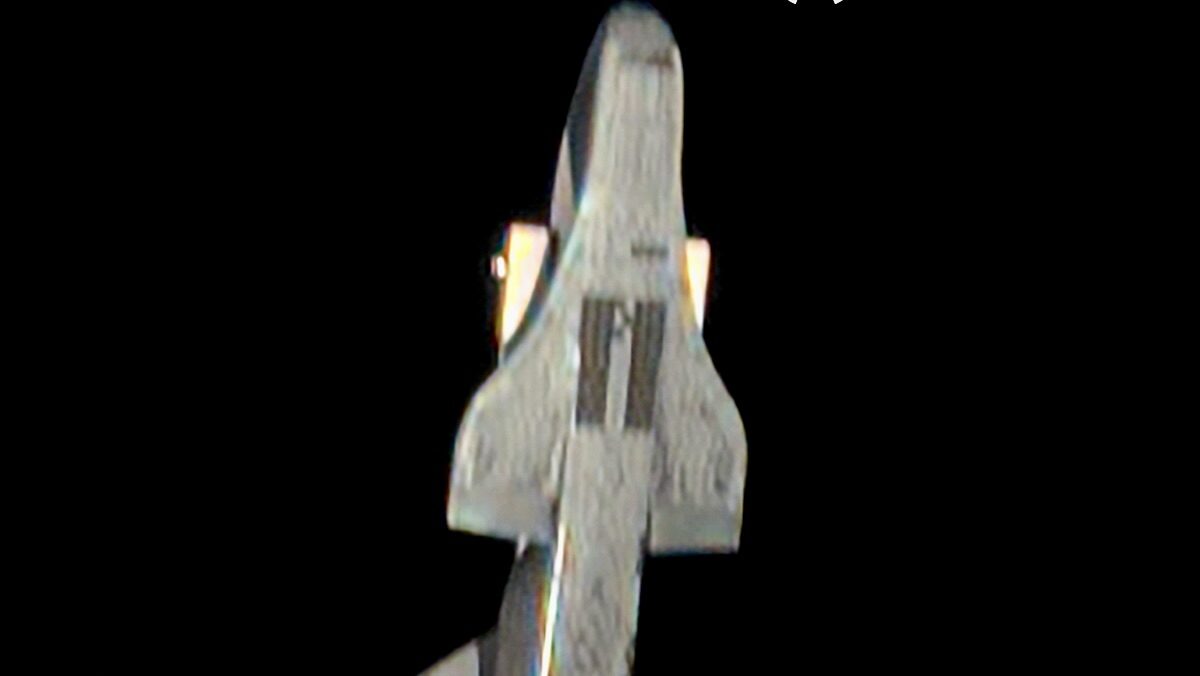
China's Test Spacecraft 3 spaceplane, taken May 28, 2024 by Vantor's WorldView-3 satellite (Image credit: Vantor)
WASHINGTON — A new report by the Defense Intelligence Agency (DIA) finds that China has tripled its fleet of intelligence, surveillance and reconnaissance (ISR) satellites since 2018 and continues to expand capabilities to detect, track and target US and allied forces on the ground and at sea.
“China employs a robust space-based ISR capability designed to enhance its worldwide situational awareness and enable long-range strikes,” including electro-optical (EO) and synthetic aperture radar (SAR) imagery satellites and others that provide electronic and signals intelligence data, according to the DIA’s 2026 Challenges to Space Security report, released Monday.
The report says China’s ISR satellite network can help the PLA monitor and target US and allied forces worldwide, particularly across the Indo-Pacific — including the Korean Peninsula, Taiwan, the Philippines, the Indian Ocean and the South China Sea.
The DIA report echoes concerns from US Space Force and Space Command about the PLA’s growing ability to build “kill chains” to target US joint forces abroad and at home.
Clayton Swope, deputy director of the Center for Strategic and International Studies’ Aerospace Security Project, said China is investing heavily in space-based sensors to monitor Earth and identify, track and target objects in the Indo-Pacific.
“A concern on the minds of US and allied decision makers should be how PLA sensor webs could erode US advantages derived from stealth in the air and undersea domains. Will we be able to operate undetected in the air and undersea domains in the future?” he told Breaking Defense.
Echoing a July 2026 Space Force fact sheet on space threats, the DIA report states that China had more than 510 ISR satellites in orbit as of July. Unlike the Space Force document, however, the DIA report acknowledges that its count includes satellites owned by both the People’s Republic of China and Chinese commercial firms.
Winning the information war is as much about ideas and perception as it is about data
"Being able to tell the commander you don't need to do something is actually a pretty powerful message, as well."
“While many of these ISR satellites are ostensibly affiliated with commercial and civil missions, the dual-use nature of their capabilities and possibly the Chinese military-civil fusion policies means the data or imagery they collect can be used by the PLA,” the report says.
The DIA also says Chinese commercial firms are supplying imagery “to state actors banned by Western providers for supporting weapons proliferation.”
China’s ISR fleet continues to expand and improve technologically, the DIA report stresses, particularly through Beijing’s growing constellation of satellites in low Earth orbit.
However, American Enterprise Institute’s (AEI) Senior Fellow Todd Harrison said the DIA’s data is unclear about which satellites are included in its count and also lacks important context.
He told Breaking Defense that China’s operational surveillance and weather satellite fleet has grown from 141 in 2018 to 541 today, while its surveillance-only fleet has increased from 124 to 453. “What those numbers don’t tell you is that the slope of the curve has leveled off in recent years — the number of satellites is not increasing as fast,” Harrison said.
Meanwhile, the US has 643 operational surveillance and weather satellites — up from 298 in 2018 — and is expanding its ISR fleet faster than China, he said.
The following chart, created for Breaking Defense from AEI’s Space Data Navigator , shows that trend.
The DIA report is the third in a series of unclassified reports examining US concerns about adversary advancements in military space, with the first version published in 2019.
The new report covers space threats emanating from China, Russia and “emerging” space powers.
It also looks at developments expected to exacerbate future challenges to US interests in space. Among those listed in the 2026 report: reusable space systems, such as rockets and spaceplanes; increasing use of artificial intelligence; orbital congestion; the collision risk posed by the many non-maneuverable spacecraft that will remain on orbit long after becoming inoperable; and the growing interest in satellites stationed in very low Earth orbit.
Intriguingly, the report includes what appears to be the first public image of China’s reusable spaceplane , most recently launched in February . The spaceplane is widely believed to be modeled after the US X-37B. Victoria Samson, chief director of space security and stability at the Secure World Foundation, said the image appears to support that assessment.
“It looks a lot like the X-37B!” she told Breaking Defense.
The DIA concludes by predicting that space will become increasingly congested and competitive as capabilities advance and more countries expand their presence in the domain.
“The increase of Chinese, Russian, Iranian, and North Korean counterspace capabilities, rapid growth in the number of space objects, and the proliferation of requirements for space-enabled services will all complicate operations in space in the coming decade,” the report adds.
Breaking Defense Video
A more flexible way to defend maneuver forces from drones that doesn’t tie them down [Sponsored]
What’s haunting the Pentagon this Halloween?
The new must-have capabilities for drones [Sponsored]
Army’s tech chief talks autonomy, acquisition and the future of drones
Drones take over AUSA, plus the Army’s plan to bring in new vendors
Hegseth talks autonomy at AUSA, a key show focus
Army doubles down on autonomy, stakes out Indo-Pacific role: AUSA Day 2
Telle talks ‘manufacturing rodeo,’ supply chain ‘weak links’: AUSA Day 1
New leaders, new drone command: What we expect from AUSA 2026
Unpacking Boeing’s F/A-XX win, plus a report from wartime Ukraine
中国试验飞船3号空天飞机,由Vantor公司的WorldView-3卫星于2024年5月28日拍摄(图片来源:Vantor公司)
华盛顿——美国国防情报局 (DIA) 的一份新报告发现,自 2018 年以来,中国的情报、监视和侦察 (ISR) 卫星数量增加了两倍,并且不断扩大其探测、跟踪和打击美国及其盟军在陆地和海上力量的能力。
根据美国国防情报局周一发布的《2026 年太空安全挑战》报告,“中国拥有强大的天基情报、监视和侦察 (ISR) 能力,旨在增强其全球态势感知能力并实现远程打击”,其中包括光电 (EO) 和合成孔径雷达 (SAR) 成像卫星以及其他提供电子和信号情报数据的卫星。
报告称,中国的 ISR 卫星网络可以帮助解放军监控和打击全球范围内的美国及其盟军,尤其是在印太地区——包括朝鲜半岛、台湾、菲律宾、印度洋和南海。
美国国防情报局的报告与美国太空部队和太空司令部的担忧相呼应,即解放军越来越有能力建立“杀伤链”,以打击美国在海外和国内的联合部队。
战略与国际研究中心航空航天安全项目副主任克莱顿·斯沃普表示,中国正在大力投资天基传感器,以监测地球并识别、跟踪和瞄准印太地区的物体。
“美国及其盟国决策者应该关注的是,解放军的传感器网络可能会如何削弱美国在空中和水下领域的隐身优势。未来我们还能继续在空中和水下不被发现地行动吗?”他告诉《防务新闻》。
与美国太空部队2026年7月发布的关于太空威胁的情况说明书相呼应,国防情报局的报告指出,截至7月,中国在轨运行的情报、监视和侦察(ISR)卫星超过510颗。然而,与太空部队的文件不同的是,国防情报局的报告承认,其统计数据包括中华人民共和国和中国商业公司拥有的卫星。
赢得信息战,关键不仅在于数据,更在于理念和认知。
“能够告诉指挥官你不需要做某件事,实际上也是一个非常有力的信息。”
报告称:“虽然这些ISR卫星中的许多表面上与商业和民用任务有关,但它们能力的双重用途性质以及中国军民融合政策可能意味着,它们收集的数据或图像可以被解放军使用。”
美国国防情报局还表示,中国商业公司正在向“被西方供应商禁止向其提供图像的国家行为体提供图像,这些行为体被指控支持武器扩散”。
美国国防情报局的报告强调,中国的情报、监视和侦察(ISR)力量正在不断扩大,技术也在不断进步,特别是通过北京在低地球轨道上不断增长的卫星星座。
然而,美国企业研究所 (AEI) 高级研究员托德·哈里森表示,国防情报局的数据不清楚统计中包含哪些卫星,而且缺乏重要的背景信息。
他告诉《防务新闻》,中国的运行监视和气象卫星数量已从2018年的141颗增加到目前的541颗,而其仅用于监视的卫星数量也从124颗增加到453颗。“这些数字没有告诉你的是,近年来卫星数量的增长速度已经放缓,”哈里森说。
与此同时,美国拥有 643 颗运行中的监视和气象卫星(2018 年为 298 颗),并且其 ISR 卫星群的扩张速度比中国更快,他说道。
以下图表由 AEI 的太空数据导航器为 Breaking Defense 创建,显示了这一趋势。
这份国防情报局报告是针对美国对敌方在军事太空领域取得进展的担忧而发布的一系列非机密报告中的第三份,第一份报告于 2019 年发布。
这份新报告涵盖了来自中国、俄罗斯和“新兴”太空强国的太空威胁。
报告还探讨了预计将加剧美国未来太空利益所面临挑战的发展趋势。2026 年报告列出的挑战包括:可重复使用的航天系统,例如火箭和空天飞机;人工智能的日益普及;轨道拥堵;许多非机动航天器在失效后仍长期滞留在轨道上所带来的碰撞风险;以及人们对超近地轨道卫星日益增长的兴趣。
引人注目的是,这份报告包含了一张中国可重复使用空天飞机的首张公开照片,该飞机最近一次发射是在2月份。外界普遍认为,这架空天飞机是以美国的X-37B为原型设计的。安全世界基金会空间安全与稳定首席主任维多利亚·萨姆森表示,这张照片似乎印证了这一判断。
“它看起来很像X-37B!”她告诉《防务新闻》网站。
美国国防情报局最后预测,随着能力的进步和更多国家扩大在该领域的存在,太空将变得越来越拥挤和竞争激烈。
报告还指出:“中国、俄罗斯、伊朗和朝鲜反太空能力的增强,太空物体数量的快速增长,以及对太空服务需求的激增,都将使未来十年太空行动变得更加复杂。”
突破性防御视频
一种更灵活的防御机动部队免受无人机攻击的方式,不会限制其行动[赞助]
今年万圣节,五角大楼究竟闹鬼?
无人机必备的新功能 [赞助内容]
陆军技术主管谈无人机的自主性、采购和未来
无人机主导了美国陆军协会(AUSA)的会议,此外,陆军还计划引入新的供应商。
Hegseth 在 AUSA 大会上谈到了自主性,这是本次大会的一个重点议题。
陆军加倍强调自主性,明确印太地区角色:AUSA第二天
特勒谈“制造业乱象”、供应链“薄弱环节”:AUSA 第一天
新领导人,新无人机指挥部:我们对 AUSA 2026 的期待
深入剖析波音F/A-XX的中标,以及来自战时乌克兰的报道