U.S. Intel Confirms This Is China’s Secret Spaceplane美国情报部门证实这是中国的秘密太空飞机
The Chinese spaceplane design is unsurprisingly very similar to the U.S. Space Force's history-making X-37B.
新闻视频
By Joseph Trevithick
Published Oct 27, 2026 5:33 PM EDT
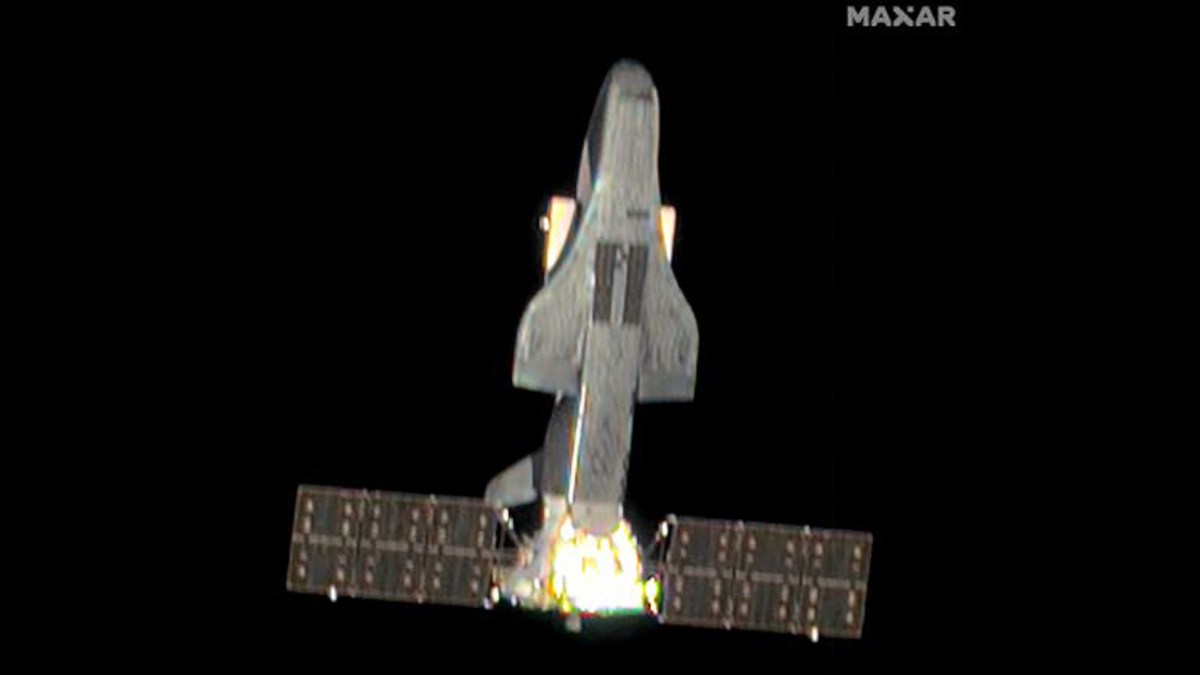
Maxar (Now Vantor) via DIA
The U.S. Defense Intelligence Agency (DIA) has confirmed that an image that has been circulating online for years does indeed show an experimental Chinese reusable spaceplane in orbit. A newly released higher-resolution copy of the image underscores that the design is nearly a dead ringer for the X-37B miniature space shuttles now operated by the U.S. Space Force .
DIA included the higher-resolution image of the Chinese spaceplane in a new unclassified report on global security challenges outside of the Earth’s atmosphere, which was released yesterday . A satellite belonging to Maxar Technologies (now Vantor) captured the image, but when exactly remains unclear. It does have a 2024 copyright date.
The image shows a miniature space shuttle-like design with small wings and twin vertical tails. It also has upward-opening doors above a central payload bay. There is also an extension at the tail end with solar panels seen deployed on either side. There are what look to be side-by-side ventral bays, which are likely for the main gear in a tricycle landing gear configuration. Overall, the core design is extremely similar to that of the U.S. X-37B , which also features tricycle landing gear and can also be fitted with an extended payload module at the tail. One major difference is that the wings on the Chinese design have a much longer chord compared to the X-37B.
A side-by-side comparison of the on-orbit shot of the experimental Chinese reusable spaceplane (at left) and a U.S. X-37B fitted with an extended payload module being prepared for launch (at right). Maxar (now Vantor) via DIA/US Space Force
Another look at an X-37B, seen here sitting on its tricycle landing gear after returning from a mission in space. USAF The X-37B used on the OTV-6 mission on the flight line at the Kennedy Space Center after its return to Earth on November 12, 2022. USAF
“A key capability for reusable space activities are spaceplanes like this PRC [People’s Republic of China] Spaceplane captured by Maxar. Spaceplanes can launch into orbit to place objects in space or even test them and return to earth [sic],” reads the caption to the picture in DIA’s report.
As noted, the basic fact of the existence of this image is not new. U.S. Space Force Col. John Patrick, then head of U.S. Space Forces-Korea (SPACEFOR-KOR), included a much lower-resolution version in a presentation at the Open Space Forum in South Korea in 2024. It was also not immediately clear at that time whether or not the picture simply showed an X-37B. TWZ had reached out at the time to the U.S. Space Force and Maxar for more information, and both had declined to comment. Two X-37Bs were built, and they have sent on eight orbital missions, in total, since 2010. The Orbital Test Vehicle 8 (OTV-8) mission was launched on August 22, 2025.
X-37B in orbit photographed by ground-based telescopes? pic.twitter.com/YPj8I4cQmZ — 笑脸男人 (@lfx160219) November 8, 2024
X-37B in orbit photographed by ground-based telescopes? pic.twitter.com/YPj8I4cQmZ
China is understood to have conducted four separate orbital spaceplane missions using the same experimental vehicle since 2020. Three of those missions had concluded before Col. Patrick gave his presentation. The most recent launch occurred on February 7 of this year, and the vehicle has not yet returned, at least as far as we are aware.
On the third mission, which lasted from December 14, 2023, to September 6, 2024, the Chinese spaceplane was observed releasing multiple smaller objects into orbit. What those payloads may have been remains unknown, but they could have been released from the main payload bay, which is seen open in the on-orbit image. The bay could have opened without any subsequent release of objects on either of the two prior missions, as well.
As an aside, the spaceplane appears to have released at least one more object earlier this year in the course of its latest mission.
A secretive airbase in the northwest end of China, sporting one of the longest runways in the world at 16,400 feet, looks to be where the spaceplane has landed after missions. The facility, which has been expanded massively in recent years , is now loosely akin to America’s top-secret proving ground at Area 51 , and has been the site of other advanced aviation test efforts .
DIA’s report also says that “China has two primary spaceplane models: the Shenlong and Tengyun,” but does not specify which one is seen in the image. The name Shenlong has been commonly used to refer to the spaceplane China has been experimenting with to date. Images said to show a prototype or test article of this design slung underneath an H-6 bomber for testing purposes had emerged in 2007.
Images that emerged in 2007 of a reusable spaceplane prototype, or a related test article, referred to as Shenlong, underneath an H-6 bomber. Chinese internet
The state-run China Aerospace Science and Industry Corporation (CASIC) unveiled the Tengyun design in 2016 as part of a so-called two-stage-to-orbit system that uses a mothership aircraft flying within the atmosphere as part of the launch method rather than a traditional space launch rocket. As of 2020, CASIC was aiming for a live test of Tengyun in 2025 , but it is not immediately clear whether or not that occurred.
Images showing wind tunnel testing of a Chinese two-stage-to-orbit concept. Chinese internet
There have been other spaceplane developments in China in recent years. This includes designs from the China Aerospace Science and Technology Corporation (CASC) and Aviation Industry Corporation of China (AVIC) subsidiary Chengdu. The design from Chengdu is called Haolong and has been in development officially as an option for resupplying the country’s Tiangong space station .
👀 They seem not only got a model but also a full-scale prototype. HaoLong-1 cargo spaceplane https://t.co/VI1Yoh3sRj pic.twitter.com/Dthfd1gi1v — CNSPACE (@CNSpaceflight) November 11, 2024
👀 They seem not only got a model but also a full-scale prototype. HaoLong-1 cargo spaceplane https://t.co/VI1Yoh3sRj pic.twitter.com/Dthfd1gi1v
In general, “spaceplanes are … reusable and feature enhanced maneuverability, making them more suitable for certain missions than traditional satellites,” DIA’s report notes.
TWZ has highlighted in the past how reusable space shuttle-like vehicles offer ideal platforms for rapidly deploying small satellites and any other payloads into orbit. In this way, they can be critical assets for space-based experimentation, as well as operational activities. This could include intelligence gathering , and even on-orbit attacks , areas of clear interest to the Chinese government .
As we often mention in the context of the X-37B , spaceplanes also have distinct advantages when it comes to rendezvousing with and maneuvering very close to other objects in space. They can execute course changes and other maneuvers in ways that traditional satellites cannot. All of this only underscores their potential as weapon systems , as well as for gathering intelligence. The fact that a Maxar (now Vantor) satellite took an on-orbit picture – a service the company is known to offer – of a Chinese spaceplane further highlights the kind of cat-and-mouse games that are increasingly emerging in space. The general risks posed by these kinds of activities were recently thrust into the public eye by the unprecedentedly close shadowing of a commercial radar imaging satellite tied to Ukraine by another satellite belonging to Russia.
China has been making massive investments, in general, in new space-based intelligence and other capabilities in recent years. Chinese space developments have now also extended into reusable space launch rocket boosters . Space launch company LandSpace became the first in China to achieve a successful recovery of a reusable space launch rocket booster on land in August. That followed CASC’s successful recovery of a reusable space launch rocket booster at sea using a specially configured ship the month before.
In general, “access to space traditionally requires expendable spacecraft: single-use launch vehicles, satellites, and one-time use capsules designed to maximize performance. Reliance on expendable vehicles has made access to space expensive and exclusive,” DIA’s report explains. “Reusable technologies, while even more difficult and expensive to develop and build, stand to greatly reduce the cost of spaceflight by recovering, refurbishing, and reusing rocket stages, fairings, and capsules.”
Chinese spaceplanes, one of which we have not definitively gotten a view of in orbit, look set to become an increasingly important part of this growing ecosystem.
Contact the author: joe@twz.com
Comments couldn’t be loaded. Please refresh the page.
作者:约瑟夫·特雷维西克
发布于美国东部时间2026年10月27日下午5:33
Maxar(现为 Vantor)通过 DIA
美国国防情报局(DIA)已证实,一张在网上流传多年的图片确实显示的是一架正在轨道上运行的中国实验性可重复使用空天飞机。最新发布的高分辨率版本显示,该设计与美国太空军目前使用的X-37B微型航天飞机几乎完全相同。
美国国防情报局(DIA)在昨天发布的一份关于地球大气层外全球安全挑战的新型非机密报告中,收录了一张中国航天飞机的高分辨率图像。该图像由Maxar Technologies(现为Vantor)公司的一颗卫星拍摄,但具体拍摄时间尚不清楚。图像的版权日期为2024年。
图片展示了一款类似小型航天飞机的模型,它拥有小型机翼和双垂尾。中央有效载荷舱上方设有向上开启的舱门。尾部延伸部分两侧展开着太阳能电池板。机身下方并排有两个舱室,很可能是用于安装三点式起落架的主起落架。总体而言,其核心设计与美国X-37B极其相似,后者也采用三点式起落架,并且同样可以在尾部加装延伸的有效载荷模块。一个主要区别在于,中国这款模型的机翼弦长比X-37B长得多。
图中并排展示了中国实验性可重复使用空天飞机在轨拍摄的照片(左)和正在准备发射的美国X-37B(配备扩展有效载荷舱)的照片(右)。图片来源:Maxar(现为Vantor),经美国国防情报局/美国太空部队授权使用。
这是另一架X-37B,图中它正从太空任务返回地球后,以三点式起落架停放在地面上。美国空军。这架X-37B曾执行OTV-6任务,于2022年11月12日返回地球后,停放在肯尼迪航天中心的飞行线上。美国空军
“可重复使用航天活动的关键能力之一是像Maxar公司捕获的这架中国航天飞机这样的航天飞机。航天飞机可以发射到轨道上,将物体送入太空,甚至可以对其进行测试,然后返回地球,”国防情报局报告中的图片说明写道。
如前所述,这张图片的存在并非新事实。时任美国驻韩太空部队司令约翰·帕特里克上校曾在2024年韩国开放空间论坛上展示过一张分辨率低得多的版本。当时也尚不清楚这张图片是否仅仅展示了一架X-37B。TWZ当时曾联系美国太空部队和Maxar公司寻求更多信息,但双方均拒绝置评。X-37B共制造了两架,自2010年以来已执行了八次轨道飞行任务。轨道试验飞行器8号(OTV-8)任务于2025年8月22日发射。
地面望远镜拍摄到的 X-37B 在轨运行? pic.twitter.com/YPj8I4cQmZ — 笑脸男人 (@lfx160219) 2024 年 11 月 8 日
地面望远镜拍摄到轨道上的X-37B? pic.twitter.com/YPj8I4cQmZ
据了解,自2020年以来,中国已使用同一架试验型航天飞机进行了四次独立的轨道飞行任务。其中三次任务在帕特里克上校作报告之前就已经完成。最近一次发射是在今年2月7日,据我们所知,该航天飞机尚未返回地球。
在2023年12月14日至2024年9月6日进行的第三次任务中,观测到中国航天飞机向轨道释放了多个小型物体。这些有效载荷的具体内容尚不清楚,但它们可能从主有效载荷舱释放,在轨图像中可以看到该舱门处于打开状态。在前两次任务中,该舱门也可能打开过,但并未释放任何物体。
顺便一提,这架空天飞机似乎在今年早些时候执行的最新任务中至少释放了一个物体。
位于中国西北部的一座神秘空军基地,拥有世界上最长的跑道之一,长达16400英尺(约5000米),似乎是该航天飞机执行任务后的着陆点。近年来,该基地规模大幅扩建,如今与美国高度机密的51区试验场颇为相似,并曾进行过其他先进航空测试项目。
美国国防情报局的报告还指出,“中国主要有两种空天飞机型号:神龙和腾云”,但并未具体说明图片中显示的是哪一种。神龙这个名称通常用来指代中国迄今为止一直在试验的空天飞机。据称,2007年曾有图片显示,该设计的原型机或测试机被吊挂在轰-6轰炸机下方进行测试。
2007年曝光的图片显示,一架被称为“神龙”的可重复使用空天飞机原型机或相关测试机型,位于一架轰-6轰炸机下方。(中国互联网)
中国航天科工集团(CASIC)于2016年公布了“腾云”火箭的设计方案,该方案属于所谓的两级入轨系统,其发射方式并非使用传统的航天运载火箭,而是利用在大气层内飞行的母舰飞机进行发射。截至2020年,CASIC曾计划在2025年进行“腾云”火箭的实弹测试,但目前尚不清楚该目标是否已实现。
图片展示了中国两级入轨火箭概念的风洞试验。中国互联网
近年来,中国还有其他空天飞机研发项目。其中包括中国航天科技集团公司(CASC)和中国航空工业集团公司(AVIC)旗下子公司成都飞机工业集团公司(成都飞机工业集团)的设计方案。成都飞机工业集团的设计方案名为“昊龙”,官方宣称其研发目标是为中国天宫空间站提供补给。
👀 他们似乎不仅有了模型,还有全尺寸原型机。昊龙一号货运空天飞机 https://t.co/VI1Yoh3sRj pic.twitter.com/Dthfd1gi1v — 中国航天科技集团公司 (@CNSpaceflight) 2024年11月11日
👀 他们似乎不仅有了模型,还有全尺寸原型机。昊龙一号货运空天飞机 https://t.co/VI1Yoh3sRj pic.twitter.com/Dthfd1gi1v
DIA 的报告指出,总的来说,“空天飞机……可重复使用,并具有增强的机动性,因此比传统卫星更适合某些任务”。
TWZ此前曾强调,可重复使用的航天飞机式飞行器是快速将小型卫星和其他有效载荷送入轨道的理想平台。因此,它们可以成为天基实验和作战活动的关键资产。这些活动可能包括情报收集,甚至在轨攻击——而这些领域显然是中国政府关注的重点。
正如我们在讨论X-37B时经常提到的,空天飞机在与太空中的其他物体进行交会和近距离机动方面也具有显著优势。它们能够以传统卫星无法做到的方式执行航向改变和其他机动动作。所有这些都凸显了它们作为武器系统以及情报收集的潜力。Maxar(现更名为Vantor)卫星拍摄了中国空天飞机的在轨照片——该公司提供这项服务——这一事实进一步凸显了太空中日益频繁的猫鼠游戏。最近,俄罗斯卫星以前所未有的近距离跟踪一颗隶属于乌克兰的商业雷达成像卫星,将此类活动带来的风险推到了公众视野。
近年来,中国在太空情报和其他领域投入巨资。如今,中国的航天发展也延伸到了可重复使用航天运载火箭助推器领域。今年8月,蓝空航天成为中国首家成功在陆地上回收可重复使用航天运载火箭助推器的企业。此前一个月,中国航天科技集团公司(CASC)也利用一艘特制船舶在海上成功回收了一枚可重复使用航天运载火箭助推器。
总的来说,“传统上,进入太空需要使用一次性航天器:一次性运载火箭、卫星和一次性使用的太空舱,这些航天器的设计旨在最大限度地提高性能。对一次性航天器的依赖使得进入太空变得昂贵且具有排他性,”国防情报局的报告解释道。“可重复使用技术虽然开发和建造起来更加困难和昂贵,但通过回收、翻新和重复使用火箭级、整流罩和太空舱,有望大幅降低太空飞行的成本。”
中国的航天飞机,其中一架我们还没有确切地看到它在轨道上运行,看起来将成为这个不断发展的生态系统中越来越重要的组成部分。
联系作者:joe@twz.com
评论加载失败,请刷新页面。