New material to cope with algae, mould from condensation among innovations unveiled at tech showcase科技展示会上,多项创新成果亮相,其中包括用于应对冷凝水中藻类和霉菌滋生的新型材料。
HDB is looking for proposals to address challenges in construction productivity, ageing buildings and heat resilience. Read more at straitstimes.com.
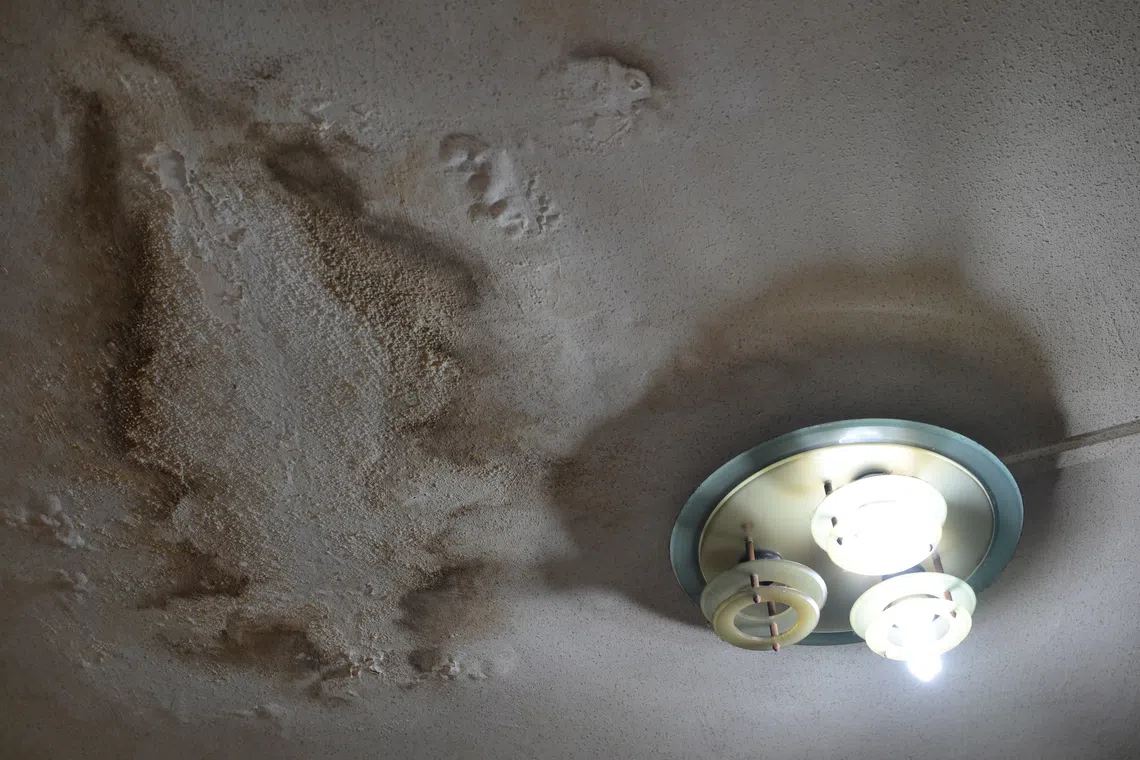
In 2025, HDB received 240 cases of feedback involving condensation and mould on ceilings and walls arising from use of air-conditioners by neighbours.
ST PHOTO: NG SOR LUAN
Published Oct 28, 2026, 06:30 PM
Updated Oct 28, 2026, 06:30 PM
SINGAPORE - An anti-condensation coating, which helps reduce algae and mould on indoor walls caused by built-up moisture from the neighbour’s air-conditioner, is undergoing trials in several Housing Board flats.
The coating is being used in HDB flats where algae and mould began growing on the walls due to a difference in temperature when the air-con is turned on in the neighbouring flat, said Leonard Lim, managing director at Envicom, the firm that developed the anti-condensation coating.
The coating is a type of plaster that is applied on the wall. It traps the cold inside the wall – similar to a cooler box – and prevents condensation from forming, Lim added.
The coating material was among 13 innovations showcased on Oct 28 at HDB and EnterpriseSG’s first Demo Day. It aims to address challenges in the built environment industry, such as construction productivity, ageing infrastructure and urban heat resilience.
Demo Day, held at the Singapore Week of Innovation and Technology (SWITCH) 2026 in the Sands Expo and Convention Centre, links enterprises with developers and building contractors to explore partnership and deployment opportunities.
Other solutions featured at Demo Day include a digital platform by QPBuddy that lets contractors, site supervisors and engineers coordinate construction activities remotely, and monitor on-site tests in real time.
A protective coating for HDB refuse chutes, developed by mining firm Imerys to reduce corrosion and deterioration of chute walls, was also showcased.
Minister of State for National Development Alvin Tan, in his speech at the event, said EnterpriseSG has committed $4 million to support the development of innovative solutions to improve the built environment under the HDB Cool Ideas Enterprise programme . That brings the programme’s funding to $9 million.
Minister of State for National Development Alvin Tan said EnterpriseSG has committed $4 million to support the development of innovative solutions to improve the built environment under the HDB Cool Ideas Enterprise programme. ST PHOTO: GAVIN FOO
Minister of State for National Development Alvin Tan said EnterpriseSG has committed $4 million to support the development of innovative solutions to improve the built environment under the HDB Cool Ideas Enterprise programme.
Tan added that HDB is looking for proposals to address challenges in construction productivity, ageing infrastructure and heat resilience. The solutions could be tried out in HDB housing projects.
One solution now rolled out in a pilot scheme in HDB flats is microwave scanning technology that can scan beneath concrete surfaces without hacking or drilling.
Developed by homegrown firm WaveScan, it can identify issues like concrete spalling, years before it becomes visible or dangerous.
Between 2024 and 2025, HDB carried out trials in more than 60 flats with water seepage issues, and also deployed the technology for complex water seepage cases, Tan said.
“This is a good example of how innovation can solve real problems for residents, improve how we maintain our ageing infrastructure, and create opportunities for our enterprises,” he added.
HDB will also open the Building Research, Innovation and Collaboration Lab on Oct 28. It is a co-working space at the HDB Centre of Building Research in Woodlands, where innovators have access to facilities and work alongside HDB’s engineers, researchers and industry partners
“This is important because it will help companies bring their solutions closer to actual deployment,” Tan said.
Johnny Wong, HDB deputy chief executive for building, said HDB is Singapore’s largest housing developer, and it is always exploring innovation that can improve construction productivity and better maintain ageing infrastructure.
He said: “By sharing our technical expertise and testing facilities with enterprises, we can help promising innovations move beyond the laboratory and accelerate their adoption in the real world and in public housing projects.”
Isabelle Liew is a journalist at The Straits Times. She covers housing issues in Singapore, with a focus on public housing.
Enterprise Singapore
2025年,建屋发展局收到240起反馈案例,涉及邻居使用空调导致天花板和墙壁出现冷凝水和霉菌。
圣徒照片:吴索銮
发布于2026年10月28日下午6:30
更新于2026年10月28日下午6:30
新加坡——一种防冷凝涂层正在多个组屋进行试验,该涂层有助于减少因邻居空调产生的湿气而在室内墙壁上滋生的藻类和霉菌。
Envicom 公司董事总经理 Leonard Lim 表示,这种防冷凝涂层正在组屋中使用,因为当隔壁组屋打开空调时,由于温度差异,藻类和霉菌开始在组屋墙壁上滋生。Envicom 正是这种防冷凝涂层的研发公司。
林补充说,这种涂层是一种涂在墙上的石膏。它能像冷藏箱一样将冷气锁在墙内,防止冷凝水的形成。
这种涂层材料是10月28日在建屋发展局和新加坡企业发展局联合举办的首届演示日上展出的13项创新技术之一。它旨在解决建筑环境行业面临的挑战,例如建筑生产力、基础设施老化和城市热岛效应应对能力。
Demo Day 将于 2026 年新加坡创新与科技周 (SWITCH) 在金沙会展中心举行,旨在连接企业与开发商和建筑承包商,以探索合作与部署机会。
Demo Day 上展示的其他解决方案包括 QPBuddy 的数字平台,该平台允许承包商、现场主管和工程师远程协调施工活动,并实时监控现场测试。
矿业公司伊梅里斯(Imerys)开发的一种用于组屋垃圾溜槽的保护涂层也进行了展示,该涂层可以减少溜槽壁的腐蚀和劣化。
国家发展部政务部长陈庆炎在活动致辞中表示,新加坡企业发展局(EnterpriseSG)已承诺投入400万新元,用于支持建屋发展局“酷创意企业计划”(Cool Ideas Enterprise programme)下旨在改善建筑环境的创新解决方案的开发。这使得该计划的总资金达到900万新元。
国家发展部政务部长陈庆炎表示,新加坡企业发展局(EnterpriseSG)已承诺投入400万新元,支持建屋发展局“酷创意企业计划”(Cool Ideas Enterprise programme)下的创新解决方案开发,以改善建筑环境。(海峡时报照片:Gavin Foo)
国家发展部政务部长陈庆炎表示,新加坡企业发展局(EnterpriseSG)已承诺投入 400 万美元,支持在建屋发展局“酷创意企业计划”(Cool Ideas Enterprise programme)下开发创新解决方案,以改善建筑环境。
陈先生补充说,建屋发展局正在征集应对建筑效率、基础设施老化和抗暑降温等挑战的方案。这些方案可以在建屋发展局的房屋项目中进行试点。
目前在组屋试点项目中推出的一种解决方案是微波扫描技术,该技术无需凿削或钻孔即可扫描混凝土表面下方。
该技术由本土公司 WaveScan 开发,可以识别混凝土剥落等问题,并在问题变得可见或危险之前数年就发现这些问题。
谭先生表示,在2024年至2025年间,建屋发展局在60多套存在渗水问题的组屋中进行了试验,并将该技术应用于复杂的渗水案例。
“这很好地说明了创新如何能够解决居民的实际问题,改善我们维护老化基础设施的方式,并为我们的企业创造机会,”他补充道。
建屋发展局将于10月28日启用建筑研究、创新与合作实验室。该实验室位于兀兰建屋发展局建筑研究中心内,是一个联合办公空间,创新者可以在这里使用各种设施,并与建屋发展局的工程师、研究人员和行业合作伙伴并肩工作。
“这很重要,因为它将帮助企业使其解决方案更接近实际部署,”谭说道。
建屋发展局副局长黄永明表示,建屋发展局是新加坡最大的房屋开发商,它一直在探索能够提高建筑效率和更好地维护老化基础设施的创新方法。
他表示:“通过与企业分享我们的技术专长和测试设施,我们可以帮助有前景的创新走出实验室,加速其在现实世界和公共住房项目中的应用。”
Isabelle Liew是《海峡时报》的记者,主要报道新加坡的住房问题,尤其关注公共住房。
新加坡企业发展局