With daily jamming of US forces on Korean Peninsula, industry needs resilient solutions: USFK commander鉴于美军在朝鲜半岛每天都在遭受干扰,工业界需要具有弹性的解决方案:驻韩美军司令
“If your capability requires pristine satellite communications, infinite bandwidth, and uninterrupted fiber optic backbone to function, it will not survive 48 hours on the peninsula,” Gen. Xavier Brunson, commander of US Forces Korea, said.
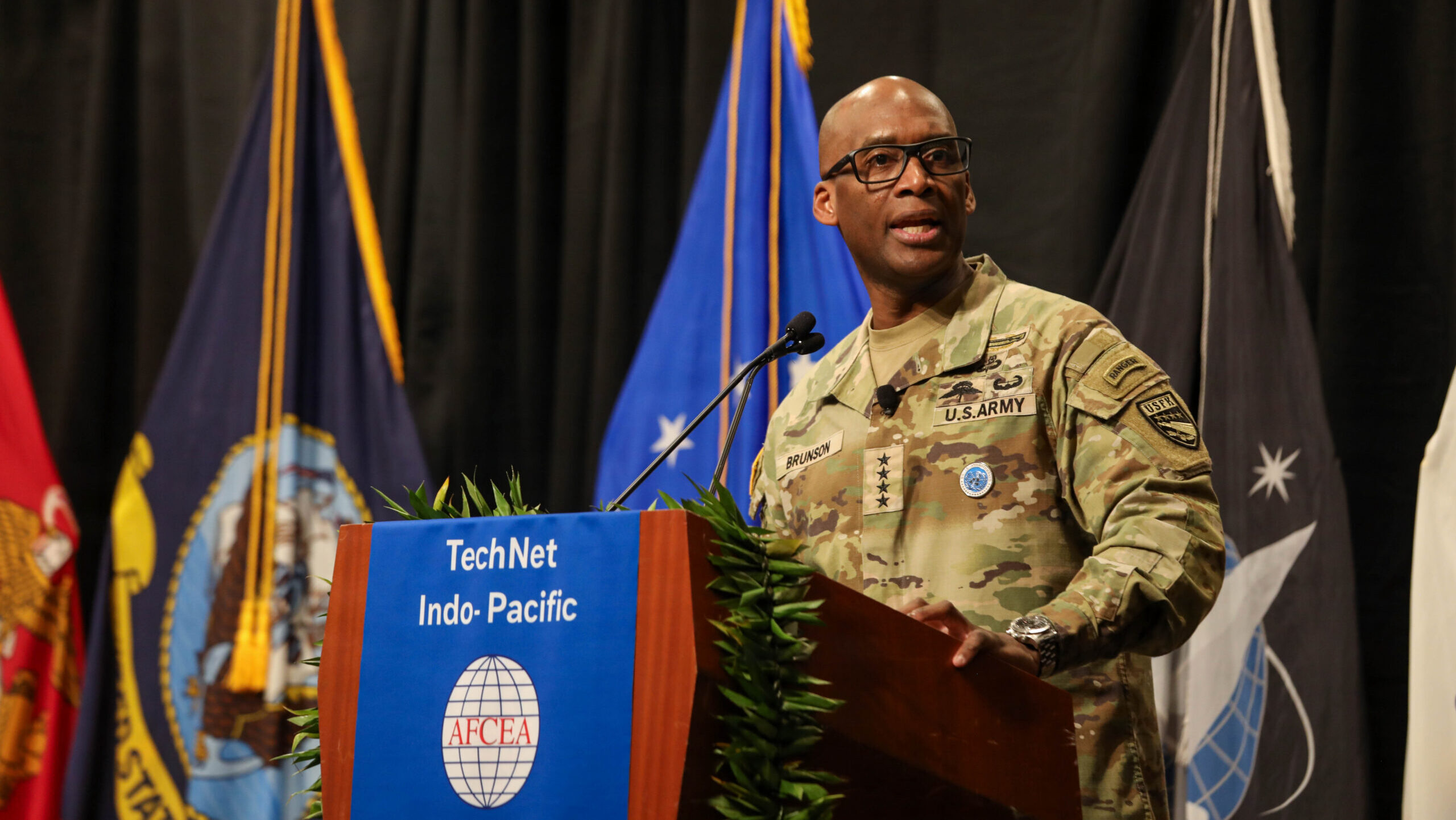
U.S. Army Gen. Xavier T. Brunson, commander of United Nations Command, Combined Forces Command, and United States Forces Korea, delivers a speech during the keynote session of TechNet Indo-Pacific 2026 at the Hilton Hawaiian Village, Honolulu, Hawaii, Oct. 27, 2026. (U.S. Army photo by Sgt. Daniela Lechuga Liggio)
WASHINGTON — Electronic systems used by US and allied forces are jammed daily on the Korean Peninsula, making it one of the most “violently contested electromagnetic environments on the planet,” according to a top US commander.
“Our adversaries practice electronic attack daily. They jam GPS in the West Sea. They attempt to blind our servers, our sensors, and our networks,” Gen. Xavier Brunson, commander of US Forces Korea, said Tuesday during a presentation at AFCEA TechNet Indo-Pacific in Hawaii.
While Brunson did not specifically name an adversary nation, he noted earlier in his remarks that “across the demilitarized zone” US forces face a “nuclear-armed adversary that constitutionally designates the Republic of Korea as its principal enemy” — a reference to North Korea. China is also known to have advanced electronic attack capabilities in the region.
To operate in this complicated environment, Brunson said forces must have resilient and redundant capabilities.
“If your capability requires pristine satellite communications, infinite bandwidth, and uninterrupted fiber optic backbone to function, it will not survive 48 hours on the peninsula,” Brunson said to the audience consisting largely of industry members.
He noted that USFK is fielding resilient high-frequency networks alongside proliferated low-Earth orbit satellite communications and terrestrial mesh networks to maintain command and control when primary comms links are disrupted.
Brunson implored the industrial base to visit the peninsula to see the dynamic environment first hand. But, for industry members making the trip, he said they need to bring lightweight, jam-resistant waveforms with low probability of intercept and low probability of detection. He also asked industry to produce Open Application Programming Interfaces and edge sensors that can integrate with joint mission networks without vendor lock-in.
Although officials have emphasized joint and coalition interoperability for years, Brunson noted that industry must start designing systems to work with partner nations from the start.
“We can no longer design exquisite systems for pure US enclaves and then try to bolt on partner interface after the contract is signed. We must design combined from the first line of code,” he said. “To get there, we have to change a fundamental security mindset.”
For over 30 years, the mindset was to build security around hardened pipes and perimeter defenses in closed networks with stringent classification, he said. When information needed to be shared with partner nations, that approach required building a new pipe.
“In a combined fight inside the weapons engagement zone, that model has failed. Hardened pipes isolate our formations. They create operational blindness,” he said. “We must shift from network-centric perimeters to data-centric security. Tag the payload and not the pipe.”
In practice, a Korean radar detecting an inbound missile would have its track verified, ingested and pushed to coalition fires network in milliseconds, Brunson said. He stressed that information must move in milliseconds — not seconds.
Turning Industry Into ‘Pickle Millionaires’
Brunson urged the audience of industry players to pay close attention to the Pentagon’s direction and strategic documents to find what the military needs and provide it, likening industry’s North Star to pickles.
Brunson said the company Vlasic became “pickle millionaires” by recognizing that consumers needed sliced pickles — not whole ones — for their burgers.
“If you continue on a course that says, ‘Hey, man, we only do one thing, we do pickles and brine, that’s us,’ then you would never get pickles on a burger,” he said. “Pickles are long. You don’t put a pickle spear on a burger. You put those little sliced pickles on there.”
In the same vein, he urged industry to adapt its offerings to meet military requirements rather than trying to force products that don’t fit.
“The instructive part of this is, industry’s got to do the same thing. What is your sliced pickle? And if it doesn’t fit with where someone’s going, you cannot try to force it in there,” he said. “If a service tells you who they are and what they’re going to do and you choose not to try to meet the requirements of how they’re going to fight, that’s going to be a problem.”
He pointed to the Army’s recently released “How the Army Fights,” a strategic document outlining its operational guidance as an example of how companies can align their products with the service’s needs.
Brunson warned that networks will be under attack in the future as forces operate in increasingly disaggregated and distributed ways, with plans potentially changing before forces even arrive in theater. Capabilities that cannot adapt to that requirement will struggle to support the Army’s approach to warfare, he added.
“If your product can’t operate on the edge, then it’s not a product that’s going to be able to help the Army fight the way the Army is going to fight, much less the joint force,” Brunson said.
Breaking Defense Video
How General Atomics views Europe’s unmanned future
A more flexible way to defend maneuver forces from drones that doesn’t tie them down [Sponsored]
What’s haunting the Pentagon this Halloween?
The new must-have capabilities for drones [Sponsored]
Army’s tech chief talks autonomy, acquisition and the future of drones
Drones take over AUSA, plus the Army’s plan to bring in new vendors
Hegseth talks autonomy at AUSA, a key show focus
Army doubles down on autonomy, stakes out Indo-Pacific role: AUSA Day 2
Telle talks ‘manufacturing rodeo,’ supply chain ‘weak links’: AUSA Day 1
New leaders, new drone command: What we expect from AUSA 2026
2026年10月27日,美国陆军上将泽维尔·T·布伦森(Xavier T. Brunson)在夏威夷檀香山希尔顿夏威夷度假村举行的2026年印太技术网络大会(TechNet Indo-Pacific 2026)主题演讲环节发表讲话。布伦森上将同时也是联合国军司令部、联合部队司令部和驻韩美军司令。(美国陆军照片,摄影:丹妮拉·莱楚加·利吉奥中士)
华盛顿——据一位美国高级指挥官称,美国及其盟军使用的电子系统每天都在朝鲜半岛遭到干扰,使其成为“地球上电磁环境竞争最激烈的地区之一”。
“我们的对手每天都在进行电子攻击演练。他们在西海干扰GPS。他们试图使我们的服务器、传感器和网络瘫痪,”驻韩美军司令泽维尔·布伦森将军周二在夏威夷举行的AFCEA TechNet Indo-Pacific会议上发表讲话时说。
虽然布伦森没有具体指明敌对国家,但他此前在讲话中提到,“在非军事区另一侧”,美军面临着一个“拥有核武器的对手,该对手在宪法中将韩国列为其主要敌人”——这里指的是朝鲜。众所周知,中国在该地区也拥有先进的电子战能力。
布伦森表示,要在这种复杂的环境中作战,部队必须具备弹性和冗余能力。
布伦森对主要由业内人士组成的听众说:“如果你的技术需要完美的卫星通信、无限的带宽和不间断的光纤骨干网才能运行,那么它在半岛上活不过 48 小时。”
他指出,驻韩美军正在部署具有弹性的高频网络,以及大量部署的低地球轨道卫星通信和地面网状网络,以便在主要通信链路中断时维持指挥和控制。
布伦森恳请工业界人士亲临半岛考察,实地感受当地充满活力的环境。但他同时指出,前来考察的工业界人士需要携带轻量级、抗干扰能力强、拦截和检测概率低的波形设备。他还呼吁工业界开发开放式应用程序编程接口(API)和边缘传感器,以便与联合任务网络集成,避免厂商锁定。
尽管官员们多年来一直强调联合和联盟互操作性,但布伦森指出,业界必须从一开始就设计能够与伙伴国家协同工作的系统。
“我们不能再为纯粹的美国飞地设计精良的系统,然后在合同签订后再试图添加合作伙伴的接口。我们必须从第一行代码开始就进行一体化设计,”他说道。“要做到这一点,我们必须改变一种根本性的安全思维。”
他表示,30多年来,安全理念一直是围绕着封闭网络中的加固管道和周界防御来构建安全体系,并采用严格的保密措施。当需要与伙伴国家共享信息时,这种方法就需要构建一条新的管道。
“在武器交战区内的联合作战中,这种模式已经失效。加固的管道会将我们的部队隔离开来,造成作战盲区,”他说道。“我们必须从以网络为中心的防御体系转向以数据为中心的安全体系。要标记的是有效载荷,而不是管道。”
布伦森说,实际上,韩国雷达探测到来袭导弹后,其轨迹会在几毫秒内得到验证、接收并推送至联军火力网络。他强调,信息传递必须以毫秒为单位,而不是秒。
将行业变成“泡菜百万富翁”
布伦森敦促在场的业内人士密切关注五角大楼的方向和战略文件,以了解军方需要什么并提供什么,并将行业的北极星比作腌黄瓜。
布伦森表示,Vlasic 公司之所以成为“泡菜百万富翁”,是因为他们意识到消费者在汉堡里需要的是切片泡菜,而不是整根泡菜。
“如果你坚持‘嘿,伙计,我们只做一件事,我们只做泡菜和腌菜,这就是我们’,那你永远也吃不到汉堡里的泡菜,”他说。“泡菜是长条状的。你不会把一整根泡菜放在汉堡里。你会放那种切成小片的泡菜。”
同样,他也敦促业界调整产品以满足军方需求,而不是强行推出不适用的产品。
“这件事的启示在于,行业也必须这样做。你的切好的腌黄瓜是什么?如果它不符合别人的发展方向,你就不能强行塞进去,”他说。“如果一家服务公司告诉你他们是谁,他们要做什么,而你却选择不去满足他们提出的要求,那就会出问题。”
他以陆军最近发布的战略文件《陆军如何作战》为例,该文件概述了陆军的作战指导方针,说明公司如何使其产品与陆军的需求保持一致。
布伦森警告说,随着部队作战方式日益分散化,网络未来将面临更多攻击,作战计划甚至可能在部队抵达战区之前就发生改变。他补充说,无法适应这种变化的能力将难以支持陆军的作战方式。
布伦森说:“如果你的产品不能在边缘环境下运行,那么它就无法帮助陆军以陆军将要的方式作战,更不用说联合部队了。”
突破性防御视频
通用原子公司如何看待欧洲的无人化未来
一种更灵活的防御机动部队免受无人机攻击的方式,不会限制其行动[赞助]
今年万圣节,五角大楼究竟闹鬼?
无人机必备的新功能 [赞助内容]
陆军技术主管谈无人机的自主性、采购和未来
无人机主导了美国陆军协会(AUSA)的会议,此外,陆军还计划引入新的供应商。
Hegseth 在 AUSA 大会上谈到了自主性,这是本次大会的一个重点议题。
陆军加倍强调自主性,明确印太地区角色:AUSA第二天
特勒谈“制造业乱象”、供应链“薄弱环节”:AUSA 第一天
新领导人,新无人机指挥部:我们对 AUSA 2026 的期待