Hardened Shelters Critical To Survival Of USAF’s Tanker Fleet: Study研究表明,加固掩体对美国空军加油机队的生存至关重要。
An independent assessment calls for new action to prevent critical aerial refueling assets from being neutralized before they even get in the air.
By Joseph Trevithick
Published Oct 28, 2026 1:28 PM EDT
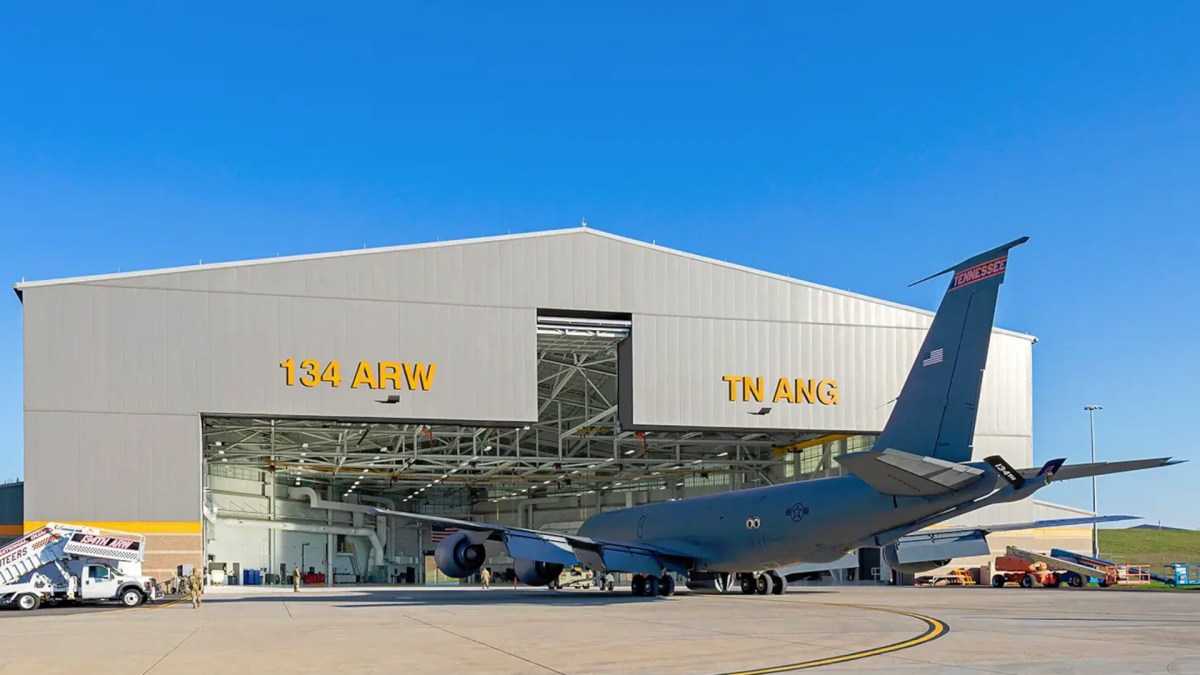
A new independent report argues that increased access to better-protected airfields is as important, if not more so, than buying advanced tanker aircraft when it comes to meeting future U.S. aerial refueling demands. The authors, in part, call for the U.S. military to invest in new hardened shelters that are large enough for tankers to fit inside. Top U.S. Air Force officials have continued to downplay any need for more physical hardening of bases, even now with the experiences from the war with Iran, which have only underscored the already glaring dangers posed to planes sitting out in the open on flightlines .
Hardened shelters and other efforts to “boost surface infrastructure resilience” form one of three main themes in a report the Hudson Institute think tank in Washington, D.C., published yesterday. It also says that the Air Force should work to “incorporate adaptive mission systems” into existing tanker fleets, including new communications and self-protection capabilities, as well as pursue acquisition of a next-generation tanker with a blended wing body (BWB) design. Hudson’s latest analysis, which is titled Resilient Reach: Redesigning Aerial Refueling for Contested Global Operations , builds on a previous report it published in 2021 . Last year, the Institute published an additional report warning more generally about the vulnerabilities created by a lack of hardened infrastructure at U.S. bases worldwide.
A rendering of one concept for a blended wing body tanker aircraft from JetZero. The Hudson Institute’s new report also includes a call for the US Air Force to acquire an aircraft in this general category. JetZero
“Aerial refueling is an unmatched United States military advantage, but it currently depends on vulnerable forward bases and medium-range tankers that could be neutralized,” Hudson’s report states as its number one finding. “Suppression of this critical capability could collapse US air operations and heavily contribute to US defeat in a war against the People’s Republic of China (PRC).”
Though not necessarily to the degree that the Hudson Institute is arguing for, the Air Force has been working in recent years to increase the networking architecture available on the KC-135 and KC-46 tankers it has now, as well as field new defensive systems . The service is also still exploring a wide range of next-generation aerial refueling concepts , including new stealthy and/or uncrewed tankers , under what is now called the Advanced Tanker Systems (ATS) program.
The US Air Force’s current tanker fleets are made up of KC-46s (one of which is seen here at left) and KC-135s (at right). USAF
Base resiliency and aerial refueling capacity
The base resiliency aspects of Hudson’s new aerial refueling report are a particular standout, especially as this is an area where the Air Force has been dragging its feet, if not actively pushing back .
“Aerial refueling surface infrastructure is the ‘network of airfields, maintenance facilities, and bulk fuel storage and distribution facilities and systems necessary to enable tanker operations,'” Hudson’s new report states, citing the Institute’s past work from 2021. “‘Enhancing the capacity and resilience of its surface architecture should be a top priority for the US Air Force – even if it comes at the cost of tanker procurement – because it will yield a greater increase in the number of employable tankers’ and receiver aircraft supported.”
A row of US Air Force KC-135 tankers. USAF
With this in mind, “the department [of the Air Force] should first pursue access to more airfields, including large commercial ones, and nurture its invaluable relationships with North Atlantic Treaty Organization (NATO) and other allies that provide access to tanker airfields,” per the report. “Second, it should improve bulk fuel storage and distribution by constructing lower-capacity hardened fuel stores rather than higher-capacity but vulnerable aboveground storage tanks, fielding airfield and over-the-shore fuel distribution systems, and securing access to more maritime tankers, including by levying higher working capital fund rates to fund bulk fuel resilience initiatives.”
On top of all this, “the Air Force will need to fund passive defenses (such as personnel and equipment bunkers, reconstitution equipment and units, redundant capabilities, the aforementioned fuel infrastructure hardening, more hardened large aircraft shelters, and tanker decoys) and active counter-command, control, communications, computing, cyber, intelligence, surveillance, reconnaissance, and targeting (C5ISRT) and air and missile defenses to defeat threats,” the report adds. “As witnessed at Prince Sultan Air Base, dispersion alone is insufficient to avoid attack in an era of persistent surveillance and precision targeting.”
Five Air Force KC-135 aerial refueling tankers were damaged on the ground in an Iranian attack on Prince Sultan Air Base in Saudi Arabia in March, just weeks after the start of hostilities with Iran. That same attack destroyed one of the service’s prized E-3 Sentry Airborne Warning and Control System (AWACS) radar planes. Lt. Gen. Linda Hurry, head of Air Force Materiel Command, confirmed just last week that repairs are still ongoing on some of the KC-135s that were damaged, reinforcing that attacks that do not outright destroy friendly aircraft on the ground can still have significant impacts.
A US Air Force KC-135 tanker, with patches covering damaged areas along its fuselage and tail, seen heading back to the United States earlier this year. Aviation photographer Andrew McKelvey
Iran was also reportedly able to damage F-15E Strike Eagles and A-10 Warthog ground attack jets on the ground at Muwaffaq Salti Air Base in Jordan during another more recent attack on the night of September 9-10.
“Historically, aerial refueling aircraft operated from sanctuary on the ground and in the air. However, as Iran’s attacks on Prince Sultan Air Base demonstrated, adversaries can target tankers on the ramp,” Hudson’s report notes. “The [Chinese] People’s Liberation Army’s (PLA) ability to attack airfields and aircraft at them dramatically exceeds the range, quality, and quantity of Iranian systems.”
By Hudson’s assessment, “in 2025 the PLA could already deliver thousands of PLA Air Force and PLA Rocket Force munitions per day against targets near its territory and around 400 munitions per day against targets in the Second Island Chain , the Middle East, and Central Asia. It could even strike Alaska and Western Europe with small numbers of weapons,” the report explains. “By 2035, the threat will be far more severe; the PLA may be capable of delivering even more munitions and striking targets throughout Europe, Africa, and the Americas. This assessment does not account for additional attacks by the PLA Navy, PLA special forces in Operation Spiderweb–style attacks, or other threats.”
A graphic representation of the Hudson Institute’s assessment of the PLA’s ability to ‘suppress’ airfield operations in a notional 2035 conflict scenario. Hudson Institute
Ukraine’s unprecedented Operation Spiderweb involved near-simultaneous near-field drone attacks on air bases across Russia, which resulted in the destruction of at least 10 Russian bombers, as well as a variety of other aircraft . All of those planes were notably parked on open flightlines.
This particular threat vector, among others, was further highlighted by the Air Force’s sudden and unexpected decision to withdraw B-1 bombers from RAF Fairford, an airbase in the United Kingdom, earlier this month. As TWZ noted at the time , it also put a spotlight on the U.S. military’s continued lack of investment in hardened aircraft shelters and other fortified air base infrastructure .
A satellite image showing B-1s parked in the open at RAF Fairford on July 29, 2026. PHOTO © 2026 PLANET LABS INC. ALL RIGHTS RESERVED. REPRINTED BY PERMISSION
To go back to the Pacific scenario, “given the PLA’s focus on systems destruction warfare and nodal analysis, tanker airfields would likely be prime targets. Tankers require bulk fuel stores, long runways, and ample ramp space,” Hudson assesses in its new report. “All of these resources would be easier to suppress and more difficult to reconstitute than operations for other assets, such as fighter aircraft or runway-independent Edge Force units. There are also currently few hardened large aircraft shelters suitable for tankers, which makes them vulnerable to observation and attack on the ramp.”
“Although large hardened aircraft shelters suitable for tankers can be expensive (ranging from $30–$150 million depending on scope and location), they can shield aircraft from observation and inclement weather, force adversaries to employ more numerous unitary weapons (rather than a small number of submunition-armed weapons) and protect tankers that cannot get airborne upon warning of an incoming attack,” Hudson’s report adds.
Hudson’s report recommends the construction of at least 60 large hardened aircraft shelters spread between an array of bases globally, at a total cost of $3.06 billion.
“The costing for this estimate assumes a conservative average Area Cost Factor of 1.87, a 10-year construction program, and 10 percent portfolio efficiencies from replicating similar projects at multiple sites, potentially using the same prime contractor or a set of contractors under a consortium,” per a footnote. “Large aircraft hardened aircraft shelters are assumed to be similar to the Andersen Air Force Base Air Expeditionary Force Forward Operating Location Aircraft Maintenance Hangar.”
A B-52 bomber sits partially inside Hangar 1 at Andersen Air Force Base on Guam. USAF
With this in mind, the report also notes that these same shelters could be used for other larger aircraft beyond tankers, like bombers. It’s also important to note that shelters with a lower, but still useful degree of hardening, or ones that are just meant to conceal what is inside, would be cheaper to construct. We will come back to this in a moment.
The base hardening debate
TWZ has highlighted all of these points and more in our prior reporting on the ongoing debate within the U.S. military about the value of constructing new hardened (and unhardened) aircraft shelters and other passive defenses . As we wrote after the withdrawal of the B-1s from Fairford:
“It is fair to point out that typical above-ground hardened aircraft shelters are not invulnerable, especially to attacks involving ballistic, cruise, and certain air-launched threats. There are also substantial cost and other factors to consider when it comes to any major military construction effort.”
“That being said, having more hardened infrastructure also imposes costs and complexities on opponents, who have to dedicate more advanced and costly munitions and other resources to ensure targets are neutralized. Shelters have the knock-on benefit of complicating the targeting process for an enemy by obscuring where aircraft are or are not positioned, to begin with. An opponent has to treat shelters like they are full even if they are empty.”
“When thinking about hardened aircraft shelters, stereotypical Cold War-era reinforced concrete structures typically come to mind. However, they do not all have to be built to a one-size-fits-all standard with the same degree of hardening across the board to be useful. Shorter-range drone attacks are typically carried out by platforms carrying small explosive charges or that are designed to drop small bomblets . Even longer-range one-way-attack drones generally have smaller warheads than traditional missiles, they also hit with less kinetic energy.”
A US Air Force F-16 fighter sits inside a traditional hardened aircraft shelter. USAF
“A structure that shields against smaller blasts and shrapnel, also including from cluster munitions that can be readily scattered across wide areas, is one that then has to be addressed by more capable weapons. This could even include mobile or otherwise temporary shelters that offer sufficient concealment and protection.”
This picture shows what the Air Force described as a “prototype portable camouflage, concealment, and deception hangar” in use during Exercise Hoodoo Sea in 2023. Air National Guard
“Eliminating, or at least substantially mitigating, the lowest rung of threats creates a dilemma for opponents, who then have to decide whether it is even worthwhile to attempt certain types of attacks. There is clear value in narrowing the available options for the enemy and pushing them toward having to expend higher-end, more expensive munitions, that are available in smaller quantities, and that traditional active defenses may be better optimized to handle. As an example, it may be more viable to shoot down a small barrage of incoming cruise missiles than a swarm of dozens of drones.”
This is a diverse threat ecosystem that extends globally, too. This was highlighted in August by an attempted drone attack on a Ukrainian An-124 at an airport in Germany , which authorities in that country subsequently blamed on Russia . This has been a growing point of concern in Europe more broadly in recent years , as well.
Drones, in particular, present increasing dangers to key U.S. military bases and critical infrastructure within the U.S. homeland, as well as in waters just off America’s coastlines . Serious incidents at Langley Air Force Base in Virginia in 2023 and Barksdale Air Force Base in Louisiana just earlier this year have reinforced that these threats are no longer limited to facilities and assets overseas.
No ‘silver bullets’ for safeguarding tankers
To be clear, hardening U.S. bases cannot address current or future threat ecosystems by itself, and needs to be part of a larger defensive architecture that incorporates a range of capabilities including surface-to-air missiles, electronic warfare systems, and directed energy weapons, as well as tactical jets in the air. Furthermore, to reiterate, the view of “surface infrastructure resilience” outlined in Hudson’s report extends beyond defensive measures entirely, and does not discount the value of distributed and dispersed operations within the larger context. When it comes to aerial refueling, more broadly, the authors do also still argue for the continued upgrading of the Air Force’s existing tankers, as well as the acquisition of next-generation aircraft.
A full breakdown of the actions to “boost surface infrastructure resilience” called for in the Hudson Institute’s latest aerial refueling report, as well as their estimated costs. Hudson Institute
At the same time, as mentioned, physical hardening is the area where the Air Force continues to push back.
“I think that I don’t want to spend a lot of money on hardening shelters. Unless you’re going to send something 100 feet or more underground, we can blow it up, and so can they,” Chief of Staff of the Air Force Gen. Kenneth Wilsbach said in an interview with Breaking Defense in July. “So, the economics of building a shelter that is impervious to a strike doesn’t work.”
“I think the economics favor defending your airspace, defending your ground space with systems that can defeat the incoming rounds, versus building a shelter,” he added. “Some people would argue, well, you should do both. Well, that’s even more expensive. And the other thing is, the shelter doesn’t go anywhere.”
Chief of Staff of the Air Force Gen. Kenneth Wilsbach. USAF
Wilsbach was responding here to a direct question about whether his position on this topic had changed since 2023.
“I’m not a big fan of hardening infrastructure,” Wilsbach, then commander of Pacific Air Forces (PACAF), had said at a roundtable at the Air and Space Forces Association’s main annual symposium that year. “The reason is because of the advent of precision-guided weapons … you saw what we did to the Iraqi Air Force and their hardened aircraft shelters. They’re not so hard when you put a 2,000-pound bomb right through the roof.”
As pointed out earlier, there are different degrees of hardening, not all of which have to rely on permanent infrastructure, and that can add defensive value balanced against cost. Shelters for concealment and to protect against attacks involving drones or submunitions, as well as nearby detonations for strikes by weapons with larger unitary warheads, can be built for far lower cost while still complicating the enemy’s ability to neuter airpower on the ground.
Gen. Wilsbach’s comments, and similar remarks from other U.S. officials , also stand in stark contrast to a very visible global trend when it comes to the construction of new aircraft shelters, hardened and not, including in China , Russia , North Korea , and Iran . Even before Operation Spiderweb, expanding Ukrainian drone and missile attacks had notably prompted Russia to kick off a large-scale push to build new hardened shelters at various bases, especially on the occupied Crimean Peninsula . These efforts now include the construction of huge shelters big enough for bombers , something the country has never done before
A satellite image taken on June 20, 2026, showing hardened aircraft shelters being built at Engels Air Base in southeastern Russia, which is a major bomber hub. PHOTO © 2026 PLANET LABS INC. ALL RIGHTS RESERVED. REPRINTED BY PERMISSION.
“It’s probably most contentious to assert that tanker aircraft should also be under consideration for hardened aircraft shelters, or at least hangars that can cover them from observation,” Timothy Walton, a Senior Fellow at Hudson’s Center for Defense Concepts and Technology and one of the report’s authors, told Breaking Defense for a piece that outlet published yesterday. “But I think in light of what we’ve seen from Operation Epic Fury, it’s necessary.”
Hudson’s latest report certainly underscores how the Air Force’s ability to provide adequate aerial refueling capability in the future requires ensuring the enemy cannot neutralize those critical assets before they can even get off the ground.
Contact the author: joe@twz.com
Comments couldn’t be loaded. Please refresh the page.
作者:约瑟夫·特雷维西克
发布于美国东部时间2026年10月28日下午1:28
一份新的独立报告指出,就满足美国未来的空中加油需求而言,增加使用防护更完善的机场的便利性,其重要性即便不超过购买先进加油机,也至少与之相当。报告作者呼吁美军投资建设新型加固机库,其规模足以容纳加油机。尽管伊朗战争的经验表明,飞机停放在露天跑道上存在着显而易见的危险,但美国空军高层官员仍然淡化加强基地防御的必要性。
位于华盛顿特区的哈德逊研究所昨日发布的一份报告指出,加固掩体和其他旨在“提升地面基础设施韧性”的举措是三大主题之一。报告还指出,空军应努力将“自适应任务系统”整合到现有加油机队中,包括新的通信和自卫能力,并寻求采购采用翼身融合(BWB)设计的下一代加油机。哈德逊研究所的最新分析报告题为《韧性覆盖:重新设计全球对抗环境下的空中加油》,该报告建立在其2021年发布的一份报告之上。去年,该研究所还发布了一份报告,更广泛地警告了美国在全球各地基地缺乏加固基础设施所造成的脆弱性。
这是JetZero公司一款翼身融合式加油机的概念图。哈德逊研究所的新报告也呼吁美国空军采购此类飞机。JetZero
“空中加油是美国无可匹敌的军事优势,但目前它依赖于脆弱的前沿基地和中程加油机,这些都可能被摧毁,”哈德森的报告将其列为首要结论。“压制这一关键能力可能会使美国空中作战能力崩溃,并严重导致美国在对中华人民共和国的战争中战败。”
尽管未必达到哈德逊研究所所主张的程度,但近年来,空军一直在努力提升现有KC-135和KC-46加油机的网络架构,并部署新的防御系统。此外,空军还在探索一系列下一代空中加油概念,包括新型隐形和/或无人加油机,这些都属于目前所谓的“先进加油机系统”(ATS)计划。
美国空军目前的加油机队由KC-46(图中左侧所示)和KC-135(图中右侧所示)组成。
基地韧性和空中加油能力
哈德逊最新发布的空中加油报告中关于基地韧性的论述尤为突出,因为空军在这个领域一直拖延不决,甚至积极抵制。
哈德森的新报告指出,“空中加油地面基础设施是指‘为实现加油机作业所必需的机场、维护设施以及散装燃料储存和配送设施及系统网络’”,并引用了该研究所2021年的研究成果。“增强其地面基础设施的容量和韧性应该是美国空军的首要任务——即使这意味着要减少加油机的采购——因为这将显著增加可用的加油机和受油机的数量。”
一排美国空军KC-135加油机。
鉴于此,报告指出,“空军部首先应寻求更多机场的使用权,包括大型商业机场,并巩固与北大西洋公约组织(北约)及其他盟国的宝贵关系,这些盟国能够提供加油机机场的使用权。” “其次,空军部应通过建设容量较小但更坚固的燃料库(而非容量较大但易受攻击的地上储罐)、部署机场和近海燃料配送系统,以及确保获得更多海上油轮的使用权(包括提高营运资金利率以资助散装燃料应急能力提升计划),来改善散装燃料的储存和配送。”
除此之外,报告还补充道:“空军还需要为被动防御(例如人员和装备掩体、重组装备和部队、冗余能力、前述的燃料基础设施加固、更坚固的大型飞机掩体以及加油机诱饵)和主动反指挥、控制、通信、计算、网络、情报、监视、侦察和目标定位(C5ISRT)以及防空和导弹防御系统提供资金,以应对威胁。正如在苏丹王子空军基地所见,在持续监视和精确打击的时代,仅靠分散部署不足以避免攻击。”
今年3月,伊朗袭击沙特阿拉伯苏丹王子空军基地,导致五架空军KC-135空中加油机在地面受损。当时距离美伊冲突爆发仅数周。同一次袭击还摧毁了空军一架重要的E-3“哨兵”空中预警与控制系统(AWACS)雷达飞机。空军装备司令部司令琳达·赫里中将上周证实,部分受损的KC-135仍在维修中,这表明即使没有直接摧毁地面友军飞机,袭击仍然会造成重大影响。
今年早些时候,一架美国空军KC-135加油机被拍到返回美国,机身和尾翼受损处都贴有补丁。航空摄影师安德鲁·麦凯尔维
据报道,伊朗在 9 月 9 日至 10 日夜间对约旦穆瓦法克萨尔蒂空军基地发动的另一次袭击中,还击坏了地面上的 F-15E 攻击鹰和 A-10 疣猪攻击机。
“历史上,空中加油机通常在地面和空中的掩体后进行作业。然而,正如伊朗对苏丹王子空军基地的袭击所表明的那样,敌方可以攻击停机坪上的加油机,”哈德森的报告指出。“中国人民解放军攻击机场及其上空飞机的能力,无论在射程、质量还是数量上,都远远超过伊朗的系统。”
根据哈德森的评估,“到2025年,解放军每天就能向其领土附近的目标投掷数千枚空军和火箭军的弹药,并向第二岛链、中东和中亚的目标投掷约400枚弹药。它甚至可以用少量武器打击阿拉斯加和西欧,”报告解释道。“到2035年,威胁将更加严峻;解放军可能能够投掷更多弹药,并打击遍布欧洲、非洲和美洲的目标。这一评估并未考虑解放军海军的额外攻击、解放军特种部队在‘蜘蛛网行动’式袭击中的行动,或其他威胁。”
这是哈德逊研究所对解放军在假想的2035年冲突情景下“压制”机场行动能力的评估图表。哈德逊研究所
乌克兰史无前例的“蜘蛛网行动”对俄罗斯各地的空军基地进行了近场无人机袭击,导致至少10架俄罗斯轰炸机以及其他各种飞机被摧毁。值得注意的是,所有这些飞机当时都停放在开放的跑道上。
空军本月初突然出人意料地决定从英国费尔福德皇家空军基地撤出B-1轰炸机,进一步凸显了这一特定威胁因素。正如TWZ当时指出的那样,这也暴露了美军在加固型飞机掩体和其他空军基地基础设施方面持续投资不足的问题。
2026年7月29日,卫星图像显示B-1轰炸机停放在英国皇家空军费尔福德基地露天场地。照片© 2026 PLANET LABS INC. 保留所有权利。经许可转载。
回到太平洋战区的情况,哈德逊在其新报告中评估道:“鉴于解放军注重系统性摧毁战和节点分析,加油机机场很可能成为首要目标。加油机需要大量的燃料储备、长跑道和充足的停机坪空间。所有这些资源都比战斗机或不依赖跑道的前沿部队等其他作战资产更容易被压制,也更难重建。此外,目前适合加油机使用的加固型大型机库很少,这使得加油机在停机坪上很容易受到观察和攻击。”
“虽然适合加油机使用的大型加固飞机掩体可能价格昂贵(根据规模和位置的不同,造价在 3000 万至 1.5 亿美元之间),但它们可以保护飞机免受侦察和恶劣天气的影响,迫使对手使用更多的单体武器(而不是少量子弹药武器),并保护在收到来袭警告后无法起飞的加油机,”哈德森的报告补充道。
哈德森的报告建议在全球各地的基地建造至少 60 个大型加固飞机掩体,总成本为 30.6 亿美元。
根据脚注,“此估算成本基于保守的平均区域成本系数1.87、10年建设周期以及通过在多个地点复制类似项目而实现的10%的组合效率提升,这些项目可能由同一总承包商或联合体下的多个承包商共同完成。” “大型飞机加固机库预计与安德森空军基地空军远征部队前沿作战基地飞机维修机库类似。”
一架B-52轰炸机部分停放在关岛安德森空军基地1号机库内。美国空军
考虑到这一点,报告还指出,这些掩体除了用于加油机外,也可用于轰炸机等其他大型飞机。此外,值得注意的是,防护等级较低但仍有用的掩体,或者仅用于遮蔽内部物品的掩体,建造费用会更低。我们稍后会再讨论这一点。
基地加固之争
TWZ 此前曾报道过美国军方内部关于建造新型加固(和非加固)飞机掩体及其他被动防御设施价值的持续争论,并重点阐述了以上所有观点以及更多内容。正如我们在 B-1 轰炸机撤离费尔福德基地后所写的那样:
“必须指出的是,典型的地面加固型飞机掩体并非坚不可摧,尤其难以抵御弹道导弹、巡航导弹以及某些空射武器的攻击。此外,任何大型军事建设项目都需要考虑巨大的成本和其他因素。”
“话虽如此,更坚固的基础设施也会给对手带来成本和复杂性,他们必须投入更先进、更昂贵的弹药和其他资源来确保目标被摧毁。掩体还有一个附带的好处,那就是首先会遮蔽飞机的位置,从而增加敌方瞄准的难度。即使掩体是空的,对手也必须将其视为已满员。”
“提到加固型飞机掩体,人们通常会想到冷战时期典型的钢筋混凝土结构。然而,并非所有掩体都必须采用统一的标准建造,加固程度也必须完全相同才能发挥作用。短程无人机攻击通常由携带小型爆炸装置或设计用于投掷小型子炸弹的平台执行。即使是远程单向攻击无人机,其弹头通常也比传统导弹小,而且动能也更低。”
一架美国空军F-16战斗机停放在传统的加固型飞机掩体内。
“能够抵御较小爆炸和弹片(包括可轻易散布在广阔区域的集束弹药)的建筑物,需要用更强大的武器来对付。这甚至可能包括提供足够隐蔽和防护的移动式或其他临时性掩体。”
这张照片展示了空军所称的“便携式伪装、隐蔽和欺骗机库原型”,该机库在2023年的“胡杜海”演习中使用。空军国民警卫队
“消除或至少大幅降低最低级别的威胁,会给对手造成两难境地,迫使他们决定是否值得尝试某些类型的攻击。缩小敌人的可用选项,迫使他们动用数量较少、价格更高昂的高端弹药,而传统的防御系统可能更适合应对这些弹药,这显然具有重要价值。例如,击落一小群来袭的巡航导弹可能比击落数十架无人机群更可行。”
这是一个多元化的威胁生态系统,而且遍及全球。今年8月,一架乌克兰安-124运输机在德国机场遭到无人机袭击未遂,德国当局随后指责俄罗斯是幕后黑手,这凸显了威胁的复杂性。近年来,这在更广泛的欧洲地区也日益引起人们的关注。
无人机尤其对美国本土的关键军事基地和重要基础设施,以及美国近海海域构成日益严重的威胁。2023年弗吉尼亚州兰利空军基地和今年早些时候路易斯安那州巴克斯代尔空军基地发生的严重事件,再次表明这些威胁不再局限于海外的设施和资产。
保护油轮没有“灵丹妙药”。
需要明确的是,仅靠加强美国基地防御本身无法应对当前或未来的威胁生态系统,它必须成为更广泛防御体系的一部分,该体系应包含一系列能力,例如地对空导弹、电子战系统、定向能武器以及空中战术战机。此外,重申一下,哈德森报告中提出的“地面基础设施韧性”概念远不止于防御措施,也并未忽视分布式和分散式作战在更大范围内的价值。就空中加油而言,作者们仍然主张继续升级空军现有的加油机,并采购下一代飞机。
哈德逊研究所最新发布的空中加油报告中,详细列出了为“提升地面基础设施韧性”而提出的各项行动及其预计成本。
与此同时,正如前面提到的,在物理强化方面,空军一直坚持采取反对立场。
“我认为没必要花太多钱加固掩体。除非你打算建造100英尺(约30米)或更深的掩体,否则我们和他们都能把它炸毁,”空军参谋长肯尼斯·威尔斯巴赫将军7月在接受《防务新闻》采访时表示。“所以,建造一个完全抵御打击的掩体在经济上行不通。”
他补充道:“我认为,从经济角度来看,与其建造掩体,不如防御领空和地面,并配备能够抵御来袭炮火的系统。有些人可能会说,两者都应该做。但那样成本更高。而且,掩体是无法移动的。”
美国空军参谋长肯尼斯·威尔斯巴赫将军。
威尔斯巴赫在此回应了一个直接问题,即自 2023 年以来,他对这一问题的立场是否有所改变。
“我不太赞成加固基础设施,”时任太平洋空军司令的威尔斯巴赫在那年空军与太空部队协会年度研讨会的圆桌会议上说道,“原因在于精确制导武器的出现……你们都看到了我们对伊拉克空军及其加固的飞机掩体做了什么。当你把一枚2000磅重的炸弹直接扔进屋顶时,它们根本就不是什么坚固的东西。”
如前所述,防御加固的程度各不相同,并非所有加固都必须依赖永久性基础设施,这可以在成本和防御能力之间取得平衡。用于隐蔽和防御无人机或子弹药攻击的掩体,以及用于防御大型单体弹头武器附近爆炸的掩体,其建造成本要低得多,同时仍能有效削弱敌方在地面削弱空中力量的能力。
威尔斯巴赫将军的言论以及其他美国官员的类似表态,与全球范围内建造新型飞机掩体(包括加固型和非加固型)的显著趋势形成鲜明对比,中国、俄罗斯、朝鲜和伊朗等国都在建造此类掩体。早在“蜘蛛网行动”之前,乌克兰无人机和导弹袭击的不断升级就已促使俄罗斯在多个基地,尤其是在被占领的克里米亚半岛,大规模建造新型加固掩体。如今,这些努力包括建造足以容纳轰炸机的巨型掩体,这是俄罗斯前所未有的壮举。
这张摄于2026年6月20日的卫星图像显示,位于俄罗斯东南部的恩格斯空军基地(一个重要的轰炸机枢纽)正在建造加固的飞机掩体。照片© 2026 PLANET LABS INC. 保留所有权利。经许可转载。
“最容易引起争议的观点或许是,加油机也应该被纳入加固机库的考虑范围,或者至少应该配备能够使其免受侦察的机库,”哈德逊国防概念与技术中心高级研究员、该报告的作者之一蒂莫西·沃尔顿在接受《防务新闻》昨日发表的一篇文章采访时表示,“但鉴于我们从‘史诗狂怒行动’中看到的情况,我认为这是必要的。”
哈德森的最新报告无疑强调了空军未来提供充足空中加油能力的必要性,即确保敌人无法在这些关键资产起飞之前将其摧毁。
联系作者:joe@twz.com
评论加载失败,请刷新页面。