Destinus’ monthly output tops Europe’s pre-war annual cruise missile productionDestinus的月产量超过了欧洲战前巡航导弹的年产量。
Defence startup Destinus says it has built more than 1,750 Ruta cruise missiles in Europe and now produces more cruise missiles in a month than Europe did in a year before Russia's full-scale invasion of Ukraine.
Maria Rugamer, Reuters
Share on Facebook (Opens in new window) Facebook
Share on X (Opens in new window) X
Share on Bluesky (Opens in new window) Bluesky
Share on Reddit (Opens in new window) Reddit
Share on LinkedIn (Opens in new window) LinkedIn
Share using Native tools Share Copied to clipboard
Share on Mail (Opens in new window) Mail
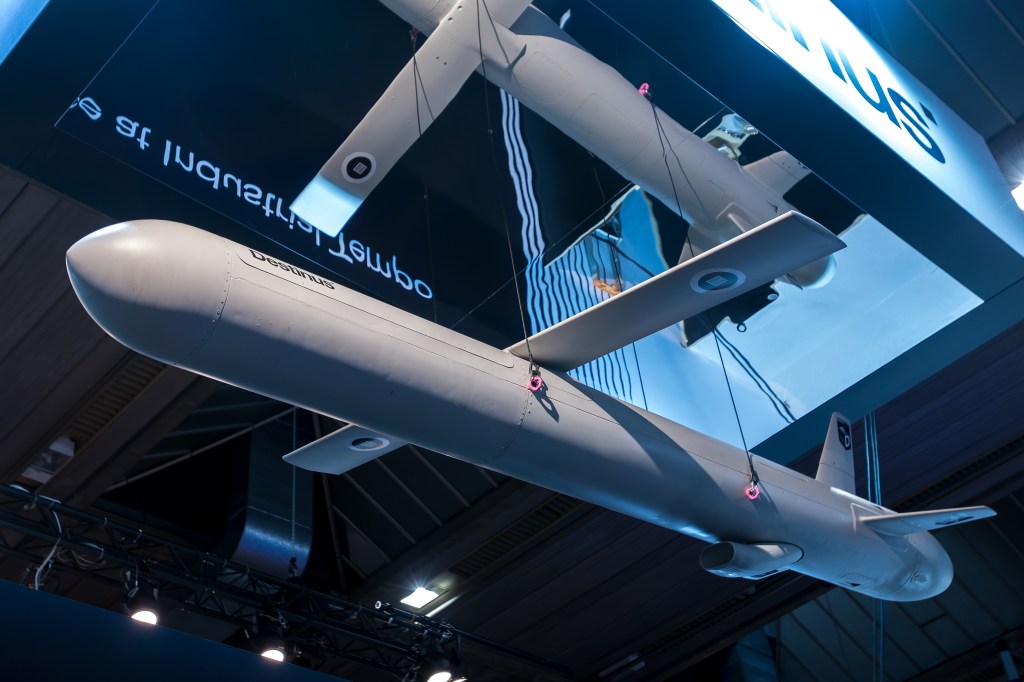
A Ruta Missile Block 1 developed by Dutch company Destinus is displayed at the company’s stand during the Brussels European Defence Exhibition and Conference (BEDEX) on March 13, 2026, in Brussels, Belgium. (Omar Havana/Getty Images)
Defence startup Destinus has built more than 1,750 Ruta cruise missiles in Europe and now produces more cruise missiles in a month than Europe did in a year before Russia’s full-scale invasion of Ukraine, it told Reuters.
The Dutch-headquartered company said monthly output of its Ruta missile had reached nearly 300 units.
Chief Executive Mikhail Kokorich said he expects Destinus from next year to be able to meet demand across Europe, including Ukraine, for turbojet engines in the roughly 1.5-kilonewton thrust class used in cruise missiles.
He said the company was already producing such engines in series and supplying them both for its own missiles and to other manufacturers.
Ukraine’s missile industry has expanded rapidly during the war, but manufacturers have faced constraints in scaling production of jet-powered weapons, including access to propulsion systems.
Ruta was publicly acknowledged as having been used in combat in October 2025, when Ukrainian President Volodymyr Zelenskiy said the missile had been employed operationally.
Integration challenge
Kokorich said in an interview that Europe was moving from a production challenge to a military integration challenge as missile inventories expand.
The company told Reuters it had begun production of the larger Ruta Block 2 missile, which is designed to carry a 250-kg payload and travel more than 700 km.
Unlike the current Block 1 version, the missile is designed to be stored, transported and launched from the same container, simplifying logistics for larger stockpiles.
“To have sufficient deterrence, you need to have tens of thousands of missiles,” Kokorich said. “But the main challenge … is that European customers still need to build the military units and logistic capabilities to operate these big numbers of systems.”
He said future missile arsenals would need supporting storage, transport, maintenance and targeting infrastructure, and argued that European militaries would need to rethink how they stockpile and deploy precision-strike weapons.
Kokorich also contrasted Destinus’ China-free supply chain with wartime production in Ukraine, saying access to Chinese suppliers would make manufacturing “cheaper, faster, easier” but that Destinus used no Chinese components.
He also pushed back against a growing focus on very long-range strike weapons, arguing that cheaper missiles with ranges below 1,000 km would account for the bulk of future demand.
“We need missiles which can fly long range and attack long-range targets,” he said. “But we need those missiles that fly shorter and cheaper.”
路透社记者玛丽亚·鲁加默报道
分享至 Facebook(在新窗口中打开) Facebook
分享至 X(在新窗口中打开)X
在 Bluesky 上分享(在新窗口中打开)Bluesky
分享到 Reddit(在新窗口中打开)
在领英上分享(在新窗口中打开)领英
使用原生工具分享 已复制到剪贴板
分享至邮件(在新窗口中打开)
2026年3月13日,在比利时布鲁塞尔举行的布鲁塞尔欧洲防务展览会暨会议(BEDEX)上,荷兰Destinus公司在其展位上展出了一枚由该公司研制的Ruta导弹Block 1型。(Omar Havana/Getty Images)
国防初创公司 Destinus 告诉路透社,该公司已在欧洲制造了 1750 多枚 Ruta 巡航导弹,现在一个月生产的巡航导弹比俄罗斯全面入侵乌克兰之前欧洲一年生产的还要多。
这家总部位于荷兰的公司表示,其 Ruta 导弹的月产量已接近 300 枚。
首席执行官米哈伊尔·科科里奇表示,他预计从明年起,Destinus 将能够满足欧洲(包括乌克兰)对推力约为 1.5 千牛级的涡轮喷气发动机的需求,这种发动机用于巡航导弹。
他说,该公司已经开始批量生产这种发动机,并将其供应给自己的导弹和其他制造商。
乌克兰的导弹工业在战争期间迅速发展,但制造商在扩大喷气式武器的生产规模方面面临诸多限制,包括获得推进系统。
2025 年 10 月,乌克兰总统弗拉基米尔·泽连斯基公开承认 Ruta 导弹已在实战中使用,并表示该导弹已投入作战使用。
整合挑战
科科里奇在一次采访中表示,随着导弹库存的增加,欧洲正从生产挑战转向军事一体化挑战。
该公司告诉路透社,它已经开始生产更大的 Ruta Block 2 导弹,该导弹设计用于携带 250 公斤的有效载荷,射程超过 700 公里。
与目前的 Block 1 版本不同,该导弹的设计使其能够从同一个容器中储存、运输和发射,从而简化了更大库存的物流。
科科里奇说:“要拥有足够的威慑力,就需要数万枚导弹。但主要挑战在于……欧洲客户仍然需要建立相应的军事单位和后勤能力来操作这些数量庞大的系统。”
他表示,未来的导弹武库需要配套的储存、运输、维护和目标定位基础设施,并认为欧洲各国军队需要重新思考如何储备和部署精确打击武器。
科科里奇还将 Destinus 不依赖中国的供应链与乌克兰的战时生产进行了对比,称获得中国供应商的供应将使生产“更便宜、更快、更容易”,但 Destinus 没有使用任何中国零部件。
他还反对日益重视超远程打击武器的做法,认为射程低于 1000 公里的廉价导弹将占据未来需求的大部分。
他说:“我们需要射程远、攻击远程目标的导弹,但我们也需要射程短、成本低的导弹。”