US, Japan ink agreements for AMRAAM assembly, SM-3 production boost: Japanese MoD美国和日本签署协议,推进AMRAAM导弹组装和SM-3导弹生产:日本国防部
The “groundbreaking agreement” on AMRAAM production “will not only ensure the acquisition of equipment needed by both Japan and the United States, but will also strengthen Japan's defense industry base,” said Japanese Defense Minister Shinjiro Koizumi.
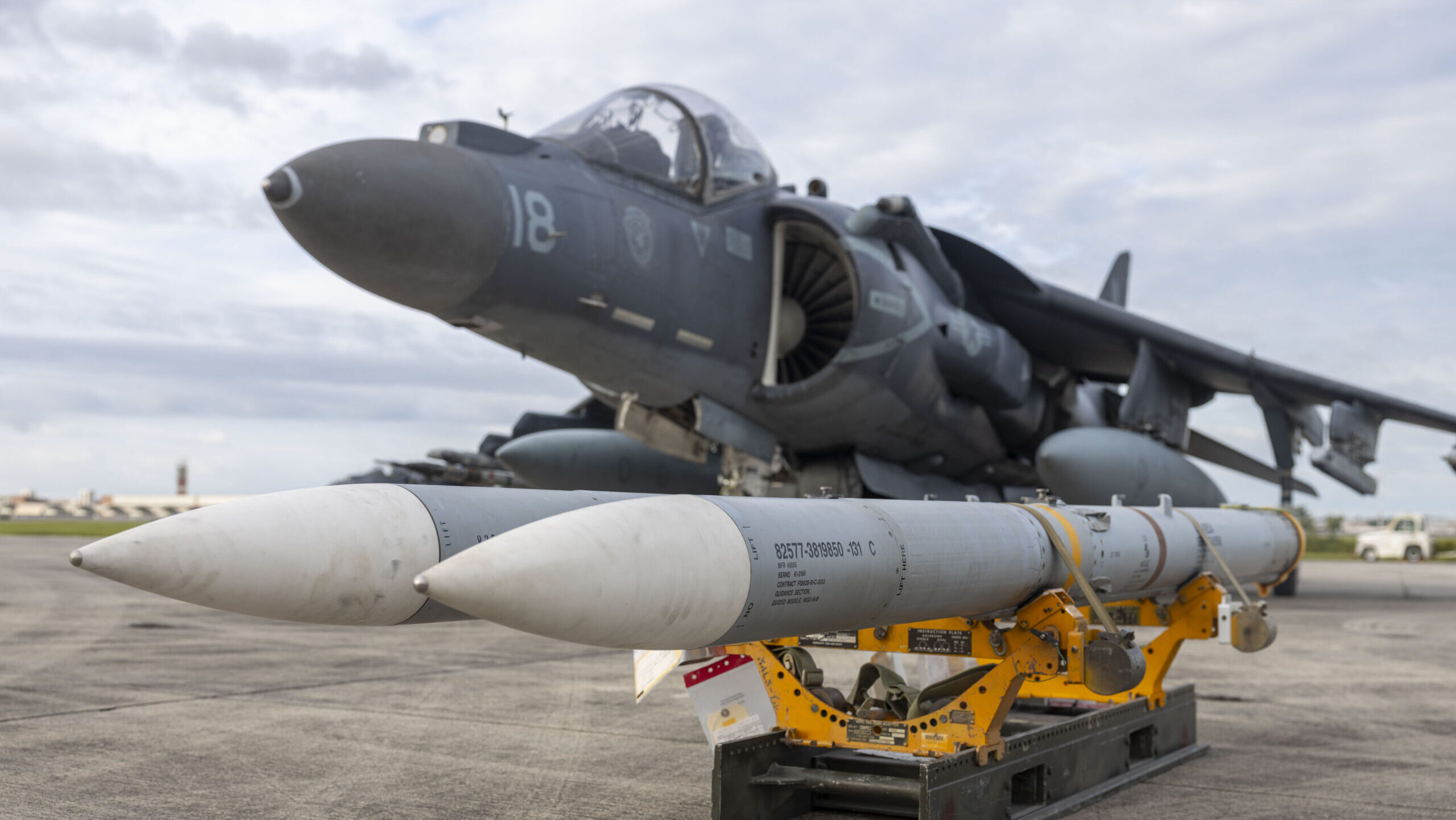
U.S. Marines with Marine Attack Squadron (VMA) 223 prepare AIM-120 AMRAAM missiles for loading onto an AV-8B Harrier II at Marine Corps Air Station Cherry Point, North Carolina, Aug. 5, 2025. (U.S. Marine Corps photo by Lance Cpl. Bryan Giraldo)
WASHINGTON — The US and Japan have finalized a plan to assemble the Advanced Medium-Range Air-to-Air Missile (AMRAAM) in Japan amid a crunch for munitions, according to Japanese Defense Minister Shinjiro Koizumi.
In remarks posted by the Japanese Defense Ministry, Koizumi confirmed the AMRAAM agreement covers “the establishment of a final assembly and inspection facility in Japan,” according to a Google translation. The weapon is “essential” for F-35 Joint Strike Fighters , Koizumi said, which are operated by Washington and Tokyo among other international partners.
“This is a groundbreaking agreement that will not only ensure the acquisition of equipment needed by both Japan and the United States, but will also strengthen Japan’s defense industry base,” Koizumi said Wednesday during a press conference on the sidelines of the Association of Southeast Asian Nations (ASEAN) Defense Ministers’ Meeting in the Philippines.
The defense minister did not share which Japanese industry partner was picked to assemble the missile. Koizumi additionally did not include a timeline for opening the facility, or its expected output.
Manufactured by RTX subsidiary Raytheon, the AMRAAM is a key air defense weapon that can be fired by aircraft and ground-based launchers. The missile is in high demand amid conflicts in Ukraine and the Middle East, and ramping up its production is a key focus of military planners.
The AMRAAM agreement follows a September contract award to Raytheon worth up to over $20 billion under a five-year agreement, with options for an additional two years of production. That contract will “nearly” double the weapon’s production, the Pentagon said at the time — as long as US lawmakers provide the necessary funding.
Koizumi additionally disclosed that the US and Japan “agreed to share the necessary technical information to achieve increased production” of the Standard Missile-3 Block IIA, a primarily ship-based interceptor used to bat down ballistic missiles. The SM-3 Block IIA is a joint program between the US and Japan, though Koizumi did not share how much the agreement may raise the interceptor’s production rate.
A Tuesday readout of a meeting between Defense Secretary Pete Hegseth published by the Pentagon does not discuss the AMRAAM or SM-3 agreements. However it says Hegseth “welcomed Japan’s efforts to strengthen its defense industrial capacity, and both leaders committed to continue close coordination on critical munitions production.”
RTX deferred to the US Defense Department when asked to comment on the agreements. A Pentagon spokesperson did not respond to an inquiry by press time.
The AMRAAM and SM-3 agreements were both part of “Operation Supercharge,” a joint US-Japan effort to boost defense technology cooperation, according to Koizumi. The two countries are deepening defense ties amid a historic ramp up in defense spending in Japan as the threat of Chinese expansion looms large over the region.
Koizumi and Hegseth “shared a sense of crisis regarding the increasingly severe regional situation and agreed to strengthen the deterrence and response capabilities of the Japan-US alliance at an even faster and stronger pace,” Koizumi said during the Wednesday press conference, without explicitly referencing China.
Breaking Defense Video
How General Atomics views Europe’s unmanned future
A more flexible way to defend maneuver forces from drones that doesn’t tie them down [Sponsored]
What’s haunting the Pentagon this Halloween?
The new must-have capabilities for drones [Sponsored]
Army’s tech chief talks autonomy, acquisition and the future of drones
Drones take over AUSA, plus the Army’s plan to bring in new vendors
Hegseth talks autonomy at AUSA, a key show focus
Army doubles down on autonomy, stakes out Indo-Pacific role: AUSA Day 2
Telle talks ‘manufacturing rodeo,’ supply chain ‘weak links’: AUSA Day 1
New leaders, new drone command: What we expect from AUSA 2026
2025年8月5日,在北卡罗来纳州切里角海军陆战队航空站,美国海军陆战队第223攻击中队(VMA-223)的陆战队员正在准备将AIM-120 AMRAAM导弹装载到AV-8B“鹞”式II战斗机上。(美国海军陆战队下士布莱恩·吉拉尔多摄)
华盛顿——据日本防卫大臣小泉进次郎称,由于弹药短缺,美国和日本已最终敲定一项计划,在日本组装先进中程空空导弹(AMRAAM)。
根据谷歌翻译,小泉纯一郎在日本防卫省发布的声明中证实,AMRAAM导弹协议涵盖“在日本建立最终组装和检验设施”。小泉表示,这种武器对于F-35联合攻击战斗机至关重要,而F-35战斗机由包括华盛顿和东京在内的多个国际伙伴国使用。
小泉周三在菲律宾举行的东盟国防部长会议间隙举行的新闻发布会上表示:“这是一项具有开创性的协议,它不仅将确保日本和美国获得所需的装备,还将加强日本的国防工业基础。”
防卫大臣没有透露选定哪家日本企业合作伙伴来组装导弹。小泉也没有说明该设施何时投产,以及预计产量是多少。
AMRAAM导弹由RTX子公司雷神公司制造,是一种关键的防空武器,可由飞机和地面发射器发射。在乌克兰和中东冲突的背景下,该导弹需求量很大,提高其产量是军事规划者的重点工作。
在AMRAAM导弹协议签署之前,雷神公司于9月份获得了一份价值高达200亿美元的五年期合同,并可选择续签两年。五角大楼当时表示,只要美国国会提供必要的资金,这份合同将使该武器的产量“几乎”翻一番。
小泉还透露,美日两国“同意共享必要的技术信息,以提高标准-3 Block IIA型导弹的产量”。该导弹主要部署在舰艇上,用于拦截弹道导弹。SM-3 Block IIA是美日两国的联合项目,但小泉并未透露该协议将使拦截导弹的产量提高多少。
五角大楼周二发布的国防部长皮特·赫格塞斯与日本领导人会晤的纪要并未提及AMRAAM或SM-3导弹协议。但纪要指出,赫格塞斯“欢迎日本为加强其国防工业能力所做的努力,双方领导人承诺继续在关键弹药生产方面保持密切协调”。
当被问及相关协议时,RTX公司表示将问题转交给了美国国防部。截至发稿时,五角大楼发言人尚未回复置评请求。
据小泉介绍,AMRAAM和SM-3导弹的合作协议均属于“超级增压行动”(Operation Supercharge)的一部分,这是美日两国为加强国防技术合作而共同开展的行动。随着中国扩张的威胁日益逼近该地区,日本也大幅增加了国防开支,两国正在深化防务关系。
小泉在周三的新闻发布会上表示,小泉和赫格塞斯“对日益严峻的地区局势感到危机,并同意以更快、更强的步伐加强日美同盟的威慑和应对能力”,但他没有明确提及中国。
突破性防御视频
通用原子公司如何看待欧洲的无人化未来
一种更灵活的防御机动部队免受无人机攻击的方式,不会限制其行动[赞助]
今年万圣节,五角大楼究竟闹鬼?
无人机必备的新功能 [赞助内容]
陆军技术主管谈无人机的自主性、采购和未来
无人机主导了美国陆军协会(AUSA)的会议,此外,陆军还计划引入新的供应商。
Hegseth 在 AUSA 大会上谈到了自主性,这是本次大会的一个重点议题。
陆军加倍强调自主性,明确印太地区角色:AUSA第二天
特勒谈“制造业乱象”、供应链“薄弱环节”:AUSA第一天
新领导人,新无人机指挥部:我们对 AUSA 2026 的期待