Ukraine completes work on new missile defense system, awaits European partner components乌克兰完成新型导弹防御系统研发,目前正等待欧洲合作伙伴提供部件。
Ukraine has completed its share of Freyja, the multinational antiballistic shield that Europe and Kyiv are racing to bring together.
Share on Facebook (Opens in new window) Facebook
Share on X (Opens in new window) X
Share on Bluesky (Opens in new window) Bluesky
Share on Reddit (Opens in new window) Reddit
Share on LinkedIn (Opens in new window) LinkedIn
Share using Native tools Share Copied to clipboard
Share on Mail (Opens in new window) Mail
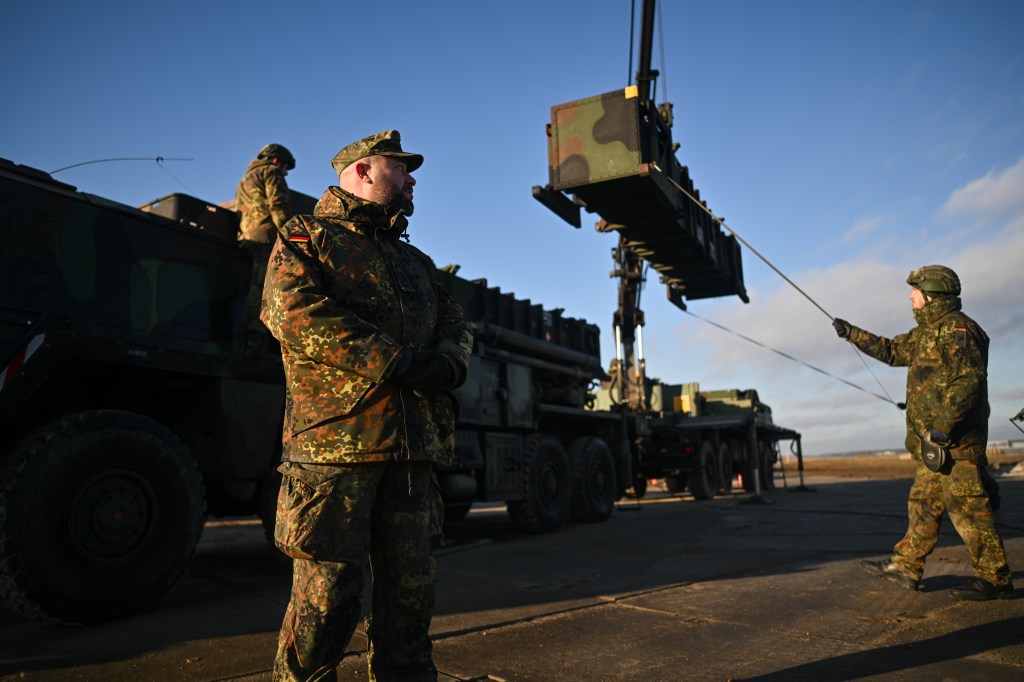
German soldiers unload the U.S. made MIM-104 Patriot surface-to-air missile (SAM) system on Jan. 23, 2025, in Jasionka, Poland. (Omar Marques/Getty Images)
KYIV, Ukraine — Ukraine has completed its share of Freyja, the multinational antiballistic shield that Europe and Kyiv are racing to bring together, the country’s president, Volodymyr Zelenskyy, said earlier this month, putting the onus on partner countries and their defense contractors to develop the interceptor’s remaining components fast enough to conduct initial tests by year’s end.
Fire Point, the Ukrainian company leading the project , is building the FP-7.X interceptor and its launcher while partners such as Norway’s Kongsberg and Germany’s Diehl Defence are responsible for developing parts that find, track and guide the missile to its target.
“Ukraine has done what it was supposed to do, and that is good news,” Zelenskyy told journalists Oct. 17. “As for what the partners are supposed to do, you know that there are ten participating countries, and they are in the process.”
The push comes as Ukraine runs short of costly Patriot interceptors and Russia fields faster weapons, including jet-powered Shahed drones, forcing Kyiv to spend scarce antiballistics on both drones and increasingly large missile barrages.
Russia has fired more than 100 ballistic missiles at Kyiv and the surrounding region in the past two weeks after launching nearly 3,500 jet-powered drones across Ukraine in September, Zelenskyy said , quoting air force figures .
The Coalition of the Willing Summit on July 13, 2026, Paris, France. (X)
Civilian casualties from January through September ran 59% higher than a year earlier, according to the U.N.
“People work on systems like this for decades. We want it very fast, because there is no time,” Zelenskyy said about the new antiballistic system.
Freyja is designed to end Kyiv’s dependence on the Patriot and provide Europe with its own antiballistic capability. However, now that Ukraine has delivered the system’s base elements, one of the program’s most demanding phases – fitting European sensors, seekers and fire-control systems to a Ukrainian interceptor – hinges on partners’ pace of development.
Fire Point had already begun “the most intense and also the most complicated stage” of final assembly with specially designed radars and seekers from other countries, capping an overall effort to “squeeze a [antiballistics development] program that usually takes 20 or 30 years into a matter of a couple of years,” chief executive Iryna Terekh said in August.
Ukrainian officials consider the Patriot their only reliable defense against ballistic missiles, but the U.S.-Israel war with Iran has drained an estimated two-thirds of America’s prewar PAC-3 interceptor stock.
The missiles are also expensive and slow to arrive. A PAC-3 interceptor costs roughly $3.8 million, takes years to deliver, and can get held up in licensing talks or delivery issues.
Fire Point unveiled Freyja in May to end that dependence, offering Kyiv and its allies an interceptor they can build and deploy independently.
Ukraine and nine European partners, including France, Germany and the United Kingdom, officially launched Freyja’s coalition in Paris on July 13.
“Europeans themselves will be able to decide how many systems Europe needs and where they should be deployed,” Zelenskyy said at the launch . Poland joined the cohort in September, and Canada is “ready to contribute its technologies,” Zelenskyy said after meeting Prime Minister Mark Carney Sept. 10, according to the presidential office .
Under a June agreement with Germany’s Hensoldt , Fire Point is the prime contractor and design authority, and Hensoldt supplies the radars, such as the TRML-4D, which the company says can track roughly 1,500 air targets.
A preliminary design shared by Fire Point co-founder Denys Shtilerman on X in May pairs the FP-7.X with a long-range radar from Sweden’s Saab, France’s Thales or Hensoldt, a fire-control radar from Denmark’s Weibel or Italy’s Leonardo, and a command center from Kongsberg, maker of the NASAMS systems Ukraine already uses.
The system would tie into Ukraine’s wider air-defense network over NATO’s Link 16 standard, connect its radars through the Asterix protocol and use a two-way data link to correct the interceptor’s course in flight, according to the slides.
European partners will supply that data link and the command center, Reuters reported in June. Most of the system’s components are designed to be interchangeable.
The system’s seeker remains the bottleneck, Terekh told The War Zone , adding that Fire Point is integrating Diehl’s infrared seeker and developing other options with two unnamed partners.
“If we look at everything but the seeker, our production is already ready, even for mass production,” she said. “Even the seeker manufacturers are doing this for the first time in such an integration.”
The first FP-7.X will use a blast-fragmentation warhead, closer to the older PAC-2 than the hit-to-kill PAC-3, and intercept at roughly 12 to 16 miles (20 to 25 kilometers) up, Terekh told Janes in July. A hit-to-kill version will follow.
Fire Point aims to produce at least 2,000 interceptors a year for under $1.2 million (€1 million) each, though Terekh said that price would come “probably not from the first iterations, but definitely in serial production.”
Frejya’s next technical milestones depend on European partners.
“If, for example, every European government starts moving swiftly, we can do interceptors by the end of this year,” Fire Point’s Shtilerman said. The company is aiming for battlefield use next July.
In Oslo last week, Zelenskyy, Norwegian Defense Minister Tore Sandvik and Kongsberg chief executive Eirik Lie identified where work “can and must be accelerated to begin testing by the end of this year,” Ukraine’s presidential office reported.
“Fortunately for Europe and for Ukraine itself, we have Fire Point,” EU Defense and Space Commissioner Andrius Kubilius said Oct. 17, according to UNN , adding that its work on ballistic missiles and Freyja “could become a huge change.”
Katie Livingstone is the Ukraine correspondent for Defense News and Military Times. Based in Kyiv, she has covered Russia’s full-scale invasion since its first days. She is a former Fulbright fellow whose award-winning work has appeared in outlets across Europe and the U.S.
分享至 Facebook(在新窗口中打开) Facebook
分享至 X(在新窗口中打开)X
在 Bluesky 上分享(在新窗口中打开)Bluesky
分享到 Reddit(在新窗口中打开)
在领英上分享(在新窗口中打开)领英
使用原生工具分享 已复制到剪贴板
分享至邮件(在新窗口中打开)
2025年1月23日,在波兰亚松卡,德国士兵卸载美国制造的MIM-104“爱国者”地对空导弹系统。(Omar Marques/Getty Images)
乌克兰基辅——乌克兰总统泽连斯基本月早些时候表示,乌克兰已完成其在“弗雷亚”拦截导弹项目中的份额。“弗雷亚”是欧洲和基辅正在竞相合作开发的多国反导系统。泽连斯基将责任推给了伙伴国家及其国防承包商,要求他们尽快开发拦截导弹的剩余部件,以便在年底前进行初步测试。
领导该项目的乌克兰公司 Fire Point 正在建造 FP-7.X 拦截器及其发射器,而挪威的 Kongsberg 和德国的 Diehl Defence 等合作伙伴则负责开发用于寻找、跟踪和引导导弹到达目标的部件。
“乌克兰已经完成了它应该做的事情,这是个好消息,”泽连斯基10月17日对记者说。“至于合作伙伴应该做什么,你们知道有十个参与国,他们正在进行中。”
乌克兰的爱国者拦截导弹数量不足,而俄罗斯则部署了速度更快的武器,包括喷气式“沙赫德”无人机,这迫使基辅不得不将稀缺的反弹道导弹资源用于无人机和规模越来越大的导弹齐射。
泽连斯基援引空军数据称,俄罗斯在过去两周内向基辅及其周边地区发射了100多枚弹道导弹,此前俄罗斯还在9月份向乌克兰境内发射了近3500架喷气式无人机。
2026年7月13日,自愿联盟峰会将在法国巴黎举行。(X)
根据联合国的数据,今年1月至9月平民伤亡人数比上年同期高出59%。
泽连斯基在谈到新的反弹道导弹系统时说:“人们研发这类系统需要几十年时间。我们希望尽快完成,因为时间紧迫。”
“弗雷娅”导弹系统旨在结束基辅对“爱国者”导弹系统的依赖,并为欧洲提供自主的反弹道导弹防御能力。然而,在乌克兰交付该系统的基础部件之后,该项目最关键的阶段之一——将欧洲的传感器、导引头和火控系统安装到乌克兰拦截导弹上——取决于合作伙伴的研发进度。
火点导弹防御系统公司首席执行官伊琳娜·捷列赫在 8 月份表示,该公司已经开始了最终组装的“最紧张也是最复杂的阶段”,使用了来自其他国家的特制雷达和导引头,这标志着一项旨在“将通常需要 20 或 30 年才能完成的[反弹道导弹研发]计划压缩到几年内”的整体努力达到了顶峰。
乌克兰官员认为“爱国者”导弹是他们唯一可靠的弹道导弹防御系统,但美国与以色列和伊朗的战争已经消耗了美国战前PAC-3拦截导弹库存的约三分之二。
这些导弹价格昂贵,交付速度也很慢。一枚PAC-3拦截导弹造价约为380万美元,需要数年时间才能交付,而且还可能因许可谈判或交付问题而延误。
Fire Point 于 5 月推出了 Freyja,旨在结束这种依赖性,为基辅及其盟友提供可以独立建造和部署的拦截机。
7月13日,乌克兰和包括法国、德国和英国在内的九个欧洲伙伴在巴黎正式启动了弗雷娅联盟。
泽连斯基在启动仪式上表示:“欧洲人将能够自行决定欧洲需要多少套系统以及应该部署在哪里。”据总统府消息,波兰已于9月加入该计划,而加拿大“准备贡献其技术”。泽连斯基在9月10日与加拿大总理马克·卡尼会晤后表示。
根据 6 月份与德国亨索尔特公司达成的协议,火点公司是主承包商和设计机构,亨索尔特公司提供雷达,例如 TRML-4D,该公司称该雷达可以跟踪大约 1500 个空中目标。
Fire Point 联合创始人 Denys Shtilerman 于 5 月在 X 上分享的初步设计方案,将 FP-7.X 与瑞典 Saab、法国 Thales 或 Hensoldt 的远程雷达、丹麦 Weibel 或意大利 Leonardo 的火控雷达以及 Kongsberg 的指挥中心(Kongsberg 是乌克兰已使用的 NASAMS 系统的制造商)相结合。
根据幻灯片显示,该系统将通过北约的Link 16标准接入乌克兰更广泛的防空网络,通过Asterix协议连接其雷达,并使用双向数据链来修正拦截器在飞行中的航向。
路透社6月份报道称,欧洲合作伙伴将提供数据链路和指挥中心。该系统的大部分组件都设计成可互换的。
Terekh 告诉《战区》杂志,该系统的导引头仍然是瓶颈,他还补充说,Fire Point 正在整合 Diehl 的红外导引头,并与两家未具名的合作伙伴开发其他方案。
“除了导引头之外,我们的生产已经准备就绪,甚至可以进行大规模生产,”她说道。“就连导引头制造商也是第一次进行如此大规模的集成。”
特雷克7月份告诉《简氏防务周刊》,首枚FP-7.X导弹将使用爆破破片弹头,其性能更接近于较老的PAC-2弹头,而非直接命中杀伤型PAC-3弹头,拦截高度约为12至16英里(20至25公里)。随后将推出直接命中杀伤型。
Fire Point 的目标是每年生产至少 2000 个拦截器,每个拦截器的成本低于 120 万美元(100 万欧元)。不过,Terekh 表示,这个价格“可能不会出现在最初的几款产品中,但肯定会在批量生产后实现”。
Frejya 的下一个技术里程碑取决于欧洲合作伙伴。
“例如,如果每个欧洲国家政府都迅速行动起来,我们就能在今年年底前研制出拦截器,”Fire Point公司的施蒂勒曼说道。该公司计划明年7月将拦截器投入战场使用。
据乌克兰总统办公室报道,上周在奥斯陆,泽连斯基、挪威国防部长托雷·桑德维克和康斯伯格首席执行官埃里克·利确定了哪些工作“可以而且必须加快速度,以便在今年年底前开始测试”。
据联合国通讯社报道,欧盟国防和航天专员安德留斯·库比留斯于10月17日表示:“幸运的是,对于欧洲和乌克兰本身而言,我们有火力点(Fire Point)”,并补充说,该机构在弹道导弹和弗雷亚(Freyja)项目上的工作“可能会带来巨大的改变”。
凯蒂·利文斯通是《防务新闻》和《军事时报》的乌克兰特派记者。她常驻基辅,自俄罗斯全面入侵乌克兰之初便开始报道此事。她曾是富布赖特学者,其获奖作品发表于欧洲和美国的多家媒体。