New UK policy requires foreign defense contractors to invest locally for all £50M+ deals英国新政策要求外国国防承包商对所有价值超过5000万英镑的交易进行本地投资。
The new policy is due to come into effect in April 2027 and make sure that “British workers and businesses still benefit,” from contracts inked with foreign firms, according to the UK Ministry of Defence
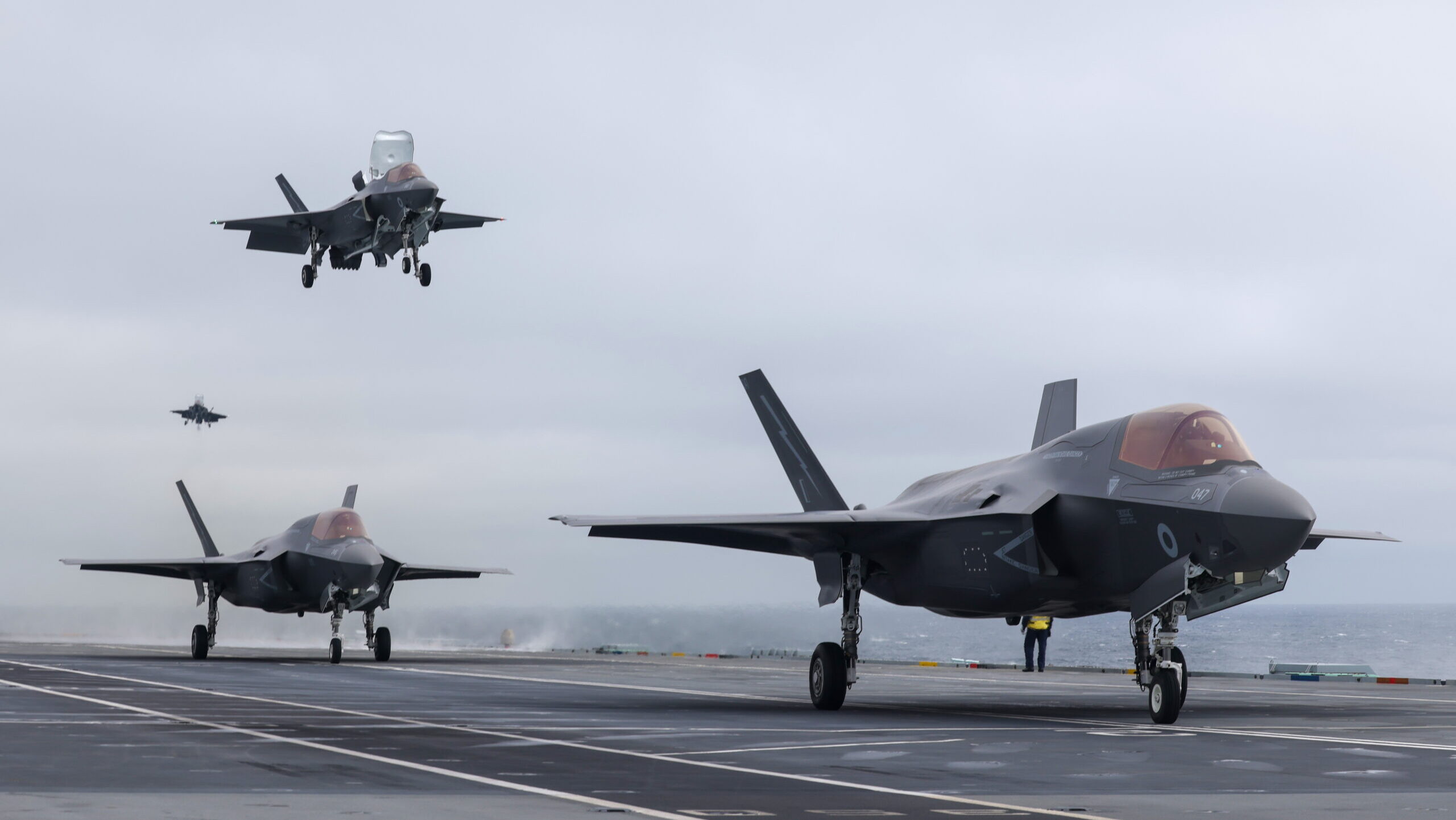
F-35B fighter jets land onboard the British aircraft carrier HMS Prince of Wales after taking part in NATO exercise, Ramstein Flag 2026. (UK MOD)
BELFAST — Foreign defense firms that secure contracts with the UK valued at £50 million ($67 million) or more will be mandated to establish British factories, invest in local suppliers and transfer technologies, as part of a newly launched offsets policy.
The oversea contractors “will be required to deliver such benefits to the UK that could reach the same value as the contract” itself, said the UK Ministry of Defence in a statement released today .
The statement claims the new approach, which is due to come into effect starting April 2027, will make sure that “British workers and businesses still benefit,” from contracts inked with foreign firms, while more generally, the UK government continues to prioritize “buying British defence contracts wherever possible.”
The offsets revamp “will encourage overseas defence suppliers to build enduring partnerships with UK industry, helping UK SMEs to access global supply chains and create new opportunities for growth,” added the statement.
To oversee the effort, the ministry will stand up a new “Offset Authority” to “agree, value and monitor delivery” of multimillion contracts.
Trade body Make UK Defence, representing hundreds of local suppliers, welcomed the move. In a statement to media, a spokesperson for the organization said that the new policy is “an important step towards strengthening our industrial readiness and delivering the Prime Minister’s ambitions to reindustrialise our country.”
The offset announcement comes amid transatlantic tension as European powers face pressure from US President Donald Trump to do more for their own security, but not at the expense of buying more US-made weapon systems.
How integrated modeling and simulation accelerates Europe’s defensive edge
Lockheed Martin’s ACES platform delivers a shared virtual battlespace that strengthens readiness, interoperability, and faster decision-making through advanced, integrated modeling and simulation capabilities designed for evolving global threats.
An early test of the policy is likely to involve contractor selection for the Skynet 6 Wideband Satellite System (WSS) acquisition, which pits Airbus against US rival Lockheed Martin. A 2023 solicitation notice values the procurement at £1.5 billion, and both companies were asked to submit their final bids in August 2025 .
Earlier this month, UK defense secretary Wes Streeting told lawmakers that he could not comment on the procurement as it is “still under investigation.”
Airbus builds and designs satellites from two production sites in Stevenage and Portsmouth, England, and both factories could be endangered should Lockheed win. For its part, Lockheed’s pitch centers around building a new satellite production hub in Durham, England, that could also be used to sustain future export deals.
From a bigger picture perspective, the introduction of the offset policy also follows the UK committing, this week , to a defense spending target of 3 percent GDP in 2030, in line with a longer term plan to hit NATO’s 3.5 percent GDP threshold in 2035.
Based on forecasting from “economists,” the UK newspaper The Times reported on Thursday that reaching the 3 percent figure will cost the government an additional £11 billion per year, with British chancellor and former defense secretary John Healey planning “off the books” funding to prevent raising taxes or cutting public services.
The Times also said that the government is hopeful a four-part treaty with Finland, Poland and the Netherlands could be sorted out in time to be part of plans related to a 2027 government-wide spending review.
Breaking Defense Video
Qatar’s domestic weapons, Turkey’s drone arsenal and the Mecca pact’s next test
3 congressional races that matter for defense
How General Atomics views Europe’s unmanned future
A more flexible way to defend maneuver forces from drones that doesn’t tie them down [Sponsored]
What’s haunting the Pentagon this Halloween?
The new must-have capabilities for drones [Sponsored]
Army’s tech chief talks autonomy, acquisition and the future of drones
Drones take over AUSA, plus the Army’s plan to bring in new vendors
Hegseth talks autonomy at AUSA, a key show focus
Army doubles down on autonomy, stakes out Indo-Pacific role: AUSA Day 2
参加完北约“拉姆施泰因旗帜2026”演习后,F-35B战斗机降落在英国“威尔士亲王”号航空母舰上。(英国国防部)
贝尔法斯特——根据一项新推出的抵消政策,与英国签订价值 5000 万英镑(6700 万美元)或以上合同的外国国防公司将被强制要求在英国建立工厂、投资当地供应商并转让技术。
英国国防部今天发表声明称,海外承包商“将被要求为英国带来与合同本身价值相当的利益”。
声明称,这项将于 2027 年 4 月生效的新措施将确保“英国工人和企业仍然能够从与外国公司签订的合同中受益”,同时,英国政府将继续优先考虑“尽可能购买英国国防合同”。
声明还补充说,补偿贸易改革“将鼓励海外国防供应商与英国工业界建立持久的合作伙伴关系,帮助英国中小企业进入全球供应链,并创造新的增长机会”。
为了监督这项工作,该部将成立一个新的“抵消管理局”,负责“商定、评估和监督”数百万美元合同的履行。
代表数百家本地供应商的行业组织“英国国防制造”(Make UK Defence)对这一举措表示欢迎。该组织的一位发言人在向媒体发表的声明中表示,这项新政策是“加强我们工业准备能力、实现首相重振国家工业化目标的重要一步”。
在跨大西洋局势紧张之际,欧盟宣布了抵消贸易协议。美国总统唐纳德·特朗普向欧洲大国施压,要求它们为自身安全做出更多努力,但又不能以牺牲购买更多美国制造的武器系统为代价。
集成建模与仿真如何加速欧洲的防御优势
洛克希德·马丁公司的 ACES 平台提供了一个共享的虚拟战场空间,通过先进的集成建模和仿真功能,增强了战备能力、互操作性和更快的决策速度,旨在应对不断演变的全球威胁。
该政策的早期检验可能涉及Skynet 6宽带卫星系统(WSS)的承包商选择,空客将与美国竞争对手洛克希德·马丁展开角逐。2023年的一份招标公告显示,该项目价值15亿英镑,两家公司均被要求在2025年8月提交最终报价。
本月初,英国国防大臣韦斯·斯特里廷告诉议员们,由于采购事宜“仍在调查中”,他无法对此发表评论。
空客公司在英国斯蒂夫尼奇和朴茨茅斯设有两处生产基地,负责卫星的制造和设计。如果洛克希德·马丁公司中标,这两家工厂都可能面临关闭的风险。而洛克希德·马丁公司的方案则围绕在英国达勒姆新建一个卫星生产中心展开,该中心未来也可用于支持出口业务。
从更宏观的角度来看,抵消政策的推出也与英国本周承诺到 2030 年将国防开支目标设定为 GDP 的 3% 相一致,这符合到 2035 年达到北约 GDP 3.5% 门槛的长期计划。
据英国《泰晤士报》周四报道,根据“经济学家”的预测,达到 3% 的增长率将使政府每年额外支出 110 亿英镑,英国财政大臣兼前国防大臣约翰·希利计划通过“账外”融资来避免增税或削减公共服务。
《泰晤士报》还表示,政府希望与芬兰、波兰和荷兰达成一项四部分条约,以便及时纳入与 2027 年政府全面支出审查相关的计划。
突破性防御视频
卡塔尔的国产武器、土耳其的无人机武库以及麦加条约的下一次测试
3场对国防至关重要的国会选举
通用原子公司如何看待欧洲的无人化未来
一种更灵活的防御机动部队免受无人机攻击的方式,不会限制其行动[赞助]
今年万圣节,五角大楼究竟闹鬼?
无人机必备的新功能 [赞助内容]
陆军技术主管谈无人机的自主性、采购和未来
无人机主导了美国陆军协会(AUSA)的会议,此外,陆军还计划引入新的供应商。
Hegseth 在 AUSA 大会上谈到了自主性,这是本次大会的一个重点议题。
陆军加倍强调自主性,明确印太地区角色:AUSA第二天