General Atomics Developing Strike-Recon Flying Wing Called NextGen That Uses Hybrid-Electric Propulsion通用原子公司正在研发一种名为“下一代”(NextGen)的打击侦察飞翼,该飞翼采用混合动力推进系统。
Development of the separate Gambit 6 is also progressing toward a live-fire air-to-ground ordnance demonstration next year.
新闻视频
By Joseph Trevithick
Published Oct 30, 2026 12:14 PM EDT
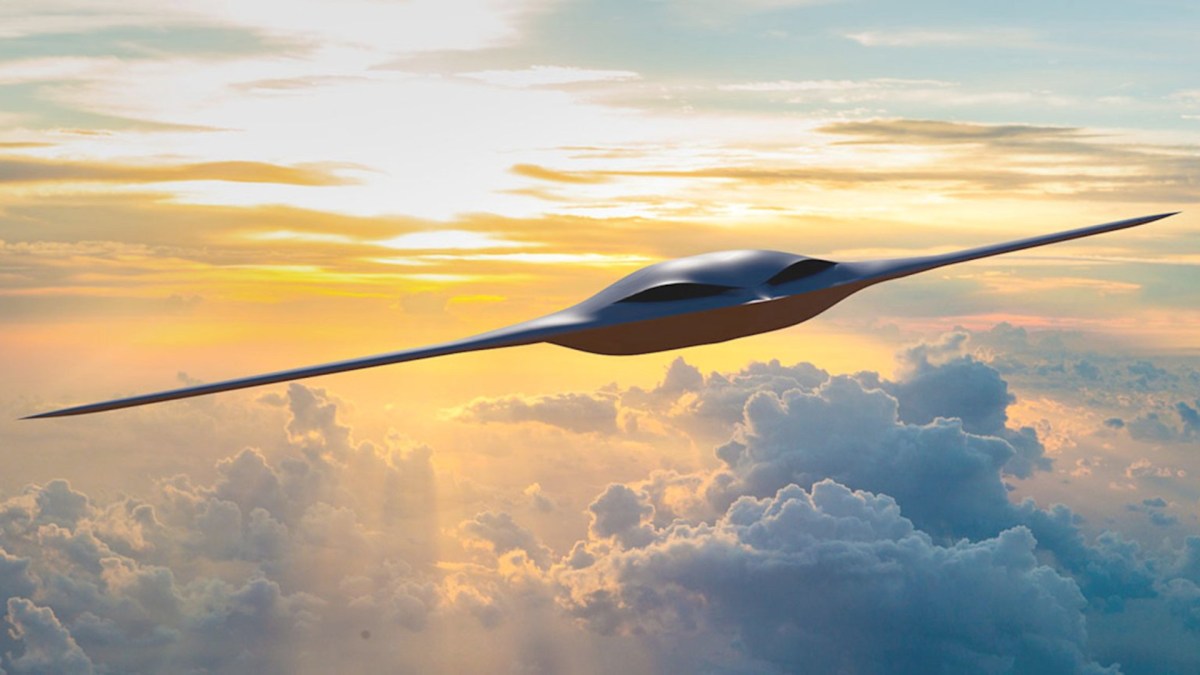
A notional rendering General Atomics has previously released showing a flying-wing-type drone. General Atomics
General Atomics says it is working on a new hybrid-electric-powered flying-wing-type strike/reconnaissance drone called NextGen that could be able to stay aloft for more than 60 hours. Work on NextGen will also feed into one of the designs within the company’s Gambit family of drones, which are also based around a common modular core ‘chassis’ concept . Separate progress is being made on the newest member of that family, the air-to-surface optimized Gambit 6, with plans now for a live-fire air-to-ground ordnance demonstration early next year.
C. Mark Brinkley, a spokesperson for General Atomics, shared these and other details with TWZ as part of an update on the status of the entire Gambit effort.
“When we announced the Gambit Series in 2022, we knew that it was an ambitious, multi-stage concept that would require many years before its full power would be realized across all variants,” Brinkley said. ” It’s not complicated to understand, but it is revolutionary, and revolutions take time.”
When the Gambit family was first rolled out four years ago, General Atomics presented four distinct design concepts. These were the intelligence, surveillance, and reconnaissance (ISR) focused Gambit 1, the air-to-air combat-optimized Gambit 2, an uncrewed ‘red air’ aggressor called Gambit 3, and the stealthy flying wing Gambit 4. Since then, the company has also added the Gambit 5 , intended for carrier-based operations, and the aforementioned Gambit 6 .
All of the Gambit concepts are designed to leverage a common ‘chassis’ that includes landing gear, baseline avionics, and other core hardware. General Atomics touts this as helping to reduce costs and accelerate the development of very different drone designs.
General Atomics’ Brinkley provided brief updates on all six existing Gambit design concepts, as well as the common core.
“ Gambit Core : First, I think you saw the recent update on our partnership with Spirit Defense . They have been partnered with us for a long time, and they’re bought in on the Gambit concept. As a teaming arrangement, it really buys down manufacturing risk and also allows General Atomics to pursue many other projects simultaneously, whether that’s MQ-9B or Wildfire or other things.”
A graphic that General Atomics released in 2022 underlining the core ‘chassis’ component of the Gambit concept. General Atomics
“ Gambit 1 is out there flying today. The first example is the XQ-67 Off-Board Sensing Station [OBSS], built in collaboration with Air Force Research Laboratory [AFRL]. They’re a great partner and really have a vision for this as a new warfighting concept for the future.”
Developed under the secretive OBSS program , the XQ-67A was unveiled to the public in 2024, as TWZ was the first to report . Experimentation using this one-off drone fed into General Atomics’ development of what is now called the FQ-42A Vengeance , which we will come back to in a moment, as well as the U.S. Air Force’s Collaborative Combat Aircraft (CCA) program . Last year, AFRL announced that the XQ-67A would receive modifications and upgrades to support further advanced autonomy and related developments under a new program called Demonstration of Autonomous Collaborative Platform Performance and Effectiveness ( abbreviated as Demon Ape ).
On Tuesday, AFRL announced in a press release that it “demonstrated integration of several advanced mission systems including state-of-the-art sensors, mission computers and power and thermal management hardware, all designed to work collaboratively in demanding combat environments,” on the XQ-67A during a recent test flight over the Nevada Test and Training Range (NTTR) as part of Demon Ape.
“Additionally, the integration of Beyond Line-of-Sight datalinks and live, virtual and constructive simulations during the flight demonstrated management of uncrewed platforms across distributed theaters, bolstering deterrence through resilient, layered command and control,” AFRL’s release added.
“ Gambit 2 is also flying today. Our first example is the FQ-42A Vengeance with the U.S. Air Force. Upcoming milestones include our first missile live-fire later this year, and participation in [Exercise] Emerald Flag . We’ll be at [the] International Fighter Conference next week with the full-scale model.”
The FQ-42A is one of two designs the Air Force has now ordered into production under the first phase, or Increment 1, of its CCA program. The other is Anduril’s FQ-44A Fury. In September, the Air Force announced a goal of having at least 500 Increment 1 CCAs in inventory by 2032.
A composite graphic showing General Atomics FQ-42A Vengeance and Anduril’s FQ-44A Fury side-by-side. USAF
“ Gambit 3 is a red-air trainer concept. We all know this is coming. It’s a critical must-have for the future. But right now, we live in a world filled with critical needs, so where does this fit in? Because of the way we have designed the Gambit Series, everything feeds everything else. You can pursue a tactical variant first, then walk back to this later. Eventually, manned aircraft will need to fight against these autonomous jets and train like they fight, but you don’t need them actually loaded with weapons. You’ll be simulating all of that anyway. So with Gambit 3, you can alter the design without starting from scratch and probably remove some fighter components from the trainers to add overall value. Considering that we have Gambits 1 and 2 flying now, we probably don’t need a pure trainer prototype unless the buyer wanted different engines and other changes.”
Gambit 3 is by far the concept within this larger family that has been discussed the least to date, so it is particularly interesting to get an update on General Atomics’ current thinking here. There continues to be a degree of interest in this kind of capability within the U.S. military , especially to help provide greater volumes of platforms capable of representing more advanced aerial threats during large-scale exercises. However, despite several past efforts , there has been no significant acquisition of next-generation unmanned aggressors that we are aware of. As an aside, Anduril’s Fury was originally developed by a company called Blue Force Technologies for the ‘red air’ role .
A graphic released in 2022 discussing the Gambit 3 design concept. General Atomics
“ Gambit 4 is a flying wing. This is where things get interesting. General Atomics is currently working on a much larger flying wing we call NextGen. It’s not a CCA. We’re talking novel hybrid-electric propulsion on a fully armed, fully outfitted, ISR/Strike wing. Our engine team has promised 60+ hours unrefueled. That work is happening in parallel with everything else we’re working on. I don’t think people realize how deep GA-ASI’s bandwidth is, or how much we dedicate to R&D. We have things I’m talking about here, and things I’m not talking about here, and five million square feet of manufacturing plus multiple flight test facilities. We’ve built and delivered more than 1,600 aircraft in 34 years. We’ve invented a lot of things, and we’re inventing other things. NetGen is coming, and the work we’re doing on that flying wing program will funnel into Gambit 4 so that when customers are ready for this, we’re not starting from scratch here either.”
From the beginning, Gambit 4 has been something of an outlier that is completely different from the other concepts in the family. This is only reinforced by the new details Brinkley has shared here about the NextGen design. The mention of “novel hybrid-electric propulsion” is particularly eye-catching. In general, this kind of propulsion arrangement offers improved fuel economy, and the potential for other benefits, like reduced infrared and acoustic signatures, through the combination of fuel-powered engines and electric motors.
General Atomics has talked in the past about hybrid electric propulsion technology helping to achieve a 60-hour-endurance target in the context of an earlier stealthy flying wing drone concept called MQ-Next. Last year, AFRL also awarded the company a contract for what it described as a “hybrid-electric propulsion ducted fan next-generation intelligence, surveillance, reconnaissance/strike unmanned aerial system,” or GHOST .
A rendering of the MQ-Next concept General Atomics released in 2021, the year before rolling out the Gambit family. General Atomics
“We’ve been promising something impressive related to hybrid-electric propulsion, and now I can’t talk about it anymore,” Brinkley told TWZ at the time when asked for more information about GHOST. It remains unclear how that program may be intertwined with the previous MQ-Next concept, as well as work now on NextGen and future plans for Gambit 4.
“ Gambit 5 is basically a Gambit 2 or Gambit 6, or a hybrid of those, optimized for shipboard use with global navies. So again we’re showing how the novelty of the Gambit design pairs with our other projects and programs to buy down risk to success. You need to address landing gear, catapults, arresting cables, salt air that eats everything, all kinds of things. But Gambit 5 is an easy reach. General Atomics has a lot of carrier expertise, and we have been experimenting with shipboard operations for more than a decade.”
The Gambit 5 concept made its public debut in 2024 at the Farnborough International Airshow in the United Kingdom with a rendering depicting the drones embarked on a Queen Elizabeth class carrier refitted with an electromagnetic catapult. General Atomics has since shown additional renderings of Gambit 5s on the decks of the U.S. Navy’s supercarrier USS Gerald R. Ford and a Japanese Izumo class ‘multifunctional destroyer.’ General Atomics also makes electromagnetic catapults for carriers , including the ones on the Ford class , and has put ideas for installing them on a variety of other naval vessels , as well as deploying them on land .
A rendering depicting Gambit 5 drones, as well as MQ-9Bs, operated from a refitted Queen Elizabeth class carrier. General Atomics
Additional renderings depicting Gambit 5s operating from the USS Gerald R. Ford , at left, and a Japanese Izumo class warship, at right. General Atomics
Last year, the Navy announced that it had awarded contracts to General Atomics, as well as Anduril, Boeing, and Northrop Grumman, to develop conceptual designs for carrier-based drones under its CCA program. General Atomics used a rendering of Gambit 5 to illustrate a subsequent press release regarding this selection.
“ Gambit 6 takes the Gambit 2 fighter and optimizes it for ground attack. We started talking about Gambit 6 last year, and the conversations around the world have really taken off. People really understand the Gambit concept and are beginning to see how different it is from the mostly concept jets being discussed. The next step is to demonstrate the capability, so we are planning a company live-fire event for early 2027 using a ground-attack munition from a company-owned Gambit 6. I’ve said this a few times, but every Gambit variant feeds expertise into the other variants by default. So the work ongoing now for live-fire on FQ-42 Vengeance, coupled with years of internal air-to-ground launches from MQ-20 Avenger , allows us to rapidly reconfigure for Gambit 6. The air-to-ground mission is pivotal for many global militaries evaluating CCAs as a concept, and we’re already seeing others hanging bombs from their wings and talking about future concepts with internal bays. We’ll probably see other companies doing air-to-ground demos like ours. But the next question is survivability. Internal carry and release is such a different beast than firing from the wings, but what comes out for the Gambit Series is a 5 th -generation combat jet optimized for survivability, scalability and flexibility.”
As mentioned, Gambit 6 is the newest entry to the family and was rolled out around last year’s International Fighter Conference . At that time, General Atomics said it was already courting international customers for this particular design, especially in Europe, underscoring a surge in interest globally in CCA-type drones in recent years. The company also subsequently announced plans to develop a derivative of the FQ-42A for the European market through an affiliate in Germany.
A rendering depicting a trio of Gambit 6 drones releasing air-to-ground munitions. General Atomics
Brinkley’s remarks here regarding internal bays versus external carriage of stores notably follow Anduril’s release of pictures showing fit checks of air-to-ground ordnance on the wings of a Fury drone last month. The FQ-42A, as well as General Atomics ‘ earlier Avenger drone design, both have internal weapons bays. An internal bay is expected to be a key feature on the Gambit 6 design, too.
A Fury drone seen with inert 70mm rocket pods and Joint Direct Attack Muntion (JDAM) precision-guided bombs loaded under its it wings during a fit check. Anduril
“General Atomics knew that low-observable with internal weapons was the only way to go for the future. It’s not specifically the fastest way, or the easiest way, but it does yield the very best jet on the back end,” Brinkley also told TWZ today. “You can get a small jet in the air, connect it to the satellite controls we pioneered here, hang weapons from the wings like we pioneered here, use the AI concepts we pioneered here, and call that a CCA. But if it isn’t low-observable, with a functioning internal carry, built for affordable high-rate production from the beginning, then it’s just a little jet.”
“When we rolled out our first four Gambit concepts, we knew that we were on to something novel, but I don’t think any of us recognized how fast it would all move. Now we’re up to six concepts, with two flying and two on track to become flying prototypes,” he added. “That leaves Gambit 3 and Gambit 4, and it would be easy to think those are the least important or least impressive, but I don’t think that’s the case at all.”
It does remain to be seen how many members of the Gambit family beyond the FQ-42A will ultimately be produced in significant numbers. For now, a Gambit 4 design, in particular, is still an ambitious future concept that will rely heavily on success with NextGen and related work.
Contact the author: joe@twz.com
Comments couldn’t be loaded. Please refresh the page.
作者:约瑟夫·特雷维西克
发布于美国东部时间2026年10月30日下午12:14
通用原子公司此前曾发布过一张概念渲染图,展示了一款飞翼式无人机。
通用原子公司表示,他们正在研发一款名为NextGen的新型混合动力飞翼式打击/侦察无人机,该无人机续航时间可超过60小时。NextGen的研发成果也将应用于该公司Gambit系列无人机的设计中,该系列无人机同样基于通用的模块化核心“底盘”概念。与此同时,Gambit系列最新成员——针对空对地攻击优化的Gambit 6无人机也在稳步推进,并计划于明年初进行实弹空对地攻击演示。
通用原子公司发言人 C. Mark Brinkley 向 TWZ 分享了这些以及其他细节,作为对整个 Gambit 项目进展情况的更新。
“我们在2022年发布Gambit系列时,就知道这是一个雄心勃勃的多阶段概念,需要很多年才能在所有版本中充分发挥其全部潜力,”布林克利说。“它并不复杂,但却是革命性的,而革命需要时间。”
四年前,通用原子公司首次推出“Gambit”系列无人机时,提出了四种不同的设计理念。它们分别是:专注于情报、监视和侦察(ISR)的“Gambit 1”;针对空对空作战优化的“Gambit 2”;无人“红方”假想敌机“Gambit 3”;以及隐形飞翼式无人机“Gambit 4”。此后,该公司又推出了用于航母作战的“Gambit 5”以及前文提到的“Gambit 6”。
所有 Gambit 概念机的设计都旨在利用一个通用的“底盘”,该底盘包括起落架、基础航空电子设备和其他核心硬件。通用原子公司宣称,这有助于降低成本并加速开发截然不同的无人机设计。
通用原子公司的布林克利简要介绍了所有六个现有的 Gambit 设计概念以及通用核心的最新情况。
“Gambit Core:首先,我想您已经看到了我们最近与Spirit Defense合作的最新进展。他们与我们合作已久,并且非常认可Gambit的概念。这种合作模式确实降低了制造风险,也使通用原子公司能够同时推进许多其他项目,无论是MQ-9B、Wildfire还是其他项目。”
通用原子公司于 2022 年发布的一张图表,重点展示了 Gambit 概念的核心“底盘”组件。通用原子公司
“Gambit 1 系统目前已投入飞行测试。首个样机是与空军研究实验室 (AFRL) 合作开发的 XQ-67 机外传感站 (OBSS)。他们是优秀的合作伙伴,并且对这项技术作为未来新型作战概念有着深刻的愿景。”
XQ-67A无人机是在秘密的OBSS项目下研发的,并于2024年向公众亮相,TWZ率先报道了此事。这款独一无二的无人机的实验成果被通用原子公司用于研发如今被称为FQ-42A“复仇”的战机(我们稍后会详细介绍),以及美国空军的协同作战飞机(CCA)项目。去年,空军研究实验室(AFRL)宣布,XQ-67A将进行改进和升级,以支持一项名为“自主协同平台性能与效能演示”(简称“Demon Ape”)的新项目,该项目旨在进一步提升无人机的自主性和相关技术。
周二,美国空军研究实验室 (AFRL) 在一份新闻稿中宣布,在最近一次于内华达州试验和训练场 (NTTR) 进行的“恶魔猿”演习中,XQ-67A 无人机“展示了多个先进任务系统的集成,包括最先进的传感器、任务计算机以及电源和热管理硬件,所有这些系统都旨在在严苛的作战环境中协同工作”。
“此外,飞行期间超视距数据链与实时、虚拟和构造模拟的集成,展示了对分散战区无人平台的管理,通过弹性、分层的指挥和控制增强了威慑力,”空军研究实验室的新闻稿补充道。
“Gambit 2今天也进行了试飞。我们的首架样机是与美国空军合作的FQ-42A复仇战斗机。接下来的里程碑包括今年晚些时候的首次导弹实弹射击,以及参加‘翡翠旗’演习。下周我们将携全尺寸模型参加国际战斗机大会。”
FQ-42A是美国空军在CCA项目第一阶段(或称“增量1”)下订购投产的两款机型之一,另一款是安杜里尔公司(Anduril)的FQ-44A“狂怒”(Fury)。今年9月,空军宣布其目标是到2032年至少拥有500架“增量1”CCA。
一张合成图,并排展示了通用原子公司的FQ-42A“复仇”战斗机和安杜里尔公司的FQ-44A“狂怒”战斗机。美国空军
“Gambit 3 是一款模拟实战教练机概念。我们都知道它终将问世,是未来至关重要的必备之物。但如今,我们身处一个充满各种迫切需求的世界,那么它该如何定位呢?由于 Gambit 系列的设计理念,所有功能都相互关联,环环相扣。您可以先研发战术型,之后再回头开发 Gambit 3。最终,有人驾驶飞机需要与这些无人驾驶喷气式飞机对抗,并进行模拟实战训练,但实际上并不需要它们携带武器。无论如何,您都会进行模拟演练。因此,Gambit 3 的设计允许您在不从零开始的情况下进行修改,甚至可以从教练机中移除一些战斗机部件,从而提升整体价值。考虑到 Gambit 1 和 Gambit 2 目前已经投入飞行,除非买家要求更换发动机或其他部件,否则我们可能不需要纯粹的教练机原型。”
就整个无人机家族而言,Gambit 3 是迄今为止讨论最少的概念,因此了解通用原子公司目前的想法尤为重要。美国军方对这类能力仍然保持着一定的兴趣,尤其是在大规模演习中,需要更多能够模拟更先进空中威胁的平台。然而,尽管过去曾有过一些努力,但据我们所知,目前还没有大规模采购下一代无人假想敌无人机的案例。顺便一提,Anduril 公司的 Fury 无人机最初是由一家名为 Blue Force Technologies 的公司开发的,用于扮演“红方”角色。
一张于 2022 年发布的图表,讨论了《Gambit 3》的设计概念。通用原子公司
“Gambit 4 是一款飞翼式飞机。这才是真正有趣的地方。通用原子公司目前正在研发一款更大的飞翼式飞机,我们称之为 NextGen。它不是 CCA(通用航空战斗机)。我们指的是在全武装、全装备的 ISR/打击机翼上采用新型混合动力推进系统。我们的发动机团队承诺,其续航时间将超过 60 小时。这项工作与我们正在进行的其他所有项目并行开展。我认为人们并没有意识到通用原子航空系统公司 (GA-ASI) 的研发实力有多么雄厚,或者我们在研发方面投入了多少。我们不仅有我在这里提到的项目,还有一些我没有提到的项目,此外,我们还拥有 500 万平方英尺的制造工厂以及多个飞行测试设施。在过去的 34 年里,我们已经制造并交付了超过 1600 架飞机。我们发明了很多东西,而且还在不断发明新的东西。NextGen 即将问世,我们在这个飞翼式飞机项目上所做的工作将融入 Gambit 4,以便在客户准备好接受这款飞机时,我们能够立即投入使用。”我们也不是从零开始。”
从一开始,Gambit 4 就显得与众不同,与该系列的其他概念飞机截然不同。布林克利在此分享的关于下一代设计的新细节进一步印证了这一点。其中,“新型混合动力推进系统”尤其引人注目。一般来说,这种推进方式结合了燃油发动机和电动机,能够提高燃油经济性,并带来其他潜在优势,例如降低红外和声学特征。
通用原子公司过去曾谈到,混合动力推进技术有助于实现60小时的续航目标,这指的是其早期名为MQ-Next的隐形飞翼无人机概念。去年,美国空军研究实验室(AFRL)也授予该公司一份合同,用于开发其所谓的“混合动力推进涵道风扇下一代情报、监视、侦察/打击无人机系统”,即GHOST。
这是通用原子公司于 2021 年发布的 MQ-Next 概念图,也就是 Gambit 系列处理器推出的前一年。
“我们之前承诺过会在混合动力推进系统方面推出一些令人印象深刻的技术,但现在我不能再透露更多了。”布林克利当时在接受TWZ采访时被问及GHOST项目的更多信息时这样说道。目前尚不清楚该项目将如何与之前的MQ-Next概念、NextGen项目以及Gambit 4的未来计划相联系。
“Gambit 5 基本上是 Gambit 2 或 Gambit 6 的改进型,或者说是二者的混合体,针对全球海军舰艇使用进行了优化。因此,我们再次展示了 Gambit 设计的创新性如何与我们的其他项目和计划相结合,从而降低风险,提高成功率。你需要考虑起落架、弹射器、阻拦索、腐蚀一切的盐雾等等各种问题。但 Gambit 5 很容易实现。通用原子公司拥有丰富的航母专业知识,而且我们在舰载操作方面已经进行了十多年的试验。”
Gambit 5概念无人机于2024年在英国范堡罗国际航展上首次公开亮相,当时公布的效果图显示,这些无人机搭载在一艘改装了电磁弹射器的伊丽莎白女王级航母上。此后,通用原子公司又展示了Gambit 5无人机部署在美国海军“杰拉尔德·R·福特”号超级航母和日本“出云”级多功能驱逐舰甲板上的更多效果图。通用原子公司也为航母(包括福特级航母)生产电磁弹射器,并提出了将其安装到其他各种海军舰艇以及陆地部署的设想。
一张渲染图,描绘了从改装后的伊丽莎白女王级航母上操作的 Gambit 5 无人机以及 MQ-9B 无人机。通用原子公司
其他效果图分别展示了从美国“杰拉尔德·R·福特”号航空母舰(左)和日本“出云”级战舰上起飞的“Gambit 5”型导弹系统。通用原子公司
去年,美国海军宣布已授予通用原子公司、安杜里尔公司、波音公司和诺斯罗普·格鲁曼公司合同,委托其根据“舰载无人机协同作战”(CCA)计划开发舰载无人机的概念设计。通用原子公司随后在一份关于此次中标的新闻稿中使用了“Gambit 5”无人机的渲染图。
“Gambit 6是在Gambit 2战斗机的基础上优化了对地攻击能力。我们去年就开始讨论Gambit 6,如今全球范围内的讨论已经非常热烈。人们真正理解了Gambit的概念,并开始意识到它与目前讨论的那些大多停留在概念阶段的战机有何不同。下一步是展示其作战能力,因此我们计划在2027年初使用公司自有的Gambit 6战机进行一次实弹射击演练,届时将使用对地攻击弹药。我之前已经多次提到,Gambit系列的每一款机型都会自然而然地为其他机型提供技术支持。目前FQ-42 Vengeance战机正在进行的实弹射击训练,加上MQ-20 Avenger战机多年来的内部空对地发射训练,使我们能够快速地为Gambit 6进行重新配置。对于许多正在评估CCA概念的全球军队来说,对地攻击任务至关重要,我们已经看到其他一些国家在机翼上挂载炸弹,并讨论未来与内部团队合作的概念。”弹舱。我们可能会看到其他公司也进行类似我们这样的空对地演示。但下一个问题是生存能力。内部携带和投放与从机翼发射截然不同,但“赌徒”系列最终打造出的是一款针对生存能力、可扩展性和灵活性进行优化的第五代战斗机。
如前所述,Gambit 6是该系列最新成员,于去年国际战斗机大会前后发布。当时,通用原子公司表示,他们已开始积极拓展国际客户,尤其是在欧洲市场,这凸显了近年来全球对CCA型无人机日益增长的兴趣。该公司随后还宣布计划通过其位于德国的子公司,为欧洲市场开发FQ-42A的衍生机型。
一张渲染图,描绘了三架 Gambit 6 无人机正在投放空对地弹药。通用原子公司
布林克利关于内置弹舱与外挂武器的言论,显然是在安杜里尔公司上个月发布照片之后发表的,这些照片展示了“狂怒”无人机机翼上空对地武器的适配性检查。FQ-42A以及通用原子公司早期的“复仇者”无人机设计都采用了内置武器舱。预计内置弹舱也将是“赌徒6”设计的关键特征。
一架“狂怒”无人机在进行适航检查时,机翼下挂载了惰性70毫米火箭弹巢和联合直接攻击弹药(JDAM)精确制导炸弹。
“通用原子公司深知,低可探测性且内置武器的飞机才是未来发展的唯一途径。这并非最快或最简单的方法,但它确实能打造出性能最佳的喷气式飞机,”布林克利今天告诉TWZ。“你可以让一架小型喷气式飞机升空,将其连接到我们在此率先开发的卫星控制系统,像我们在此率先开发的那样在机翼上挂载武器,运用我们在此率先开发的人工智能概念,然后称之为CCA(协同作战飞机)。但如果它不具备低可探测性,没有功能完善的内置武器系统,并且从一开始就设计成能够以低成本实现高产量生产,那么它就只是一架普通的小型喷气式飞机而已。”
“当我们推出最初的四个Gambit概念时,我们就知道我们正在做一些新颖的事情,但我想我们谁也没有预料到这一切会发展得如此迅速。现在我们已经有了六个概念,其中两个已经可以飞行,另外两个正在研发中,有望成为飞行原型,”他补充道。“这样就只剩下Gambit 3和Gambit 4了,人们很容易认为它们最不重要或最不令人印象深刻,但我完全不这么认为。”
目前尚不清楚除了FQ-42A之外,Gambit系列最终会有多少型号能够实现大规模生产。就目前而言,Gambit 4的设计仍然是一个雄心勃勃的未来概念,其能否实现很大程度上取决于NextGen项目及相关工作的成功与否。
联系作者:joe@twz.com
评论加载失败,请刷新页面。