Rare, roomy and pricey? Inside Singapore's niche jumbo HDB flat market稀有、宽敞、价格昂贵?走进新加坡小众的巨型组屋市场
With HDB reviewing the flat conversion scheme to create jumbo flats, CNA speaks with owners of such units about the attraction of extra space – and the extra cost.
With HDB reviewing the flat conversion scheme to create jumbo flats, CNA speaks with owners of such units about the attraction of extra space – and the extra cost.
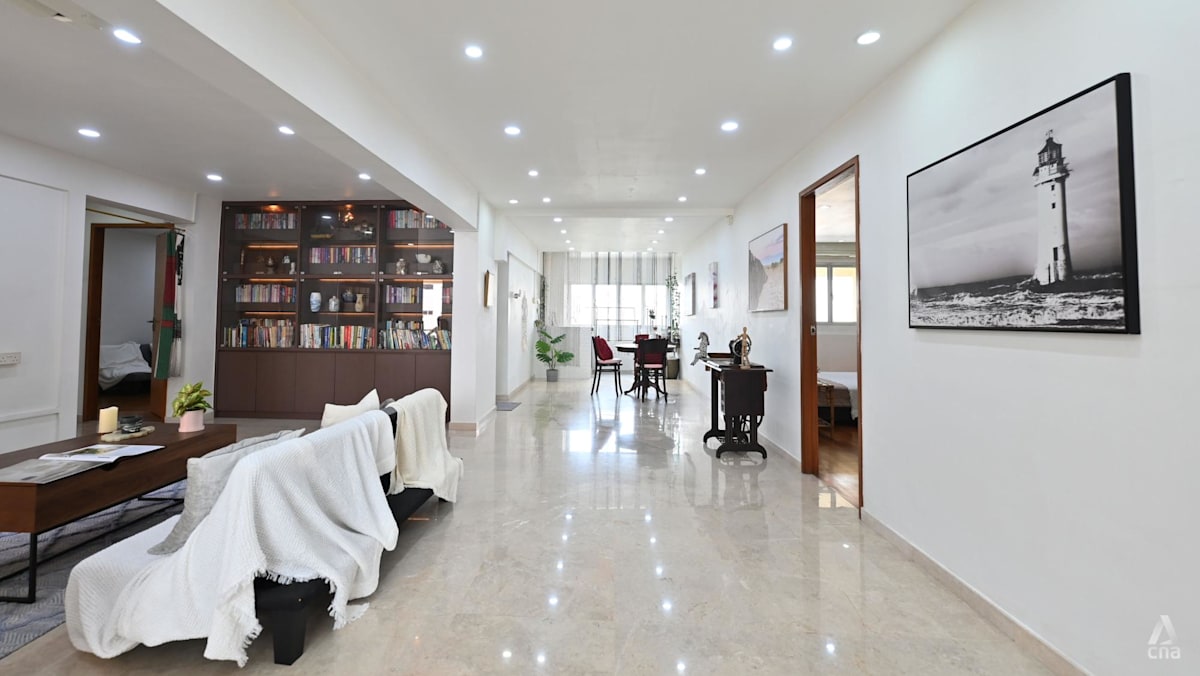
The common area in a Clementi jumbo flat owned by Aileen Tan, Oct 15, 2026. (Photo: CNA/Alyssa Tan)
This audio is generated by an AI tool.
SINGAPORE: When Ms Aileen Tan’s father decided to downsize from his semi-detached house in 2018, he had one condition – his new home had to be spacious enough for his grandchildren to play when they visited, and large enough for the weekend parties he loved to host.
A jumbo flat in Clementi fit the bill - the 1,615 sq ft unit was created by combining a two-room and three-room flat, giving it four rooms and three bathrooms.
After her father died, Ms Tan inherited the flat. Today, the 61-year-old retiree lives in the jumbo flat and rents out two spare rooms for a combined S$3,300 (US$2,580) a month.
“There's plenty of storage and room for my books and a very large kitchen, so we sometimes can have parties and cookouts. I have a little spa room,” said Ms Tan.
CNA Games Guess Word Crack the word, one row at a time Buzzword Create words using the given letters Mini Sudoku Tiny puzzle, mighty brain teaser Mini Crossword Small grid, big challenge Word Search Spot as many words as you can Show More Show Less “It's very, extremely comfortable. I cannot think of anything more that I would want from a home.” Her jumbo flat is rare. It is one of an estimated 2,900 such flats created by merging two complete units into one – that is about 0.25 per cent of the over 1.1 million flats in Singapore. Their generous living space and rarity have at times translated to eye-watering asking prices. In September, a 1,465 sq ft jumbo flat in Telok Blangah was listed for S$2.18 million on PropertyGuru, prompting the Housing and Development Board (HDB) to announce it would review the flat conversion scheme , which allows eligible owners to combine adjoining HDB units. The asking price has since been lowered to S$1,999,999. At the same time, shorter leases, financing and a limited pool of potential buyers can add to the challenges of selling such homes. “This jumbo flat market is niche and could be illiquid, meaning subsequent resales could be harder,” said Professor Sing Tien Foo, Provost's Chair Professor of the Department of Real Estate at the National University of Singapore (NUS). While jumbo flats in good locations can “command substantial premiums”, less well-located and older units could be more difficult to sell, he added.
“It's very, extremely comfortable. I cannot think of anything more that I would want from a home.”
Her jumbo flat is rare. It is one of an estimated 2,900 such flats created by merging two complete units into one – that is about 0.25 per cent of the over 1.1 million flats in Singapore.
Their generous living space and rarity have at times translated to eye-watering asking prices. In September, a 1,465 sq ft jumbo flat in Telok Blangah was listed for S$2.18 million on PropertyGuru, prompting the Housing and Development Board (HDB) to announce it would review the flat conversion scheme , which allows eligible owners to combine adjoining HDB units.
The asking price has since been lowered to S$1,999,999.
At the same time, shorter leases, financing and a limited pool of potential buyers can add to the challenges of selling such homes.
“This jumbo flat market is niche and could be illiquid, meaning subsequent resales could be harder,” said Professor Sing Tien Foo, Provost's Chair Professor of the Department of Real Estate at the National University of Singapore (NUS).
While jumbo flats in good locations can “command substantial premiums”, less well-located and older units could be more difficult to sell, he added.
Aileen Tan, owner of a jumbo flat in Clementi, posing in her living room on Oct 15, 2026. (Photo: CNA/Alyssa Tan)
MORE SPACE AND FLEXIBILITY
HDB first began combining adjoining flats in the late 1980s due to an oversupply of unsold flats in several new towns then, such as Woodlands, Yishun and Bedok, said Prof Sing.
In 1993, the flat conversion scheme was introduced to let households needing more living space combine their flats.
“The scheme gave flexibility to families whose housing needs had expanded but who wanted to stay in their existing neighbourhood and social networks,” he said.
Today, supply is limited as HDB no longer offers jumbo flats, and new flats would only be available if flat owners find adjoining units suitable for merging when conditions are met.
Property agent Thomas Tong, who listed the Telok Blangah jumbo flat, said going through the flat conversion scheme requires a lot of “timing and luck”.
For one, home owners can only buy their neighbour’s unit after fulfilling their minimum occupation period (MOP), then meet the new MOP before they can sell their jumbo flat.
“A combination of all these things makes jumbo (flats) rare, hard to find, and they don't come by easily,” he said.
Mr Tong said he has received a “ridiculous” number of enquiries on the Telok Blangah listing as its long remaining lease of 91 years sets it apart from other jumbo flats, which tend to be older. In Singapore, public housing units have a 99-year lease before they are returned to the government.
Buyers value jumbo flats because of the space they offer, he said.
“(It) means I have a bigger space. If I don't need the space, I can rent it out. If I need the space, I can use it as a store. If my kids decide to come and want to stay with me, I can have it all,” he said.
It was this flexibility that interior designer Vivian Wang had in mind when searching for her first flat this year. The 30-year-old permanent resident, who currently lives with her husband and his parents in a rented flat in Bishan, specifically sought out a jumbo flat.
As her parents-in-law are foreigners and cannot buy their own, the family has to live in one house.
But they have different lifestyles – Ms Wang and her husband enjoy eating out and late nights while his parents prefer to cook and stay in.
“It is a lifestyle that is very different. So I want to find a jumbo flat so we can live separately, become like two units, but we still can share the common area,” she said.
It was a challenge to find a jumbo flat that had an ideal layout and was in a location they preferred.
Most of the jumbo flats she came across were in estates such as Woodlands and Bedok, Ms Wang said.
The couple eventually bought a 1,600 sq ft jumbo flat in Bendemeer for S$940,000 earlier this year.
It has about 46 years left on the lease, meaning the property’s value could fall as the lease term shortens. But that is not a drawback for Ms Wang, who said they have no intention of selling the flat.
REALITIES OF SELLING
For jumbo flat home owners, selling can come with its own set of challenges.
Despite Ms Tan’s affection for her jumbo flat, she hopes to sell the place, which has about 56 years left on the lease.
“Initially, I didn't intend to sell the place. It has memories of my dad here. It's providing very good income with the tenants, and it's very spacious, lots of room, so my children can come back and visit,” she said.
But circumstances have changed, she said. Both her children are based overseas, and Ms Tan sees herself travelling to meet them more often for long periods of time.
Her house is listed for about S$1.1 million, and has been on the market for over a year.
In the first five months, there were only two enquiries and two viewings. The lifting of the 15-month wait-out period in July has helped, she said, with the house now receiving multiple viewings a week.
With the removal of the wait-out period, private property owners can buy any size non-subsidised HDB resale flat immediately without waiting, as long as they do not take an HDB loan.
Prof Sing said demand for jumbo flats has become more selective, appealing to those with large families and who need more space.
Additionally, many jumbo flats created in the late 1980s and 1990s are in less central locations and face significant lease decay , which may soften demand, he added.
Willing buyers may also not translate to a successful sale; property agent Mr Tong said the challenge often comes in financing such a property, which is often older and comes with a higher price tag.
The older a property is, the shorter its remaining lease. This may affect a buyer’s ability to finance the purchase, as a shorter remaining lease can limit the amount that they can borrow from the bank or the Central Provident Fund (CPF) savings they can use.
“So, regardless of whether or not it's valuable, the value might not match the price that people can afford. So a buyer might want to buy a jumbo … they are willing to pay, but they cannot take a loan,” he said.
Rafael Shah Adam and Ann Baki, owners of a jumbo flat in Woodlands, posing at the balcony area of their flat, Oct 23, 2026. (Photo: CNA/Alyssa Tan)
For jumbo flat owners Rafael Shah and Ann Baki, the challenge was about finding the right buyer and aligning timelines.
The couple first bought their jumbo flat for S$650,000 in 2012 after getting married. They were drawn to the huge space it offered, which was ideal for hosting family and friends.
After having children, Mr Shah and Ms Baki spent about S$100,000 to renovate and partition the approximately 1,900 sq ft home to create separate living areas for themselves and Mr Shah's mother, allowing them to live together while maintaining privacy.
The couple listed their flat in 2018, hoping to move closer to the central area, but eventually decided against selling it as they could not find a suitable replacement home. They put it on the market again this year in hopes of moving closer to their daughter’s primary school in the east.
But they found that their dual-key arrangement – with two kitchens, two living areas and separate entrances connected by a shared corridor – did not appeal to everyone.
“Means to say they don't want the dual-key stuff, so they wanted the space. And out of 10, maybe one of the buyers actually (said), ‘oh, okay, this might work for me’,” said Mr Shah, who works in the hospitality industry.
“So the pool of buyers for us, we’re looking very specific. We wanted those people who either want a passive income or families that want to live together but separately,” the 47-year-old added.
Although they received a “healthy number” of enquiries and eventually found a buyer willing to offer close to their expected price of S$1.2 million, the sale did not proceed.
The buyer could only move in a year later, which meant the family would have to endure long daily commutes when their daughter entered primary school in January.
Ann Baki in the kitchen of her Woodlands jumbo flat, Oct 23, 2026. (Photo: CNA/Alyssa Tan)
Mr Shah and Ms Baki have since decided to hold off the sale and rent out part of their flat for about S$3,500 a month, while renting a private property in the east. His mother will continue to stay in the flat.
The couple said they are not concerned about selling the house in the future.
“I believe there's always a buyer in any home … but it is whether you can reach the (price) expectation or not,” Ms Baki, 39, said.
Prof Sing said that asking prices do not indicate market value.
“The S$2 million record could only become reality if a willing buyer completes a transaction at or near that price. Otherwise, the listing reflects the seller's optimism and niche demand, not a fundamental repricing of the jumbo flat market,” he said.
In a parliamentary reply in October, the Ministry of National Development said there were a total of 408 resale transactions of converted flats between 2016 and 2025. In 2025, the median resale price was S$910,000.
THE FUTURE OF JUMBO FLATS
HDB has not disclosed details about its review, including what it entails and when it will be completed.
Prof Sing said the scheme could be tightened to prevent conversions from causing significant price inflation in resale markets, which could have unintended spillover effects on surrounding flats.
“The conversion scheme and jumbo flats were introduced during the oversupply period, and the scheme needs to be reviewed; it may no longer be relevant in today's market, when resale flat prices have increased significantly,” he added.
While the future of the conversion scheme remains uncertain, existing jumbo flat owners said the appeal of these homes goes beyond their potential resale value.
For Ms Tan, her jumbo flat would be the “perfect forever home” – if not for her frequent travels.
“But since I'm not here most of the time, it makes sense to leave this home to other families who need it, who need the space, and would appreciate it more,” she said.
Get our pick of top stories and thought-provoking articles in your inbox
Stay updated with notifications for breaking news and our best stories
Join our channel for the top reads for the day on your preferred chat app
由于建屋发展局正在审查组屋改建计划,以创建超大型组屋,CNA采访了此类组屋的业主,了解额外空间的吸引力以及额外成本。
2026年10月15日,位于金文泰的一套大型组屋的公共区域,该组屋所有者为陈爱玲(Aileen Tan)。(图片:CNA/陈爱玲)
这段音频由人工智能工具生成。
新加坡:2018 年,当 Aileen Tan 女士的父亲决定从他的半独立式住宅搬到较小的房子时,他提出了一个条件——他的新家必须足够宽敞,以便他的孙辈们来访时可以玩耍,并且足够大,可以举办他喜欢的周末派对。
克莱门蒂的一套超大公寓符合要求——这套 1615 平方英尺的公寓是由一套两房式公寓和一套三房式公寓合并而成,共有四个房间和三个浴室。
父亲去世后,谭女士继承了这套公寓。如今,这位61岁的退休人士住在这套超大公寓里,并将两间空房出租,每月租金共计3300新元(约合2580美元)。
“这里储物空间充足,可以放我的书,厨房也很大,所以我们有时会举办派对和烧烤。我还有一个小小的水疗室,”谭女士说。
CNA游戏 猜词游戏 逐行破解单词 流行词游戏 用给定的字母组成单词 迷你数独 小谜题,脑力挑战 迷你填字游戏 小方格,大挑战 单词搜索 尽可能多地找出单词 显示更多 显示更少 “这里非常非常舒适。我想不出还有什么比这更适合我的家了。” 她的超大单位非常罕见。据估计,新加坡约有2900套这样的单位,是由两个完整的单位合并而成——约占新加坡110多万套组屋的0.25%。它们宽敞的居住空间和稀缺性有时会导致令人咋舌的要价。今年9月,一套位于直落布兰雅(Telok Blangah)的1465平方英尺的超大单位在PropertyGuru网站上以218万新元的价格挂牌出售,促使建屋发展局(HDB)宣布将审查组屋合并计划,该计划允许符合条件的业主合并相邻的组屋单位。该房产的要价已降至1,999,999新元。与此同时,较短的租赁期限、融资方式以及潜在买家数量有限等因素,都增加了此类房产的销售难度。“这种大型组屋市场属于小众市场,流动性可能较差,这意味着后续转售可能会更加困难,”新加坡国立大学(国大)房地产系教务长讲席教授宋天福(Sing Tien Foo)表示。他补充说,虽然地段优越的大型组屋可以“获得相当可观的溢价”,但位置较差或房龄较老的组屋则可能更难出售。
“这里非常非常舒适。我想不出还有什么比这更让我心仪的房子了。”
她的超大型公寓非常罕见。据估计,新加坡约有2900套这样的公寓,是由两套完整的单元合并而成——这大约占新加坡110多万套公寓的0.25%。
这些组屋宽敞的居住空间和稀缺性有时会导致令人咋舌的要价。今年9月,一套位于直落布兰雅(Telok Blangah)的1465平方英尺(约136平方米)的超大组屋在房地产网站PropertyGuru上挂牌出售,标价218万新元,促使建屋发展局(HDB)宣布将重新审视组屋改建计划。该计划允许符合条件的业主将相邻的组屋单位合并。
要价现已降至 1,999,999 新元。
与此同时,较短的租期、融资以及潜在买家数量有限等因素,都会增加出售此类房屋的挑战。
“这种巨型组屋市场属于小众市场,流动性可能较差,这意味着后续转售可能会更加困难,”新加坡国立大学房地产系教务长讲席教授宋天福教授表示。
他补充说,虽然位置优越的大型公寓可以“获得相当高的溢价”,但位置较差和较老的公寓可能更难出售。
2026年10月15日,金文泰一套巨型组屋的业主陈爱玲在自家客厅拍照。(图片:CNA/Alyssa Tan)
更大的空间和灵活性
辛格教授表示,由于兀兰、义顺和勿洛等几个新市镇当时存在大量未售出的组屋,建屋发展局(HDB)于 20 世纪 80 年代末开始合并相邻的组屋。
1993年,政府推出了公寓改建计划,允许需要更多居住空间的家庭合并他们的公寓。
他说:“该计划为那些住房需求增加但又想留在现有社区和社交网络中的家庭提供了灵活性。”
如今,由于建屋发展局不再提供巨型组屋,供应有限;只有在满足条件的情况下,组屋业主才能找到适合合并的相邻单位,从而获得新的组屋。
负责代理直落布兰雅巨型组屋的房产经纪人 Thomas Tong 表示,通过组屋改建计划需要很多“时机和运气”。
首先,业主只有在满足最低居住年限 (MOP) 后才能购买邻居的单位,然后在满足新的最低居住年限后才能出售自己的巨型组屋。
他说:“所有这些因素加在一起,使得巨型(公寓)变得稀少、难找,而且不容易获得。”
唐先生表示,由于直落布兰雅组屋剩余91年的地契期限使其与其他通常较老的大型组屋截然不同,因此他收到了“数量惊人”的询价。在新加坡,公共组屋的地契期限为99年,之后将归还政府。
他说,买家看重超大户型公寓是因为它们提供的空间。
“(这)意味着我拥有更大的空间。如果我不需要这个空间,我可以把它出租。如果我需要这个空间,我可以把它用作商店。如果我的孩子们决定来和我一起住,我也可以拥有这一切,”他说。
正是这种灵活性,让室内设计师王薇薇在今年寻找她的第一套公寓时格外看重。这位30岁的永久居民目前与丈夫和公婆租住在碧山的一套公寓里,她特意寻找的是一套超大户型的公寓。
由于她的公婆是外国人,买不起自己的房子,所以一家人只能挤在一栋房子里。
但他们的生活方式不同——王女士和她的丈夫喜欢外出就餐和熬夜,而他的父母则更喜欢在家做饭和待在家里。
“这是一种截然不同的生活方式。所以我想要找一套超大户型的公寓,这样我们就可以分开居住,就像两个独立的单元一样,但仍然可以共享公共区域,”她说。
找到一套户型理想、位置也符合他们心意的超大公寓并非易事。
王女士说,她遇到的超大型组屋大多位于兀兰和勿洛等住宅区。
今年早些时候,这对夫妇最终以 94 万新元的价格在 Bendemeer 购买了一套 1600 平方英尺的超大公寓。
这套房产的剩余租期约为46年,这意味着随着租期缩短,房产价值可能会下降。但这对于王女士来说并非坏事,她说他们没有出售这套公寓的打算。
销售的现实
对于超大型公寓的业主来说,出售房产可能会面临一系列独特的挑战。
尽管谭女士很喜欢她的超大公寓,但她希望卖掉这套房子,该公寓还有大约 56 年的租约到期。
“起初我并没有打算卖掉这栋房子。这里承载着我父亲的回忆。它现在租金收入很好,而且房子很宽敞,有很多空间,所以我的孩子们可以经常回来探望,”她说。
但她表示,情况已经发生了变化。她的两个孩子都在海外生活,谭女士预计自己会更频繁地、长时间地与他们见面。
她的房子标价约110万新元,已经上市一年多了。
前五个月只有两份咨询和两次看房。她说,7月份取消15个月的等待期后情况有所好转,现在这套房子每周都有好几组人来看房。
取消等待期后,私人房产业主可以立即购买任何大小的非补贴组屋转售组屋,无需等待,只要他们不申请建屋发展局贷款即可。
辛格教授表示,人们对巨型组屋的需求变得更加挑剔,更受大家庭和需要更大空间的人们的青睐。
此外,他还补充说,上世纪 80 年代末和 90 年代建造的许多大型公寓楼位置不太中心,而且面临着严重的租约到期损耗,这可能会削弱需求。
即使有购买意愿,也不一定能成功售出;房产经纪人童先生表示,挑战往往在于如何为这类房产融资,因为这类房产通常比较老旧,价格也更高。
房产房龄越老,剩余租赁期限越短。这可能会影响买家的融资能力,因为剩余租赁期限越短,他们能从银行贷款的金额或可使用的公积金(CPF)储蓄就越少。
“所以,无论它是否有价值,其价值可能与人们能够承受的价格不符。例如,买家可能想买一辆巨型卡车……他们愿意支付,但他们无法贷款,”他说。
2026年10月23日,兀兰一套超大型组屋的业主拉斐尔·沙阿·亚当和安·巴基在自家阳台上合影。(图片:CNA/Alyssa Tan)
对于巨型公寓的业主 Rafael Shah 和 Ann Baki 来说,挑战在于找到合适的买家并协调好时间安排。
这对夫妇在2012年结婚后,以65万新元的价格买下了这套超大户型公寓。他们被公寓宽敞的空间所吸引,这非常适合招待亲朋好友。
沙先生和巴基女士在有了孩子之后,花费了大约 10 万新元对这栋约 1900 平方英尺的房子进行了翻新和隔断,为自己和沙先生的母亲创造了独立的居住区域,使他们既能住在一起,又能保持隐私。
这对夫妇于2018年挂牌出售他们的公寓,希望能搬到市中心附近,但最终由于找不到合适的房子而放弃了出售。今年,他们再次将公寓挂牌出售,希望能搬到东部,离女儿的小学更近一些。
但他们发现,他们的双钥匙布局——两个厨房、两个起居区和独立入口,通过一条共用走廊连接——并不是每个人都喜欢。
“这意味着他们不想要双钥匙公寓,所以他们想要的是空间。十个买家里,可能只有一个人会说,‘哦,好吧,这可能适合我’,”在酒店行业工作的沙阿先生说道。
“所以我们的目标买家群体非常明确。我们想要的是那些想要被动收入的人,或是想要住在一起但又各自拥有独立空间的家庭,”这位47岁的男子补充道。
尽管他们收到了“相当多的”询价,并且最终找到了一位愿意出价接近他们预期价格 120 万新元的买家,但交易并未完成。
买家只能在一年后才能入住,这意味着当他们的女儿在一月份上小学时,一家人将不得不忍受每天漫长的通勤。
2026年10月23日,安·巴基在她位于兀兰的超大型组屋厨房里。(图片:CNA/Alyssa Tan)
沙先生和巴基女士决定暂缓出售房产,将部分公寓以每月约3500新元的价格出租,同时在东部租住一处私人房产。他的母亲将继续住在公寓里。
这对夫妇表示,他们并不担心将来出售这栋房子。
“我相信任何房子总会有买家……但关键在于你是否能达到(价格)预期,”39岁的巴基女士说。
辛格教授表示,要价并不代表市场价值。
“只有当有买家愿意以接近或等于200万新元的价格完成交易时,200万新元的成交价纪录才能成为现实。否则,这笔交易反映的是卖家的乐观情绪和特定市场需求,而不是大型组屋市场价格的根本性调整,”他说道。
国家发展部在10月份的国会答复中表示,2016年至2025年间,共有408套改建组屋的转售交易。2025年,转售价格中位数为91万新元。
巨型公寓的未来
建屋发展局尚未披露其审查的详情,包括审查内容和完成时间。
辛格教授表示,可以收紧该计划,以防止改建导致转售市场价格大幅上涨,从而对周边组屋产生意想不到的溢出效应。
“房屋改建计划和巨型组屋是在房屋供应过剩时期推出的,现在需要重新审视该计划;鉴于二手组屋价格大幅上涨,该计划可能已不再适用于当今市场,”他补充道。
尽管改造计划的未来仍不明朗,但现有的巨型公寓业主表示,这些房屋的吸引力不仅仅在于其潜在的转售价值。
对于谭女士来说,如果不是因为她经常出差,她的超大公寓将是“完美的永久住所”。
“但由于我大部分时间都不在这里,所以把这栋房子留给其他需要它、需要空间、并且会更加珍惜它的家庭,才是更明智的选择,”她说。
订阅我们的邮件,即可获取精选热点新闻和引人深思的文章。
订阅通知,第一时间获取突发新闻和精彩报道。
加入我们的频道,即可在您常用的聊天应用上获取当日热门文章。