Lebanon’s military stagnates amid economic turmoil, Hezbollah influence黎巴嫩军方在经济动荡和真主党影响下停滞不前
Lebanon’s military is working with a U.N.-led force to improve security, but economic and political factors are hindering these efforts, analysts say.
BEIRUT — The Lebanese militant group Hezbollah has exchanged near-daily strikes with Israeli forces near the border region for almost seven months in the wake of Israel’s war against Hamas in Gaza.
And while Lebanon’s national military is working closely with a United Nations-led force to deescalate tension and improve border security, economic and political factors are hindering these efforts, analysts have told Defense News.
The Lebanese Armed Forces, or LAF, is struggling to fulfill its mission due to Hezbollah’s “position in national politics, the spillover effects of the Syrian and Gazan conflicts, the severe and prolonged economic depression and an ongoing governance crisis,” according to the International Institute for Strategic Studies, a London-based think tank.
Formed in 1982, Hezbollah is an Iran-backed armed group and also a Shiite political party in Lebanon. The U.S. considers the organization a terrorist group.
In the years leading up to Lebanon’s 1975-1990 civil war and throughout the conflict, the presence of militant groups affiliated with sectarian parties grew. The sectarian leaders themselves preferred to create their own armed groups instead of empowering a government institution with the mandate to defend the whole country, according to Dina Arakji, a defense analyst with the Middle East Institute think tank.
Hezbollah members stand in formation during a gathering in Beirut's southern suburb on April 5, 2024. (Anwar Amro/AFP via Getty Images)
In October 2019, Lebanon was plunged into a severe financial crisis, stemming from decades of corruption and mismanagement by a political class that has ruled the country since the end of the civil war. The state of the economy was further exacerbated by the COVID-19 pandemic and the deadly Port of Beirut explosion in August 2020, per the World Bank.
The government has predominantly allocated its defense budget to salaries and benefits over the last two decades, limiting procurement programs. The situation is worsened by the absence of a political will to empower the military, Arakji told Defense News.
Hassan Jouni, a former Lebanese Armed Forces brigadier general who now works in academia, agreed.
“There is no accordance neither in politics, nor in strategy. We lack a national view,” Jouni told Defense News.
While the military does have governmental support, Jouni added, some perceive it as weak and unable to defend the country’s borders, “especially people in south Lebanon, who have firsthand experience with the Israeli threat.”
Since the 2019 economic collapse, foreign security assistance to the LAF has largely focused on supporting and sustaining existing capabilities, including providing the force with spare parts for its equipment, Arakji noted.
Until recently made up of approximately 80,000 troops, the military likely lost about 7,000 personnel due to early retirement and a failure to adjust salaries following the economic crash, according to Jouni. To avoid mass resignation, the military allowed personnel to work other jobs, such as driving for ride-hailing services.
“When I was commander of the Staff College, the yearly budget used to be around $160,000 for approximately 100, between trainers and students. After the collapse, it went down to $10,000,″ Jouni said.
An armored vehicle with the U.N. interim force in Lebanon patrols a coastal road in the country's south on April 17, 2024, amid cross-border tension as fighting continues between Israel and Palestine-based Hamas militants. (AFP via Getty Images)
In current U.S. dollars, Lebanon went from a $2 billion defense budget in 2019 to a $432 million fund in 2020, after the economy crashed, according to data from the Stockholm International Peace Research Institute, a Swedish think tank. Its 2023 defense budget dropped to $241 million.
“The LAF remains dependent on foreign support to replace and modernise its ageing equipment. Lebanon has no significant domestic defence industry,” the IISS think tank wrote in a February report analyzing militaries around the world.
Amid its financial troubles, the military lacks advanced air defense systems that would defend against the increased proliferation of drones and missiles in modern warfare. However, “the LAF has some capabilities that Hezbollah does not, and most of those are derived from the fact that the LAF is a conventional military, whereas Hezbollah remains fundamentally an asymmetric paramilitary force,” said Aram Nerguizian, a Middle East military expert at the U.S.-based Center for Strategic and International Studies think tank.
He noted the military fields the A-29 Super Tucano plane and the MD-530F+ helicopter for light attack capabilities and to fulfill intelligence, surveillance and reconnaissance missions. Both aircraft types can deploy U.S.-supplied weapons systems that let the force launch precision strikes against soft, high-value targets.
He pointed to the military’s drone fleet, which includes the Boeing Insitu ScanEagle provided by the United States. The force has also significantly expanded its artillery inventory with the M109A5 self-propelled howitzer.
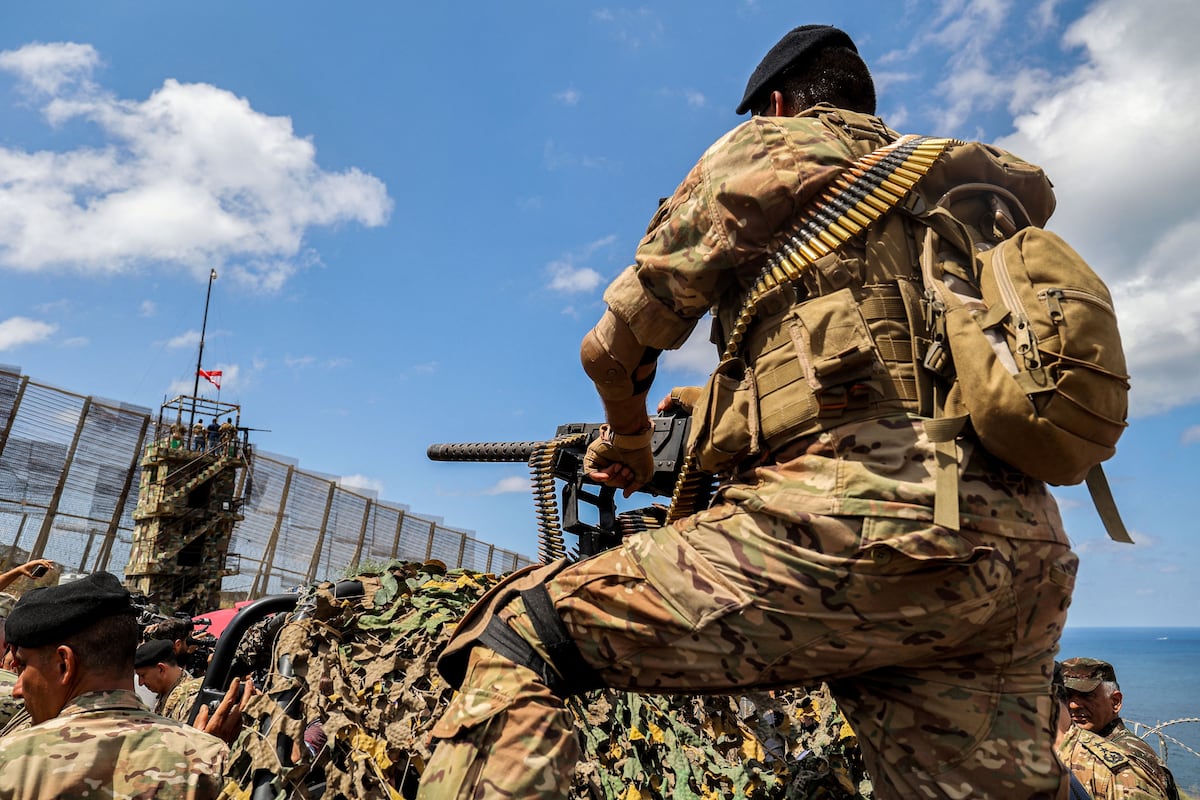
Lebanese soldiers, equipped with turrets on military vehicles, patrol the country's southern border on Aug. 8, 2023. (Anwar Amro/AFP via Getty Images)
In addition, some LAF units, such as the special forces , have counterterror and warfare experience, and they receive training abroad. Indeed, Lebanon’s armed forces are one of the most operationally capable among Arab militaries, Nerguizian said. As an example, he cited the military’s response to the threat of the Islamic State group along the border with Syria from 2014 to 2017.
“The U.S. military looks at the LAF as the only case of a national military in the Middle East decisively defeating and ejecting ISIS,” he told Defense News.
The United States is a major financial contributor to Lebanon’s security . Since 2006, the U.S. has provided more than $5.5 billion in total foreign assistance to Lebanon, according to the U.S. State Department, with more than $3 billion meant to boost the military and security as well as counter Hezbollah’s influence.
“The Lebanese security environment is not organized the way you would have it in Jordan or Egypt in terms of the bilateral relationships. For example, there is no explicit U.S.-Lebanon state-to-state military relationship. It’s a U.S.-LAF military-to-military relationship,” Nerguizian said.
Together with Qatar, the U.S. also helps pay the salaries of security personnel.
America’s support signals its confidence the Lebanese military is “an innovative and adaptable partner in a complicated region” Nerguizian said. But this commitment remains subject to periodical review, and is vulnerable to the ebbs and flows of U.S. politics.
Still, there are other sources of foreign aid, Jouni noted: NATO members, such as the U.K., support Lebanese special units; Italy trains Lebanese forces on military combat techniques; and Canada provides winter weather training and the necessary equipment for such conditions.
The British, American, Italian and Canadian embassies in Lebanon did not respond to requests for comment. The Lebanese Army also did not respond to Defense News’ inquiries.
However, Kai Zimmermann, a military official with the German Embassy in Beirut, told Defense News the country has supported the LAF as part of the Enable and Enhance Initiative started in 2017, with a focus on rebuilding the military infrastructure in the port of Beirut as well as strengthening the Lebanese Navy’s training activities and ability to deploy vessels at sea.
For Jouni, the LAF faces two challenges: defending itself against Israel and countering the threat of terrorism.
“When we talk about [the] Israeli threat, we talk about the implementation of the Resolution 1701,″ the former officer said, referring to the U.N.’s call to end the 2006 conflict between Hezbollah and Israel.
It also encouraged the deployment of 15,000 Lebanese troops along the southern border with Israel , although the military contingent there currently numbers about 5,000, according to Abdallah Bou Habib, Lebanon’s foreign minister, who spoke to the Lebanese daily newspaper L’Orient-Le Jour.
Indeed, there’s support among the partners of Lebanon and Israel for “an expanded and consolidated LAF deployment” along the U.N.-drawn border demarcation line, Nerguizian said, adding that this is also preferable to the Israel Defense Forces and would benefit the region, within a larger international framework.
A house lies in ruins in the border village of Kafr Shuba in southern Lebanon following an Israeli strike on April 27, 2024. (Rabih Daher/AFP via Getty Images)
One of the LAF’s missions is to fully implement that U.N. resolution, preferably “in a nonconfrontational way,” Jouni said; others include neutralizing the threat of militias and resistance groups as well as uniting a divided population. Failure to achieve these aims could lead to further conflict, Jouni said, and the force can only reach its goals with “a military and defense strategy, backed by a political vision.”
“There are events happening in the Middle East that are relatively routine and predictable,” Nerguizian said.
“Then you have once-in-a-generation, but potentially dramatic, changes,” he added, citing Hamas’ attack on Israel in early October, and before that the formation of Hezbollah, “which ultimately led to a tectonic change.”
According to the expert, Lebanon’s military proactively understood the scale of potential change to come, more so than any other Lebanese institution or faction.
However, “the only missing element is the national political willpower to commit the LAF to its national security duties,” Nerguizian said. Without this, Lebanon risks remaining unprepared for these rare but significant events.
The Associated Press contributed to this report.
Agnese Stracquadanio is a Middle East correspondent for Defense News. She has a background in writing and photojournalism, holds a master's degree in international relations, and previously worked for Reuters.
贝鲁特——在以色列对加沙地带的哈马斯发动战争后的近七个月里,黎巴嫩真主党武装组织与以色列军队在边境地区附近几乎每天都发生袭击事件。
分析人士告诉《防务新闻》,虽然黎巴嫩国家军队正与联合国领导的部队密切合作,以缓和紧张局势并改善边境安全,但经济和政治因素正在阻碍这些努力。
据总部位于伦敦的智库国际战略研究所称,由于真主党在国家政治中的地位、叙利亚和加沙冲突的溢出效应、严重且持续的经济萧条以及持续的治理危机,黎巴嫩武装部队(LAF)难以完成其使命。
真主党成立于1982年,是伊朗支持的武装组织,也是黎巴嫩的一个什叶派政党。美国将其视为恐怖组织。
在黎巴嫩1975年至1990年内战爆发前的几年以及整个冲突期间,与宗派政党有关联的武装团体势力日益壮大。中东研究所的国防分析师迪娜·阿拉克吉指出,宗派领导人更倾向于组建自己的武装团体,而不是赋予政府机构保卫全国的权力。
2024年4月5日,真主党成员在贝鲁特南部郊区集会时列队站立。(Anwar Amro/AFP via Getty Images)
2019年10月,黎巴嫩陷入严重的金融危机,其根源在于自内战结束以来一直统治该国的政治阶层数十年的腐败和管理不善。据世界银行称,新冠疫情和2020年8月贝鲁特港口发生的致命爆炸进一步加剧了黎巴嫩的经济困境。
过去二十年来,政府将国防预算主要用于支付薪金和福利,限制了采购项目。阿拉克吉告诉《防务新闻》,缺乏赋予军队更大权力的政治意愿,使情况更加恶化。
曾在黎巴嫩武装部队担任准将、现在从事学术研究的哈桑·朱尼对此表示赞同。
“无论是在政治上还是战略上,我们都缺乏共识。我们缺乏国家视角,”朱尼告诉《防务新闻》。
朱尼补充说,虽然军方得到了政府的支持,但有些人认为军方软弱无力,无法保卫国家边境,“特别是黎巴嫩南部的人们,他们亲身经历了以色列的威胁。”
阿拉克吉指出,自 2019 年经济崩溃以来,外国对拉各斯武装部队的安全援助主要集中在支持和维持现有能力上,包括为该部队提供装备的备件。
据尤尼称,这支军队此前约有8万人,但由于提前退休以及经济危机后未能及时调整薪资,可能流失了约7000名人员。为了避免大规模辞职,军方允许人员从事其他工作,例如为网约车平台开车。
“我担任参谋学院院长时,学院的年度预算约为16万美元,供大约100名教员和学员使用。破产后,预算骤降至1万美元,”朱尼说道。
2024年4月17日,在以色列和巴勒斯坦哈马斯武装分子之间的冲突持续升级、跨境局势紧张之际,一辆隶属于联合国驻黎巴嫩临时部队的装甲车在黎巴嫩南部沿海公路巡逻。(法新社/盖蒂图片社)
根据瑞典智库斯德哥尔摩国际和平研究所的数据,以当前美元计算,黎巴嫩的国防预算从2019年的20亿美元锐减至2020年的4.32亿美元,原因是该国经济崩溃。预计其2023年的国防预算将进一步降至2.41亿美元。
国际战略研究所(IISS)在2月份一份分析世界各国军队的报告中写道:“黎巴嫩武装部队仍然依赖外国援助来更换和更新其老旧装备。黎巴嫩没有重要的国内国防工业。”
由于财政困境,黎巴嫩武装部队缺乏先进的防空系统来应对现代战争中无人机和导弹日益增多的威胁。然而,美国战略与国际研究中心的中东军事专家阿拉姆·内尔吉兹安表示:“黎巴嫩武装部队拥有一些真主党所不具备的能力,而这些能力大多源于黎巴嫩武装部队是一支常规军队,而真主党本质上仍然是一支非对称准军事部队。”
他指出,军方部署了A-29“超级巨嘴鸟”攻击机和MD-530F+直升机,用于轻型攻击以及执行情报、监视和侦察任务。这两种机型均可搭载美国提供的武器系统,使部队能够对高价值的软目标进行精确打击。
他指出,军方拥有包括美国提供的波音公司Insitu ScanEagle无人机在内的无人机机队。此外,军方还大幅扩充了火炮装备,引进了M109A5自行榴弹炮。
2023年8月8日,黎巴嫩士兵驾驶装有炮塔的军用车辆在南部边境巡逻。(Anwar Amro/AFP via Getty Images)
此外,黎巴嫩武装部队的一些单位,例如特种部队,拥有反恐和作战经验,并接受过海外训练。内尔吉齐安表示,事实上,黎巴嫩武装部队是阿拉伯国家军队中作战能力最强的军队之一。他举例说,2014年至2017年期间,黎巴嫩军队曾积极应对伊斯兰国组织在叙利亚边境的威胁。
“美国军方认为,拉各斯武装部队是中东地区唯一一个彻底击败并驱逐ISIS的国家军队,”他告诉《防务新闻》。
美国是黎巴嫩安全的主要财政捐助者。据美国国务院统计,自2006年以来,美国已向黎巴嫩提供了超过55亿美元的对外援助,其中超过30亿美元用于加强黎巴嫩的军事和安全,以及遏制真主党的影响力。
内尔吉齐安说:“黎巴嫩的安全环境与约旦或埃及的双边关系截然不同。例如,美国和黎巴嫩之间没有明确的国家间军事关系,只有美国与黎巴嫩武装部队之间的军事关系。”
美国与卡塔尔共同帮助支付安保人员的工资。
内尔吉齐安表示,美国的支持表明其相信黎巴嫩军队是“一个复杂地区中富有创新精神且适应性强的合作伙伴”。但这一承诺仍需定期评估,并易受美国政治风云变幻的影响。
不过,朱尼指出,还有其他外国援助来源:北约成员国,如英国,支持黎巴嫩特种部队;意大利训练黎巴嫩军队军事作战技术;加拿大提供冬季气候训练和应对此类条件所需的必要设备。
英国、美国、意大利和加拿大驻黎巴嫩大使馆均未回应置评请求。黎巴嫩军方也未回应《防务新闻》的问询。
然而,德国驻贝鲁特大使馆的军事官员凯·齐默尔曼告诉《防务新闻》,德国一直支持黎巴嫩武装部队,这是自 2017 年启动的“赋能与增强倡议”的一部分,重点是重建贝鲁特港的军事基础设施,以及加强黎巴嫩海军的训练活动和海上舰艇部署能力。
尤尼认为,拉脱维亚武装部队面临两大挑战:一是抵御以色列的进攻,二是应对恐怖主义的威胁。
“当我们谈到以色列的威胁时,我们谈论的是第 1701 号决议的执行情况,”这位前军官说道,他指的是联合国呼吁结束 2006 年真主党与以色列之间的冲突。
据黎巴嫩外交部长阿卜杜拉·布·哈比卜在接受黎巴嫩日报《东方日报》采访时表示,该协议还鼓励在黎巴嫩南部与以色列接壤的边境部署 15,000 名黎巴嫩军队,尽管目前驻扎在那里的军事人员约有 5,000 人。
内尔吉齐安表示,黎巴嫩和以色列的合作伙伴确实支持“在联合国划定的边界线沿线扩大和巩固黎巴嫩武装部队的部署”,他还补充说,这对以色列国防军来说也是可取的,并且在更大的国际框架内将有利于该地区。
2024年4月27日,以色列空袭后,黎巴嫩南部边境村庄卡夫尔舒巴的一栋房屋沦为废墟。(Rabih Daher/AFP via Getty Images)
朱尼表示,拉各斯武装部队的任务之一是全面落实联合国决议,最好“以非对抗的方式”进行;其他任务包括消除民兵和抵抗组织的威胁,以及团结分裂的民众。朱尼指出,未能实现这些目标可能导致进一步的冲突,而该部队只有通过“以政治愿景为支撑的军事和国防战略”才能实现其目标。
内尔吉兹安说:“中东正在发生一些相对常规和可预测的事件。”
“然后就会出现一代人一次但可能非常剧烈的变化,”他补充道,并提到了哈马斯在 10 月初对以色列的袭击,以及在此之前真主党的成立,“这最终导致了结构性的变化”。
这位专家表示,黎巴嫩军方比黎巴嫩任何其他机构或派别都更积极主动地认识到未来可能发生的变革规模。
然而,内尔吉齐安表示,“唯一欠缺的是国家政治意愿,即促使黎巴嫩武装部队履行其国家安全职责的决心。” 否则,黎巴嫩将面临应对这些罕见但意义重大的事件时措手不及的风险。
美联社对本报道亦有贡献。
阿格尼斯·斯特拉夸达尼奥是《防务新闻》的中东记者。她拥有写作和摄影新闻背景,持有国际关系硕士学位,此前曾在路透社工作。