Bridge to home ownership: Why Singapore is exploring build-to-rent通往住房所有权的桥梁:新加坡为何探索“先建后租”模式
Singapore explores Build-To-Rent as younger adults seek flexible housing before buying homes Read more at straitstimes.com.
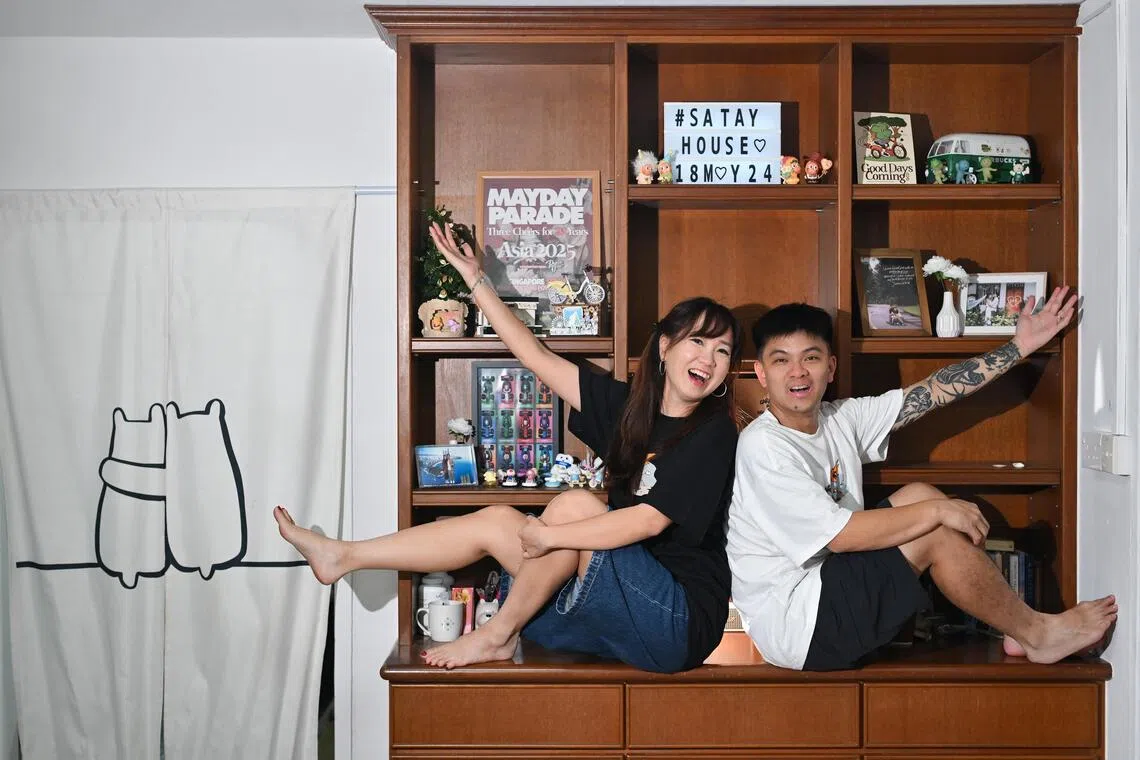
With their BTO flat about three years from completion, Henry Tay and Sarah Tong turned to renting their love nest after they got married in 2024.
ST PHOTO: LIM YAOHUI
Published Nov 02, 2026, 05:00 AM
Updated Nov 02, 2026, 05:00 AM
SINGAPORE – Singaporean couple Henry Tay and Sarah Tong wanted to live on their own immediately after they got married in May 2024.
With their Build-To-Order (BTO) flat in Tanah Merah about three years from completion, they turned to renting their love nest even though it would cost them about 25% of their combined take-home pay.
Home was in two places in the last two years: first, a one-bedroom unit in a Bright Hill condominium, then a three-room flat in Ang Mo Kio. Rent was between $2,200 and $2,500 monthly.
In land-scarce Singapore, renting is often seen as an expensive option that yields no future returns, compared with ownership of a property which increases in value over time.
Yet it made sense to Tay, 36, a freelance photographer, and Tong, 32, a civil servant – having personal space and living close to their workplaces were their top priorities.
“We thought it’s better to start afresh,” said Tong.
In Singapore, a good number of married couples live with one spouse’s family or continue living separately until they get the keys to their BTO flat several years later.
To get their own space sooner, some opt to buy resale HDB flats, which usually cost more than BTO ones, or condo units, if they can afford it.
Tong and Tay’s decision to rent is unusual, but perhaps increasingly less so.
As housing needs and preferences change, the Government has been exploring build-to-rent (BTR) models as part of its efforts to offer more housing options.
“While home ownership remains a key tenet of our housing policy, we recognise that there is demand for flexible, longer-stay rental housing, including from younger Singaporeans who wish to live independently or rent before buying their own home, as well as those who come to Singapore to work or study,” said a Ministry of National Development spokesman.
National Development Minister Chee Hong Tat said in August that the authorities were looking to meet younger Singaporeans’ demand for flexible accommodation such as the BTR model, co-living and long-stay serviced apartments.
BTR an interim option
Sociologist Tan Ern Ser, an adjunct principal research fellow at the Institute of Policy Studies, said that while most Singaporeans are more inclined towards home ownership, having a BTR option could serve as an interim pathway for those who want to have their own private space and to live independently.
“But affordability remains an important consideration, especially (since) the option of living with their parents would certainly be less expensive,” he said.
Tay and Tong said renting came with financial pressures – it could go up to $100,000 over three years, on top of the cost of their $570,000 BTO flat, not to mention the cost of furnishing their rental unit, house-moving fees and utility bills.
But they said it would still be cheaper than buying a resale flat in a good location, which could cost as much as $1 million in some parts of Singapore.
They have cut down on travelling and are eating out less. And to reduce renovation costs for their upcoming BTO flat, they have decided to keep the design simple.
Married couple Henry Tay and Sarah Tong said renting came with financial pressures, but it would still be cheaper than buying a resale flat in a good location, which could cost as much as $1 million in some parts of Singapore. ST PHOTO: LIM YAOHUI
Married couple Henry Tay and Sarah Tong said renting came with financial pressures, but it would still be cheaper than buying a resale flat in a good location, which could cost as much as $1 million in some parts of Singapore.
Eugene Lim, key executive officer of property agency ERA Singapore, said if the BTR model aims to support younger Singaporeans, it needs a clear value proposition compared with traditional rental options.
“To make BTR more accessible for young Singaporeans, offering a discount on the median monthly condominium rent could be effective,” he said, adding that the BTR model could be a public-private partnership similar to the long-stay serviced apartments piloted by the Government in 2023 .
In the first eight months of 2026, the median monthly rent for non-landed residential properties in Singapore was $5.24 per sq ft. Homes in the core central region had the highest median rent at $5.92 psf, while that for the city fringe stood at $5.57 psf and $4.58 psf in the suburbs.
To bolster his point, Lim pointed to the high demand for a recent co-living pilot under the SG Youth Plan . Over 600 Singaporeans aged 21 to 35 showed interest in the more than 100 units, which were priced at about 30% below market rates.
Not only is rental cost high, it can also be unpredicable. Lim noted that rents can be affected by policy measures, such as the 15-month wait-out period for private home owners who wanted to buy a resale flat that was in effect between September 2022 and July 2026. Thereafter, in 2023 and 2024, residential rents increased sharply.
Observers The Straits Times spoke to agreed that implementing a BTR model would not make renting seem more attractive than home ownership, which the Government has pursued as “a key national policy” to give “every Singaporean a stake in the country”, as then Prime Minister Lee Hsien Loong said in 2018.
Sociologist Chua Beng Huat, emeritus professor at the NUS Department of Sociology and Anthropology, said renting tends to be transitory, and renters would likely try to move up the housing ladder and buy a flat when their financial circumstances allow.
Many singles are living with their parents because they cannot afford to move out, and there is pressure by many who want to live independently, hence the introduction of the subsidised co-living pilot, he noted.
“The Government’s sentiments have changed in the past few years, given the increasing pressure of singles wanting to live independently from their families.”
Independent living before marriage
Buying a home was always the goal for Asher Chua, 31, who rented a flat with two friends from 2021 to 2023, before he got married and bought a resale flat with his wife.
He said the sentiment that renting was “throwing away money” that could have gone towards his home purchase put a damper on his decision to rent at first.
But living in his parents’ five-room flat in Jurong West meant Chua, who has three siblings, did not have a bedroom of his own and often needed to study or work in the living room.
So when he managed to save six months’ worth of his monthly income, he looked for a place to rent. He eventually settled on a four-room flat in Pinnacle @ Duxton, paying $1,150 a month for a room without an attached bathroom. The total rent for the unit was $4,000, which he shared with two friends.
“That’s $24,000 I know I won’t get back, but it’s money well spent because I got to experience living independently before marriage,” said Chua, who works in technology.
His rented flat in a central location also meant that he could experience the perks of “city living”, such as being able to cycle to his workplace in the Central Business District, and having many amenities, such as gyms, close by.
“I’m a firm believer that when it comes to money, you can always earn it back. But experiences are something you cannot get back,” he added.
OCBC Bank’s head of wealth advisory Chez Anbu noted that rent adds up. For instance, $1,500 in monthly rent amounts to $54,000 over three years and $90,000 over five years.
“Compared with living at home and contributing $500 a month to family expenses, renting at $1,500 a month could leave a young person with about $60,000 less in savings after five years,” he said.
But he also said living independently can provide valuable benefits, such as privacy, autonomy and the opportunity to develop household and budgeting skills.
Chua said the money spent on renting did not affect the budget for his home purchase. He and his wife agreed that they did not want to fork out any cash for the down payment and monthly mortgage for their purchase – it should be fully covered by their CPF savings.
Their plan worked out. They bought their resale four-room flat in Clementi for $790,000 in 2023. They were also eligible for an $80,000 CPF Housing Grant and a $20,000 Proximity Housing Grant.
Asher Chua said the money spent on renting a room in Pinnacle @ Duxton did not affect the budget for his home purchase. He and his wife bought their resale four-room flat in Clementi for $790,000 in 2023 with their CPF savings. ST PHOTO: GIN TAY
Asher Chua said the money spent on renting a room in Pinnacle @ Duxton did not affect the budget for his home purchase. He and his wife bought their resale four-room flat in Clementi for $790,000 in 2023 with their CPF savings.
Sing Tien Foo, provost’s chair professor of real estate at NUS Business School, said the BTR model will supplement home ownership by meeting the short-term and temporary housing needs of families waiting for their flats to be completed, or those who cannot yet buy flats, such as singles under 35 years old.
“The dominant housing option is still ownership, where families consider buying houses not just to meet consumption needs but also to build housing wealth and provide retirement safety nets.”
Adeline Lim, 37, is currently renting a room in a two-bedroom condo in Sengkang while applying for a BTO flat as a single.
The marketing executive said she moved out of her parents’ home when she was 35 as she wanted to be independent.
“My parents were kind of overbearing,” she said. “I couldn’t truly be independent if I was still living under their roof.”
Her monthly rental of $2,000 is worth the independence, even though it means she has to live with a housemate, she added.
Lim said that despite the rental taking up a substantial portion of her take-home pay, she still has a “comfortable” amount for daily expenses, investments and savings.
Singapore Management University sociology professor Paulin Straughan said social norms have shifted – singles want to experience living independently rather than live with their parents until they get married.
This group would welcome the BTR model, especially if their current living arrangement is tight or if they have tense family relations, she said.
“When you give them a bit more space, and therefore there’s no contest for limited resources in a small home, it may actually ease the family tensions,” she added.
IPS’ Tan added: “If the BTR model is intended to be not just a place to live in, but also a growing community of young people, I reckon it may increase the probability of one meeting one’s life partner. In short, it could be a catalyst for marriage and family formation.”
Isabelle Liew is a journalist at The Straits Times. She covers housing issues in Singapore, with a focus on public housing.
Christine Tan is a correspondent at The Straits Times reporting on social affairs and issues of justice in Singapore.
Property market/sector
Ministry of National Development
Henry Tay 和 Sarah Tong 的预购组屋还有大约三年才能完工,因此他们在 2024 年结婚后选择租房居住。
ST 照片:林耀辉
发布于 2026 年 11 月 2 日 上午 5:00
更新于2026年11月2日 上午5:00
新加坡——新加坡夫妇Henry Tay和Sarah Tong希望在2024年5月结婚后立即开始独立生活。
由于他们在丹那美拉的预购组屋(BTO)还有大约三年才能完工,他们决定将自己的爱巢出租,尽管这会花费他们两人税后收入的约 25%。
过去两年,我的住所有两个:第一个是位于布莱特山(Bright Hill)的一居室公寓,第二个是位于宏茂桥(Ang Mo Kio)的一套三房式组屋。月租金在2200至2500新元之间。
在土地稀缺的新加坡,租房通常被视为一种昂贵的选择,而且没有未来的回报,而拥有房产则会随着时间的推移而增值。
但对于 36 岁的自由摄影师 Tay 和 32 岁的公务员 Tong 来说,这很有意义——拥有个人空间和住在离工作地点近的地方是他们的首要考虑因素。
“我们认为最好重新开始,”童说道。
在新加坡,很多已婚夫妇会与配偶一方的家人同住,或者继续分居,直到几年后拿到预购组屋的钥匙。
为了更快地拥有自己的空间,一些人选择购买转售组屋(通常比预购组屋贵),或者如果经济条件允许,购买公寓。
Tong 和 Tay 决定租房住,这虽然不寻常,但也许正变得越来越不寻常了。
随着住房需求和偏好的变化,政府一直在探索建造出租(BTR)模式,以此作为提供更多住房选择的努力的一部分。
国家发展部发言人表示:“虽然房屋所有权仍然是我们住房政策的关键原则,但我们也认识到,人们对灵活的、长期租赁住房有需求,包括希望独立生活或在购房前租房的年轻新加坡人,以及来新加坡工作或学习的人。”
国家发展部长徐芳达在8月份表示,当局正在寻求满足新加坡年轻人对灵活住宿的需求,例如租赁公寓模式、合租公寓和长期服务式公寓。
BTR 是一种过渡方案
社会学家陈恩瑟(Tan Ern Ser)是政策研究所的兼职首席研究员,他表示,虽然大多数新加坡人更倾向于拥有自己的住房,但对于那些想要拥有自己的私人空间和独立生活的人来说,拥有BTR(购房出租)选项可以作为一种过渡途径。
“但经济承受能力仍然是一个重要的考虑因素,尤其是考虑到和父母一起生活肯定会更便宜,”他说。
Tay 和 Tong 表示,租房会带来经济压力——三年租金可能高达 10 万美元,这还不包括他们价值 57 万美元的预购组屋的费用,更不用说布置出租房的家具费用、搬家费和水电费了。
但他们表示,这仍然比在新加坡某些地段购买二手组屋便宜,二手组屋的价格可能高达 100 万美元。
他们减少了旅行,也减少了外出就餐的次数。为了降低即将入住的组屋的装修成本,他们决定采用简约的设计。
已婚夫妇郑亨利和唐莎拉表示,租房虽然会带来经济压力,但仍然比在新加坡某些地段购买二手组屋便宜,后者价格可能高达100万新元。(海峡时报摄影:林耀辉)
已婚夫妇Henry Tay和Sarah Tong表示,租房会带来经济压力,但仍然比在好地段购买二手组屋便宜,在新加坡的一些地区,一套二手组屋的价格可能高达100万美元。
新加坡房地产代理公司 ERA Singapore 的主要执行官 Eugene Lim 表示,如果 BTR 模式旨在支持年轻的新加坡人,那么与传统的租赁选择相比,它需要有明确的价值主张。
“为了让新加坡年轻人更容易负担得起BTR(建房出租),提供公寓月租金中位数折扣可能有效,”他说道,并补充说,BTR模式可以是一种公私合作模式,类似于政府在2023年试行的长期服务式公寓。
2026 年前八个月,新加坡非有地住宅物业的月租金中位数为每平方英尺 5.24 美元。核心中心区域的房屋租金中位数最高,为每平方英尺 5.92 美元,而城市边缘地区的租金中位数为每平方英尺 5.57 美元,郊区的租金中位数为每平方英尺 4.58 美元。
为了佐证自己的观点,林先生指出,新加坡青年计划(SG Youth Plan)近期推出的共享居住试点项目需求旺盛。超过600名年龄在21岁至35岁之间的新加坡人对100多套单元房表示了兴趣,这些单元房的定价比市场价低约30%。
租金不仅高昂,而且难以预测。林指出,租金会受到政策措施的影响,例如2022年9月至2026年7月期间,私人住宅业主购买二手组屋需等待15个月的宽限期。此后,在2023年和2024年,住宅租金大幅上涨。
《海峡时报》采访的观察人士一致认为,实施“买房出租”模式不会让租房比拥有住房更有吸引力,而政府一直将住房所有权作为一项“关键的国家政策”,旨在让“每个新加坡人都对国家有所贡献”,正如时任总理李显龙在 2018 年所说。
新加坡国立大学社会学与人类学系荣誉教授、社会学家蔡明发表示,租房往往是暂时的,租房者可能会在经济条件允许的情况下尝试改善住房条件,购买一套公寓。
他指出,许多单身人士因为负担不起搬出去的费用而与父母同住,而且许多人想要独立生活,因此政府推出了补贴合租试点项目。
“鉴于单身人士越来越希望脱离家庭独立生活,政府的态度在过去几年里发生了变化。”
婚前独立生活
31岁的Asher Chua一直梦想着买房,在2021年至2023年期间,他与两位朋友合租了一套公寓,之后结婚并与妻子一起购买了一套二手公寓。
他说,租房是“浪费钱”,而这些钱本来可以用来买房,这种想法一开始让他对租房的决定打了冷冰冰的心理。
但住在裕廊西父母的五房式组屋里,意味着有三个兄弟姐妹的蔡先生没有自己的卧室,经常需要在客厅学习或工作。
所以,当他攒够了六个月的月收入后,就开始找房子租住。最终,他在达士敦Pinnacle公寓租到了一套四房式组屋,每月租金1150新元,租的是一个没有独立卫生间的房间。整套公寓的租金是4000新元,他和两个朋友合租。
“我知道这24000美元是拿不回来的,但这钱花得值,因为我在结婚前体验了独立生活,”在科技行业工作的蔡女士说。
他在市中心租住的公寓也意味着他可以体验到“城市生活”的种种好处,例如骑自行车去中央商务区的工作场所,以及附近有许多便利设施,如健身房。
“我坚信,金钱总能再赚回来,但经历却是无法挽回的。”他补充道。
华侨银行财富咨询主管切兹·安布指出,租金累积起来是一笔不小的开支。例如,每月1500美元的租金,三年下来就是54000美元,五年下来就是90000美元。
他说:“与住在家里每月支付 500 美元家庭开支相比,每月租房 1500 美元可能会让一个年轻人五年后少存下大约 6 万美元。”
但他还表示,独立生活可以带来诸多益处,例如隐私、自主权以及培养家务和预算技能的机会。
蔡先生表示,租房的花费并没有影响他的购房预算。他和妻子一致认为,他们不想为购房的首付和每月的房贷支付任何现金——所有费用都应该由他们的公积金储蓄支付。
他们的计划成功了。2023年,他们在金文泰以79万新元的价格购买了一套二手四房式组屋。他们还有资格获得8万新元的公积金购房津贴和2万新元的邻近购房津贴。
蔡亚仕表示,在达士岭组屋(Pinnacle @ Duxton)租房的费用并未影响他购房的预算。他和妻子计划于2023年用公积金(CPF)储蓄在金文泰(Clementi)购买一套价值79万新元的二手四房式组屋。(海峡时报摄影:金泰)
蔡亚仕表示,在达士岭组屋(Pinnacle @ Duxton)租房的费用并没有影响他购房的预算。他和妻子计划在2023年用公积金(CPF)储蓄,以79万新元的价格在金文泰(Clementi)购买一套二手四房式组屋。
新加坡国立大学商学院房地产学教务长讲席教授宋天福表示,BTR模式将通过满足等待组屋建成或尚无法购买组屋的人(例如35岁以下的单身人士)的短期和临时住房需求,来补充房屋所有权。
“目前占主导地位的住房选择仍然是拥有房产,家庭购买房屋不仅是为了满足消费需求,也是为了积累住房财富和提供退休保障。”
37岁的Adeline Lim目前在盛港的一套两居室公寓租住一个房间,同时她正在申请一套预购组屋(BTO)。
这位市场营销主管表示,她35岁时搬出了父母家,因为她想要独立。
“我的父母有点管束过严,”她说。“如果我还住在他们家,我就无法真正独立。”
她补充说,虽然每月2000美元的租金让她不得不和室友合住,但这种独立感对她来说很值得。
林女士表示,尽管房租占了她税后收入的很大一部分,但她仍然有“相当可观”的金额用于日常开支、投资和储蓄。
新加坡管理大学社会学教授保琳·斯特劳恩表示,社会规范已经发生了转变——单身人士希望体验独立生活,而不是在结婚前一直和父母住在一起。
她表示,这部分人群会欢迎BTR模式,特别是如果他们目前的居住环境比较拥挤或者家庭关系紧张的话。
她补充说:“当你给他们更多空间,让他们在小房子里不会争夺有限的资源时,实际上可能会缓解家庭紧张关系。”
IPS的谭先生补充道:“如果BTR模式的目标不仅是提供一个居住场所,更是一个不断发展的年轻人社区,我认为它可能会提高人们遇到人生伴侣的概率。简而言之,它可能会成为婚姻和家庭形成的催化剂。”
Isabelle Liew是《海峡时报》的记者,主要报道新加坡的住房问题,尤其关注公共住房。
克里斯汀·谭是《海峡时报》的记者,报道新加坡的社会事务和司法问题。
房地产市场/行业
国家发展部