These Are The U.S. Weapons Most At Risk In The Looming Rare Earths Supply Crisis在即将到来的稀土供应危机中,以下这些是美国最易受威胁的武器。
Rare earths are critical in thousands of weapon systems, many of which are essential to national security, and China is the source for most of them.
Published Nov 2, 2026 11:40 AM EST
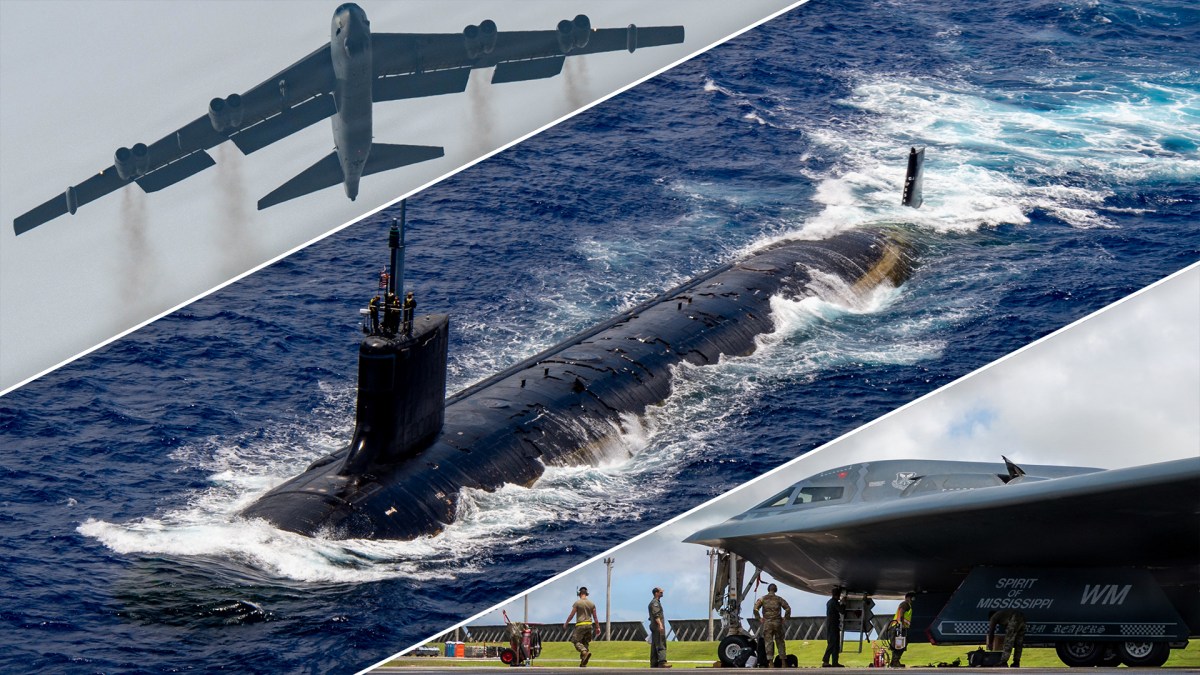
Virginia class submarine (U.S. Navy photo by Mass Communication Specialist 2nd Class Terrin Hartman)/B-52 (U.S. Air Force)/B-2 (U.S. Air Force photo by Staff Sgt. Joshua Hastings)
A new report from the think tank founded by former Google CEO Eric Schmidt quantifies the grim realities of the U.S. defense industrial base’s dependence on China for critical rare earth minerals. It also details which weapons systems might face the most impact if that delicate supply relationship breaks down.
The white paper, exclusively obtained from the Special Competitive Studies Project, uses AI intelligence from the supply chain tech firm Exiger to assess how many unique components, identified by National Item Identification Number, or NIIN, contain critical minerals, such as antimony, gallium, germanium and tungsten.
America’s arsenal depends on a steady flow of rare earths, and especially its most advanced weapons. U.S. Air Force photo by Tech Sgt. Thomas Barley Tech. Sgt. Thomas Barley
From an assessment of almost nine million parts and 3,000 U.S. military weapon systems, the company identified more than 28,000 unique components across 1,400 weapons systems containing just these four rare earths. The isolation of these parts is relevant in particular because of a near-term crisis: the expiration of a suspension on Chinese export controls set to take effect in November. Disruption to weapons fielding plans, as well as operational readiness and sustainment activities, according to the white paper, is very much a possibility. Yet according to Kit Conklin, chief strategy and global affairs officer at Exiger, the crisis is already here.
In an interview with TWZ , he pointed to Japan, which is facing the prospect of a manufacturing halt after China choked off supply of some rare earths to the tune of more than 80% earlier this year.
“There’s no question that right now it’s a crisis for a lot of companies that are trying to get licenses approved by China and just not getting the licenses,” Conkling said. “So there’s there’s real risk to current production, and when I think about us and scaling, whether it’s the drone industrial base or trying to scale our interceptor capacity to 1000, 2000, 3000 interceptors a year, I mean, these are real choke points that we have that are impacting our ability to deliver these to the warfighter right now.”
Among the weapons systems most at risk for supply chain and manufacturing disruption, according to the data, is the vital Virginia -class submarine, which requires more than 300 critical NIINs containing the four elements, including 190 parts requiring germanium.
USS Virginia (SSN 774), the leader of the Virginia class that serves as the backbone of the U.S. Navy’s fast attack submarine force. U.S. Navy photo by General Dynamics Electric Boat U.S. Navy
Germanium, used in optics, night vision systems, EO/IR equipment and more, is a byproduct of zinc ore . In January, the Pentagon announced an $18 million investment in the country’s only germanium production facility in St. George, Utah to expand refining capacity “sevenfold” to more than 20 metric tons annually by an unspecified deadline.
China controls some 68% of the world’s refined germanium. It has a far greater chokehold on gallium, used in semiconductors and solar cells, and especially advanced radars, controlling up to 99% of production . Each Virginia -class sub requires 50 unique parts containing gallium.
China controls about half the production of antimony, used to harden ammunition and to manufacture optics and electronics; and up to 80% of the supply of tungsten, used in manufacturing tools, warheads and heat-resistant components.
While it doesn’t break down components by weight, the report notes that the rare earth requirements for the Virginia -class sub are also considerable by mass: each sub required 9,200 pounds of the elements, while an F-35 Joint Strike Fighter jet requires 900 pounds.
Special Competitive Studies Project
The Virginia -class submarine is America’s only in-production fast-attack nuclear-powered sub that has been in service since 2004. 23 of these critical vessels are in service today , or roughly half of the total planned program, with the remaining boats yet to be built. It’s notable in the context of the paper because it has multiple points of exposure to supply chain disruption. Another of these exposure points: its 1,700 mission or safety-critical parts requiring casting, forging or extrusion. As the report lays out, supply chain bottlenecks around limited metal casting, forging and extruding capacity are delaying production timelines and putting manufacturing at risk.
China, again, produces about half of the world’s casting output and “is often the sole option for large castings,” the paper found. The analysis shows that more than half, or nearly 8,000, unique supply items containing steel castings have delivery lead times of more than 36 weeks. More than 9,400 items containing extruded aluminum, about 47% of these parts, have lead times that long.
A large metal casting for a port crane. Voestalpine Foundry Group
“ Virginia -class submarines, already threatened by U.S. reliance on China for critical minerals, are reportedly also three years behind schedule, potentially due in part to the lack of domestic large-scale casting capacity,” the report finds. An analysis of Navy construction timelines published earlier this year does indeed find that 10 of the 12 Virginia subs now under construction face delays of 36-44 months.
Alarmingly, a recent war game simulation found that the U.S. could not replace ships, planes and missiles lost to combat specifically due to casting and forging shortfalls, the report notes. That’s despite a $2 billion Pentagon initiative launched in 2024 aimed at revitalizing this industry.
Beyond submarines, the report shows that aircraft, including some of the nation’s workhorse fighter jets, face outsized production and sustainment risk due to rare-earth elements and casting/forging dependencies.
The B-2 Spirit bomber – the nation’s only nuclear-armed stealth bomber until fielding begins on the B-21 Raider sometime next year – requires 782 parts containing the four rare-earth elements isolated in the report.
The F/A-18 Hornet family of fighters flown by the Navy and Marine Corps, including the Navy’s Growler electronic warfare variant, tops the list for dependency on steel castings, with 3,800 individual parts requiring the process. Following is the KC-135 Stratolifter tanker, with 2,570 parts. All 10 of the systems requiring the most metal castings for production are aircraft, the analysis shows. The legacy Hornet and the KC-135 have been out of production for decades, while the Navy’s Super Hornet will see its production line go cold in 2027. Any ongoing demand for castings for these systems would thus be in spares and repair parts.
Military aircraft also represent the highest-need category among weapons systems requiring cadmium plating, a process used to make aerospace components corrosion-resistant. The domestic supplier base has shrunk due to EPA safety limitations established in 2008. All of the top 10 weapons systems requiring the most cadmium-plated parts are aircraft, with the KC-135 topping the list with 2,780 unique components. The C-130 Hercules transport, B-52 Stratofortress bomber and Galaxy C-5 transport all have more than 2,000 parts.
The B-52, which is undergoing service life extension to take it into the 2050s – past its century mark – may run into modernization delays not only over cadmium-plated and steel-casted components, but also due to overly rigid military specifications, which increase lead time and delays. The white paper cites the bomber’s rib airfoil and fuel vent valve components, which both have lead times of more than 400 days due in part to production being burdened with dozens of mil-spec compliance requirements, which the authors say have not kept pace with today’s commercial practices.
“The requirement for a part to meet so many mil-specs, if not reasonably necessary, may limit the number of possible suppliers of that part, potentially increasing its lead time and bottlenecking production,” they write. “For the B-52, this could inhibit current modernization efforts intended to keep the airplane operational through the 2050s.”
A B-52H Stratofortress undergoing programmed depot maintenance is towed into a hangar at Tinker Air Force Base, Oklahoma, July 28, 2025. U.S. Air Force photo by Paul Shirk Paul Shirk
A final risk the paper addresses is workforce shortages and dangers from limited suppliers creating single points of failure. Across defense, the number of small suppliers has decreased by 43% in the last decade, it notes. It cites, as a case study, the February 2025 fire that forced the closure of SPS Technologies in Jenkintown, Penn. – a fastener maker that produced components for more than 1,000 weapons systems and was deemed critical for 90, including the Nimitz -class carrier, the F/A-18 fighter and the M1 Abrams tank. For systems including the Tomahawk Land Attack Missile and the MH-60 Black Hawk helicopter, the facility was a single-source supplier.
With operations offline until at least 2028, the supply chain has been “actively disrupted” due to the outage of just one facility, according to the paper.
“This case underscores the risk of single sourcing in the defense industrial base and the need to qualify alternate sources to avoid such significant chokepoints,” the authors write.
The paper hails work that has already begun to invest in domestic critical minerals production and shore up the defense industrial base. But it does hint that these efforts may be too late to avoid a crash if China shuts off or severely reduces exports. The paper notes that, on average, it takes the U.S. 29 years to open a new mine. The U.S. has one established domestic mine: The Mountain Pass Rare Earth Mine and Processing Facility, just outside of Las Vegas. Initially established in 1952 and reopened in 2018 after a long hiatus, it now produces more than 50,000 tons of rare earth oxides annually . Last year, for the first time in seven decades, a new domestic rare-earth mine opened in Wyoming , stating plans to start producing ores extracted from coal, including gallium and germanium, by 2029 . Production is projected to total 456 tons of rare earths per year. The project had been in development for more than a decade before opening.
The Mountain Pass Rare Earth Mine and Processing Facility. MP Materials
Conklin said a July executive order aimed at developing domestic production of rare earths while collecting data on what elements systems required created opportunities for smart policy creation – perhaps in the next National Defense Authorization Act – around holistically attacking the problem.
“I would love for us to figure out a way to get out of thinking about these supply chain risks system by system. We tend to have disparate requirements to look at the nuclear triad or subs or interceptors,” he said. “I think with the executive order that came out earlier this year, there’s a real opportunity for Congress to legislate on some of these issues beyond just figuring out what the risk for antimony in the sub industrial base, and thinking about it a little bit more holistically.”
One potential solution he proposed: an agency within the executive branch (led, perhaps, by a critical minerals czar) who can coordinate production needs and resourcing and develop the most efficient pathways to secure needed materials.
There are few weapons that are not impacted by the scarcity of robust sources for rare earths. RTX
While no U.S. defense manufacturer has yet publicly cited manufacturing disruptions due to rare earth availability, signs are increasing that the federal government is taking supply concerns seriously. In addition to Project Vault , a $12 billion White House initiative announced in February that would create a strategic stockpile of rare earths akin to existing stockpiles of critical medical supplies and petroleum, the U.S. Army has begun extending long-term leases on military land to companies seeking to build critical mineral processing facilities.
Conklin said he doesn’t anticipate major changes in rare earth exports between now and the end of the year, describing the U.S.-China supply relationship as “in a bit of a détente.” That said, with new policies pending, we could be only days away from new revelations about the extent of the impact of these materials on the defense manufacturing enterprise.
Contact the editor: Tyler@twz.com
Comments couldn’t be loaded. Please refresh the page.
发布于美国东部时间2026年11月2日上午11:40
弗吉尼亚级潜艇(美国海军二级大众传播专家特林·哈特曼拍摄)/B-52(美国空军)/B-2(美国空军参谋军士约书亚·黑斯廷斯拍摄)
由谷歌前首席执行官埃里克·施密特创立的智库发布的一份新报告,量化了美国国防工业基础对中国关键稀土矿物供应的依赖程度,并详细阐述了如果这种脆弱的供应关系破裂,哪些武器系统可能受到最大的冲击。
这份白皮书由特别竞争研究项目独家提供,利用供应链技术公司 Exiger 的人工智能技术,评估了有多少独特的组件(通过国家物品识别号 (NIIN) 识别)含有锑、镓、锗和钨等关键矿物。
美国的武器库,尤其是其最先进的武器,依赖于稀土的稳定供应。美国空军技术军士托马斯·巴利摄。
通过对近900万个零部件和3000套美国军用武器系统的评估,该公司在1400套武器系统中识别出超过28000个独特的组件,这些组件仅包含这四种稀土元素。由于近期即将面临危机:中国出口管制暂停令将于11月到期,因此对这些零部件的识别尤为重要。白皮书指出,武器部署计划以及作战准备和保障活动极有可能受到影响。然而,Exiger公司首席战略与全球事务官基特·康克林认为,这场危机已经到来。
在接受 TWZ 采访时,他指出,今年早些时候,中国切断了日本部分稀土的供应,减少了 80% 以上,日本正面临制造业停滞的局面。
康克林表示:“毫无疑问,目前很多公司都面临着危机,他们正努力获得中国颁发的许可证,但却始终未能如愿。因此,目前的生产确实面临风险。就我们自身而言,无论是无人机产业基础,还是将拦截器的年产能提升至1000、2000甚至3000枚,这些都是我们面临的真正瓶颈,它们正在影响我们向作战人员交付这些装备的能力。”
根据数据,在最容易受到供应链和制造中断影响的武器系统中,至关重要的弗吉尼亚级潜艇需要 300 多个包含四种元素的关键 NIIN,其中包括 190 个需要锗的部件。
“弗吉尼亚”号(SSN 774)是美国海军快速攻击潜艇部队的中坚力量,属于弗吉尼亚级潜艇。照片由美国海军通用动力电船公司提供。
锗是锌矿的副产品,广泛应用于光学器件、夜视系统、光电/红外设备等领域。今年1月,五角大楼宣布投资1800万美元,用于扩建位于犹他州圣乔治市的美国唯一一家锗生产厂,计划在未指明的期限内,将精炼产能扩大“七倍”,达到每年20吨以上。
中国控制着全球约68%的精炼锗。对于用于半导体、太阳能电池,尤其是先进雷达的镓,中国拥有更大的垄断地位,控制着高达99%的产量。每艘弗吉尼亚级潜艇都需要50个含有镓的独特部件。
中国控制着全球约一半的锑产量(用于硬化弹药以及制造光学和电子产品);以及高达 80% 的钨供应量(用于制造工具、弹头和耐热部件)。
虽然报告没有按重量细分各部件,但指出弗吉尼亚级潜艇的稀土需求量也相当大:每艘潜艇需要 9200 磅稀土,而一架 F-35 联合攻击战斗机则需要 900 磅。
特殊竞争性研究项目
弗吉尼亚级潜艇是美国目前唯一在产的核动力快速攻击潜艇,自2004年服役以来一直保持着高产量。目前已有23艘该级潜艇在役,约占计划建造总数的一半,其余潜艇尚未建造。该级潜艇之所以值得关注,是因为它存在多个供应链中断的风险点。其中一个风险点是:其1700个任务或安全关键部件需要铸造、锻造或挤压成型。正如报告所述,由于金属铸造、锻造和挤压产能有限,供应链瓶颈正在延误生产进度,并使制造面临风险。
该报告指出,中国再次占据全球铸件产量的一半左右,并且“往往是大型铸件的唯一选择”。分析显示,超过一半(近8000种)含有钢铸件的供应品交货周期超过36周。此外,超过9400种含有挤压铝的供应品(约占这些零件的47%)交货周期也同样如此。
为港口起重机铸造的大型金属铸件。奥钢联铸造集团
报告指出,“弗吉尼亚级潜艇的建造计划本已因美国对中国关键矿产的依赖而受到威胁,据报道,该计划目前也已延期三年,部分原因可能是国内缺乏大规模铸造能力。” 今年早些时候公布的一项海军建造时间表分析确实发现,目前正在建造的12艘弗吉尼亚级潜艇中有10艘面临36至44个月的延期。
报告指出,令人担忧的是,近期一项战争推演模拟发现,美国无法弥补因铸造和锻造工艺短缺而损失的舰艇、飞机和导弹。尽管五角大楼在2024年启动了一项耗资20亿美元的计划,旨在振兴该行业,但情况依然如此。
除了潜艇之外,该报告还显示,飞机(包括该国的一些主力战斗机)由于稀土元素和铸造/锻造依赖性,面临着巨大的生产和维护风险。
B-2“幽灵”隐形轰炸机——在明年某个时候B-21“突袭者”轰炸机开始部署之前,它是美国唯一一款携带核武器的隐形轰炸机——需要782个零件,其中包含报告中分离出的四种稀土元素。
海军和海军陆战队使用的F/A-18“大黄蜂”系列战斗机,包括海军的“咆哮者”电子战型,在对钢铸件的依赖程度上位居榜首,共有3800个零部件需要铸件加工。紧随其后的是KC-135“同温层运输机”,需要2570个零部件。分析显示,生产过程中对金属铸件需求量最大的10个系统均为飞机。老款“大黄蜂”和KC-135已经停产数十年,而海军的“超级大黄蜂”战斗机的生产线将于2027年停止。因此,这些系统对铸件的任何持续需求都将集中在备件和维修部件上。
在所有需要镀镉的武器系统中,军用飞机的需求量最大。镀镉是一种用于提高航空航天部件耐腐蚀性的工艺。由于美国环保署(EPA)2008年制定的安全限制,国内供应商数量有所减少。需要镀镉部件最多的十大武器系统均为飞机,其中KC-135加油机以2780个独特的部件位居榜首。C-130大力神运输机、B-52同温层堡垒轰炸机和C-5银河运输机的部件数量均超过2000个。
B-52轰炸机正在进行延寿改造,以使其服役至2050年代——超过其百年历史——但其现代化改造可能会遭遇延误,这不仅是因为镀镉和铸钢部件,还因为过于严格的军用规范,这些规范增加了交付周期和延误。白皮书指出,轰炸机的肋状翼型和燃油排放阀部件的交付周期均超过400天,部分原因是生产过程中需要满足数十项军用规范合规要求,而这些要求并未跟上当今商业实践的步伐。
他们写道:“如果一个零部件需要满足如此多的军用规格,即使并非合理必要,也可能限制该零部件的供应商数量,从而延长交货周期并造成生产瓶颈。对于B-52轰炸机而言,这可能会阻碍旨在确保该机型服役至2050年代的现代化改造工作。”
2025年7月28日,一架正在进行例行大修的B-52H同温层堡垒轰炸机被拖入俄克拉荷马州廷克空军基地的机库。美国空军照片,摄影:保罗·希尔克
该报告探讨的最后一个风险是劳动力短缺以及供应商数量有限导致的单一故障点。报告指出,过去十年间,国防领域的小型供应商数量减少了43%。报告以2025年2月发生在宾夕法尼亚州詹金顿的SPS Technologies公司为例,该公司因火灾被迫关闭。SPS Technologies是一家紧固件制造商,曾为1000多种武器系统生产零部件,其中90种系统的关键零部件包括尼米兹级航母、F/A-18战斗机和M1艾布拉姆斯主战坦克。对于包括战斧陆攻导弹和MH-60黑鹰直升机在内的系统,SPS Technologies是其唯一的供应商。
报告称,由于一家工厂停工,供应链至少要到 2028 年才能恢复运营,因此供应链受到了“严重干扰”。
“这个案例凸显了国防工业基地单一采购的风险,以及对替代供应商进行资质审查以避免出现此类重大瓶颈的必要性,”作者写道。
该报告赞扬了美国已开始投资国内关键矿产生产并加强国防工业基础的工作。但报告也暗示,如果中国停止或大幅减少出口,这些努力可能为时已晚,无法避免经济崩溃。报告指出,美国平均需要29年才能开采一座新矿。美国目前只有一座成熟的国内矿:位于拉斯维加斯郊外的芒廷帕斯稀土矿及加工厂。该矿最初建于1952年,在长期停产后于2018年重新开放,目前每年生产超过5万吨稀土氧化物。去年,怀俄明州一座新的国内稀土矿在70年来首次投产,并计划于2029年开始生产从煤中提取的矿石,包括镓和锗。预计年产量将达到456吨稀土。该项目在投产前已开发了十多年。
山隘稀土矿及加工厂。MP材料公司
康克林表示,7 月份的一项行政命令旨在发展国内稀土生产,同时收集有关系统需要哪些元素的数据,这为制定明智的政策创造了机会——或许可以在下一部《国防授权法案》中——围绕全面解决这个问题。
“我希望我们能找到一种方法,摆脱逐个系统地思考这些供应链风险的思维模式。我们往往需要分别考虑核三位一体、潜艇或拦截器等不同的系统,”他说道。“我认为,今年早些时候发布的行政命令为国会提供了一个真正的机会,让他们能够就其中一些问题进行立法,而不仅仅局限于确定次工业基础中锑的风险,而是从更全面的角度来思考这个问题。”
他提出的一个潜在解决方案是:在行政部门内设立一个机构(或许由一位关键矿产沙皇领导),负责协调生产需求和资源,并制定获取所需材料的最有效途径。
几乎所有武器都受到稀土资源短缺的影响。RTX
尽管目前尚无美国国防制造商公开表示稀土供应短缺导致生产中断,但越来越多的迹象表明,联邦政府正在认真对待供应问题。除了白宫2月份宣布的耗资120亿美元的“金库计划”(Project Vault)——该计划旨在建立一个类似于现有关键医疗用品和石油储备的稀土战略储备——之外,美国陆军也已开始向寻求建设关键矿物加工设施的公司提供军事用地长期租赁合同。
康克林表示,他预计今年年底前稀土出口不会发生重大变化,并称美中稀土供应关系目前“处于某种缓和状态”。尽管如此,随着新政策即将出台,我们可能很快就会了解到这些材料对国防制造业的影响程度。
联系编辑:Tyler@twz.com
评论加载失败,请刷新页面。