Russia is giving its drones bigger antennas to beat Ukrainian jamming俄罗斯正在为其无人机配备更大的天线,以对抗乌克兰的干扰。
Kyiv now needs roughly twice as many jammers to stop each upgraded Shahed, intel officials and experts said.
Share on Facebook (Opens in new window) Facebook
Share on X (Opens in new window) X
Share on Bluesky (Opens in new window) Bluesky
Share on Reddit (Opens in new window) Reddit
Share on LinkedIn (Opens in new window) LinkedIn
Share using Native tools Share Copied to clipboard
Share on Mail (Opens in new window) Mail
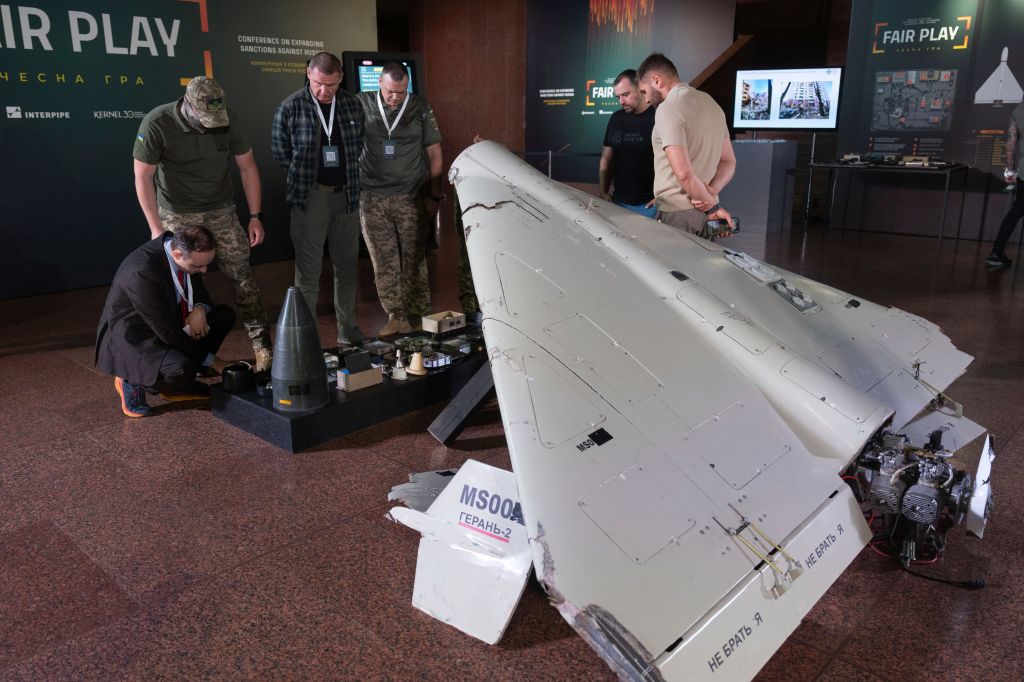
Conference visitors inspect a damaged Iranian-made Shahed drone in Ukraine in June 2025. (Efrem Lukatsky/AP)
KYIV, Ukraine — Russia is fitting drones with larger jam-resistant antennas , making it harder for Ukrainian forces to use electronic countermeasures to scramble their navigation signals, Ukrainian officials said.
Russia’s Kometa navigation modules, produced by the company VNIIR-Progress, use arrays of small receiving elements called patch antennas to keep satellite navigation working through jamming. They have been found on Geran drones, glide-bomb kits, Iskander-M and Kinzhal missiles and the new Filin cruise missile, according to a database of Russian weapons run by Ukraine’s military intelligence agency , HUR.
The Kremlin is already using Kometa modules with 16-element antenna arrays at scale and is setting up serial production of 20-element arrays, increasing its capability to work out which direction jamming comes from and compensate for it, HUR said Oct. 19.
Shaheds carrying antennas with 32 elements have already been found attacking Kyiv, said Serhii “Flash” Beskrestnov, an electronic-warfare specialist and adviser to Ukrainian President Volodymyr Zelenskyy on defense technology.
“The more elements, the more electronic-warfare signal sources the antenna can suppress,” he said in an October post on Telegram.
The larger antennas give Russia an asymmetric advantage by being easier to counter than to install, Beskrestnov said.
“This race is difficult for us because it is easier for the enemy to increase the number of elements on an antenna than it is for us to add electronic warfare sites,” Beskrestnov said.
Russia’s better-protected drones can fly through Ukraine’s EW shield — one of its most affordable and widespread layers of air defense — leaving more of them to be shot down by costlier options, like interceptor drones, jets and missiles .
A Kometa module’s resistance to jamming depends on the number and arrangement of its patch antennas, the receiving elements on the array, and on the algorithm its processing chip uses to separate the satellite signal from interference, HUR said.
Drones carrying the upgraded antennas can still be taken out by jamming more satellite bands at once or by networking devices to feed drones false coordinates, defense leaders say.
The commander of Ukraine’s Night Watch unit, who goes by the call sign Alkhimik, bought a 32-element antenna taken from a Shahed, “that had crashed and was being sold on the secondary market,” he told Militarnyi in July.
He discovered that the device was simply two 16-element arrays covering different satellite-navigation bands put together, he said, giving him inspiration on how to counter it.
“By creating two systems — one operating in the L1 band and the other covering L2/L5 — we’ll be able to jam this antenna without any problems,” Alkhimik said.
Spoofing works, too, according to Fly Group Ukraine. It links multiple devices into a network to feed a drone false coordinates, Anatoliy Khrapchynskyi, the defense company’s director of development, told Reuters in September.
“The drone continues to think it is flying toward its target, but its own autopilot, relying on the false coordinates, gradually changes course on its own and steers the craft away from cities into safe areas,” he said.
Russian defense firms have ordered more than 100,000 Kometa modules in various configurations this year to guide cruise and ballistic missiles, strike drones and guided bombs, HUR said, a measure of demand for the technology.
Katie Livingstone is the Ukraine correspondent for Defense News and Military Times. Based in Kyiv, she has covered Russia’s full-scale invasion since its first days. She is a former Fulbright fellow whose award-winning work has appeared in outlets across Europe and the U.S.
分享至 Facebook(在新窗口中打开) Facebook
分享至 X(在新窗口中打开)X
在 Bluesky 上分享(在新窗口中打开)Bluesky
分享到 Reddit(在新窗口中打开)
在领英上分享(在新窗口中打开)领英
使用原生工具分享 已复制到剪贴板
分享至邮件(在新窗口中打开)邮件
2025年6月,在乌克兰,参加会议的人员正在检查一架受损的伊朗制造的“沙赫德”无人机。(Efrem Lukatsky/AP)
乌克兰基辅——乌克兰官员表示,俄罗斯正在为无人机安装更大的抗干扰天线,这使得乌克兰军队更难使用电子对抗措施来干扰其导航信号。
俄罗斯VNIIR-Progress公司生产的“彗星”(Kometa)导航模块,利用被称为贴片天线的微型接收元件阵列,在干扰下仍能保持卫星导航正常工作。据乌克兰军事情报机构HUR运营的俄罗斯武器数据库显示,这些模块已被用于“格朗”(Geran)无人机、滑翔炸弹套件、“伊斯坎德尔-M”(Iskander-M)和“匕首”(Kinzhal)导弹以及新型“菲林”(Filin)巡航导弹。
10 月 19 日,HUR 表示,克里姆林宫已经大规模使用 Kometa 模块,配备 16 单元天线阵列,并正在建立 20 单元阵列的批量生产,以提高其确定干扰方向并进行补偿的能力。
乌克兰总统泽连斯基的国防技术顾问、电子战专家谢尔盖·“闪电”·别斯克列斯特诺夫表示,已经发现携带 32 个元件天线的“沙赫德”无人机袭击了基辅。
他在 10 月份发布于 Telegram 的一篇文章中写道:“元件越多,天线能够抑制的电子战信号源就越多。”
别斯克列斯特诺夫表示,更大的天线使俄罗斯获得了不对称优势,因为与其安装不如反制。
“这场竞赛对我们来说很艰难,因为敌人增加天线上的元件数量比我们增加电子战站点要容易得多,”贝斯克列斯特诺夫说。
俄罗斯防护性能更好的无人机可以穿过乌克兰的电子战防御系统——这是乌克兰最经济实惠、覆盖面最广的防空体系之一——从而让更多无人机被更昂贵的拦截选项(如拦截无人机、喷气式飞机和导弹)击落。
HUR表示,Kometa模块的抗干扰能力取决于其贴片天线的数量和排列方式、阵列上的接收元件以及其处理芯片用于将卫星信号与干扰分离的算法。
国防领导人表示,即使携带升级版天线的无人机,仍然可以通过同时干扰更多卫星频段或通过联网设备向无人机提供虚假坐标来摧毁。
乌克兰夜间巡逻队指挥官,代号“阿尔希米克”,在7月份告诉《军事报》,他从一架“沙赫德”飞机上拆下了一根32单元天线,“这架飞机坠毁后正在二手市场上出售”。
他说,他发现该装置只是两个覆盖不同卫星导航频段的 16 单元阵列组合在一起,这给了他对抗该装置的灵感。
“通过创建两个系统——一个在 L1 频段运行,另一个覆盖 L2/L5 频段——我们将能够毫无问题地干扰这个天线,”阿尔希米克说。
据乌克兰Fly Group公司称,欺骗技术也有效。该公司研发总监阿纳托利·赫拉普钦斯基9月份告诉路透社,该技术将多个设备连接到一个网络中,向无人机提供虚假坐标。
他说:“无人机仍然认为自己正朝着目标飞行,但它的自动驾驶系统依靠错误的坐标,逐渐自行改变航向,并将无人机引导至远离城市的安全区域。”
据HUR报道,俄罗斯国防公司今年已订购了超过10万个不同配置的“彗星”模块,用于引导巡航导弹、弹道导弹、攻击无人机和制导炸弹,这体现了市场对该技术的需求。
凯蒂·利文斯通是《防务新闻》和《军事时报》的乌克兰特派记者。她常驻基辅,自俄罗斯全面入侵乌克兰之初便开始报道此事。她曾是富布赖特学者,其获奖作品发表于欧洲和美国的多家媒体。