On American destroyers, avoid a self-inflicted wound in Spain关于美国驱逐舰,避免在西班牙自取灭亡。
"The Trump administration should keep six destroyers stationed at Rota. Any other action would be a gift to America’s adversaries."
Mark Montgomery and Bradley Bowman
Share on Facebook (Opens in new window) Facebook
Share on X (Opens in new window) X
Share on Bluesky (Opens in new window) Bluesky
Share on Reddit (Opens in new window) Reddit
Share on LinkedIn (Opens in new window) LinkedIn
Share using Native tools Share Copied to clipboard
Share on Mail (Opens in new window) Mail
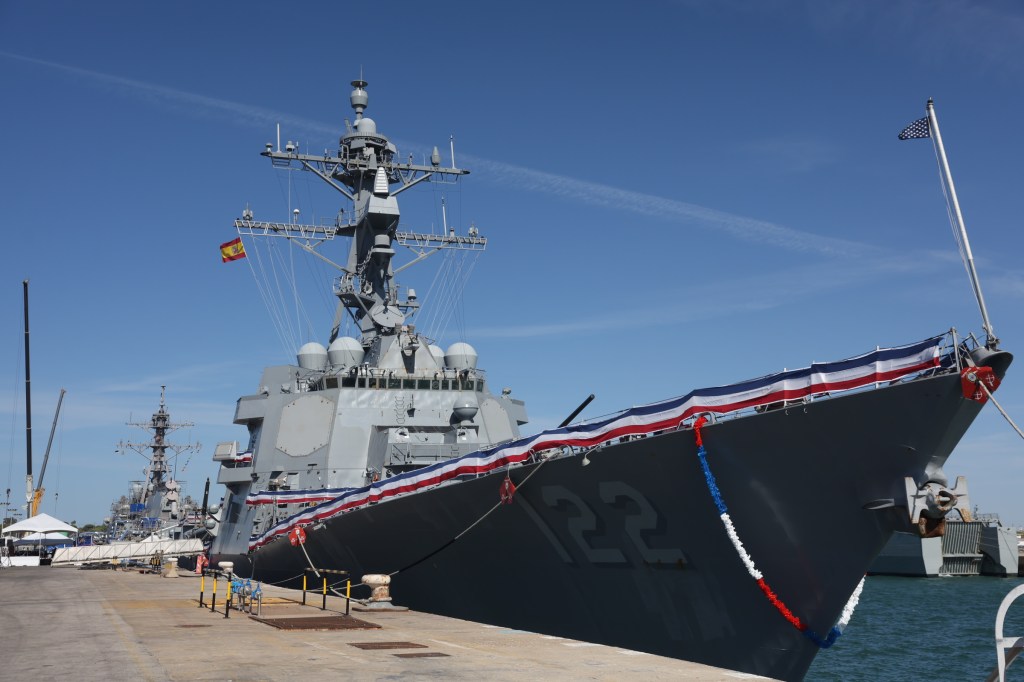
A photograph of the destroyer USS John Basilone at its new home port at the Rota Naval Base, Spain, on Oct. 15, 2026. (Nacho Frade/Europa Press via Getty Images)
Sometimes friends behave badly. When that happens, it is not smart to hurt yourself in retaliation for the friend’s bad behavior. That is true in one’s personal life — and also when it comes to defense strategy.
Consider the case of the Trump administration’s ongoing review of U.S. force posture in Europe and whether Washington will maintain a handful of American naval destroyers forward-stationed in Rota, Spain. Stationing destroyers at Rota helps secure vital American interests in Europe, North Africa, and the Middle East and allows the ships to spend more time conducting missions than traversing back and forth across the Atlantic.
To be clear, the government in Spain has certainly not been working overtime to win favor in Washington. Madrid has stubbornly refused to honor its NATO defense spending commitments, spending a paltry 2% of the country’s gross domestic product on defense. “2.1%, no more, no less,” President Pedro Sanchez said in June . “We fully respect the legitimate desire of other countries to increase their defense investment, but we are not going to do it,” he said.
To make matters worse, earlier this year, Madrid also restricted the U.S. use of Spanish airspace or military bases for operations against Iran.
With the administration openly weighing significant troop reductions across the continent, Spain’s actions may have put it near the top of the candidate list for cuts. But a careful examination makes clear that removing the destroyers based at Rota or closing the base there would be a big mistake.
The base hosts six Arleigh Burke-class guided-missile destroyers, up from four under a 2023 agreement. These vessels, which pack a powerful punch, can conduct anti-air, anti-submarine, and anti-surface warfare missions. The ships’ Aegis Ballistic Missile Defense upgrade enables them to defend against ballistic missiles, cruise missiles, and drones. There is no other platform that combines mobile, multi-mission air and missile defense with the endurance to stay on station for months at a time.
Those capabilities have proved pivotal in recent conflicts in the Middle East. Over the past two years, Rota-based destroyers have rotated continuously into the Eastern Mediterranean. As many as four have been on station in those waters, simultaneously defending American interests and supporting the defense of Israel against Iranian ballistic missile attacks. That has saved the lives of Americans and Israelis.
The same ships also provide NATO’s sea-based missile shield against threats from the Middle East. That shield is important to protecting American bases in Europe and their ability to project power into the Middle East and North Africa. The destroyers also serve as the Navy’s forward presence for countering Russian submarine and surface activity in the Mediterranean and increasingly assertive Chinese naval activity off the African coast.
Some might ask whether these vessels can be replaced with European vessels. The answer is no, at least in the short term.
Years of under-resourcing have left European navies a mess. Spain’s own Álvaro de Bazán-class frigates are the most capable European warships, but Europe’s collective sea-based ballistic missile defense capacity remains thin to non-existent, and no European navy can surge Aegis BMD-equivalent coverage into the Eastern Mediterranean the way U.S. destroyers from Rota can.
If Washington brings the American destroyers home to the continental United States, the gap in missile defense coverage for NATO’s southern flank, Israel, and shipping lanes vital to the American economy would not be filled by European navies anytime soon and could potentially create a dangerous security gap for years or even decades.
Plus, a destroyer homeported in Spain, as part of Forward Deployed Naval Force-Europe, spends dramatically more time on station and far less time in transit than a U.S.-based ship that must cross the Atlantic to reach the same waters. That multiplies the combat power each hull generates over its service life.
If anyone in Washington doubts these arguments, consider the current actions of the Pentagon. It has increased the number of destroyers at Rota from four to six, with the final ship arriving only this year. In a recent interview, U.S. 6th Fleet Commander Vice Adm. Jeffrey Anderson suggested the sixth destroyer could not arrive soon enough. Clearly, senior U.S. military leaders believe we need more naval capacity stationed at Rota — not less.
Rota’s submarine support infrastructure, logistics hub, naval special operations support, and air operations also make it one of the most versatile forward installations the U.S. maintains anywhere, facilitating operations across Europe, the High North, Africa, and the Middle East simultaneously from a single location.
None of this means the diplomatic friction with Madrid should be ignored. Washington has every right to press Spain on burden-sharing, defense spending, and foreign policy differences. Washington may need to impose some consequences for Madrid’s decisions, but those should not include self-inflicted wounds that hurt U.S. military readiness and power projection capabilities, making Americans less safe.
The Trump administration should keep six destroyers stationed at Rota. Any other action would be a gift to America’s adversaries.
Rear Adm. (Ret.) Mark Montgomery and Bradley Bowman are senior directors at the Foundation for Defense of Democracies. Montgomery served 32 years in the U.S. Navy, including as deputy director for plans, policy, and strategy (J5) at U.S. European Command. Bowman served in the U.S. Army as a Black Hawk pilot, taught at West Point, and advised members of the Senate Armed Services and Foreign Relations committees.
马克·蒙哥马利和布拉德利·鲍曼
分享至 Facebook(在新窗口中打开) Facebook
分享至 X(在新窗口中打开)X
在 Bluesky 上分享(在新窗口中打开)Bluesky
分享到 Reddit(在新窗口中打开)
在领英上分享(在新窗口中打开)领英
使用原生工具分享 已复制到剪贴板
分享至邮件(在新窗口中打开)邮件
2026年10月15日,美国海军驱逐舰“约翰·巴斯隆”号停靠在位于西班牙罗塔海军基地的新母港。(图片来源:Nacho Frade/Europa Press via Getty Images)
朋友有时会做出不好的行为。在这种情况下,以牙还牙、自残并非明智之举。这不仅适用于个人生活,也适用于防御策略。
以特朗普政府正在进行的美国驻欧兵力部署评估为例,探讨华盛顿是否会继续在西班牙罗塔前沿部署少量美国海军驱逐舰。在罗塔部署驱逐舰有助于保障美国在欧洲、北非和中东的重要利益,并使这些舰艇能够将更多时间用于执行任务,而不是往返于大西洋两岸。
需要明确的是,西班牙政府显然并没有竭尽全力讨好华盛顿。马德里一直顽固地拒绝履行其北约国防开支承诺,国防开支仅占该国国内生产总值的2%。“2.1%,不多不少,”佩德罗·桑切斯总统在6月份表示。“我们完全尊重其他国家增加国防投入的合理愿望,但我们不会这样做,”他说道。
更糟糕的是,今年早些时候,马德里还限制美国使用西班牙领空或军事基地对伊朗开展军事行动。
鉴于美国政府公开考虑大幅削减欧洲大陆的驻军规模,西班牙的举动可能使其位列裁军候选名单的前列。但仔细分析就会发现,撤走驻扎在罗塔的驱逐舰或关闭该基地将是一个巨大的错误。
该基地驻扎着六艘阿利·伯克级导弹驱逐舰,根据2023年的协议,数量从四艘增加到六艘。这些舰艇火力强大,可执行防空、反潜和反水面作战任务。舰艇升级后的宙斯盾弹道导弹防御系统使其能够防御弹道导弹、巡航导弹和无人机。目前没有任何其他平台能够像它一样,兼具机动性、多任务的防空和导弹防御能力,并拥有连续数月驻守的续航能力。
这些能力在近期中东冲突中发挥了至关重要的作用。过去两年,驻扎在罗塔港的驱逐舰持续轮换部署到东地中海。最多时曾有四艘驱逐舰在该海域执勤,既捍卫美国利益,又支援以色列抵御伊朗弹道导弹袭击。这挽救了美国人和以色列人的生命。
这些舰艇也为北约提供海上导弹防御系统,抵御来自中东的威胁。这一防御系统对于保护美国在欧洲的军事基地及其向中东和北非投射力量的能力至关重要。此外,这些驱逐舰还作为海军前沿部署力量,用于应对俄罗斯在地中海的潜艇和水面舰艇活动,以及日益活跃的中国海军在非洲沿海的活动。
有人可能会问,这些船只能否用欧洲船只替代。答案是否定的,至少短期内不能。
多年来资源不足导致欧洲海军一片混乱。西班牙的阿尔瓦罗·德·巴赞级护卫舰是欧洲最强大的战舰,但欧洲整体的海基弹道导弹防御能力仍然薄弱甚至缺失,没有哪个欧洲海军能够像美国罗塔海军基地的驱逐舰那样,将相当于宙斯盾弹道导弹防御系统的防御能力迅速部署到东地中海。
如果华盛顿将美国驱逐舰撤回美国本土,北约南翼、以色列以及对美国经济至关重要的航道的导弹防御缺口将无法很快由欧洲海军填补,并可能造成持续数年甚至数十年的危险安全漏洞。
此外,作为欧洲前沿部署海军部队的一部分,以西班牙为母港的驱逐舰,其在指定海域的停留时间远长于必须横渡大西洋才能抵达同一海域的美国本土舰艇,而航行时间则大大缩短。这成倍提升了每艘舰艇在其服役期内的作战能力。
如果华盛顿有人对这些论点表示怀疑,不妨看看五角大楼目前的行动。五角大楼已将罗塔海军基地的驱逐舰数量从四艘增加到六艘,最后一艘将于今年抵达。美国第六舰队司令杰弗里·安德森海军中将在最近的一次采访中表示,第六艘驱逐舰的到来越快越好。显然,美国高级军事领导人认为我们需要在罗塔海军基地部署更多海军力量,而不是更少。
罗塔的潜艇支援基础设施、后勤枢纽、海军特种作战支援和空中作战能力,也使它成为美国在任何地方都拥有的最多功能的前沿基地之一,可以从一个地点同时在欧洲、高北地区、非洲和中东开展行动。
但这并不意味着与马德里的外交摩擦应该被忽视。华盛顿完全有权就责任分担、国防开支和外交政策分歧向西班牙施压。华盛顿或许需要对马德里的决定施加一些后果,但这些后果不应包括损害美国军事战备和力量投射能力、从而降低美国民众安全的自残行为。
特朗普政府应该继续在罗塔港驻扎六艘驱逐舰。任何其他做法都将是送给美国对手的一份大礼。
退役海军少将马克·蒙哥马利和布拉德利·鲍曼是保卫民主基金会的高级主管。蒙哥马利曾在美国海军服役32年,包括担任美国欧洲司令部计划、政策和战略(J5)副主任。鲍曼曾在美国陆军担任黑鹰直升机飞行员,在西点军校任教,并曾担任参议院军事委员会和外交关系委员会成员的顾问。