X-BAT VTOL ‘Fighter’ Drone Prototype UnveiledX-BAT垂直起降“战斗机”无人机原型机亮相
We are finally getting our first look at Shield AI's extremely ambitious tail-sitting X-BAT multi-role combat drone.
新闻视频
By Joseph Trevithick
Published Nov 3, 2026 1:33 PM EST
Shield AI has shared the first look at a full-scale prototype of its X-BAT jet-powered stealth ‘fighter’ drone , which is designed to both take off and land vertically from a tail-sitting position. This is the company’s latest step toward proving out what remains an extremely ambitious aircraft concept. The tailless X-BAT has already received a significant vote of confidence from the U.S. Navy , which is hoping to see the drone develop into a real operational capability on a very aggressive timeline.
A video showing X-BAT 001, the first of two full-scale prototypes Shield AI plans to build, was released earlier today and is seen below. The drone is in the process of being moved from the company’s main hub in Frisco, Texas, to its flight test facility in Newton, Kansas . These sites are also known as X-Forge 1 and X-Forge 2, respectively. X-BAT was revealed to the public last year, as TWZ was first to report on in depth .
X-BAT has already evolved significantly since its unveiling. In April, a half-scale model was displayed at the Navy League’s Sea-Air-Space 2026 exposition, showing major changes to the core design . The entire planform was reworked from a ‘cranked kite’ type arrangement to one with an arrowhead-shaped profile featuring a straight leading edge with a more dramatic sweep.
The configuration of the X-BAT 001 prototype is broadly reflective of the model seen at Sea-Air-Space this year, as well as more recent computer renderings. However, there are some notable differences.
For one, the prototype’s thrust-vectoring exhaust nozzle extends significantly to the rear of the drone beyond the trailing edges of the wings. Previously shown models and renders had the nozzle in a position more inset in the rear fuselage.
A side-by-side comparison of X-BAT 001’s exhaust nozzle configuration, at left, and the arrangement of the nozzle seen on the half-scale model at Sea-Air-Space 2026 in April. Shield AI capture/Jamie Hunter
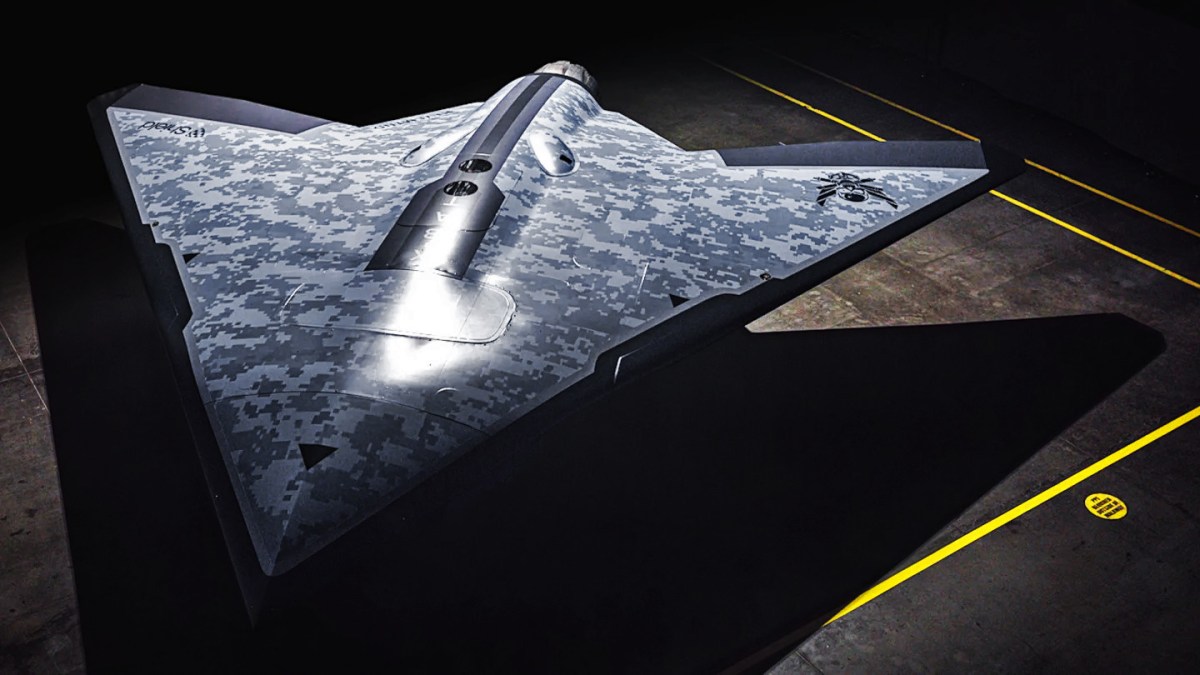
There are also two pronounced bulges toward the rear of the central body, one on either side of X-BAT 001’s dorsal ‘spine.’ These do not appear to be present on any models or renderings shown in the past. Each one of the bulges also has a small opening at the front. There are two circular openings on top of the spine with mesh screens covering them, as well. Small fans may be visible inside them.
The purpose of these features on top is unknown, and Shield AI declined to comment when asked for more information. They could be tied to the drone’s propulsion arrangement. The drone’s thrust-vectoring exhaust nozzle only provides pitch and yaw control. Shield AI has said in the past that bleed air routed through thrusters in the wings will be used for roll control.
A top-down look at X-BAT 001, showing the bulges on either side of the dorsal ‘spine,’ as well as the circular openings. Shield AI capture
Various panel lines with circular edges are also visible across the top of the drone. This is distinctly different from the saw-tooth-edged paneling depicted on previously shown models and renders.
Another full look at X-BAT 001 from the front quarter. Shield AI capture
As an aside, the prototype also features an insignia on the top of its left wing with a skull and other motifs, which the company says is meant to pay homage to all four branches of the U.S. military.
A close-up look at the ‘skull’ insignia. Shield AI capture
“X-BAT 001 is a development aircraft, so the design will evolve as we test and refine it,” a Shield AI spokesperson also told TWZ today.
Shield AI had previously said that the prototype nozzle arrangement would lack low-observable (LO) attributes, but also that this would change after initial testing. From what we can see now, the experimental nozzle is well blended considering the current stage of development. Beyond that, it has what appears to be remarkably good low-observable (stealthy) optimization, especially true for a prototype. Initial examples of new designs are often cluttered with elements that are eliminated later on, like antennas and air data probes. Some of these features could be added to X-BAT 001 prior to flight testing.
In an interview with TWZ last month , Shield AI’s Armor Harris, Senior Vice President and General Manager of the company’s aircraft division, had also compared the expected differences between the full-scale prototypes and production version “as like X-35 versus F-35.” This is a reference to Lockheed Martin’s X-35 demonstrators, which were broadly similar, but also distinctly different from the production variants of the Joint Strike Fighter.
“That’s a full-scale vehicle,” Harris also stressed when talking about the configuration of the full-scale prototypes. “It’s got the outer mold line, it’s got the F110 engine, the full propulsion path, everything in it.”
The “propulsion path” mentioned here, which includes the aforementioned exhaust nozzle and thrusters, is absolutely critical to the X-BAT concept. The design leverages past work on an Axisymmetric Vectoring Exhaust Nozzle (AVEN), first developed in the 1990s for an experimental thrust-vectoring F-16 fighter. Shield AI has been using the original test nozzle, which had been in storage for decades, as part of the development process.
No runway, no problem. Shield AI and @GE_Aerospace just cleared a critical path to vertical flight, completing engine light-off testing of the Axisymmetric Vectoring Exhaust Nozzle (AVEN) for X-BAT. Engineers from both companies integrated the AVEN into GE Aerospace's… pic.twitter.com/OxV3y3sRKB — Shield (@shieldaitech) July 20, 2026
No runway, no problem. Shield AI and @GE_Aerospace just cleared a critical path to vertical flight, completing engine light-off testing of the Axisymmetric Vectoring Exhaust Nozzle (AVEN) for X-BAT. Engineers from both companies integrated the AVEN into GE Aerospace's… pic.twitter.com/OxV3y3sRKB
X-BAT’s ability to take off and land vertically comes down to this propulsion arrangement combined with guidance, navigation, and control (GNC) systems. The GNC elements will leverage Shield AI’s experience with the much smaller, internal combustion-engine-powered, tail-sitting V-BAT . This, in turn, creates benefits from the design perspective, especially obviating the need for any kind of landing gear, and opens the door to a host of new operational possibilities. X-BAT is designed to be launched and recovered via a trailer-based system that can be deployed on land and on ships with sufficient deck space, all with a minimal footprint.
“The launch and recovery vehicle is actually critical to the operation of the X-BAT weapon system because it enables survivability on the ground. So when you’re operating in a land-based environment, it enables basically shoot-and-scoot tactics,” Shield AI’s Harris told us last month. “Enemy transporter-erector-launchers [for missiles] are like pretty hard to find because they’re constantly moving around. Just like X-BAT, when it’s mated onto the launch and recovery vehicle, [it] is always moving around, makes it hard to track, hard to find, hard to destroy.”
A graphic highlighting various options for deploying X-BATs on land and at sea. Shield AI
Land-based deployment concepts could be particularly attractive for expeditionary and distribution operations scenarios, especially in the Pacific. This is something TWZ has explored in more detail in the past .
On the maritime side, Shield AI envisions X-BATs on their launch and recovery trailers – potentially dozens at a time – being embarked on a variety of ships, including amphibious warfare and expeditionary sea base-type vessels. The company notably touts the concept as offering additional air combat capacity without having to sacrifice space for crewed planes on aircraft carriers.
A rendering depicting X-BAT drones on the deck of the US Navy’s future America class amphibious assault ship USS Bougainville . Shield AI
“So when you think about the number of carrier air wings that the Navy has to deploy, deploying X-BAT across all these other ships basically significantly increases the number of carrier air wings,” Harris said in his interview with us in October.
Once in the air, X-BAT is designed to operate as a multi-mission tactical platform capable of carrying munitions internally and on hardpoints under the wings. The drones will also be able to carry various sensors, electronic warfare packages, and other mission systems. Shield AI plans to leverage its Hivemind software to give X-BATs a high degree of autonomy when carrying out any assigned task.
“Those multirole abilities put X-BAT in a very different category from Air Force Increment 1 CCAs . Those are much smaller aircraft, focused exclusively on air-to-air,” Shield AI’s Harris wrote in an extended statement today. “X-BAT is twice the size, has the capacity for air-to-ground strike missions, and carries many more sensors on board. The F110 engine with thrust vectoring also gives X-BAT a much more fighter-like flight envelope than those smaller aircraft with Williams-type engines.”
Before any of these operational capabilities can be demonstrated, the core X-BAT concept still very much needs to be proven out. There have been several unsuccessful attempts to operationalize broadly similar designs in the past, which Shield AI itself has acknowledged .
In the past year, Shield AI has conducted “wind tunnel testing, engine testing, thermal testing, all kinds of stuff to basically take the major risks in the program, [and] burn them down, so we can move confidently into the production design,” Harris told TWZ last month. The plan for the prototypes now is to “start with the vehicle horizontal, sitting on that launch and recovery vehicle, running the engine. Then we bring it up vertical, run the engine vertically, run the vehicle vertically.”
“Then we have one of the biggest cranes in the world that’s getting set up at our test site in Kansas right now, and we hang the vehicle suspended from that crane and do a bunch of testing while it’s hanging from the crane in free flight,” he added. “Then we take the crane away, and then we do the actual untethered flights.”
A rendering of the X-Forge 2 test facility in Kansas. Shield AI
As mentioned, the U.S. Navy is already actively supporting development of X-BAT with a clear eye toward fielding the drones operationally in the future. Just this year, Shield AI has received $200 million in funding from the Navy in support of a program called Runway Independent Maritime Expeditionary Strike (RIMES). Some of this money has come via the Office of the Under Secretary of War for Acquisition and Sustainment. The company has also committed an equal amount of internal funding to the project.
“The Department of the Navy Rapid Capabilities Office (DONRCO), in partnership with the Defense Innovation Unit (DIU), is aggressively accelerating development and testing of RIMES in order to deliver a runway-independent, long-range maritime strike capability to the fleet at the speed of relevance,” a Navy spokesperson told TWZ last week. “Specific timelines for achieving operational capability will be determined by operational evaluations, flight-test performance, and subsequent fleet requirements.”
RIMES is distinct from the Navy’s program pursuing carrier-based Collaborative Combat Aircraft (CCA) type drones.
Shield AI has said previously that the goal is to fly a fully missionized X-BAT in 2028 and start series production the following year. The company has also raised the prospect of achieving at least a limited degree of operational capability in 2029. As we have noted in the past, X-BAT reaching any real level of operational maturity within three years is, to say the least, an extraordinarily ambitious timeline.
How fast Shield AI progresses with testing of its initial prototypes, the first of which we have now seen, will speak to its ability to keep to this schedule.
Contact the author: joe@twz.com
Comments couldn’t be loaded. Please refresh the page.
作者:约瑟夫·特雷维西克
发布于美国东部时间2026年11月3日下午1:33
Shield AI公司首次公开了其X-BAT喷气动力隐形“战斗”无人机的全尺寸原型机。该无人机采用尾部坐姿设计,可垂直起降。这是该公司为验证这一雄心勃勃的飞行器概念而迈出的最新一步。无尾X-BAT已获得美国海军的高度认可,美国海军希望看到该无人机在非常紧迫的时间表内发展成为真正的作战能力。
今天早些时候,Shield AI发布了一段视频,展示了该公司计划建造的两架全尺寸原型机中的第一架——X-BAT 001,视频如下。这架无人机目前正在从位于德克萨斯州弗里斯科的公司总部运往位于堪萨斯州牛顿的飞行测试基地。这两个基地分别被称为X-Forge 1和X-Forge 2。X-BAT于去年首次公开亮相,TWZ网站率先对其进行了深入报道。
X-BAT自发布以来已经发生了显著变化。今年4月,在海军联盟举办的2026年海空航天博览会上,展出了一个半比例模型,展示了其核心设计的重大改变。整个平面形状从“曲柄风筝”式布局重新设计为箭头形轮廓,其前缘笔直,后掠角更大。
X-BAT 001原型机的配置与今年海空航天展上展出的模型以及最近的计算机渲染图基本一致。然而,两者之间也存在一些显著差异。
首先,原型机的推力矢量喷射喷嘴明显向无人机尾部延伸,超过了机翼的后缘。此前展示的模型和渲染图显示,喷嘴的位置更靠近机身后部。
左侧为X-BAT 001的排气喷嘴配置,右侧为4月份在2026年海空航天展上展出的半比例模型上的喷嘴布置,两者并排对比。图片由Shield AI拍摄/Jamie Hunter提供
在X-BAT 001的背部“脊柱”两侧,靠近中央躯干后部还有两个明显的凸起。这些凸起在以往展示的任何模型或渲染图中似乎都没有出现过。每个凸起的前端都有一个小开口。脊柱顶部也有两个圆形开口,上面覆盖着网状屏幕。从这些开口内部可以看到小型风扇。
这些顶部装置的用途尚不清楚,Shield AI在被问及更多信息时拒绝置评。它们可能与无人机的推进系统有关。无人机的推力矢量喷嘴仅提供俯仰和偏航控制。Shield AI此前曾表示,将利用引气通过机翼推进器来实现滚转控制。
从上方俯视X-BAT 001,可以看到背部“脊柱”两侧的凸起以及圆形开口。Shield AI捕获
无人机顶部还可以看到各种带有圆形边缘的面板线条。这与之前展示的模型和渲染图中锯齿状边缘的面板截然不同。
从正面四分之一处再次完整展示 X-BAT 001。盾牌人工智能捕获
另外,该原型机左翼顶部还饰有骷髅头和其他图案的徽章,该公司表示,这是为了向美国军队的四个分支致敬。
近距离观察“骷髅”徽章。盾牌人工智能捕获
“X-BAT 001 是一架研发飞机,因此随着我们进行测试和改进,其设计也会不断演变,”Shield AI 的一位发言人今天也告诉 TWZ。
Shield AI此前曾表示,原型喷嘴布局将缺乏低可观测性(LO)特性,但也表示在初步测试后会进行改进。就目前来看,考虑到其研发阶段,实验性喷嘴的融合度相当不错。此外,它似乎还拥有非常出色的低可观测性(隐身)优化,这对于原型机而言尤为难得。新设计的初期版本通常会包含一些后续会被移除的部件,例如天线和空速探头。X-BAT 001在飞行测试前可能会添加其中一些部件。
上个月,Shield AI公司飞机部门高级副总裁兼总经理阿莫尔·哈里斯在接受TWZ采访时,也将全尺寸原型机和量产版之间的预期差异比作“X-35与F-35”。他指的是洛克希德·马丁公司的X-35验证机,这些验证机与联合攻击战斗机的量产型大致相似,但也存在明显差异。
“那是一辆全尺寸样车,”哈里斯在谈到全尺寸原型车的配置时也强调说。“它有外形轮廓线,有F110发动机,有完整的推进系统,所有东西都包含在内。”
这里提到的“推进路径”,包括前文所述的排气喷嘴和推进器,对X-BAT概念至关重要。该设计借鉴了轴对称矢量排气喷嘴(AVEN)的过往研究成果,AVEN最初于20世纪90年代为实验性推力矢量F-16战斗机开发。Shield AI公司在研发过程中一直使用着尘封数十年的原始测试喷嘴。
没有跑道?没问题!Shield AI 和 @GE_Aerospace 刚刚扫清了垂直飞行的关键障碍,完成了 X-BAT 轴对称矢量喷管 (AVEN) 的发动机点火测试。两家公司的工程师将 AVEN 集成到了 GE Aerospace 的…… pic.twitter.com/OxV3y3sRKB — Shield (@shieldaitech) July 20, 2026
没有跑道?没问题!Shield AI 和 @GE_Aerospace 刚刚扫清了垂直飞行的关键障碍,完成了 X-BAT 轴对称矢量喷管 (AVEN) 的发动机点火测试。两家公司的工程师将 AVEN 集成到了 GE Aerospace 的…… pic.twitter.com/OxV3y3sRKB
X-BAT垂直起降的能力得益于其推进装置以及制导、导航和控制(GNC)系统。GNC系统将借鉴Shield AI在小型化、内燃机驱动的尾座式V-BAT无人机上的经验。这从设计角度带来了诸多优势,尤其无需任何类型的起落架,并开启了诸多全新的作战可能性。X-BAT采用拖车式系统进行发射和回收,该系统可部署在陆地和甲板空间充足的舰船上,且占地面积极小。
“发射回收车对于X-BAT武器系统的运行至关重要,因为它能确保其在地面上的生存能力。因此,在陆地作战环境中,它基本上可以实现‘打了就跑’的战术,”Shield AI公司的哈里斯上个月告诉我们。“敌方的导弹运输-起竖-发射装置很难找到,因为它们一直在移动。就像X-BAT一样,当它与发射回收车对接后,它也一直在移动,这使得它难以追踪、难以发现、难以摧毁。”
一张图表展示了在陆地和海上部署 X-BAT 的各种方案。Shield AI
陆基部署方案对于远征和物资分发行动场景可能特别具有吸引力,尤其是在太平洋地区。TWZ过去曾对此进行过更深入的研究。
在海上作战方面,Shield AI设想将X-BAT无人机搭载在其发射和回收拖车上——一次可能搭载数十架——部署到各种舰艇上,包括两栖作战舰艇和远征海上基地舰艇。该公司特别强调,该概念能够在不占用航空母舰载机空间的情况下,提供额外的空中作战能力。
一张渲染图,描绘了美国海军未来“美利坚”级两栖攻击舰“布干维尔”号甲板上的X-BAT无人机。Shield AI
“所以,当你考虑到海军必须部署的航母舰载机联队数量时,在所有这些其他舰艇上部署 X-BAT 基本上大大增加了航母舰载机联队的数量,”哈里斯在 10 月份接受我们采访时说道。
X-BAT无人机升空后,将被设计成一个多任务战术平台,能够携带内部弹药和机翼下方的挂点。这些无人机还能搭载各种传感器、电子战组件和其他任务系统。Shield AI计划利用其Hivemind软件,赋予X-BAT无人机在执行任何指定任务时高度的自主性。
“X-BAT 的多用途能力使其与空军第一阶段 CCA 机型截然不同。后者体型小得多,仅专注于空对空作战,”Shield AI 的哈里斯今天在一份声明中写道。“X-BAT 的尺寸是后者的两倍,具备空对地打击能力,并且机载传感器数量更多。此外,配备推力矢量控制的 F110 发动机也使 X-BAT 的飞行包线比那些配备威廉姆斯发动机的小型飞机更接近战斗机。”
在展示这些作战能力之前,X-BAT的核心概念仍需进一步验证。过去曾有多次尝试将类似设计付诸实践,但均以失败告终,Shield AI也承认这一点。
过去一年,Shield AI进行了“风洞测试、发动机测试、热测试等等各种测试,基本上是为了规避项目中的主要风险,并排除它们,这样我们才能充满信心地进入生产设计阶段,”哈里斯上个月告诉TWZ。目前的原型机计划是“先让飞行器水平放置在发射回收飞行器上,启动发动机。然后将其竖直放置,垂直运行发动机,再垂直运行飞行器。”
“然后,我们会在堪萨斯州的测试场地架设一台世界上最大的起重机之一,我们会把飞行器悬挂在这台起重机上,进行一系列自由飞行测试,”他补充道。“之后,我们会把起重机移走,然后进行真正的无绳飞行测试。”
位于堪萨斯州的 X-Forge 2 测试设施效果图。Shield AI
如前所述,美国海军已积极支持X-BAT无人机的研发,并明确计划在未来将其投入作战使用。仅今年一年,Shield AI公司就从海军获得了2亿美元的资金,用于支持一项名为“跑道独立海上远征打击”(RIMES)的项目。其中一部分资金来自美国陆军部负责采购和保障的副部长办公室。该公司也为该项目投入了等额的内部资金。
海军发言人上周告诉TWZ:“海军部快速能力办公室(DONRCO)与国防创新部门(DIU)合作,正积极加快RIMES的研发和测试,以便尽快为舰队提供无需跑道的远程海上打击能力。实现作战能力的具体时间表将取决于作战评估、飞行测试性能以及后续舰队需求。”
RIMES 与海军正在研发的舰载协同作战飞机 (CCA) 型无人机项目截然不同。
Shield AI此前曾表示,其目标是在2028年完成X-BAT的完整任务试飞,并在次年开始批量生产。该公司还提出了在2029年实现至少一定程度的作战能力的设想。正如我们之前指出的,X-BAT在三年内达到任何真正的作战成熟度,至少可以说是一个极其雄心勃勃的时间表。
Shield AI 对其初始原型(我们现在已经看到了第一个)的测试进展速度,将决定其能否按计划完成。
联系作者:joe@twz.com
评论加载失败,请刷新页面。