Defense contractors to demo cargo drones for US Marine Corps国防承包商将为美国海军陆战队演示货运无人机
An event early next year in Huntsville, Alabama, will allow contractors to display their solutions for a Marine battlefield cargo drone.
Share on Facebook (Opens in new window) Facebook
Share on X (Opens in new window) X
Share on Bluesky (Opens in new window) Bluesky
Share on Reddit (Opens in new window) Reddit
Share on LinkedIn (Opens in new window) LinkedIn
Share using Native tools Share Copied to clipboard
Share on Mail (Opens in new window) Mail
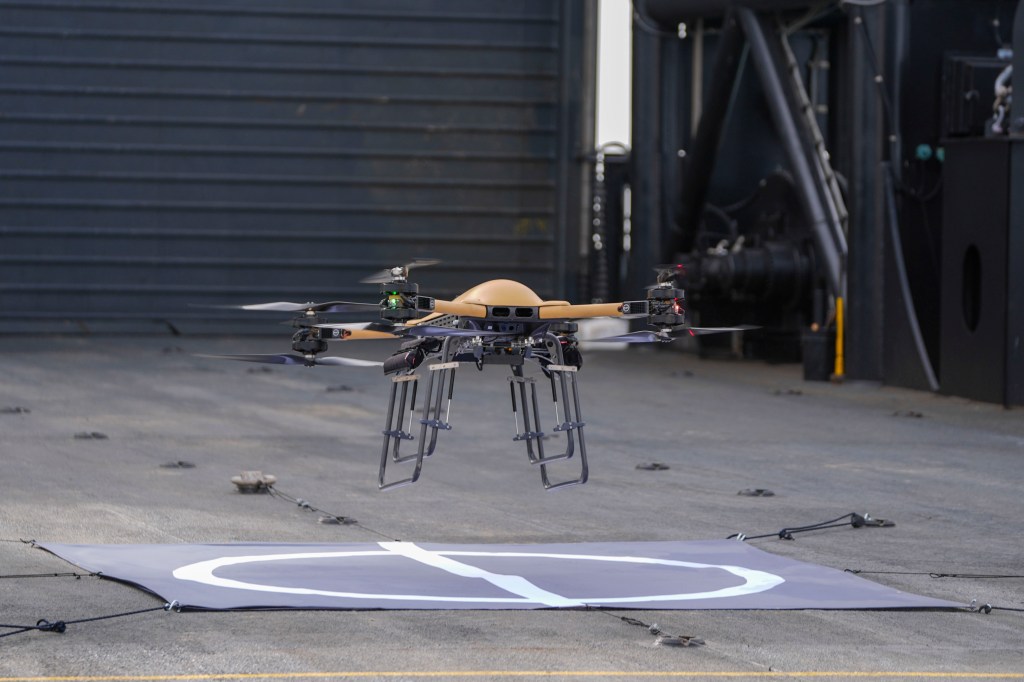
A Tactical Resupply Vehicle-150, an electric vertical takeoff and landing air cargo drone, takes off from the deck of the Stern Landing Vessel as part of Project Convergence Capstone 4 on Feb. 24, 2024, off the coast of Red Beach at Camp Pendleton, California. (Kevin Ray Salvador/U.S. Marine Corps Warfighting Laboratory)
The U.S. Marine Corps and Navy will be conducting a technology demonstration for a Marine battlefield cargo drone early next year.
The event, from Jan. 25 to Feb. 5, 2027, in Huntsville, Alabama , will allow contractors to display their drones for the Increment II the Marine Corps’ Tactical Resupply Unmanned Aircraft System, or TRUAS , program.
TRUAS Increment II aims to “provide an organic aerial distribution capability for small-unit logistics support across the last tactical mile in expeditionary advanced base operations and distributed operations,” according to the Monday announcement by the Navy’s Air Warfare Program Management Office, which is sponsoring the demonstration.
Contractors will perform up to five flights, as well as demonstrate ground setup and flight preparation.
The first flight calls for a drone to transport a 100-pound payload up to 40 nautical miles under no-wind conditions, drop off the cargo either automatically or under manual control, and then return to the launch site without refueling. The second flight involves carrying and depositing a payload of 150 pounds or more out to 10 nautical miles.
The UAV must have a speed of at least 50 knots per hour and fly no higher than 1,000 feet during the flights. The UAS must be capable of launch and recovery without mechanical equipment such as a catapult, arresting net or cable.
“Following the two required flights, participants may be given the opportunity to perform up to three additional flights to demonstrate unique features and/or capabilities,” the Navy said.
The announcement lists a variety of technical specifications. They include flying at an altitude of up to 4,500 feet and, eventually, 8,000 feet. Speed should be a minimum of 50 knots per hour, with an eventual goal of 150 knots per hour, in crosswinds of 20 to 30 knots.
The Marine Corps is looking for an unmanned aircraft that can function autonomously, such as assessing the landing zone “before and during landing, day and night, and detect and avoid personnel, equipment, structures, excessive slope, and other terrain hazards.”
With skies becoming saturated by drones, TRUAS craft should have safeguards against collisions, including an “organic airborne sense-and-avoid capability for manned and unmanned aircraft at cruise speed, with performance comparable to a human pilot operating under Visual Flight Rules and sufficient reaction time for collision avoidance.”
The service also anticipates that its cargo drones will be forced to land under enemy fire.
“TRUAS shall minimize the time required to descend from cruise altitude to the LZ [landing zone] to enhance survivability by reducing the window for hostile detection,” the announcement noted.
The announcement did not specify what kind of cargo TRUAS will carry.
Last month, Ukraine claimed to have performed the world’s first drone medevac of a casualty from a frontline position. Ukraine’s 92nd Separate Assault Brigade posted a dramatic video of a wounded soldier being hoisted on a sling attached to the underside of a large hexacopter.
“Heavy Russian drone activity and mined terrain made evacuation by an unmanned ground vehicle impossible,” said Ukrainian media. “Working with the manufacturer, the troops developed a technical solution that allowed the heavy drone to carry the wounded soldier while remaining stable in flight, preventing it from tipping over or swaying excessively.”
Michael Peck is a correspondent for Defense News and a columnist for the Center for European Policy Analysis. He holds an M.A. in political science from Rutgers University. Find him at theuncommondefense.com. His email is mikedefense1@gmail.com.
分享至 Facebook(在新窗口中打开) Facebook
分享至 X(在新窗口中打开)X
在 Bluesky 上分享(在新窗口中打开)Bluesky
分享到 Reddit(在新窗口中打开)
在领英上分享(在新窗口中打开)领英
使用原生工具分享 已复制到剪贴板
分享至邮件(在新窗口中打开)邮件
2024年2月24日,在加利福尼亚州彭德尔顿营红滩海岸附近,一架战术补给飞行器-150(TTV-150)——一种电动垂直起降空中货运无人机——从“船尾登陆舰”的甲板上起飞,这是“融合项目”第四阶段演练的一部分。(凯文·雷·萨尔瓦多/美国海军陆战队作战实验室)
美国海军陆战队和海军将于明年初进行海军陆战队战场货运无人机的技术演示。
此次活动将于 2027 年 1 月 25 日至 2 月 5 日在阿拉巴马州亨茨维尔举行,届时承包商将展示他们为海军陆战队战术补给无人机系统 (TRUAS) 计划第二阶段开发的无人机。
据海军航空作战项目管理办公室周一发布的公告称,TRUAS Increment II 的目标是“为远征前进基地作战和分布式作战中的小型部队后勤保障提供有机空中分发能力,以覆盖最后一公里战术距离”。该办公室是此次演示的赞助方。
承包商将进行最多五次飞行,并演示地面设置和飞行准备。
第一次飞行任务要求无人机在无风条件下,将100磅(约45公斤)的有效载荷运送至40海里(约64公里)的距离,并以自动或手动控制的方式投放货物,然后无需加油即可返回起飞点。第二次飞行任务则要求无人机携带并投放150磅(约68公斤)或以上的有效载荷至10海里(约16公里)的距离。
无人机飞行速度必须至少达到每小时50节,飞行高度不得超过1000英尺。无人机系统必须能够在无需弹射器、阻拦网或缆绳等机械设备的情况下进行起飞和回收。
海军方面表示:“完成两次必修飞行后,参与者可能有机会进行最多三次额外的飞行,以展示其独特的功能和/或能力。”
公告列出了多项技术规格,其中包括飞行高度最高可达4500英尺,最终目标是8000英尺。最低速度应为每小时50节,最终目标是每小时150节,侧风风速为20至30节。
海军陆战队正在寻找一种能够自主运行的无人机,例如在着陆前和着陆期间、白天和晚上评估着陆区,并探测和避开人员、设备、建筑物、过大的坡度和其他地形危险。
随着天空被无人机填满,TRUAS 飞行器应具备防撞保护措施,包括“在巡航速度下对有人驾驶和无人驾驶飞机进行机载感知和规避的有机能力,其性能与在目视飞行规则下操作的人类飞行员相当,并有足够的反应时间来避免碰撞”。
该部门还预计其货运无人机将被迫在敌方火力下降落。
公告指出:“TRUAS 将最大限度地缩短从巡航高度下降到着陆区所需的时间,从而减少敌方发现的时间窗口,提高生存能力。”
公告并未具体说明TRUAS将运输何种货物。
上个月,乌克兰声称完成了世界上首次从前线阵地使用无人机进行伤员后送的行动。乌克兰第92独立突击旅发布了一段震撼的视频,视频中一名受伤士兵被吊索吊起,吊索连接在一架大型六旋翼无人机的底部。
乌克兰媒体报道称:“由于俄罗斯无人机活动频繁且地形布满地雷,无人地面车辆撤离行动无法进行。部队与制造商合作,开发出一种技术解决方案,使重型无人机能够在飞行中保持稳定,运送受伤士兵,防止其倾覆或过度摇晃。”
迈克尔·佩克是《防务新闻》的通讯员,也是欧洲政策分析中心的专栏作家。他拥有罗格斯大学政治学硕士学位。您可以在theuncommondefense.com找到他。他的邮箱是mikedefense1@gmail.com。