Ministerial salaries to increase by up to 9% to S$1.2m, lower than review committee's recommendation部长级薪酬将增加至多9%,达到120万新元,低于审查委员会的建议。
The new salaries will take effect from Oct 15 this year.
The new salaries will take effect from Oct 15 this year.
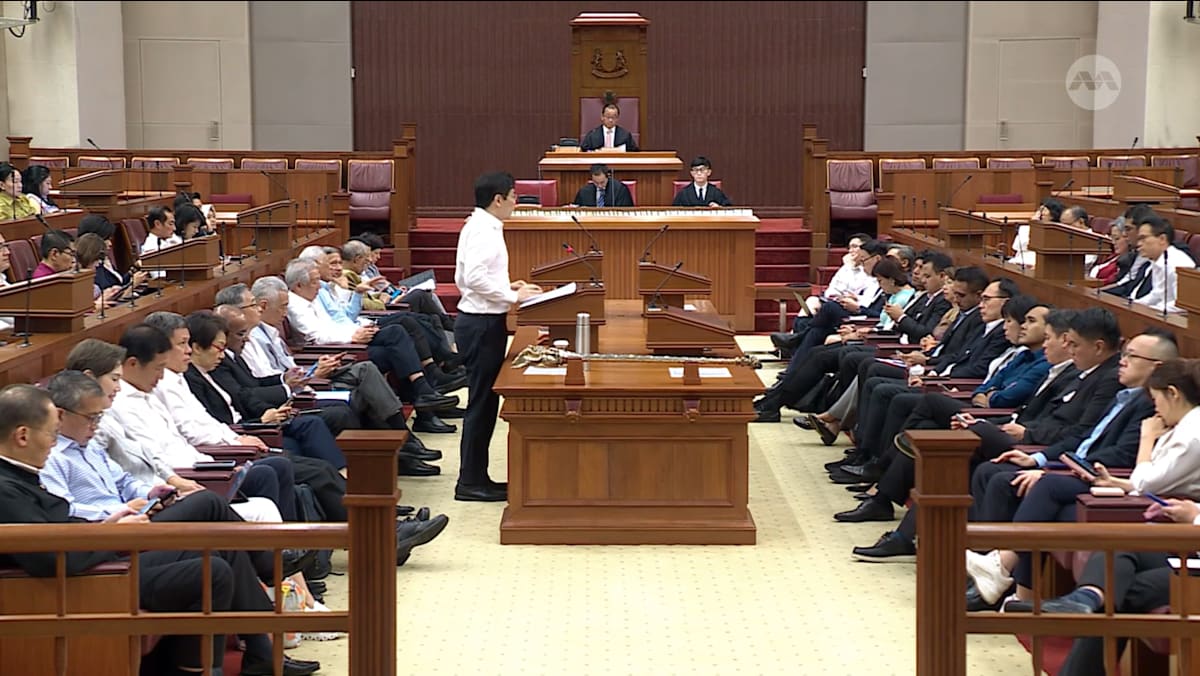
Prime Minister Lawrence Wong addressing questions from Members of Parliament on Apr 8, 2025.
This audio is generated by an AI tool.
SINGAPORE: Singapore’s political office holders will receive a salary increase of up to 9 per cent, taking the sum to about S$1.2 million annually for a minister in the lowest MR4 grade , Prime Minister Lawrence Wong announced on Tuesday (Sep 8).
Speaking in parliament, Mr Wong, who is also finance minister, said the changes will kick in from Oct 15 this year, after the government accepted the recommendations by an independent review committee that was appointed in December last year.
It is the first time since 2011 that ministerial salaries have been changed.
Mr Wong was delivering the government’s response to the committee’s recommendations for the benchmark salary for a minister at the MR4 grade – the lowest of four tiers – to be raised from the current reference salary of S$1.1 million to S$1.8 million.
The committee also recommended changes to other political salaries and to the allowances of members of parliament and other parliamentarians.
Adjustments to the salaries of the president, parliamentary speaker and deputy speakers will also take effect from the same date, said Mr Wong.
“We will not move immediately to the new salary benchmarks. Instead, we will make a one-off adjustment now of up to 9 per cent for political office holders,” said Mr Wong.
“I say ‘up to’ because the same increase will not automatically apply to everyone. The adjustment for each officeholder will depend on individual circumstances, including performance and when his or her salary was last adjusted.”
Mr Wong explained that for an MR4 minister earning the current reference salary of S$1.1 million, the full 9 per cent adjustment would bring the amount to about S$1.2 million.
There would be no further special adjustments to close the gap to S$1.8 million thereafter, said Mr Wong.
Instead, any subsequent changes will be based on individual performance and responsibilities, he noted.
CNA Games Guess Word Crack the word, one row at a time Buzzword Create words using the given letters Mini Sudoku Tiny puzzle, mighty brain teaser Mini Crossword Small grid, big challenge Word Search Spot as many words as you can Show More Show Less
MINISTERS’ WAGE PACKAGE
There are currently four ministerial grades – MR4, MR3, MR2 and MR1 – with a range of salary points within each grade which determine a minister’s fixed pay, said Mr Wong.
“As PM, I decide the grade of each minister; where each minister is positioned within the salary range for that grade; and the individual performance bonus each year,” he said.
A total of 10 out of the 16 ministers are currently at MR4.
The other six are at higher grades, reflecting their seniority and heavier responsibilities, including those serving as coordinating ministers.
The three coordinating ministers are Defence Minister Chan Chun Sing who oversees public services, Health Minister Ong Ye Kung who oversees social policies, and Home Affairs Minister K Shanmugam who helms national security. The two senior ministers in Cabinet are Mr Shanmugam and former prime minister Lee Hsien Loong.
Over time, ministers can move to different salary points within their grade based on their performance, said Mr Wong.
“They may begin at the lower end of the salary range. Those who perform well may move to a higher point within the range. Some ministers may also be promoted to a higher grade as they take on greater responsibilities,” he said.
There are also variable components which make up more than one-third of a minister’s annual remuneration, he said.
For instance, a National Bonus applies to all office holders, based on the outcomes specified in the framework.
An individual performance bonus also depends on the prime minister’s assessment of each office holder’s performance. Last year, it ranged from three to six months, said Mr Wong.
“So when we refer to the current MR4 reference salary of S$1.1 million, this is an all-in reference figure. It includes fixed pay together with assumed levels of performance and bonus payouts,” Mr Wong said.
“The actual remuneration received by an individual minister in any year can therefore be higher or lower than the reference salary, depending on his or her salary point and the variable payouts.”
PM DONATES SALARY INCREASE TO CHARITY
In his speech, Mr Wong said that the prime minister’s salary is set at twice the MR4 benchmark.
“I have decided that, for the next five years – assuming I remain PM – I will donate the full increase in my salary arising from this adjustment,” he said.
He will continue to receive his salary as provided for under the framework, and will then “donate the increase to suitable good causes”, said Mr Wong.
“This is my own decision. I do not expect other office holders to do the same. As a general rule, I do not believe in making a public show of charitable giving.”
Mr Wong said that, as prime minister, he carries the “ultimate responsibility” for the salary framework, and so “it is right that Singaporeans should know what I have decided, and that I am taking these changes forward because I believe they are in Singapore’s interests”.
He will review the position again at the end of five years, taking into account the circumstances at that time.
“I fully expect to continue supporting good causes, as I have always done. But I do not want to make an open-ended public commitment, or to create an expectation that future prime ministers may feel obliged to follow,” he added.
STREAMLINING MINISTERIAL GRADES
The review committee also recommended combining the MR2 and MR3 grades into one, bringing the number of tiers down from four to three, said Mr Wong.
The salary range for each grade will also be widened to plus or minus 25 per cent, he said.
“We agree with these changes. But the basic approach to assessing and differentiating individual salaries will remain the same,” he said.
“After the one-off special adjustment, I will continue to assess ministers and adjust their salaries in the usual way, based on performance.”
On that basis, he expects most ministers who remain at MR4 to be at the lower end of the new salary range – about S$1.35 million – by the end of this term of government.
Mr Wong said that those who excel and take on larger responsibilities may move higher within the range, or be promoted to a higher grade.
“So the revised MR4 benchmark of S$1.8 million is not a target salary that every minister must eventually reach. Ministers can be paid above or below the benchmark, within the prescribed range,” he noted.
OTHER OFFICE HOLDERS
For ministers of state, parliamentary secretaries and mayors, Mr Wong said he would “typically consult their supervising ministers on their performance”, but noted that the final decision on their salary points, grades and bonuses rests with him.
New office holders appointed in the next term will likewise come in at different points within those ranges, taking into account their experience and previous remuneration, he said.
This would over time bring a wider spread in salaries compared to today, which is the purpose of the revised structure, said Mr Wong.
“It gives the PM more room to differentiate pay according to performance, and importantly, to bring in people with substantial experience from outside government, especially those already earning significantly more in the private sector,” he said.
While they are still expected to make a “meaningful sacrifice” to enter political service, “we should not make that gap larger than it needs to be”, said Mr Wong.
“Overall, I believe this will give me and future prime ministers a better chance of persuading capable Singaporeans to step forward, and of building the strongest possible team for Singapore,” he said.
The government’s response to the review committee’s recommendations will be debated in parliament on Thursday.
Get our pick of top stories and thought-provoking articles in your inbox
Stay updated with notifications for breaking news and our best stories
Join our channel for the top reads for the day on your preferred chat app
新的薪资标准将于今年10月15日起生效。
2025年4月8日,总理黄循财回答国会议员提问。
这段音频由人工智能工具生成。
新加坡:新加坡总理黄循财周二(9月8日)宣布,新加坡政治官员的薪水将增加至多9%,最低级别MR4部长的年薪将达到约120万新元。
黄之锋在国会发言时表示,这些改革措施将于今年10月15日生效。此前,政府接受了去年12月成立的独立检讨委员会的建议。黄之锋同时也是财政部长。
这是自2011年以来部长级薪酬首次调整。
黄先生当时正在就委员会的建议发表政府的回应,该建议将 MR4 级(四个级别中最低的一个)部长的基准薪酬从目前的 110 万新元参考薪酬提高到 180 万新元。
委员会还建议对其他政治人物的薪酬以及议员和其他议会工作人员的津贴进行调整。
黄先生表示,总统、国会议长和副国会议长的薪金调整也将从同一天生效。
黄先生表示:“我们不会立即实施新的薪酬标准。相反,我们将先对政治公职人员进行一次性调整,调整幅度最高可达9%。”
“我说‘最高’是因为同样的涨幅不会自动适用于所有人。每位官员的薪资调整幅度将取决于个人情况,包括绩效以及上次薪资调整的时间。”
黄先生解释说,对于一位目前参考薪资为 110 万新元的 MR4 部长来说,9% 的全面调整将使薪资达到约 120 万新元。
黄先生表示,此后不会再进行任何特别调整来缩小180万新元的差距。
他指出,任何后续的变动都将基于个人的表现和责任。
CNA游戏 猜词游戏 逐行破解单词 流行词游戏 用给定的字母组成单词 迷你数独 小小谜题,挑战你的大脑 迷你填字游戏 小方格,大挑战 单词搜索 尽可能多地找出单词 显示更多 显示更少
部长薪酬方案
黄先生表示,目前部长级分为四个等级——MR4、MR3、MR2 和 MR1——每个等级内都有一系列薪级点,这些点决定了部长的固定薪酬。
他说:“作为总理,我决定每位部长的级别;每位部长在该级别薪资范围内的具体位置;以及每年的个人绩效奖金。”
目前,16 位部长中有 10 位处于 MR4 级别。
其他六人级别较高,反映了他们的资历和更重的责任,其中包括担任协调部长的人员。
三位统筹部长分别是负责公共服务的国防部长陈振声、负责社会政策的卫生部长王乙康以及负责国家安全的内政部长尚穆根。内阁中的两位高级部长分别是尚穆根和前总理李显龙。
黄先生表示,随着时间的推移,部长可以根据其表现,在同一级别内晋升到不同的薪级。
他说:“他们的起薪可能在较低的水平。表现出色的人可能会升到更高的薪资水平。一些部长也可能因为承担更多责任而被晋升到更高的级别。”
他还表示,部长年薪中还有可变部分,这些部分占部长年薪的三分之一以上。
例如,根据框架中规定的结果,所有公职人员均可获得国家奖金。
黄先生表示,个人绩效奖金还取决于总理对每位官员绩效的评估。去年,奖金期限为三到六个月不等。
黄先生表示:“因此,当我们提到目前MR4的参考薪资110万新元时,这是一个包含所有费用的参考数字。它包括固定工资、预期的绩效水平以及奖金。”
“因此,任何一位部长每年实际获得的薪酬都可能高于或低于参考工资,具体取决于他或她的工资级别和浮动奖金。”
总理将加薪部分捐赠给慈善机构
黄之锋在演讲中表示,总理的薪酬设定为MR4基准的两倍。
他说:“我已经决定,在接下来的五年里——假设我继续担任总理——我将把此次调整带来的全部加薪捐出去。”
黄先生表示,他将继续按照框架规定领取薪水,并将“增加的部分捐赠给合适的慈善事业”。
“这是我自己的决定。我不期望其他官员也这样做。总的来说,我不赞成公开炫耀慈善捐赠。”
黄先生表示,作为总理,他对薪酬体系负有“最终责任”,因此“新加坡人理应知道我的决定,我之所以推进这些改革,是因为我相信这符合新加坡的利益”。
五年后,他将根据届时的具体情况再次评估这一立场。
“我完全有信心继续支持公益事业,就像我一直以来所做的那样。但我不想做出没有期限的公开承诺,也不想让未来的首相感到有义务效仿,”他补充道。
精简部长级职级
黄先生表示,审查委员会还建议将 MR2 和 MR3 等级合并为一个等级,将等级数量从四个减少到三个。
他还表示,各职级的薪资范围也将扩大至正负25%。
“我们同意这些改变。但评估和区分个人薪酬的基本方法将保持不变,”他说。
“在这次特别调整之后,我将继续按照惯例,根据绩效对部长们进行评估并调整他们的薪酬。”
基于此,他预计到本届政府任期结束时,大多数留在 MR4 级别的部长的薪酬将处于新薪酬范围的较低水平——约为 135 万新元。
黄先生表示,表现优异并承担更大责任的人可能会在现有职位范围内晋升,或者升至更高的职级。
他指出:“因此,修订后的MR4基准薪资180万新元并非每位部长最终必须达到的目标薪资。部长们的薪资可以在规定的范围内高于或低于该基准薪资。”
其他职务持有者
黄先生表示,对于国务部长、政务次长和市长,他“通常会就他们的表现咨询他们的上级部长”,但他指出,他们的薪级、等级和奖金的最终决定权在他手中。
他表示,下一届新任命的官员也将根据他们的经验和之前的薪酬,在这些范围内处于不同的位置。
黄先生表示,随着时间的推移,这将使薪资差距比现在更大,这也是修订后薪酬结构的目的。
他说:“这让总理有更大的空间根据绩效来区分薪酬,更重要的是,还能从政府以外引进拥有丰富经验的人才,特别是那些已经在私营部门收入高得多的人。”
黄先生表示,虽然人们仍然期望他们为进入政界做出“有意义的牺牲”,但“我们不应该让这种差距比必要的更大”。
“总的来说,我相信这将使我和未来的总理们更有机会说服有能力的的新加坡人挺身而出,并为新加坡组建最强大的团队,”他说。
政府对审查委员会建议的回应将于周四在议会进行辩论。
订阅我们的邮件,即可获取精选热门新闻和引人深思的文章。
订阅通知,第一时间获取突发新闻和精彩报道。
加入我们的频道,即可在您常用的聊天应用上获取当日热门文章。