US Air Force asks industry for new cruise missile for Ukraine美国空军向工业界寻求为乌克兰研制新型巡航导弹
The U.S. Air Force is looking for contractors to mass produce the Extended Range Attack Munition for Ukraine.
Share on Facebook (Opens in new window) Facebook
Share on X (Opens in new window) X
Share on Bluesky (Opens in new window) Bluesky
Share on Reddit (Opens in new window) Reddit
Share on LinkedIn (Opens in new window) LinkedIn
Share using Native tools Share Copied to clipboard
Share on Mail (Opens in new window) Mail
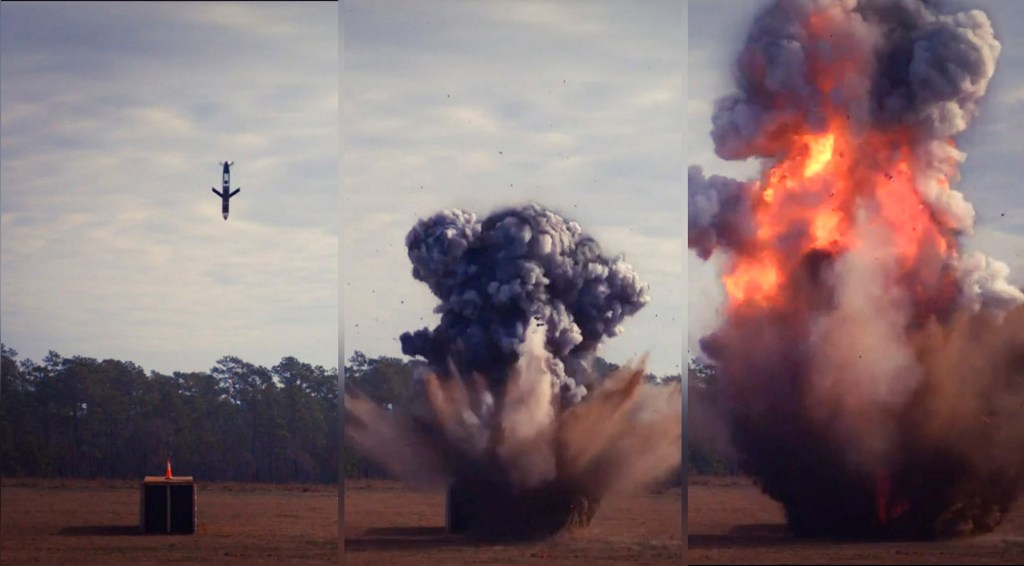
Earlier this year, the U.S. Air Force conducted its first test of the Extended Range Attack Munition, a new standoff cruise missile, less than 16 months after awarding its contract. (U.S. Air Force)
The U.S. Air Force is asking the defense industry whether it can deliver a new cruise missile intended for Ukraine.
Potential contractors are asked to detail their capabilities to provide the Extended Range Attack Munition , a small, air-launched standoff missile intended for mass production.
The Air Force’s new Request For Information , which has a deadline of Nov. 19, offers some technical specifications for ERAM. It should be a 500-pound class weapon with a range of greater than 250 nautical miles and a speed of more than Mach 0.6. Terminal accuracy should be within 10 meters of the target even amid jamming, such as degraded GPS. In addition to blast and fragmentation effects, the weapon should also be capable of limited penetration on impact.
The Air Force describes ERAM as a next-generation cruise missile “designed to provide affordable mass to the fight,” and which “delivers a precision-guided, stand-off capability against high-value fixed targets.”
ERAM is part of the Pentagon’s push for cheaper weapons developed more quickly. In 2024, the Air Force awarded a contract to two small defense companies — Zone 5 Technologies and CoAspire — to develop ERAM prototypes. In January 2026 — less than a year and a half later, the Air Force conducted a live warhead test at Eglin Air Force Base, Florida.
Similar haste can be seen in the RFI, which states that companies should begin delivering the first of more than 1,000 ERAMs no later than three months after the contract is awarded. Deliveries should be complete within 15 months.
One question is whether Ukraine is already using ERAM on its American-made F-16 fighters. In August 2025, the Trump administration announced an $825 million sale of 3,350 ERAMs to Ukraine. In June 2026, Ukrainian media suggested that Ukraine has used the AGM-188A Rusty Dagger — an ERAM version — against the Voronezh Semiconductor Plant , which makes components for Russian missiles.
Another question is to what extent the U.S. military will make use of ERAM. The Air Force published the original RFI in January 2024, nearly two years into the Ukraine War — and nearly two years before the Iran war depleted U.S. inventories of expensive missiles.
Michael Peck is a correspondent for Defense News and a columnist for the Center for European Policy Analysis. He holds an M.A. in political science from Rutgers University. Find him at theuncommondefense.com. His email is mikedefense1@gmail.com.
分享至 Facebook(在新窗口中打开) Facebook
分享至 X(在新窗口中打开)X
在 Bluesky 上分享(在新窗口中打开)Bluesky
分享到 Reddit(在新窗口中打开)
在领英上分享(在新窗口中打开)领英
使用原生工具分享 已复制到剪贴板
分享至邮件(在新窗口中打开)邮件
今年早些时候,美国空军在授予合同不到16个月后,就对新型远程攻击导弹(一种新型防区外巡航导弹)进行了首次测试。(美国空军)
美国空军正在询问国防工业界能否交付一种计划射向乌克兰的新型巡航导弹。
潜在承包商需详细说明其提供远程攻击弹药的能力,这是一种小型空射防区外导弹,旨在进行大规模生产。
美国空军最新发布的征求信息书(RFI)截止日期为11月19日,其中列出了ERAM导弹的一些技术规格。该导弹应为500磅级,射程超过250海里,速度超过0.6马赫。即使在受到干扰(例如GPS信号减弱)的情况下,其末端精度也应在目标10米以内。除了爆炸和碎片效应外,该导弹还应具备一定的冲击穿透能力。
美国空军将 ERAM 描述为下一代巡航导弹,“旨在为战斗提供经济实惠的火力”,并且“能够对高价值固定目标进行精确制导的防区外打击”。
ERAM是五角大楼加快研发更廉价武器计划的一部分。2024年,空军与两家小型国防公司——Zone 5 Technologies和CoAspire——签订合同,开发ERAM原型。不到一年半后的2026年1月,空军在佛罗里达州埃格林空军基地进行了实弹弹头测试。
类似的紧迫感也体现在信息征询书中,该书规定各公司应在合同授予后三个月内开始交付首批超过1000个ERAM芯片。所有芯片的交付应在15个月内完成。
一个问题是,乌克兰是否已在其美制F-16战斗机上使用ERAM导弹。2025年8月,特朗普政府宣布向乌克兰出售价值8.25亿美元的3350枚ERAM导弹。2026年6月,乌克兰媒体暗示,乌克兰已使用AGM-188A“锈匕首”(一种ERAM导弹)袭击了沃罗涅日半导体厂,该厂为俄罗斯导弹生产零部件。
另一个问题是,美军将在多大程度上利用ERAM系统。空军于2024年1月发布了最初的RFI(信息征询书),当时乌克兰战争已持续近两年,而伊朗战争导致美国昂贵导弹库存耗尽也还有近两年时间。
迈克尔·佩克是《防务新闻》的通讯员,也是欧洲政策分析中心的专栏作家。他拥有罗格斯大学政治学硕士学位。您可以在theuncommondefense.com找到他。他的邮箱是mikedefense1@gmail.com。