Pentagon is beginning to follow Ukraine into wider use of ground robots五角大楼开始效仿乌克兰,更广泛地使用地面机器人。
But many U.S. UGVs are more complicated than the attritable ones that Kyiv is buying.
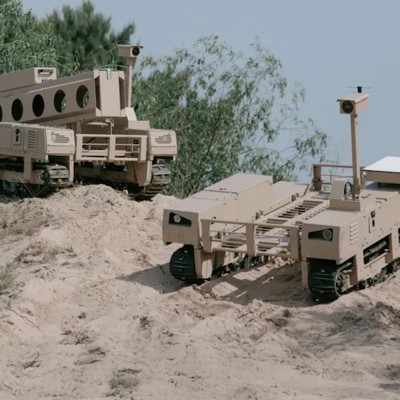
TERMIT unmanned ground vehicles Ukraine Ministry of Defense
But many U.S. UGVs are more complicated than the attritable ones that Kyiv is buying.
When it comes to wide adoption of ground robots, the U.S. military is starting to walk the road pioneered by Ukraine.
The Pentagon isn’t yet close to buying unmanned ground vehicles, or UGVs, at Ukrainian scale. The Ukrainian Ministry of Defense says it ordered more than 22,000 in the first seven months of this year, which is about as many as it ordered in all of 2025. But the U.S. Defense Department committed more than $115 million to UGV projects in fiscal 2026, per public records and GovTribe, a Defense One sister brand that tracks government contracts.
Still, the number of ground robots on Ukrainian battlefields is dwarfed by that of aerial drones. In 2025, Ukraine made some 4 million quadcopters and other flying drones, and ministry officials say 2026 deliveries are moving 3.7 times faster. Russia is also producing armed drones faster, and both sides’ increasing ability to target anything that moves on the battlefield has spurred manufacturers to keep their UGV designs relatively small and cheap.
“What Ukraine says they need, and obviously it’s the same for the Russians, more or less, is something that’s not very expensive, something that is attritable, something that if lost could be easily replaced,” Samuel Bendett, a drone analyst at CNA, CNAS, and CSIS, said in an interview. “These are not overly complicated UGVs. They’re relatively simple. They have a lot of commercial components.”
Ukraine’s UGVs are often used for logistics, casualty evacuation and related duties. Its TERMIT UGV can carry up to 300 kg of supplies or wounded soldiers. But increasingly, they are being armed for combat. In the summer of 2025, Ukraine used a Droid TW 12.7 UGV armed with a .50-caliber machine gun to defend a key intersection from repeated attacks, Defense One reported earlier this year. Russia employs similar vehicles, one of which was used as an explosive kamikaze as early as November 2024.
The U.S. military, which envisions fighting in a wider range of environments than does Kyiv, has more diverse UGV projects under development. Last month, for example, the Marine Corps converted an artillery unit into its first Navy-Marine Expeditionary Ship Interdiction System, or NMESIS, battalion. NMESIS uses UGVs equipped to fire two Naval Strike Missiles at ground and naval targets more than 100 nautical miles away. The system is intended for use in sea-denial missions in the Pacific. It uses a modified Oshkosh Joint Light Tactical Vehicle with autonomy packages provided by Forterra and Kodiak AI. The program is part of roughly $92 million in USMC ROGUE Fires orders this year.
Meanwhile, the Marines and the Army’s 75th Ranger Regiment are spending nearly $25 million to buy more than a dozen IBEX UGVs made by Overland AI for logistics and counter-UAV defense missions, company officials said last month. The company also received two contract awards totaling more than $34 million for autonomous breaching capabilities in August and September.
Compared to Ukraine’s focus on cheap, attritable systems which are typically remote-controlled, the U.S. ecosystem, with the affordances of peacetime research and development, is shooting for more capable autonomous UGVs.
“Soldiers train for and are expected to complete the mission in these types of environments, cut off from consistent communications and data networks,” Byron Boots, Overland AI’s co-founder and CEO, said in a statement. “Overland AI believes that autonomous systems should be held to the same standard.”
Time will tell which approach proves more successful.
NEXT STORY: Can inertial navigation make ground-robot swarms real?
乌克兰国防部 TERMIT 无人地面车辆
但许多美国无人地面车辆比基辅正在购买的消耗型无人地面车辆要复杂得多。
在地面机器人的广泛应用方面,美国军方正开始走乌克兰开创的道路。
五角大楼目前距离像乌克兰那样大规模采购无人地面车辆(UGV)还很远。乌克兰国防部表示,今年前七个月订购了超过22000辆UGV,这大约相当于2025年全年的订单量。但根据公开记录和政府合同追踪网站GovTribe(Defense One旗下专注于追踪政府合同的品牌)的数据,美国国防部在2026财年已承诺为UGV项目投入超过1.15亿美元。
尽管如此,乌克兰战场上的地面机器人数量与空中无人机相比仍然相形见绌。2025年,乌克兰生产了约400万架四旋翼无人机和其他飞行无人机,乌克兰国防部官员表示,2026年的交付速度是之前的3.7倍。俄罗斯也在加速生产武装无人机,双方打击战场上任何移动目标的能力不断增强,促使制造商将无人地面车辆(UGV)的设计做得更小巧、更便宜。
“乌克兰方面表示他们需要的,显然俄罗斯方面也大同小异,是价格不高、消耗性强、即使丢失也能轻易替换的无人机,”美国国家航空航天局(CNA)、美国国家安全与应用中心(CNAS)和战略与国际研究中心(CSIS)的无人机分析师塞缪尔·本德特在接受采访时表示。“这些无人地面车辆(UGV)结构并不复杂,相对简单,而且很多部件都是商用的。”
乌克兰的无人地面车辆(UGV)通常用于后勤、伤员撤离及相关任务。其TERMIT UGV可运载高达300公斤的物资或伤员。但越来越多的UGV被武装用于作战。据Defense One今年早些时候报道,2025年夏季,乌克兰曾使用一辆配备.50口径机枪的Droid TW 12.7 UGV,抵御对一个重要路口的多次袭击。俄罗斯也使用类似的车辆,其中一辆早在2024年11月就被用作自杀式爆炸袭击车辆。
与基辅方面设想的作战环境更为广泛,美国军方正在研发的无人地面车辆(UGV)项目也更加多样化。例如,上个月,美国海军陆战队将一个炮兵单位改编为首个海军陆战队远征舰艇拦截系统(NMESIS)营。NMESIS使用配备两枚海军打击导弹的无人地面车辆,可攻击100海里以外的地面和海上目标。该系统旨在用于太平洋地区的海上拒止任务。它采用改装后的奥什科什联合轻型战术车辆(JLTV),并配备了由Forterra和Kodiak AI提供的自主系统。该项目是美国海军陆战队今年价值约9200万美元的“叛逆火力”(ROGUE Fires)项目的一部分。
与此同时,据Overland AI公司官员上月透露,海军陆战队和陆军第75游骑兵团正斥资近2500万美元,采购十几辆该公司生产的IBEX无人地面车辆,用于后勤保障和反无人机防御任务。该公司还在8月和9月获得了两份总额超过3400万美元的合同,用于开发自主突入能力。
与乌克兰专注于廉价、易损耗且通常由远程控制的系统相比,美国凭借和平时期研发的优势,致力于研发功能更强大的自主无人地面车辆。
Overland AI联合创始人兼首席执行官拜伦·布茨在一份声明中表示:“士兵们接受训练,并被要求在与外界通信和数据网络隔绝的此类环境中完成任务。Overland AI认为,自主系统也应遵循同样的标准。”
时间会证明哪种方法更成功。
下一篇报道:惯性导航能否使地面机器人集群成为现实?