China’s J-20 Stealth Fighter Stuns By Brandishing Full Load Of Missiles At Zhuhai Air Show中国歼-20隐形战斗机在珠海航展上展示满载导弹,惊艳全场。
Beijing's stealth fighter shows its full set of teeth for the very first time.
Updated Dec 1, 2019 7:09 AM EST
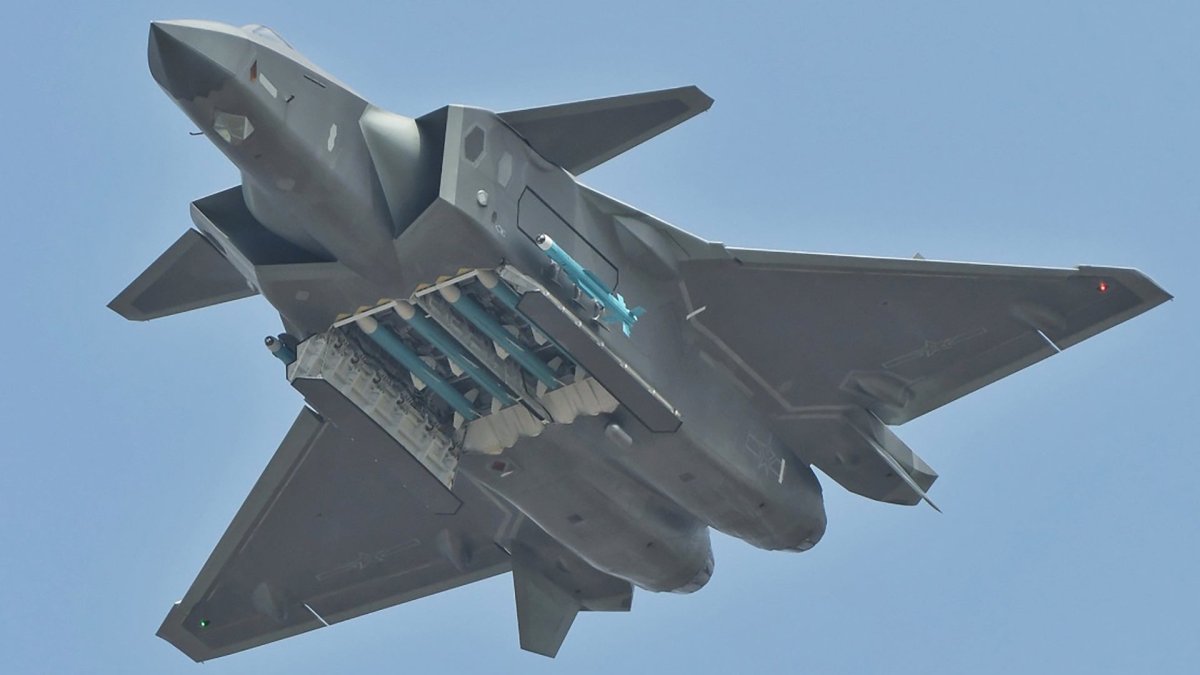
On the last day of China’s biennial air show and weapons expo in Zhuhai , a pair of the country’s J-20 heavy stealth fighters added a surprise twist to their routine—they popped open their weapons bays and showed off full magazines of missiles. This is the first time such a full load of weapons has been fully exposed and the first time China has officially shown off the jet’s complete internal weapons configuration in the flesh.
What we see isn’t necessarily surprising, but it is interesting nonetheless. In the main ventral bays, the J-20 is carrying four PL-15 medium-to-long-range air-to-air missiles. The type is somewhat analogous to the American AIM-120D AMRAAM . Speculation about what missile actually would hold the PL-15 designation has bounced around a lot, with very long-range missiles and those fitted with throttleable ramjets also potentially receiving the designation, but now it seems the PL-15 is indeed a dual-pulse motor and AESA equipped missile with a similar profile as its predecessor PL-12. The PL-12 is loosely analogous to the AIM-120A/B.
Note that even with their clipped fins, only four PL-15s are mounted in the J-20’s bays in a similar fashion to the YF-22’s missile configuration. It isn’t clear exactly what the launch mechanism for these missiles is based on these photos. A staggered arrangement with six PL-15s may be possible in the future by the looks of the bays, but this depends a lot on the how the missiles are ejected from the bay itself. The F-22 uses a trapeze launcher system to chuck the missiles clear of the bay. The J-20’s main weapons bays also look remarkably uncluttered, which makes one wonder if the missiles are just mounted to static hardpoints inside, but this is doubtful as what appear to be launchers have been visible in the J-20s bays for years.
The most interesting part of this display of the J-20’s lethal payload carrying abilities is the pair of PL-10s deployed on the outside of the jet’s side weapons bays. This novel configuration is one of the most fascinating aspects of the J-20’s design. I was one of the first to point it out and explain its utility back in early 2013, when I wrote the following :
“The F-22, a very loose analog for the J-20 ( emphasize very ), uses a canted trapeze that pushes the AIM-9’s seeker out into the air-stream for proper establishment of a lock before launch once the bay doors are swung open. Only once the missile has acquired a target and the pilot ‘receives tone’ (the AIM-9 series has an audible growl as it hunts for a heat source, once it finds one it goes from an intermittent growling sound to a solid tone, cueing the pilot to fire) the missile can be fired and only then do the launch bay doors close up. This method increases the F-22’s radar signature dramatically while also disturbing the airflow around the jet which makes for lower performance and a rougher ride during close-in air combat maneuvering, or dogfighting. Soon, the F-22 will have the AIM-9X Block II which features lock-on after launch data-link capability. In other words, the pilot can ‘acquire’ a target via his or hers onboard sensors, including the hopefully forthcoming Scorpion helmet mounted display… Once the target is ‘virtually locked’ within the AIM-9X Block II’s engagement envelope the pilot can quickly fire the Sidewinder, with the bay doors opening and closing momentarily, and allow the data-link to transfer the acquiring secondary sensor’s info to the missile after it has left the bay in the form of a vector [to the target]. The missile will fly in this prescribed direction so that it can acquire the target itself, at which point the AIM-9X Block II becomes truly ‘fire and forget.’ Once the AIM-9X Block II is integrated into the Raptor, and especially once the helmet mounted display is operational, the F-22’s side bay doors only have to briefly open to let the AIM-9X on its one-way mission. All this begs the question: If China loves copying the US when it comes to weapons systems, why not just build something similar for the J-20 when it comes to deploying its short-range air-to-air missiles? The answer is quite simple, lock-on after launch capability is not an easy one to achieve. It is technologically complex, requires deep systems integration (software architecture permitting), and robust testing using live missiles, and thus it is expensive. China, being the resourceful and cunning folks that they are, figured out a way to employ any new or relatively archaic high-off-bore-sight short ranged air to air missile while keeping the jet’s aerodynamics relatively intact (doors closed during prolonged maneuvering while the missile hangs out on its rail) while also minimizing the impact a ‘deployed missile’ has the J-20’s low radar cross-section. That is right folks, China just said “we don’t want to have to rely on LOAL capability, so why not just temporarily (as in for seconds or minutes) mount a similarly agile, but much less complex and expensive, short ranged air-to-air missile outside of the bay during times when close range combat is imminent?” This is exactly what they did, and honestly, I think it is genius. Radar signature becomes a small factor when fighting for one’s life at close range, having a reliable missile ready to make a u-turn off the rail and subsequently turn your enemy into chaff is so important that is can be seen as a life and death requirement [especially for a big, not remarkably maneuverable fighter]. The alternative, such as the reality the F-22 has faced for the better part of a decade, is that you open the bay up for prolonged periods of time and pay a large penalty in radar cross section and [some] performance. Also, by building a relatively simple contraption, kind of similar to one of those bars that goes on your lap on a roller coaster, albeit with a missile attached, Chinese engineers simplified the launch system and also probably made it much lighter than an F-22 type design. Once again, genius. Another point to be taken from the J-20’s short-range air-to-air missile launch mechanism revelations are that designers absolutely thought it was necessary to give this jet high-off-bore-sight close range missile capability from day one, and in a reliable and persistent nature when needed. This could be due to lack of maneuverability and/or because of its mission, which I have said for years is to break through the enemy’s (American, Taiwanese etc.) fighter cover and take out their enablers (see tankers, AEW&C, C2 and connectivity nodes). In such a case, being electronically silent is your best bet at surviving, so using infra-red passively guided missiles, which require no electronic emissions, at medium-close ranges may be your only play, at least for anything that does not put out a continuous or semi-continuous form of radiation (see AWACS or JSTARS). In that case, a passively guided anti-radiation missile may be the J-20’s weapon of choice, or a medium-long range AAM that can get within locking distance and featuring active radar or IR for terminal homing, via a traditional data-link feeding the J-20’s targeting picture to it provided by passive sensors (IRST, ESM etc).
“The F-22, a very loose analog for the J-20 ( emphasize very ), uses a canted trapeze that pushes the AIM-9’s seeker out into the air-stream for proper establishment of a lock before launch once the bay doors are swung open. Only once the missile has acquired a target and the pilot ‘receives tone’ (the AIM-9 series has an audible growl as it hunts for a heat source, once it finds one it goes from an intermittent growling sound to a solid tone, cueing the pilot to fire) the missile can be fired and only then do the launch bay doors close up.
This method increases the F-22’s radar signature dramatically while also disturbing the airflow around the jet which makes for lower performance and a rougher ride during close-in air combat maneuvering, or dogfighting. Soon, the F-22 will have the AIM-9X Block II which features lock-on after launch data-link capability. In other words, the pilot can ‘acquire’ a target via his or hers onboard sensors, including the hopefully forthcoming Scorpion helmet mounted display… Once the target is ‘virtually locked’ within the AIM-9X Block II’s engagement envelope the pilot can quickly fire the Sidewinder, with the bay doors opening and closing momentarily, and allow the data-link to transfer the acquiring secondary sensor’s info to the missile after it has left the bay in the form of a vector [to the target]. The missile will fly in this prescribed direction so that it can acquire the target itself, at which point the AIM-9X Block II becomes truly ‘fire and forget.’
Once the AIM-9X Block II is integrated into the Raptor, and especially once the helmet mounted display is operational, the F-22’s side bay doors only have to briefly open to let the AIM-9X on its one-way mission. All this begs the question: If China loves copying the US when it comes to weapons systems, why not just build something similar for the J-20 when it comes to deploying its short-range air-to-air missiles?
The answer is quite simple, lock-on after launch capability is not an easy one to achieve. It is technologically complex, requires deep systems integration (software architecture permitting), and robust testing using live missiles, and thus it is expensive. China, being the resourceful and cunning folks that they are, figured out a way to employ any new or relatively archaic high-off-bore-sight short ranged air to air missile while keeping the jet’s aerodynamics relatively intact (doors closed during prolonged maneuvering while the missile hangs out on its rail) while also minimizing the impact a ‘deployed missile’ has the J-20’s low radar cross-section.
That is right folks, China just said “we don’t want to have to rely on LOAL capability, so why not just temporarily (as in for seconds or minutes) mount a similarly agile, but much less complex and expensive, short ranged air-to-air missile outside of the bay during times when close range combat is imminent?”
This is exactly what they did, and honestly, I think it is genius. Radar signature becomes a small factor when fighting for one’s life at close range, having a reliable missile ready to make a u-turn off the rail and subsequently turn your enemy into chaff is so important that is can be seen as a life and death requirement [especially for a big, not remarkably maneuverable fighter]. The alternative, such as the reality the F-22 has faced for the better part of a decade, is that you open the bay up for prolonged periods of time and pay a large penalty in radar cross section and [some] performance. Also, by building a relatively simple contraption, kind of similar to one of those bars that goes on your lap on a roller coaster, albeit with a missile attached, Chinese engineers simplified the launch system and also probably made it much lighter than an F-22 type design. Once again, genius.
Another point to be taken from the J-20’s short-range air-to-air missile launch mechanism revelations are that designers absolutely thought it was necessary to give this jet high-off-bore-sight close range missile capability from day one, and in a reliable and persistent nature when needed. This could be due to lack of maneuverability and/or because of its mission, which I have said for years is to break through the enemy’s (American, Taiwanese etc.) fighter cover and take out their enablers (see tankers, AEW&C, C2 and connectivity nodes). In such a case, being electronically silent is your best bet at surviving, so using infra-red passively guided missiles, which require no electronic emissions, at medium-close ranges may be your only play, at least for anything that does not put out a continuous or semi-continuous form of radiation (see AWACS or JSTARS). In that case, a passively guided anti-radiation missile may be the J-20’s weapon of choice, or a medium-long range AAM that can get within locking distance and featuring active radar or IR for terminal homing, via a traditional data-link feeding the J-20’s targeting picture to it provided by passive sensors (IRST, ESM etc).
A diagram of how the rail works as well as a shot of it dating back to roughly late 2012 during the J-20’s early testing in Chengdu. , Chinese Internet
Here’s a cool little animation of how this system works.
Something I would like to emphasize from my original analysis is that the PL-10 that is fired from these side bays is something of a short-to-intermediate range air-to-air missile. This means that in addition to the missile being capable of high-off-boresight shots that are cued via the J-20’s helmet-mounted display or other sensors during a dogfight, it is also capable of near beyond-visual-range engagements as well.
Able to reach out over a dozen miles or so (possibly substantially farther according to different assessments), this missile, combined with its ability to ride outside of the J-20’s side-bays, can be used as a silent assassin of sorts. The J-20 can leverage its stealth and sneak up on targets without emitting any electromagnetic energy, using just its advanced passive avionics , which includes electronic surveillance measures, infrared search and track and electro-optical targeting systems, and third-party sensor data fed to it via data-link, to locate its prey.
In other words, the J-20 can take advantage of the PL-10 when maximum emissions control tactics are used or when it has snuck up on its target and gets within close, but not yet short-range. Using these methods, the J-20 pilot can also use the PL-10 for offensive tasks when its longer-range missiles are expended. Considering the jet only carries four long-range missiles, at least at this time, being able to wield the PL-10 to its maximum potential is key. Once again, this is in addition to using the missile in classic close-range dogfighting scenarios.
Finally, an infrared-guided missile with decent range like this and the ability to hang outside the bay for prolonged periods of time is also a good fallback when fighting in heavy electronic warfare environments as the missile’s imaging infrared seeker is not impacted by electronic warfare tactics.
As for the rest of the J-20’s air show display, it looks pretty much exactly as what one would expect from a big, canard-equipped heavy fighter-interceptor that doesn’t possess gobs of excess power. It can roll fairly fast and it can change direction quickly and point its nose decently, but it bleeds energy very fast and energy recovery is likely slow. But extreme agility wasn’t the motivation idea behind this design, so that isn’t surprising. With uprated engines, it will only get more capable in this regard, though.
At the air show, the J-20’s designer even teased that the thrust vectoring tech that is now being tested on a modified J-10B, a jet that flew at the show as well, may find itself on the J-20, or maybe it has even already been tested. Equipping the J-20 with thrust vectoring now seems counterproductive as it adds weight to an aircraft that is already in need of more powerful engines. But as time goes on, and as new powerplants are fitted, the weight issue may not be so pressing.
Still, the added capability of thrust vectoring is debatable, but as the J-20’s designer stated, it could reduce the J-20’s canard deflections during flight. Fluttering flight control surfaces are not good for a stealthy aircraft’s radar cross-section. This is an issue I have discussed in depth before and one of the biggest knocks against the J-20’s delta-canard design which puts those surfaces—two huge ones in fact—up front where a stealthy aircraft’s radar cross section is most sensitive and important to its survival. So maybe that alone is enough to justify migrating thrust vectoring tech to the J-20.
China did do something else pretty unique at Zhuhai 2018 in that it appears that they devised a way to allow a J-10 to ‘torch.’ Of course, this operation was made famous by the F-111, and Australia’s ‘Pigs’ in particular . The maneuver, which included dumping fuel and lighting it on fire with the jet’s afterburners, was forbidden in the U.S., at least in the latter years of the F-111’s reign, so it is a bit funny that China seems to have gone out of their way to pull something similar off. It appears as if this ability uses the August 1st Display Team’s smoke oil injector to function. It could also be a malfunction of that system, but I doubt that’s the case. Either way, it’s cool to see a fighter in China torching it up!
Contact the author: Tyler@thedrive.com
Comments couldn’t be loaded. Please refresh the page.
更新于美国东部时间2019年12月1日上午7:09
在珠海举行的两年一度的中国航展暨武器展的最后一天,两架歼-20重型隐形战斗机在例行展示中带来了一个令人惊喜的环节——它们打开了弹舱,展示了满载的导弹弹匣。这是歼-20战机首次完整展示其全部武器载荷,也是中国首次正式公开展示该战机的完整内部武器配置。
我们看到的景象或许并不令人惊讶,但仍然很有意思。歼-20的主腹部弹舱内挂载了四枚PL-15中远程空空导弹。该型号与美国的AIM-120D先进中程空空导弹(AMRAAM)有些类似。关于PL-15究竟是哪种导弹,众说纷纭,超远程导弹以及配备可调推力冲压发动机的导弹都有可能被冠以这个名称,但现在看来,PL-15确实是一款双脉冲发动机、配备有源相控阵雷达(AESA)的导弹,其外形与前身PL-12相似。PL-12则与AIM-120A/B有些类似。
值得注意的是,即使PL-15导弹的尾翼被削短,歼-20的弹舱内也只安装了四枚,其布局与YF-22的导弹配置类似。根据这些照片,尚不清楚这些导弹的具体发射机构。从弹舱的布局来看,未来或许可以采用六枚PL-15导弹的交错式排列,但这很大程度上取决于导弹从弹舱弹出的方式。F-22使用梯形发射器系统将导弹抛出弹舱。歼-20的主武器舱看起来也异常简洁,这让人不禁怀疑导弹是否只是安装在内部的固定挂点上,但这种可能性不大,因为多年来在歼-20的弹舱内一直可以看到疑似发射器的装置。
歼-20展现其强大载荷能力的最引人注目之处在于其侧舷武器舱外侧部署的两枚PL-10导弹。这种新颖的配置是歼-20设计中最令人着迷的亮点之一。早在2013年初,我就率先指出并解释了这种配置的用途,当时我写道:
F-22 战机与歼-20战机在设计上存在诸多相似之处(强调“非常相似”),它采用倾斜的梯形结构,将AIM-9导弹的导引头推入气流中,以便在弹舱门打开后进行精确锁定。只有当导弹锁定目标且飞行员“接收到信号”(AIM-9系列导弹在搜索热源时会发出低沉的轰鸣声,一旦找到目标,声音会从间歇性的轰鸣声变为持续的音调,提示飞行员发射)后,导弹才能发射,弹舱门才会关闭。这种方法会显著增加F-22的雷达反射截面积,同时也会扰乱飞机周围的气流,导致近距离空战机动或近距离缠斗时性能下降,飞行更加颠簸。不久之后,F-22将配备AIM-9X Block II型导弹,该导弹具备发射后数据链锁定能力。换句话说,飞行员可以在发射后“锁定”目标。通过飞行员的机载传感器,包括有望即将推出的“蝎子”头盔显示器……一旦目标在AIM-9X Block II的交战范围内被“虚拟锁定”,飞行员即可快速发射“响尾蛇”导弹。此时弹舱门会短暂开启和关闭,数据链会将辅助传感器获取的目标信息以矢量形式传输给已离开弹舱的导弹。导弹将按照预设方向飞行,从而锁定目标。此时,AIM-9X Block II真正实现了“发射后不管”。一旦AIM-9X Block II导弹集成到猛禽战斗机上,尤其是在头盔显示器投入使用后,F-22的侧舱门只需短暂打开,即可让AIM-9X执行其单程任务。这一切不禁让人产生疑问:如果中国在武器系统方面热衷于效仿美国,为什么不为歼-20战斗机开发类似的系统来部署其短程空空导弹呢?答案很简单,发射后锁定目标的能力并非易事。它技术复杂,需要深度系统集成(软件架构允许的情况下),以及使用实弹进行严格的测试,因此成本高昂。中国以其足智多谋和精明著称,他们找到了一种方法,既能使用任何新型或相对老旧的高离轴角短程空空导弹,又能保持战机气动性能的相对稳定(在长时间机动飞行期间舱门关闭,导弹挂载在挂架上),同时最大限度地减少对战机性能的影响。 “部署导弹”具备歼-20的低雷达反射截面。没错,各位,中国刚刚表示“我们不想依赖LOAL(近程空空导弹)能力,那么为什么不在近距离空战即将发生时,临时(比如几秒钟或几分钟)在弹舱外挂载一枚同样灵活但结构更简单、成本更低的短程空空导弹呢?”他们正是这么做的,说实话,我认为这堪称天才之举。在近距离生死搏斗中,雷达反射截面积微不足道,拥有一枚可靠的导弹随时准备脱离弹道,将敌机打成碎片至关重要,这甚至可以被视为生死攸关的必要条件(尤其对于体型庞大、机动性并不出色的战斗机而言)。另一种方案,例如F-22近十年来面临的困境,就是需要长时间打开弹舱,但这会大幅增加雷达反射截面积,并影响部分性能。此外,中国工程师设计了一种相对简单的装置,类似于过山车上放在腿上的那种横杆,只不过上面挂载的是导弹,从而简化了发射系统,而且可能比F-22的设计轻得多。再次强调,这堪称天才之举。从歼-20的短程空空导弹发射机构中我们还可以了解到,设计人员绝对认为这架战机必须具备这种能力。从一开始就具备高离轴角近程导弹能力,并且在需要时能够可靠且持续地执行此类任务。这可能是由于机动性不足,也可能是由于其任务性质所致。多年来我一直强调,歼-20的任务是突破敌方(美国、台湾等)战斗机的掩护,摧毁其支援力量(例如加油机、预警机、指挥控制系统和通信节点)。在这种情况下,保持电子静默是生存的最佳保障,因此,使用无需电子辐射的红外被动制导导弹进行中近距离作战可能是唯一的选择,至少对于那些不会发出持续或半持续辐射的目标(例如预警机或联合监视目标攻击雷达系统)而言是如此。在这种情况下,被动制导反辐射导弹可能是歼-20的首选武器,或者是一种能够进入锁定距离并配备主动雷达或红外末端制导的中远程空空导弹,该导弹可以通过传统数据链将歼-20的目标图像传输给它。被动传感器(IRST、ESM 等)。
F-22 战机与歼-20战机非常相似(强调“非常相似”),它采用倾斜的梯形结构,将AIM-9导弹的导引头推入气流中,以便在弹舱门打开后进行精确锁定。只有当导弹锁定目标且飞行员“接收到信号”(AIM-9系列导弹在搜索热源时会发出低沉的轰鸣声,一旦找到目标,声音就会从间歇性的轰鸣声变为持续的音调,提示飞行员发射)时,导弹才能发射,发射舱门也只有在此时才会关闭。
这种方法会显著增加F-22的雷达反射截面积,同时也会扰乱飞机周围的气流,导致近距离空战机动或缠斗时性能下降,飞行更加颠簸。不久之后,F-22将配备AIM-9X Block II型导弹,该导弹具备发射后锁定目标的数据链功能。换句话说,飞行员可以通过机载传感器(包括有望即将推出的“蝎子”头盔显示器)“捕获”目标。一旦目标在AIM-9X Block II的交战范围内被“虚拟锁定”,飞行员即可快速发射“响尾蛇”导弹。此时弹舱门会短暂开启和关闭,数据链会将辅助传感器获取的目标信息以矢量形式传输给已离开弹舱的导弹。导弹将按照预设方向飞行,从而自行捕获目标。此时,AIM-9X Block II真正实现了“发射后不管”。
一旦AIM-9X Block II导弹集成到猛禽战斗机上,尤其是在头盔显示器投入使用后,F-22的侧舱门只需短暂打开,即可让AIM-9X执行其单程任务。这一切不禁让人产生疑问:如果中国在武器系统方面热衷于效仿美国,那么为什么不为歼-20战斗机也开发类似的系统来部署其短程空空导弹呢?
答案很简单,发射后锁定目标的能力并非易事。它技术复杂,需要深度系统集成(软件架构允许的情况下),以及使用实弹导弹进行严格的测试,因此成本高昂。中国素来足智多谋,他们找到了一种方法,既能使用任何新型或相对老旧的高离轴角短程空空导弹,又能保持战机气动性能基本不受影响(在导弹挂载于挂架上进行长时间机动时,舱门保持关闭),同时还能最大限度地减少“部署导弹”对歼-20低雷达反射截面的影响。
没错,各位,中国刚才说“我们不想依赖LOAL能力,那么为什么不在近距离战斗即将发生时,暂时(比如几秒钟或几分钟)在弹舱外安装一种类似敏捷但复杂度和成本低得多的短程空空导弹呢?”
他们正是这么做的,说实话,我认为这简直是天才之举。在近距离生死搏斗中,雷达反射截面积微不足道,拥有一枚可靠的导弹随时准备脱离弹道,将敌人打成废铁至关重要,这甚至可以被视为生死攸关的要求(尤其对于体型庞大、机动性并不出色的战斗机而言)。另一种方案,例如F-22近十年来面临的现实,就是长时间打开弹舱,但这会大幅增加雷达反射截面积,并影响部分性能。此外,中国工程师通过制造一个相对简单的装置——有点像过山车上放在腿上的那种横杆,只不过上面装的是导弹——简化了发射系统,而且可能比F-22的设计轻得多。再次强调,这真是天才之举。
从歼-20短程空空导弹发射机构的揭示中,我们还可以看出,设计人员从一开始就认为必须赋予这款战机高离轴角近程导弹发射能力,并且在需要时能够可靠且持续地执行此类任务。这可能是由于其机动性不足,也可能是因为它的任务性质。多年来我一直强调,歼-20的任务是突破敌方(美国、台湾等)战斗机的掩护,摧毁其支援力量(例如加油机、预警机、指挥控制系统和通信节点)。在这种情况下,保持电子静默是生存的最佳保障,因此,使用无需电子辐射的红外被动制导导弹进行中近距离作战可能是唯一的选择,至少对于那些不会发出持续或半持续辐射的目标(例如预警机或联合监视目标攻击雷达系统)而言是如此。在这种情况下,歼-20 可以选择被动制导的反辐射导弹,或者选择中远程空空导弹,该导弹能够进入锁定距离,并配备主动雷达或红外进行末端制导,通过传统的数据链将被动传感器(IRST、ESM 等)提供的歼-20 目标图像传输给歼-20。
一张展示轨道工作原理的示意图,以及一张拍摄于2012年末歼-20在成都进行早期测试期间的照片。(中国互联网)
这里有一个很酷的小动画,展示了这个系统是如何运作的。
我想在我之前的分析中强调一点,从这些侧舷弹舱发射的PL-10导弹是一种短程到中程空空导弹。这意味着,除了能够在近距离空战中通过歼-20的头盔显示器或其他传感器进行高偏轴角射击外,该导弹还能够进行近乎超视距的交战。
这款导弹射程可达十几英里(根据不同评估,射程可能更远),加之其能够挂载在歼-20战斗机的侧舱之外,可以作为一种无声的刺客。歼-20可以利用其隐身性能,在不发射任何电磁能量的情况下悄悄接近目标,仅依靠其先进的被动航电系统,包括电子监视措施、红外搜索跟踪系统和光电瞄准系统,以及通过数据链传输的第三方传感器数据来定位目标。
换句话说,歼-20在采用最大限度的辐射控制战术或悄悄接近目标并进入近距离但尚未进入短程范围时,可以充分利用PL-10导弹的优势。利用这些方法,当歼-20的远程导弹耗尽时,飞行员还可以使用PL-10执行进攻任务。考虑到歼-20目前仅携带四枚远程导弹,因此能够最大限度地发挥PL-10的潜力至关重要。此外,PL-10导弹还可以用于传统的近距离空战场景。
最后,像这样射程相当远、能够在弹舱外长时间停留的红外制导导弹,在电子战环境下作战时也是一个很好的后备选择,因为导弹的成像红外导引头不会受到电子战战术的影响。
至于歼-20在航展上的其他表现,它看起来基本符合人们对一款大型、采用鸭式布局的重型战斗截击机的预期,毕竟它并没有过多的动力储备。它的滚转速度相当快,转向也迅速,机头指向性也不错,但能量损耗非常快,能量恢复速度可能较慢。不过,极致的机动性并非这款战机的设计初衷,所以这并不令人意外。当然,随着发动机的升级,它在这方面的能力将会得到显著提升。
在航展上,歼-20的设计者甚至暗示,目前正在改进型歼-10B(同样在航展上亮相)上测试的推力矢量技术,未来可能会应用到歼-20上,甚至可能已经进行了测试。现在看来,为歼-20配备推力矢量系统似乎适得其反,因为它会增加飞机的重量,而歼-20本身就需要更强大的发动机。但随着时间的推移,以及新型发动机的安装,重量问题或许不再那么紧迫。
尽管如此,推力矢量控制的附加能力仍存在争议,但正如歼-20的设计者所说,它可以减少歼-20在飞行过程中鸭翼的偏转。飞行控制面的颤动不利于隐形飞机的雷达反射截面积。我之前曾深入探讨过这个问题,这也是歼-20三角翼鸭式布局的最大缺陷之一,因为该布局将两个巨大的鸭翼置于机头,而机头正是隐形飞机雷达反射截面积最为敏感、对其生存至关重要的区域。因此,或许仅凭这一点就足以证明将推力矢量控制技术应用于歼-20的合理性。
在2018年珠海航展上,中国还展示了一项相当独特的技术:他们似乎研发出了一种让歼-10战机“燃烧”燃料的方法。当然,这项技术因F-111战机,尤其是澳大利亚的“猪”(Pigs)特技飞行表演队而闻名。这种机动动作包括倾倒燃料并用加力燃烧室点燃,在美国是被禁止的,至少在F-111服役后期是如此。因此,中国似乎特意尝试实现类似的效果,这多少有些令人意外。据悉,这项技术似乎是利用了八一飞行表演队的烟雾油喷射器来实现的。当然,也可能是该系统的故障,但我对此表示怀疑。无论如何,看到中国的战机进行这种“燃烧”表演,确实令人兴奋!
联系作者:Tyler@thedrive.com
评论加载失败,请刷新页面。