The Nuclear Bomber Carrying USS United States Was Going To Be America’s First Supercarrier搭载核轰炸机的“美国”号航空母舰原本将成为美国的第一艘超级航母。
Its purpose was nearsighted but its design was imaginative, with elements incorporated into later designs, and some are more relevant today than ever.
Published Aug 10, 2018 7:05 PM EDT
Today, American supercarriers remain the largest and most expensive weapons on earth and are the ultimate symbol of power projection, but shortly following World War II they were just an idea. Then in 1949, that all changed when President Truman approved construction of USS United States (CVA-58), the first of four new supercarriers that would bring the strategic nuclear deterrence mission to the U.S. Navy’s fleet.
The initiative didn’t go as planned, but looking back, the United States class was incredibly novel and even forward thinking in some regards, and at the same time it was also incredibly nearsighted.
USS United States, the first carrier to be built in the post-World War II era, and her three sister ships were going to be supercarriers indeed. Measuring 1090 feet long and 190 feet wide, and displacing roughly 65,000 tons—83,000 tons when fully loaded—they would dwarf their predecessors. With eight Foster-Wheeler boilers and four Westinghouse turbines, USS United States would produce 280,000hp with her four screws propelling her to speeds in excess of 33 knots. The crew size would have been roughly 5,500 personnel, with nearly half that made up by the carrier’s embarked air wing.
Based on these metrics alone, USS United States as a link between earlier carrier designs and the Forrestal class of supercarriers that would emerge after the Korean War, is clear.
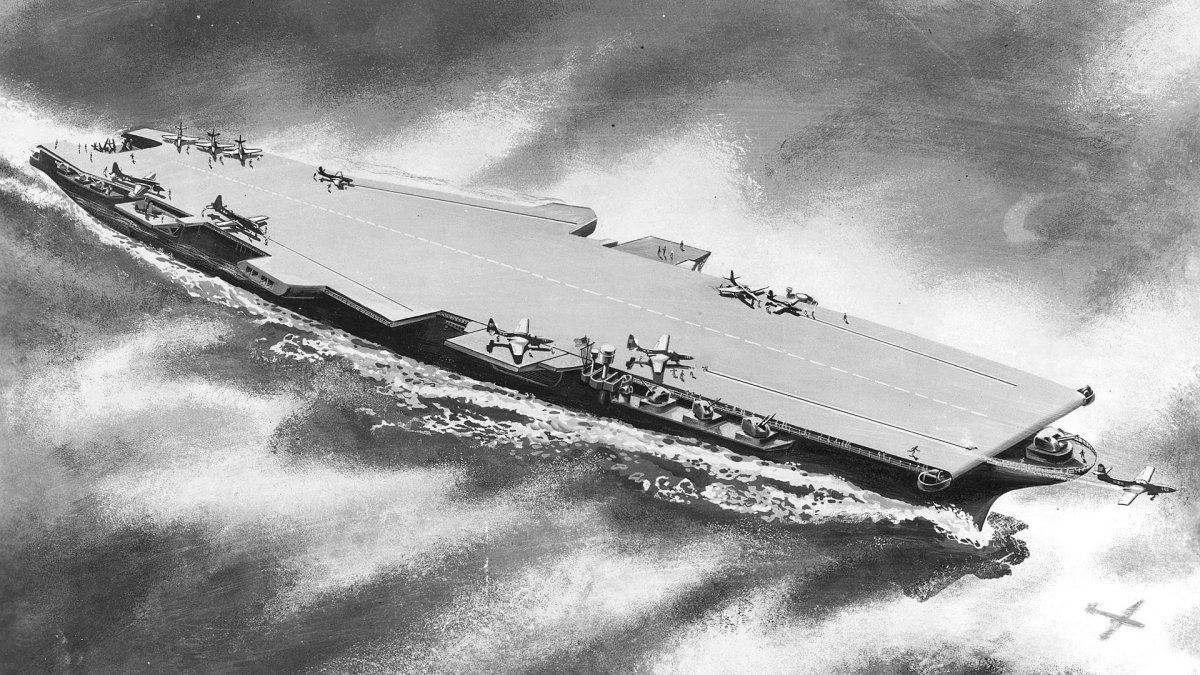
Other features were also foreshadowing the future of carrier design. CVA-58’s configuration rapidly evolved as the 1940s drew to a close. In its final form, the vessel’s four catapults were arrayed on the bow and angled out on the ship’s waist. The location of the ship’s four elevators, arrayed on the periphery of its deck to keep from interrupting flight operations and to keep from compromising the integrity of the heavily armored deck, looks somewhat familiar to what we see on supercarriers today.
But USS United States’ commonality with established supercarrier configuration ends there. The United States class was far more exotic. The whole concept focused on the ability to field bomber aircraft—each weighing upwards of 100,000lbs—at sea that would be capable of lugging the bulky and heavy nuclear weapons of the early atomic age over long distances to vaporize enemy targets.
Preliminary exploratory design model for CVA-58. In the end, the finalized design looked very different., USN
With this requirement in mind, the ship needed to have an open enough deck to accommodate a jet bomber’s wide wingspan. As a result, there was no island superstructure. It was a flush-deck design that harkened back to the dawn of naval aviation. Even its funnels were retractable and arranged along the ship’s edge to provide the widest possible operating area for big nuclear-armed aircraft. There was no angled landing area either, although there were outcropped sponsons for launching fighters off the waist catapults while the main operating area was in use.
By the end of 1947, the United States class’s exotic configuration was largely locked in., National Archives
In addition, the ship’s deck would be heavily armored, instead of the hangar bay as in past designs. This resulted in a much higher center of gravity that was overcome by adding to the ship’s overall size and displacement.
Even getting the bombers into a hangar bay was less of a priority in the overall design as they were so large. Instead, most of them would live life in the elements on the ship’s deck throughout an entire cruise. A hangar bay did exist, but it was intended mainly to support a contingent of escort jet fighters that would also call the vessel home.
In all, the air wing would be made up of about a dozen bombers and 48 jet fighters, with a surge capacity to roughly 18 bombers and 54 fighters.
The lack of an island meant that the ship wouldn’t have a radar or any other command and control capabilities. A small pop-up wheelhouse was part of the design for basic navigation purposes alone, as well as an enclosed tower-like platform for directing movements around the deck. Beyond that, an accompanying specially outfitted command ship cruiser would have to provide all the ship’s radar, navigation, war planning, and command and control functionality. In a sense, USS United States the arsenal ship of her day.
As a ‘bomber carrier,’ nuclear strike was the ship’s primary mission, but it could also execute more traditional tasks like supporting amphibious operations, sea control, and tactical air support. They were planned to have been the centerpieces in a new 39 ship architecture that was tailored around them. Two smaller, more traditional carriers would operate alongside each of the four United States class supercarriers and her escorts to provide additional fighter escort and other duties, like anti-submarine and anti-surface warfare support. In all, the procurement of this force would cost at least $1.265B, with USS
United States costing $190M alone.
The whole concept was designed to challenge the USAF’s monopoly on nuclear weapons delivery. This enraged the newly minted Air Force’s top leadership, and the Army wasn’t too excited to see more funding and mission sets handed over to the Navy, either.
As the post World War II defense budget retracted, calls to outright cancel the United States class program grew louder. Then, on April 23rd, 1949 Defense Secretary Louis Johnson, who had just been on the job a number of weeks after President Truman fired Secretary of Defense James Forrestal who supported the Navy’s plans, canceled construction of the United States without seeking the approval of the Chief of Naval Operations. Navy Secretary John Sullivan resigned in protest.
Louis Johnson, America’s second Secretary of Defense., Truman Library
Congressional hearings commenced to better understand Johnson’s snap decision. Through this process, the aircraft carrier’s modern utility in a nuclear age wasn’t well articulated and the decision to sink the United States class was upheld, with the USAF’s strategic bombers being favored over the Navy’s carriers for the nuclear delivery mission.
All this, as well as a number of other service rivalry and political factors, led to what is widely called the “ Revolt of the Admirals, ” where a number of the Navy’s top brass resigned in protest just as the CNO did. The shockwaves from this standoff between the services, Pentagon and White House leadership, still reverberate to this very day.
The keel of USS United States had already been laid when word of her abrupt cancellation came., USN
Even though USS United States was canceled, these events brought attention to the plight of the supercarrier in general and were intrinsic in seeing the far more conventionally configured and aptly named Forrestal class make it into production just half a decade later.
In the end, the Korean War proved that carrier air power was still highly relevant and a necessary investment—especially in conventional weapons terms. Nuclear weapons rapidly shrunk in size while increasing dramatically in power as well. By 1950, nukes were at sea about the USS Franklin D. Roosevelt (CVA-42), a far smaller carrier than the USS
As for the Navy’s role in the Pentagon’s grander strategic deterrent mission, missile technology, and most notably the submarine-launched ballistic missiles, would make the outrage over canceling the USS United States a non-factor, and in retrospect, a glaringly good decision.
Still, while the Forrestal class gave birth to the supercarrier operationally speaking, the United States class was the genesis of the idea as a real fundable concept the Navy could hang its hat on.
F-8 Crusaders over USS Forrestal in 1962., USN
Fast forward to today, an age of rapidly increasingly supercarrier prices , with the yet to be named fourth Ford class carrier costing $16B—almost the entire annual defense budget of Canada—and that’s just to purchase, not to operate for 50 years and then dispose of . Maybe the United States class concept could be mined for ideas on how to lower the cost and complexity of future carrier designs.
A shrunken island size and more deck area are already parts of the Ford class’s feature list, but the idea of deleting most of a carrier’s sensors, including their very costly radar system, and leveraging those on a nearby cruiser and from the strike group overall, is an interesting proposition. It is a far more plausible concept today, where advanced data-links and cooperative engagement capabilities are becoming common, than in the late 1940s when most all information was relayed by traditional radio communications.
Moving command and control, intelligence gathering and exploitation, and combat information center tasks to a surface combatant is also an interesting idea. Vessels like the Zumwalt class, which has a command deck more like the ones found at fixed installations on land that command entire wars than those commonly found on traditional surface combatants, may be able to accommodate such a concept. Even the Navy’s upcoming next-generation cruiser could be designed with this capability in mind.
Also the idea of placing larger, longer-range aircraft back on aircraft carriers is attractive considering the lack of range of modern naval tactical aircraft and the raising specter of anti-access/area-denial peer state conflict. In those scenarios, the threat posed by multiple anti-ship weapons technologies far outranges the reach of modern carrier-based combat aircraft.
The Navy is working to at least partially solve this problem with carrier-based tanker drones , but even then, aircraft with more generous unrefueled range would be highly prized assets for a modern American carrier air wing. Basically, this capability could be affordably fielded by procuring navalized unmanned combat air vehicles (UCAVs), which you can read all about here .
Even nuclear weapons may soon make their return to American carrier air wings in the weapons bays of F-35Cs. So in addition to looking at building smaller, conventionally fueled aircraft carriers to replace at least a portion of the Navy’s supercarrier force, maybe examining what a modern supercarrier arsenal ship type concept would look like and what it would cost would be a logical endeavor.
Regardless, that’s the tale of the abortive United States class, the first American supercarrier that almost was.
Contact the author: Tyler@thedrive.com
Comments couldn’t be loaded. Please refresh the page.
发布于美国东部时间2018年8月10日晚上7:05
如今,美国的超级航母仍然是地球上最大、最昂贵的武器,也是力量投射的终极象征,但在二战结束后不久,它们还只是一个构想。1949年,杜鲁门总统批准建造“美国”号航空母舰(CVA-58),这是四艘新型超级航母中的第一艘,它们将为美国海军舰队带来战略核威慑任务,一切都因此而改变。
这项计划并没有按计划进行,但回顾过去,美国班组在某些方面非常新颖,甚至具有前瞻性,但同时它也非常短视。
“美国”号航空母舰是二战后建造的第一艘航空母舰,它和它的三艘姊妹舰堪称超级航母。它们长1090英尺,宽190英尺,排水量约65000吨(满载排水量达83000吨),比之前的航母要大得多。“美国”号配备八台福斯特-惠勒锅炉和四台西屋汽轮机,四轴推进,总功率达28万马力,航速超过33节。舰员编制约为5500人,其中近一半是舰载航空联队。
仅从这些指标来看,美国号航空母舰作为早期航母设计与朝鲜战争后出现的福莱斯特级超级航母之间的联系,这一点是显而易见的。
其他一些特征也预示着航母设计的未来方向。随着20世纪40年代的临近尾声,CVA-58的布局迅速演变。最终方案中,该舰的四座弹射器排列在舰艏,并向舰腰方向呈一定角度。为了避免干扰飞行作业并保护厚重的装甲甲板,舰上四部升降机的布局也位于甲板外围,这种布局与我们今天在超级航母上看到的有些相似。
但“美国”号航母与现有超级航母的共同之处仅限于此。“美国”级航母的设计要独特得多。其核心理念在于能够在海上部署轰炸机——每架重量超过10万磅——这些轰炸机能够携带早期原子时代笨重的核武器进行远距离轰炸,摧毁敌方目标。
CVA-58的初步探索性设计模型。最终,最终设计与此截然不同。(美国海军)
考虑到这一要求,该舰需要足够开阔的甲板,以容纳喷气式轰炸机宽阔的翼展。因此,舰上没有岛式上层建筑,而是采用了平甲板设计,这种设计可以追溯到海军航空兵的早期阶段。就连烟囱也是可伸缩的,并沿舰体边缘排列,以便为大型核动力飞机提供尽可能宽阔的作业区域。该舰也没有倾斜的着陆区,不过舰体两侧设有突出的舷侧弹射器,用于在主作业区使用时从腰部弹射器起飞战斗机。
到1947年底,美国级战列舰独特的配置基本定型。(美国国家档案馆)
此外,与以往设计不同,该舰的甲板而非机库将采用厚重的装甲防护。这导致舰艇重心大幅升高,因此通过增加舰艇的整体尺寸和排水量来克服这一问题。
由于轰炸机体型庞大,将它们停放在机库并非整体设计的首要考虑因素。相反,大多数轰炸机在整个航程中都将暴露在甲板上,饱受风吹雨打。虽然舰上确实设有机库,但其主要用途是为护航战斗机编队提供机库,这些战斗机也将以该舰为母舰。
总的来说,该航空联队将由大约 12 架轰炸机和 48 架喷气式战斗机组成,并具备快速增援能力,可增至约 18 架轰炸机和 54 架战斗机。
由于没有舰岛,这艘军舰无法配备雷达或其他任何指挥控制系统。设计中仅包含一个小型可升降驾驶室,用于基本的导航,以及一个封闭的塔状平台,用于指挥甲板上的行动。除此之外,所有雷达、导航、作战计划和指挥控制功能都必须由一艘配套的特制指挥巡洋舰提供。从某种意义上说,“美国”号是当时的军火库舰。
作为一艘“轰炸机航母”,核打击是该舰的主要任务,但它也能执行更传统的任务,例如支援两栖作战、海上控制和战术空中支援。它们原本计划成为围绕其量身打造的39艘新型舰艇架构的核心。两艘较小、更传统的航母将与四艘“美国”级超级航母及其护航舰艇协同作战,提供额外的战斗机护航和其他任务,例如反潜和反水面作战支援。总而言之,这支舰队的采购至少需要12.65亿美元,其中包括“美国”号。
仅美国就耗资1.9亿美元。
整个方案旨在挑战美国空军对核武器投放的垄断地位。这激怒了新成立的空军高层领导,而陆军也对海军获得更多资金和任务感到不满。
二战后国防预算不断缩减,要求彻底取消“美国”级巡洋舰建造计划的呼声日益高涨。1949年4月23日,国防部长路易斯·约翰逊上任仅数周,而此前杜鲁门总统刚刚解雇了支持海军计划的国防部长詹姆斯·福雷斯特尔。约翰逊在未征得海军作战部长批准的情况下,擅自取消了“美国”级巡洋舰的建造计划。海军部长约翰·沙利文愤而辞职。
路易斯·约翰逊,美国第二任国防部长。杜鲁门图书馆
为了更好地了解约翰逊的仓促决定,国会举行了听证会。在此过程中,航母在核时代的现代用途并未得到充分阐述,击沉美国级航母的决定最终得以维持,空军的战略轰炸机而非海军的航母被优先用于执行核武器投送任务。
所有这些,以及其他一些军种间的竞争和政治因素,最终导致了被广泛称为“海军将领叛乱”的事件,海军多位高级将领和海军作战部长一样,集体辞职以示抗议。这场军种、五角大楼和白宫领导层之间的对峙所造成的冲击,至今仍在持续。
“美国”号航空母舰的龙骨已经铺设完毕,却突然传来取消建造的消息。
尽管“美国”号航母项目被取消,但这些事件引起了人们对超级航母困境的普遍关注,并且对于五年后设计更为常规、名称也更贴切的“福莱斯特”级航母投入生产至关重要。
最终,朝鲜战争证明,航母舰载机力量仍然至关重要,是一项必要的投资——尤其是在常规武器方面。核武器的体积迅速缩小,而威力却大幅提升。到1950年,核武器已经部署在“富兰克林·罗斯福”号航空母舰(CVA-42)上,这艘航母比“苏圣玛丽”号小得多。
至于海军在五角大楼更宏大的战略威慑任务中的作用,导弹技术,尤其是潜射弹道导弹,将使取消“美国”号航母建造计划所引起的愤怒变得无关紧要,而且事后看来,这是一个非常明智的决定。
尽管从作战角度来看,“福莱斯特”级航母催生了超级航母,但“美国”级航母才是海军真正可以依靠的、可融资概念的起源。
1962年,美国海军F-8十字军战士战斗机飞越“福莱斯特”号航空母舰。
时至今日,超级航母的价格飞速上涨,尚未命名的第四艘福特级航母造价高达160亿美元——几乎相当于加拿大全年的国防预算——而且这仅仅是购置成本,还不包括50年的运营和退役费用。或许我们可以从美国级航母的设计理念中汲取灵感,探索如何降低未来航母设计的成本和复杂性。
缩小舰岛面积、增加甲板面积已是福特级航母的既定特征,但移除航母上大部分传感器(包括造价昂贵的雷达系统),转而利用附近巡洋舰和整个打击群的传感器,这一设想颇具吸引力。如今,先进的数据链和协同作战能力已日趋普及,相比20世纪40年代末几乎所有信息都依赖传统无线电通信的情况,这一设想无疑更具可行性。
将指挥控制、情报收集与利用以及作战信息中心等任务转移到水面作战舰艇上也是一个很有意思的想法。像朱姆沃尔特级这样的舰艇,其指挥甲板更像是陆地上那些指挥整个战争的固定设施的甲板,而不是传统水面作战舰艇上的常见甲板,或许能够容纳这种概念。甚至海军即将推出的下一代巡洋舰也可以在设计时考虑到这种能力。
此外,考虑到现代舰载战术飞机航程不足以及与势均力敌国家发生反介入/区域拒止冲突的风险日益增加,将更大、航程更远的飞机重新部署到航空母舰上的想法也颇具吸引力。在这些情况下,多种反舰武器技术构成的威胁远远超出了现代舰载战斗机的作战范围。
海军正致力于利用舰载加油无人机来部分解决这个问题,但即便如此,对于现代化的美国航母舰载机联队而言,拥有更远航程的飞机仍然是极其宝贵的资产。实际上,这种能力可以通过采购舰载无人作战飞行器(UCAV)以经济实惠的方式实现,您可以在这里了解更多信息。
甚至核武器也可能很快重返美国航母舰载机联队,出现在F-35C战斗机的武器舱中。因此,除了考虑建造更小、使用常规燃料的航空母舰来取代海军至少一部分超级航母之外,研究一下现代化超级航母武器库的概念及其成本,或许也是一项合乎逻辑的工作。
不管怎样,这就是夭折的“美国”级航母的故事,它是美国第一艘几乎建成的超级航母。
联系作者:Tyler@thedrive.com
评论加载失败,请刷新页面。