Data centre operators seek adequate time to meet green targets under proposed Bill数据中心运营商寻求充足的时间来实现拟议法案下的绿色目标。
The public consultation drew 25 responses from data centre operators, cloud service providers and industry associations. Read more at straitstimes.com.
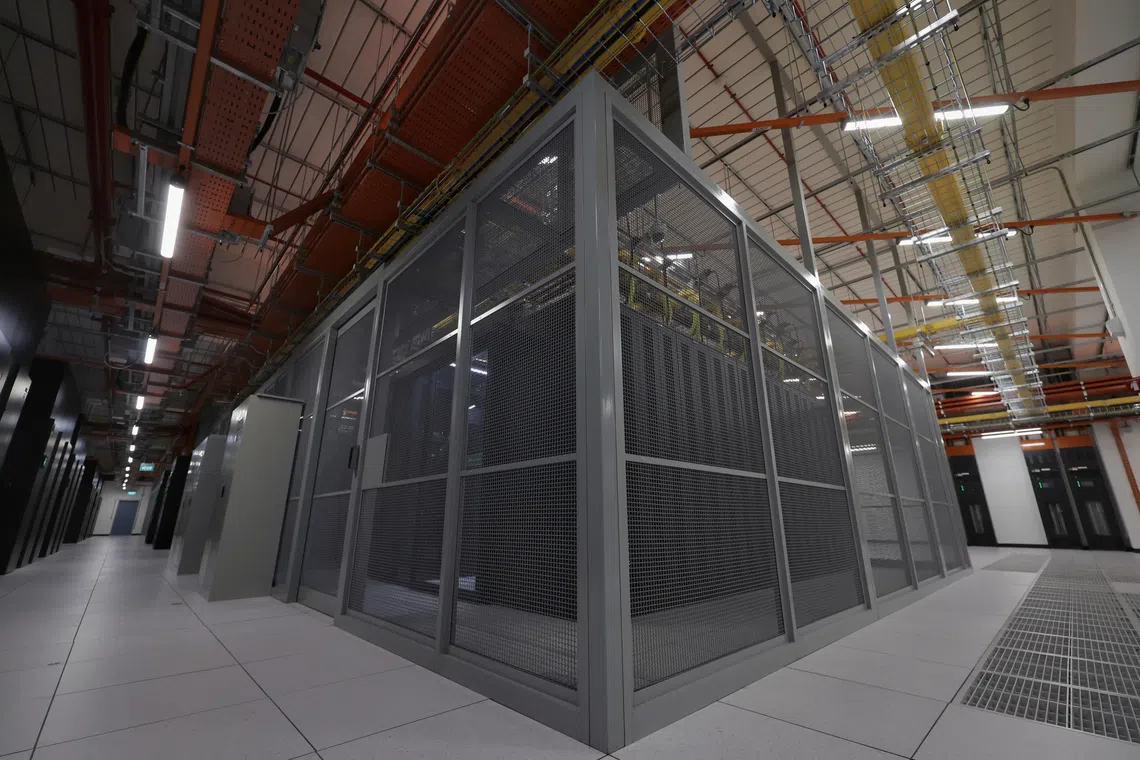
Providing adequate time for the transition was among several issues raised during a public consultation on the draft Digital Infrastructure Bill from July 1 to 22.
Published Sep 08, 2026, 01:39 PM
Updated Sep 08, 2026, 01:40 PM
Data centre operators in Singapore seek sufficient time to comply with new energy-efficiency rules under the upcoming Digital Infrastructure Bill.
The Bill introduces two licensing regimes focusing on energy efficiency and security for data centres using over 3MW power and large cloud providers.
Authorities plan to streamline reporting and licensing processes.
Follow our live coverage here.
SINGAPORE - Data centre operators have asked for sufficient time to meet new energy-efficiency requirements under proposed new laws to ensure that critical digital infrastructure remains sustainable and resilient.
Providing adequate time for the transition was among several issues raised during a public consultation on the draft Digital Infrastructure Bill from July 1 to 22, which drew 25 responses from data centre operators, cloud service providers and industry associations.
Overall, respondents supported the new Bill, which they said was important given the role of digital infrastructure in supporting Singapore’s digital way of life. Data centre capacity increase must also come sustainably to conserve Singapore’s scarce natural resources.
The new legislation was tabled in Parliament on Sept 8. If passed, major data centre operators and cloud service providers would have to obtain a license to operate by mid-2027 . They would also need to meet power efficiency, incident reporting and security requirements, which will be finalised from next year and updated as technology evolves.
Licenced data centre and cloud service operators could be fined up to $1 million, or up to 10 per cent of their annual turnover in Singapore, whichever is higher, if they fail to meet cybersecurity, business continuity and incident reporting requirements under the proposed new legislation.
The move comes as Singapore is increasingly digitalised, and services offered by data centres and cloud operators power everything from digital banking to ride hailing and e-commerce. At the same time, demand for data centre capacity is growing with the push to adopt artificial intelligence.
In a closing note on the public consultation, the Ministry of Digital Development and Information (MDDI) and Infocomm Media Development Authority (IMDA) said that resource-constrained Singapore needs to grow its compute and data centre capacity in a disciplined manner as such facilities are intensive users of land, power and water.
“Scarce resources must be managed carefully as compute demand grows, so that we make the best use of the resources we have to build the infrastructure Singapore needs, while improving resource efficiency and ensuring that scarce resources generate lasting value,” said MDDI and IMDA.
The Bill will introduce two licensing regimes: one for foundational digital infrastructure (FDI) and another for data centre (DC).
Data centres that require 10 megawatts (MW) of electrical power to operate their essential computing equipment, and cloud service providers that generate more than an average annual revenue of $100 million in Singapore users over three years will need to apply for an FDI licence.
FDI licensees will need to physically and digitally secure their services, have business continuity and disaster recovery plans, and notify IMDA of cybersecurity incidents or service disruptions.
Details, which are still being worked out, will take reference from advisory guidelines introduced in February 2025 for data centre operators and cloud service providers.
Advisory guidelines introduced earlier require data centres to have fire and flood mitigation measures to minimise service disruptions, as well as safeguards against supply chain attacks, malware and ransomware. Cloud service providers also need to strengthen controls over privileged accounts and user access, and maintain audit logs to detect and investigate security incidents.
DC licensees are those that use at least 3MW of electricity to power their essential computing equipment like servers, storage drives and networking hardware.
DC licensees will also need to meet power usage effectiveness (PUE) requirements, which measure how efficiently a data centre uses energy. A score that is closer to 1 indicates greater efficiency.
The PUE requirement has yet to be determined. Meanwhile , data centre contracts awarded to operators in July 2023 had a PUE requirement of 1.3. Proposals selected in August 2026 had a requirement of 1.25.
US-based data centre Digital Realty, which took part in the public consultation, had asked for sufficient time to meet new energy requirements.
Serene Nah, managing director and Asia-Pacific head of Digital Realty, said: “A transition period is necessary because it lets us assess sites properly and make upgrades in a structured, non-disruptive way.”
The operator has three data centres in Singapore. Two of them have PUE ratings close to 1.3. The third data centre, which begun operating in 2011, has a PUE rating above 1.3.
There are currently about 70 data centres in Singapore. It is estimated that about two thirds of them will require both the DC and FDI licenses.
During the consultation, several respondents called for the Government to streamline the license application and renewal process, as well as auditing and reporting requirements.
Responding, MDDI and IMDA said: “We are exploring the streamlining of processes such as a single application form and documentation for all DCs and FDI services covered under (the new law), and will be working with the industry to ensure that these are practical for licensees.”
Respondents said that some FDI licencees could be subject to both the DIA and the Cybersecurity Act, resulting in duplication of obligations. The Cybersecurity Act also requires operators of critical information infrastructure to report cyber security incidents including malware infections and denial-of-service attacks.
Responding, MDDI and IMDA said that they and CSA will streamline the requirements, compliance and operational processes under both the Digital Infrastructure Act and Cybersecurity Act.
Where reporting requirements for cybersecurity incidents are similar, licensees will only need to report to IMDA, with the understanding that relevant information will be shared with CSA, MDDI and IMDA said.
Singapore Parliament
AI/artificial intelligence
Environmental issues
在 7 月 1 日至 22 日就《数字基础设施法案》草案进行的公众咨询中,提出的几个问题之一是,是否有足够的过渡时间。
发布于 2026 年 9 月 8 日下午 1:39
更新于2026年9月8日下午1:40
新加坡的数据中心运营商希望获得足够的时间来遵守即将出台的《数字基础设施法案》中的新能效规定。
该法案引入了两项许可制度,重点关注使用超过 3MW 电力的数据中心和大型云服务提供商的能源效率和安全。
当局计划简化报告和许可流程。
请点击此处关注我们的实时报道。
新加坡——数据中心运营商要求有足够的时间来满足拟议新法律规定的新的能效要求,以确保关键数字基础设施保持可持续性和弹性。
在 7 月 1 日至 22 日就《数字基础设施法案》草案进行的公众咨询中,提出了几个问题,其中就包括如何为过渡提供充足的时间。此次咨询共收到来自数据中心运营商、云服务提供商和行业协会的 25 份回复。
总体而言,受访者支持这项新法案,他们认为鉴于数字基础设施在支撑新加坡数字化生活方式方面的重要作用,该法案至关重要。数据中心容量的增长也必须以可持续的方式进行,以保护新加坡稀缺的自然资源。
新法案于9月8日提交议会。如果获得通过,大型数据中心运营商和云服务提供商必须在2027年年中之前获得运营许可证。他们还需要满足能效、事件报告和安全方面的要求,这些要求将从明年开始最终确定,并随着技术的发展而更新。
根据拟议的新立法,如果获得许可的数据中心和云服务运营商未能满足网络安全、业务连续性和事件报告要求,则可能被处以最高 100 万美元的罚款,或最高可达其在新加坡年营业额的 10% 的罚款,以较高者为准。
此举正值新加坡数字化进程不断推进之际,数据中心和云运营商提供的服务为从数字银行到网约车和电子商务等方方面面提供了支持。与此同时,随着人工智能的广泛应用,对数据中心容量的需求也在不断增长。
在公众咨询的总结性说明中,数字发展及新闻部 (MDDI) 和资讯通信媒体发展局 (IMDA) 表示,资源有限的新加坡需要以有条不紊的方式发展其计算和数据中心能力,因为这些设施是土地、电力和水的密集型用户。
“随着计算需求的增长,必须谨慎管理稀缺资源,以便我们能够最大限度地利用现有资源来建设新加坡所需的基础设施,同时提高资源效率,并确保稀缺资源产生持久价值,”新加坡资讯通信媒体发展局 (MDDI) 和新加坡资讯通信媒体发展局 (IMDA) 表示。
该法案将引入两种许可制度:一种是针对基础数字基础设施(FDI),另一种是针对数据中心(DC)。
运行其基本计算设备需要 10 兆瓦 (MW) 电力的数据中心,以及在新加坡用户中三年内平均年收入超过 1 亿美元的云服务提供商,都需要申请 FDI 许可证。
获得外国直接投资许可证的企业需要对其服务进行物理和数字安全保护,制定业务连续性和灾难恢复计划,并向新加坡资讯通信媒体发展局 (IMDA) 报告网络安全事件或服务中断情况。
具体细节仍在制定中,将参考 2025 年 2 月推出的针对数据中心运营商和云服务提供商的咨询指南。
此前发布的指导原则要求数据中心采取防火防洪措施,以最大程度地减少服务中断,并采取措施防范供应链攻击、恶意软件和勒索软件。云服务提供商还需要加强对特权账户和用户访问的控制,并维护审计日志,以便检测和调查安全事件。
DC许可证持有者是指使用至少3MW电力为其基本计算设备(如服务器、存储驱动器和网络硬件)供电的用户。
数据中心许可证持有者还需要满足电源使用效率 (PUE) 要求,该指标衡量数据中心使用能源的效率。PUE 值越接近 1,效率越高。
PUE(电源使用效率)的具体要求尚未确定。同时,2023年7月授予运营商的数据中心合同中,PUE要求为1.3。2026年8月选定的方案中,PUE要求为1.25。
参与公众咨询的美国数据中心 Digital Realty 要求有足够的时间来满足新的能源需求。
Digital Realty 的董事总经理兼亚太区负责人 Serene Nah 表示:“过渡期是必要的,因为它可以让我们正确评估场地,并以结构化、非干扰性的方式进行升级。”
该运营商在新加坡拥有三个数据中心。其中两个数据中心的 PUE 值接近 1.3。第三个数据中心于 2011 年开始运营,其 PUE 值高于 1.3。
目前新加坡约有70个数据中心。据估计,其中约三分之二的数据中心需要同时申请数据中心牌照和外商直接投资牌照。
在咨询过程中,一些受访者呼吁政府简化许可证申请和续期流程,以及审计和报告要求。
对此,MDDI 和 IMDA 回应称:“我们正在探索简化流程,例如针对(新法)涵盖的所有 DC 和 FDI 服务采用单一申请表和文件,并将与业界合作,确保这些措施对持牌人切实可行。”
受访者表示,部分外商直接投资许可证持有者可能同时受《国防投资法》和《网络安全法》的约束,导致义务重复。《网络安全法》还要求关键信息基础设施运营商报告网络安全事件,包括恶意软件感染和拒绝服务攻击。
对此,MDDI 和 IMDA 表示,他们将与 CSA 一起简化《数字基础设施法》和《网络安全法》下的要求、合规性和运营流程。
如果网络安全事件的报告要求类似,持牌机构只需向新加坡资讯通信媒体发展局 (IMDA) 报告,但相关信息将与网络安全局 (CSA)、马来西亚数字基础设施发展局 (MDDI) 和新加坡资讯通信媒体发展局 (IMDA) 共享。
新加坡国会
人工智能
环境问题