EXCLUSIVE: House China committee pushes Air Force on think tank cuts独家报道:众议院中国事务委员会敦促空军削减智库预算
“Under-resourcing” the China Aerospace Studies Institute (CASI) “could risk undermining the ability of military leaders and civilian policymakers to understand” Beijing’s aerospace strategy and military prowess, according to a letter addressed to Air Force Secretary Troy Meink.
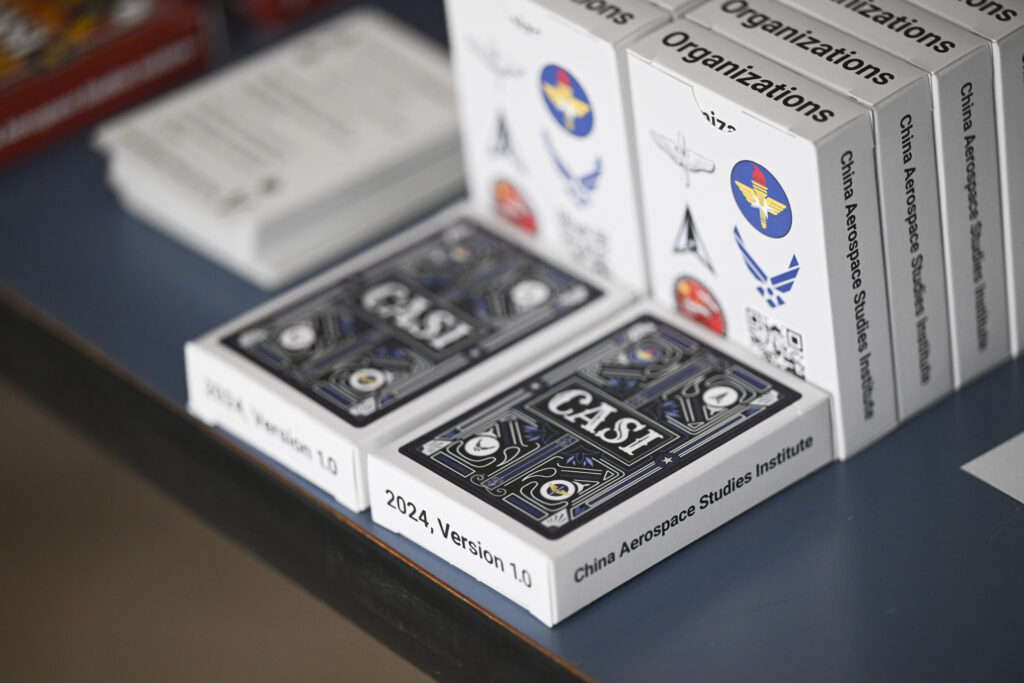
China Aerospace Studies Institute playing cards rest on a table during the Understanding China’s Aerospace event at Joint Base Andrews, Md., April 21, 2025. (U.S. Air Force photo/Senior Airman Gianluca Ciccopiedi)
WASHINGTON — Lawmakers on the House Select Committee on China are pushing the Air Force for answers about a planned downsizing of its Beijing-focused think tank, warning that any reduction in the group’s output could impact America’s national security.
“Under-resourcing” the mission of the China Aerospace Studies Institute (CASI) “could risk undermining the ability of military leaders and civilian policymakers to understand” Beijing’s aerospace strategy and military prowess, according to a copy of the letter viewed exclusively by Breaking Defense.
Addressed to Air Force Secretary Troy Meink and signed by Republican Chairman John Moolenaar and Democratic Ranking Member Ro Khanna, the letter requests a briefing by Nov. 20 to provide “resourcing and personnel decisions” for CASI.
In their letter, House lawmakers say that “[a]ny potential loss” of CASI’s skills “is particularly worrisome” due to China’s burgeoning aerospace capabilities and “aggressive activities in the Indo-Pacific region.” Praising CASI’s work, the lawmakers say that alternatives to the institute’s “in-house expertise” would likely require the Air Force and other government entities “to expend considerable resources to purchase contracted expertise from external vendors.”
Given rapidly advancing air and space power by the Chinese People’s Liberation Army (PLA), the lawmakers say that diminishing relevant analysis is “particularly concerning” and could impact American deterrence, as fears mount over a potential battle for Taiwan.
“As the PLA continues to expand its aerospace capabilities, our need to understand these advancements will continue to grow,” the letter says. An Air Force spokesperson told Breaking Defense that the service “will respond directly to the committee.”
The letter comes after it was revealed in September that the Air Force planned to axe CASI’s 10-member civilian workforce. While the Air Force maintained its premier China-focused think tank would remain open and operate with military personnel, its director, Brendan Mulvaney, stressed in an interview with Breaking Defense that the elimination of its civilian staff would functionally shutter the institute.
Edge computing fails when the mission hardware can’t evolve
The payoff is quicker tech insertion, avoiding vendor lock, and more room for autonomy, sensors, weapons, and mission growth.
Founded by Mulvaney roughly a decade ago, CASI regularly publishes on Beijing’s air and space forces, drawing on open-source information translated from Mandarin. The institute’s publications and training courses are seen as valuable resources for educating the broader military policy community on Chinese air and space power, prompting experts to denounce CASI’s expected downsizing.
“The idea that you could do research or the translations that we’re doing is not credible” without civilian experts, Mulvaney previously told Breaking Defense.
Mulvaney explained that the think tank’s civilian posts are being converted to an unfunded status, meaning that staffers will continue to work until being moved to a different role elsewhere in the Department of the Air Force — and once they leave, their positions cannot be backfilled. CASI’s current commitments stretch until around March and will largely function as usual until then, but after that the institute’s fate becomes more unclear, according to Mulvaney.
News of the CASI cuts raised questions about similar efforts run by the Army, Navy and Marine Corps, though spokespeople for each service previously told Breaking Defense that there are no planned changes for their respective Beijing-focused programs.
Breaking Defense Video
The defense show circuit keeps rolling, plus Jimmy Stewart goes to war
Qatar’s domestic weapons, Turkey’s drone arsenal and the Mecca pact’s next test
3 congressional races that matter for defense
How General Atomics views Europe’s unmanned future
A more flexible way to defend maneuver forces from drones that doesn’t tie them down [Sponsored]
What’s haunting the Pentagon this Halloween?
The new must-have capabilities for drones [Sponsored]
Army’s tech chief talks autonomy, acquisition and the future of drones
Drones take over AUSA, plus the Army’s plan to bring in new vendors
Hegseth talks autonomy at AUSA, a key show focus
2025年4月21日,在马里兰州安德鲁斯联合基地举行的“了解中国航空航天”活动上,中国航空航天研究所的扑克牌摆放在桌子上。(美国空军照片/高级空军兵詹卢卡·西科皮迪)
华盛顿——众议院中国问题特别委员会的议员们正在向空军施压,要求其就计划缩减其专注于北京问题的智库规模一事作出解释,并警告说,该智库产出的任何减少都可能影响美国的国家安全。
据 Breaking Defense 独家获得的信件副本显示,对中国航天研究所 (CASI) 的使命“资源不足”可能会“削弱军事领导人和文职决策者了解”北京的航天战略和军事实力的能力。
这封致空军部长特洛伊·梅因克的信,由共和党主席约翰·穆勒纳尔和民主党首席成员罗·卡纳签署,要求在 11 月 20 日之前进行简报,以便为 CASI 提供“资源和人员决策”。
众议院议员在信中表示,鉴于中国航空航天能力的快速发展以及在印太地区的“咄咄逼人的活动”,CASI技能的“任何潜在损失”都“尤其令人担忧”。议员们赞扬了CASI的工作,并指出,如果要寻找替代该研究所“内部专业知识”的方案,空军和其他政府机构可能需要“耗费大量资源从外部供应商处购买合同技术”。
鉴于中国人民解放军(PLA)的空中和太空力量迅速发展,议员们表示,减少相关分析“尤其令人担忧”,并且可能会影响美国的威慑力,因为人们对台湾可能爆发战争的担忧日益加剧。
信中写道:“随着解放军不断拓展其航空航天能力,我们了解这些进步的需求也将日益增长。”一位空军发言人告诉《防务新闻》,空军“将直接回复委员会”。
这封信是在9月份空军计划裁撤中国高级研究所(CASI)的10名文职人员之后发出的。尽管空军坚称其首屈一指的中国问题智库将继续开放并由军方人员运营,但该研究所所长布伦丹·穆尔瓦尼在接受《防务新闻》采访时强调,裁撤文职人员实际上将导致该研究所关闭。
当任务硬件无法升级时,边缘计算就会失败。
这样做的好处是技术植入速度更快,避免被供应商锁定,并为自主性、传感器、武器和任务发展留出更多空间。
中国空天力量研究所(CASI)由穆尔瓦尼大约十年前创立,定期发布关于北京空天力量的文章,其内容主要基于从中文翻译而来的开源信息。该研究所的出版物和培训课程被视为向更广泛的军事政策界普及中国空天力量的重要资源,因此,专家们对CASI即将缩减规模的计划表示谴责。
穆尔瓦尼此前告诉《防务新闻》:“如果没有民间专家,就无法进行我们正在进行的研究或翻译,这种想法是不可信的。”
穆尔瓦尼解释说,该智库的文职岗位正在转为无经费编制,这意味着工作人员将继续工作,直到被调往空军部其他部门担任其他职务——一旦他们离开,他们的职位将无法被填补。穆尔瓦尼表示,CASI目前的各项工作安排将持续到3月份左右,在此之前,该机构将基本照常运作,但之后其命运将变得更加不明朗。
CASI 削减的消息引发了人们对陆军、海军和海军陆战队类似工作的质疑,尽管各军种的发言人此前都告诉 Breaking Defense,他们各自的以北京为中心的计划没有计划进行任何改变。
突破性防御视频
国防题材的巡回演出仍在继续,此外,吉米·斯图尔特也参战了。
卡塔尔的国产武器、土耳其的无人机武库以及麦加条约的下一次测试
3场对国防至关重要的国会选举
通用原子公司如何看待欧洲的无人化未来
一种更灵活的防御机动部队免受无人机攻击的方式,不会限制其行动[赞助]
今年万圣节,五角大楼究竟闹鬼?
无人机必备的新功能 [赞助内容]
陆军技术主管谈无人机的自主性、采购和未来
无人机主导了美国陆军协会(AUSA)的会议,此外,陆军还计划引入新的供应商。
Hegseth 在 AUSA 大会上谈到了自主性,这是本次大会的一个重点议题。