The Beechcraft M-346N Is The Only Known Aircraft Left In The Navy’s Jet Trainer Competition比奇M-346N是目前已知唯一仍在海军喷气式教练机竞赛中的飞机。
Sierra Nevada Corp decided not to bid to replace the Navy's T-45s with its Freedom Jet, one of two known contenders left in the running.
新闻视频
By Thomas Newdick , Joseph Trevithick
Published Nov 4, 2026 12:36 PM EST
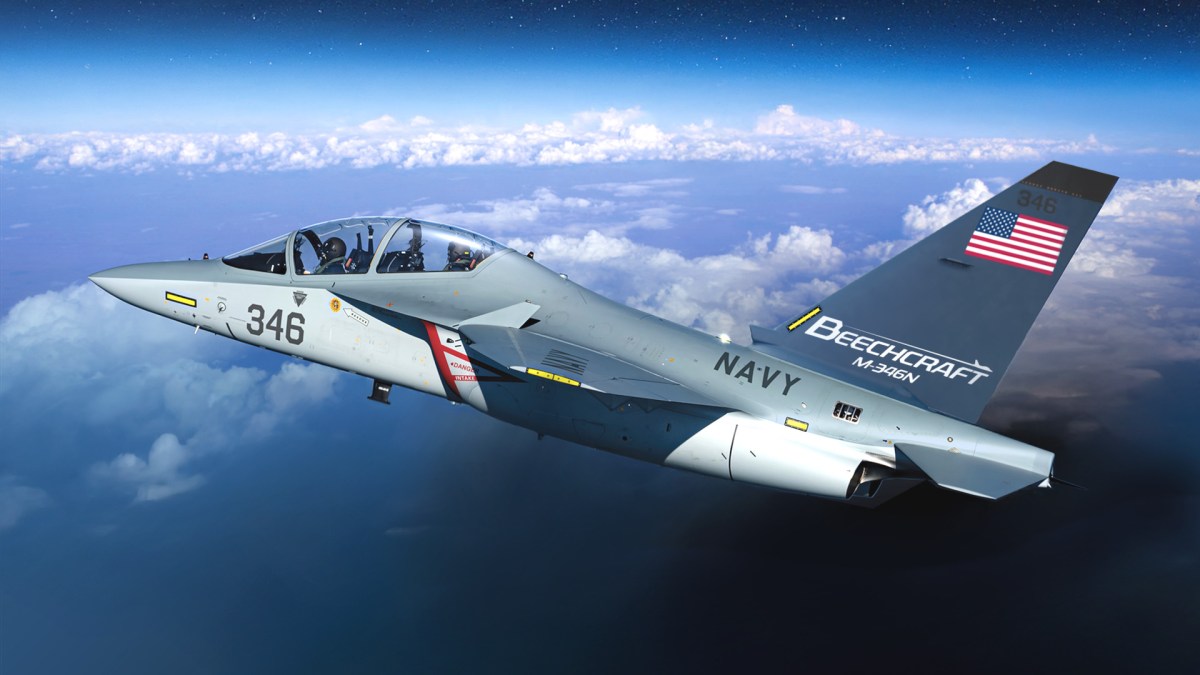
The Sierra Nevada Corporation (SNC) has decided not to propose its Freedom Jet design for the U.S. Navy’s Undergraduate Jet Training System (UJTS) competition. The field of contenders for UJTS, which aims to find a replacement for the aging T-45 Goshawk jet trainer, has narrowed significantly already this year. The Beechcraft M-346N , put forward by U.S. firm Textron and Italy’s Leonardo, is now the only known major design left in the running.
SNC’s decision on UJTS was first reported by Breaking Defense and has since been further confirmed by Aviation Week . In September, Northrop Grumman had announced it was dropping out of its partnership with SNC on the Freedom Jet proposal. General Atomics has also been named in the past as being part of this team. The Navy’s deadline for bids for its jet trainer competition had come up on October 30. The service’s stated goal has been to acquire 216 new trainers to replace the just under 200 T-45s that are in its inventory today.
“With great respect for the Navy and PMA-273, SNC could not responsibly bid the UJTS program under the current contract structure,” SNC said in a statement to Breaking Defense . “We do remain committed to naval jet training and stand ready to re-engage if the approach is revisited.”
Textron Aviation Defense separately confirmed to that outlet that it submitted the M-346N, a navalized version of the Leonardo-developed M-346 Master advanced jet trainer, and said that it was “ready to support the U.S. Navy and its future training needs.”
TWZ previously flew aboard the M-346, providing a firsthand look at the aircraft Textron is pitching to the service.
Whether or not any other serious bids have been submitted for UJTS is unknown. What impact SNC’s decision not to put forward a proposal may now have on the competition is unclear. TWZ has reached out to SNC and Textron Aviation Defense, as well as the Navy, for additional details.
“Proposals were due on 30 October 2026,” the Navy’s UJTS program office said in response to our queries. “The Government is in source selection with the intent to award the UJTS procurement in 4QFY27 [the fourth quarter of Fiscal Year 2027].”
A competition that has steadily narrowed
As mentioned, SNC’s announcement follows decisions by several other major aerospace companies to pull out of the running for UJTS.
Lockheed Martin announced in April that it would not submit a proposal for UJTS. The company had previously planned to submit the TF-50N, a navalized version of the T-50 developed with Korea Aerospace Industries (KAI). Neither firm appears to have given a detailed explanation for this decision.
A rendering of the TF-50N. Lockheed Martin
Boeing followed suit in June , saying it would not put forward a proposal due to issues tied to the General Electric F404 turbofan and UJTS engine qualification requirements. The company had been expected to submit a bid involving a version of the T-7A Red Hawk being built now for the U.S. Air Force, which is powered by a single F404.
After Boeing’s announcement, the Navy’s competition looked to be down to just two established teams: Textron and Leonardo with the M-346N, and SNC with its Freedom Jet. It is important to note that the M-346N and Freedom Jet are twin-engine aircraft, while the TF-50N and T-7A are single-engine types. SNC had also been the only one in the running with a clean-sheet design.
Now the field has dwindled to just one major contender, the Textron/Leonardo team, at least that we know of, barring the emergence of a surprise entrant. The Navy has not confirmed how many bids it ultimately received for UJTS. The service could also potentially reopen the UJTS competition or otherwise restructure its T-45 replacement plans.
A changing naval aviation training landscape
Since the early 1990s, the Navy has been using variants of the T-45 Goshawk to train future naval aviators destined to fly tactical jets and other carrier-based aircraft. This includes members of the U.S. Marine Corps and foreign student aviators. The Goshawks are currently the service’s only fast jet trainer aircraft.
The winning UJTS design will replace the Navy’s T-45 jet trainers, one of which is seen here. U.S. Navy
Despite having received various upgrades over the years, the T-45 fleet continues to age and has faced significant struggles . This includes a spate of reported hypoxia-like physiological episodes among pilots that led to the development of a new oxygen system . There have been several Goshawk crashes in recent years due to a variety of factors, the most recent of which came just this past May . The pilots of that aircraft involved in that mishap thankfully survived.
As such, there has been a growing imperative to replace the T-45s, which led to the UJTS program. UJTS also reflects broader changes to how future naval aviators are trained.
One of the most significant developments already has been the elimination of carrier qualification requirements, including touch-and-goes and full landings, from the syllabus for students in the tactical air aviator training pipeline. Those individuals can still get carrier qualifications in T-45s, if there is time and space available. There is currently still a carrier qualification requirement for future E-2 Hawkeye pilots and foreign student aviators in order to graduate and earn their coveted wings of gold.
At present, prospective naval aviators training to fly fixed-wing carrier-based aircraft do still have to conduct so-called Field Carrier Landing Practice (FCLP) at facilities ashore. FCLP is structured in such a way that it “simulates, as near as practicable, the conditions encountered during carrier landing operations,” per the Navy .
This is all set to change further with the acquisition of new trainers through UJTS. Unlike the T-45, the Navy’s future jet trainers are not required to have features to support full carrier-based operations, touch-and-goes on those ships, or even FCLP training at bases on land.
The Navy’s decision to alter what have long been considered vital aspects of the naval aviator training pipeline has been and continues to be controversial. Concerns and criticisms have been raised about safety and other ramifications of cutting carrier qualification and other requirements.
For its part, the Navy has argued that other modernization efforts have fundamentally changed what is necessary to train naval aviators. The service regularly points to the development of new live, virtual, and constructive training capabilities and associated constructs, as well as assisted carrier landing capabilities, such as Magic Carpet and its successors.
The Navy has also said that the changes help move student aviators through training faster, helping to address chronic pilot shortages . There is a cost-benefit argument to be made here, too.
It is important to note here that with Freedom Jet, SNC had made an explicit and deliberate decision to develop an aircraft that could still perform carrier qualifications and FCLP training. The company said it did so to preserve those capabilities and give the Navy flexibility to alter its naval aviator training plans in the future.
The T-45 replacement schedule continues to slip
Beyond the further narrowing of the field of competitors, the UJTS program has already faced delays and other hurdles. The Navy had originally hoped to see its new jet trainers begin entering service in 2028. That schedule subsequently slipped multiple times. The stated plan earlier this year was to at least award the UJTS contract by March 2027. As mentioned earlier, the contract award timeline has now shifted again to sometime in the fourth quarter of the current fiscal cycle, which runs between next July and September.
Earlier this year, the Navy also confirmed that it had increased the total cost ceiling for the prospective UJTS contract from approximately $1.8 billion to $2.7 billion. “The cost structure has raised concerns as the Navy has detailed an initial award cost of $52.8 million in fiscal 2027 and $181 million for fiscal 2028,” according to Aviation Week’ s report today .
With all this in mind, the M-346N does offer an option that is powered by established Honeywell F124 turbofan engines and that can leverage significant existing supply chains. Other versions of the M-346 are already in service with multiple air forces globally, and more operators are on the horizon .
Another rendering of the M-346N. Textron
At the same time, SNC’s withdrawal and other prior setbacks for the UJTS program can only raise questions about how the competition might now proceed with only one major entrant left. SNC’s statement to Breaking Defense makes clear the company is willing to re-engage with the Navy if there is a further shake-up in the T-45 replacement plans.
For the Navy, acquiring a successor to the T-45 is only becoming an ever-more pressing priority. That being said, with how the UJTS effort has already proceeded to date, another change of tack cannot be entirely ruled out.
Contact the author: thomas@thewarzone.com
Comments couldn’t be loaded. Please refresh the page.
作者:托马斯·纽迪克、约瑟夫·特雷维西克
发布于2026年11月4日下午12:36(美国东部时间)
内华达山脉公司(SNC)已决定不提交其“自由喷气机”设计方案参与美国海军本科生喷气式教练机训练系统(UJTS)的竞标。UJTS旨在寻找老旧T-45“苍鹰”喷气式教练机的替代机型,今年的竞标范围已大幅缩小。目前,由美国德事隆公司和意大利莱昂纳多公司联合推出的比奇M-346N是已知的唯一仍在角逐的主要设计方案。
SNC公司关于UJTS的决定最初由Breaking Defense报道,随后Aviation Week也予以证实。今年9月,诺斯罗普·格鲁曼公司宣布退出与SNC公司在“自由喷气机”项目上的合作。通用原子公司此前也曾被认为是该项目团队的成员之一。海军喷气式教练机竞标的截止日期是10月30日。海军的目标是采购216架新型教练机,以替换目前服役的近200架T-45教练机。
SNC在发给《防务新闻》的一份声明中表示:“出于对海军和PMA-273的尊重,SNC无法在目前的合同结构下负责任地参与UJTS项目的投标。我们仍然致力于海军喷气式飞机训练,如果重新考虑该方案,我们随时准备再次参与。”
德事隆航空防务公司向该媒体单独证实,该公司已提交了 M-346N,这是莱昂纳多公司开发的 M-346 Master 高级喷气教练机的海军版,并表示“已准备好支持美国海军及其未来的训练需求”。
TWZ 之前曾乘坐 M-346 飞机,亲身体验了德事隆公司向美国军方推销的这款飞机。
目前尚不清楚是否还有其他公司提交了UJTS项目的正式投标。SNC决定不提交方案会对竞争产生何种影响也尚不明确。TWZ已联系SNC、德事隆航空防务公司以及海军,以获取更多详情。
海军UJTS项目办公室在回复我们的询问时表示:“提案截止日期为2026年10月30日。政府正在进行供应商遴选,计划在2027财年第四季度授予UJTS采购合同。”
竞争日益激烈
如前所述,SNC 的声明是在其他几家主要航空航天公司决定退出 UJTS 竞标之后发布的。
洛克希德·马丁公司四月份宣布将不会提交UJTS竞标方案。该公司此前计划提交TF-50N,这是与韩国航空航天工业公司(KAI)合作开发的T-50舰载型。两家公司似乎都没有对此决定给出详细解释。
TF-50N的效果图。洛克希德·马丁公司
波音公司在6月份也宣布,由于通用电气F404涡扇发动机和UJTS发动机的鉴定要求存在问题,该公司将不会提交竞标方案。此前预计波音公司将提交一份方案,该方案将使用目前正在为美国空军建造的T-7A“红鹰”教练机,该机型由一台F404发动机提供动力。
波音公司宣布方案后,海军的竞标似乎只剩下两家老牌竞标团队:德事隆和莱昂纳多公司联合推出的M-346N,以及SNC公司推出的自由喷气机。值得注意的是,M-346N和自由喷气机均为双引擎飞机,而TF-50N和T-7A则是单引擎飞机。此外,SNC公司也是唯一一家采用全新设计方案的竞标团队。
现在,主要竞争者只剩下一家——德事隆/莱昂纳多联合体,至少我们目前所知是这样,除非出现意想不到的竞争者。海军尚未确认最终收到了多少份UJTS竞标书。海军也可能重新启动UJTS竞标,或者调整其T-45的替代计划。
不断变化的海军航空训练格局
自20世纪90年代初以来,美国海军一直使用T-45“苍鹰”教练机的各种改进型来训练未来驾驶战术喷气式飞机和其他舰载机的海军飞行员。这些飞行员包括美国海军陆战队成员和外国飞行学员。“苍鹰”目前是美国海军唯一的快速喷气式教练机。
中标的UJTS设计方案将取代海军现役的T-45喷气式教练机,图中所示即为其中一架。美国海军
尽管多年来经过多次升级,T-45机队仍然老化,并面临着诸多挑战。其中包括飞行员中频频出现类似缺氧的生理症状,促使新型供氧系统应运而生。近年来,由于各种原因,苍鹰教练机也发生过多起坠毁事故,最近一起就发生在今年五月。所幸的是,事故中的飞行员全部幸存。
因此,替换T-45教练机的迫切需求日益增长,这也促成了联合训练系统(UJTS)项目的启动。UJTS项目也反映了未来海军飞行员训练方式的更广泛变革。
其中一项最重要的进展是,战术飞行员训练课程中取消了航母起降资格要求,包括触地复飞和完整着陆。如果时间和名额允许,这些学员仍然可以驾驶T-45教练机获得航母起降资格。目前,未来的E-2“鹰眼”预警机飞行员和外国学员飞行员仍需通过航母起降资格考核才能毕业并获得梦寐以求的金色飞行徽章。
目前,接受固定翼舰载机飞行训练的海军飞行员仍需在岸上设施进行所谓的舰载机着陆训练(FCLP)。根据海军的说法,FCLP 的结构旨在“尽可能地模拟航母着陆作业中遇到的情况”。
随着通过联合联合训练系统(UJTS)采购新型教练机,这种情况还将进一步改变。与T-45不同,海军未来的喷气式教练机无需具备支持完整的航母作战、舰上起降训练,甚至陆上基地飞行训练(FCLP)的功能。
海军决定改变长期以来被视为海军飞行员训练体系关键环节的做法,一直以来都备受争议。人们对削减航母资格认证和其他要求所带来的安全隐患及其他后果表示担忧和批评。
海军方面则辩称,其他现代化举措已从根本上改变了海军飞行员的训练方式。海军经常提及新型实战、虚拟和构造性训练能力及相关技术的开发,以及辅助航母着舰能力的提升,例如“魔毯”及其后续系统。
海军方面也表示,这些改革措施有助于加快学员飞行员的训练进度,从而有助于解决长期存在的飞行员短缺问题。此外,从成本效益的角度来看,这些改革也具有一定的意义。
值得注意的是,SNC公司在研发“自由喷气机”时,明确且有意地决定开发一款能够执行航母资格认证和FCLP训练的飞机。该公司表示,这样做是为了保留这些能力,并使海军在未来能够灵活地调整其海军飞行员训练计划。
T-45的替换计划持续延期。
除了竞争者范围进一步缩小之外,UJTS项目此前已遭遇延误和其他障碍。海军最初希望其新型喷气式教练机于2028年开始服役,但这一计划随后多次推迟。今年早些时候公布的计划是至少在2027年3月前授予UJTS合同。如前所述,合同授予时间表现已再次推迟至本财年第四季度,即明年7月至9月之间。
今年早些时候,海军也证实,已将潜在的UJTS合同的总成本上限从约18亿美元提高到27亿美元。据《航空周刊》今天报道,“成本结构引发了人们的担忧,因为海军详细列出了2027财年的初始授标成本为5280万美元,2028财年为1.81亿美元。”
考虑到以上所有因素,M-346N 提供了一种采用成熟的霍尼韦尔 F124 涡扇发动机的动力选择,并能充分利用现有的供应链。M-346 的其他型号已在全球多个国家的空军服役,未来还将有更多用户加入。
M-346N 的另一幅渲染图。德事隆公司
与此同时,SNC的退出以及此前UJTS项目遭遇的其他挫折,无疑会引发人们对如今仅剩一家主要竞争者的情况下,竞争将如何进行的疑问。SNC向Breaking Defense发表的声明明确表示,如果T-45替代计划发生进一步变动,该公司愿意重新与海军接洽。
对海军而言,采购T-45的后继机型已成为日益紧迫的优先事项。话虽如此,鉴于联合联合训练系统(UJTS)项目迄今为止的进展情况,也不能完全排除再次改变策略的可能性。
联系作者:thomas@thewarzone.com
评论加载失败,请刷新页面。