India taps two domestic shipbuilders for $5.7B corvette program印度选定两家国内造船厂承接价值57亿美元的轻型护卫舰项目
India awarded Garden Reach Shipbuilders & Engineers and Goa Shipyard Limited contracts to build five and three corvettes, respectively, for the country's navy.
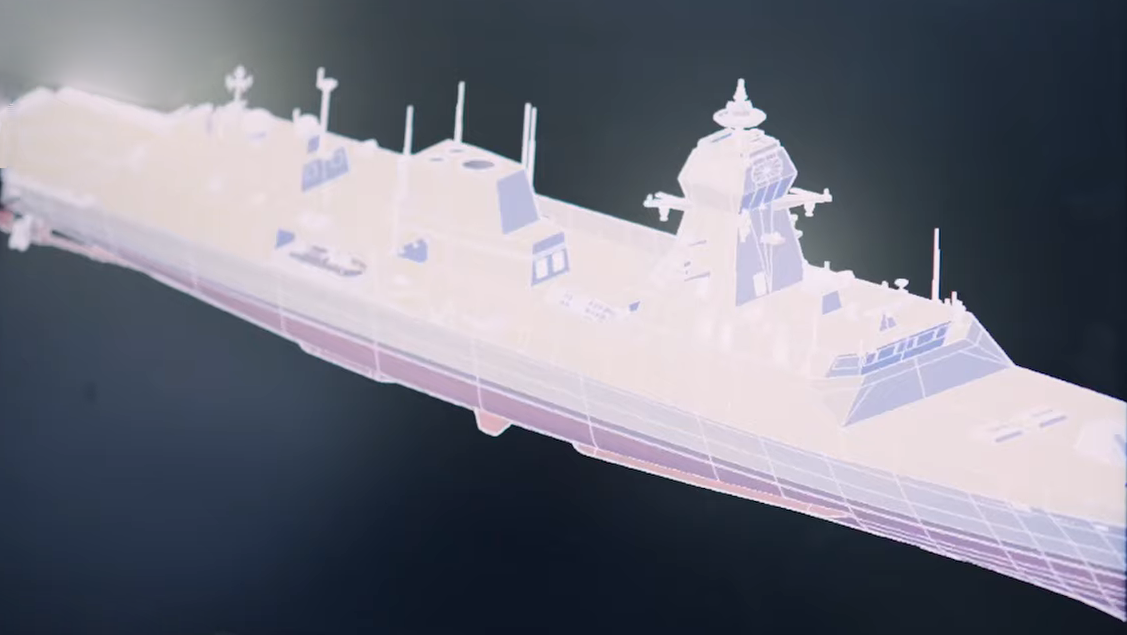
A computer rendering of India's Next Generation Corvette from an Indian Navy promotional video (Photo: Indian Navy)
SINGAPORE — India has signed a contract with two local shipbuilders to build eight Next Generation Corvettes (NGCs) for its navy, the country’s defense ministry announced Monday.
The Indian government awarded Garden Reach Shipbuilders & Engineers Limited (GRSE) and Goa Shipyard Limited (GSL) a contract valued at 53,866.50 crore Indian rupees (approximately US $5.7 billion) to build five and three corvettes, respectively. A crore is a unit in the Indian numbering system equal to 10 million.
The corvettes will feature advanced missiles, weapons and sensor systems, allowing the ships to engage threats in the air, on the surface and underwater, according to the ministry. “The induction of these ships will significantly enhance the Indian Navy’s operational capabilities in safeguarding maritime trade routes, conducting anti-surface and anti-submarine warfare operations, strengthening coastal defence, undertaking littoral c ombat operations, and carrying out maritime presence and surveillance missions,” the ministry said in its announcement.
The ministry described the contract award as a “significant milestone,” noting that it marks the first project in which the Indian navy will design the ships and government-owned shipyards — known as Defence Public Sector Undertakings (DPSUs) — will build them after being selected through a competitive process.
Both GRSE and GSL are majority owned by the Indian government.
GRSE said in its own announcement that the corvettes “will measure 127 metres in length and 17.6 metres in beam, with a specified deadweight tonnage of 4,950 tonnes” an d will be operated by a crew of 150, including 11 offic ers and 139 sailors.
The company added that the ships will be powered by a combined diesel and gas turbine–cross connect (CODAG-CC) propulsion arrangement driving two controllable-pitch propellers (CPP), giving them a top speed of 26 knots. The ships will be able to remain at sea for up to 14 days without replenishments.
The shipbuilder also provided further details on the corvettes’ planned equipment, stating that they will be armed with indigenous Medium Range Anti-Ship Missiles (MRAShM — although this weapon has also been called the Naval Anti-Ship Missile or NASM-MR), MRSAM medium-range surface-to-air missiles and 324mm torpedo tubes.
Other onboard weapons include the Leonardo 76mm Super Rapid naval gun, Russian AK-360 close-in weapon systems and 12.7mm remote weapon stations.
The corvettes will also feature electro-optical infrared search-and-track systems and multifunction surveillance, tracking and guidance radars — although neither the ministry nor the shipbuilders have identified the specific systems selected.
Breaking Defense Video
The defense show circuit keeps rolling, plus Jimmy Stewart goes to war
Qatar’s domestic weapons, Turkey’s drone arsenal and the Mecca pact’s next test
3 congressional races that matter for defense
How General Atomics views Europe’s unmanned future
A more flexible way to defend maneuver forces from drones that doesn’t tie them down [Sponsored]
What’s haunting the Pentagon this Halloween?
The new must-have capabilities for drones [Sponsored]
Army’s tech chief talks autonomy, acquisition and the future of drones
Drones take over AUSA, plus the Army’s plan to bring in new vendors
Hegseth talks autonomy at AUSA, a key show focus
这是印度海军宣传视频中展示的印度下一代轻型护卫舰的电脑渲染图(图片来源:印度海军)。
新加坡——印度国防部周一宣布,印度已与两家当地造船厂签署合同,为其海军建造八艘下一代轻型护卫舰(NGC)。
印度政府授予加登里奇造船工程有限公司(GRSE)和果阿造船有限公司(GSL)价值5386.65亿印度卢比(约合57亿美元)的合同,分别建造五艘和三艘轻型护卫舰。一亿(crore)是印度计数系统中的单位,等于一千万。
据国防部称,这些轻型护卫舰将配备先进的导弹、武器和传感器系统,使其能够应对空中、水面和水下威胁。国防部在公告中表示:“这些舰艇的入列将显著提升印度海军在维护海上贸易航线安全、开展反水面和反潜作战、加强海岸防御、执行近岸作战以及执行海上存在和监视任务方面的作战能力。”
该部将此次合同授予描述为“一个重要的里程碑”,并指出这是印度海军首次设计舰艇,而政府所有的造船厂(即国防公共部门企业 (DPSU))将在通过竞争性程序选定后进行建造。
GRSE 和 GSL 的多数股权均由印度政府持有。
GRSE 在自己的公告中表示,这些护卫舰“长 127 米,宽 17.6 米,额定载重吨为 4,950 吨”,将由 150 名船员操作,其中包括 11 名军官和 139 名水兵。
该公司补充说,这些船舶将采用柴油燃气轮机交叉连接(CODAG-CC)联合推进系统,驱动两台可调螺距螺旋桨(CPP),最高航速可达26节。这些船舶无需补给即可在海上航行长达14天。
造船厂还提供了有关护卫舰计划装备的更多细节,称它们将配备国产中程反舰导弹(MRAShM——尽管这种武器也被称为海军反舰导弹或NASM-MR)、MRSAM中程舰空导弹和324毫米鱼雷发射管。
舰上其他武器包括莱昂纳多76毫米超速射舰炮、俄罗斯AK-360近程武器系统和12.7毫米遥控武器站。
这些护卫舰还将配备光电红外搜索跟踪系统和多功能监视、跟踪和制导雷达——尽管国防部和造船厂都没有透露具体选择了哪些系统。
突破性防御视频
国防题材的巡回演出仍在继续,此外,吉米·斯图尔特也参战了。
卡塔尔的国产武器、土耳其的无人机武库以及麦加条约的下一次测试
3场对国防至关重要的国会选举
通用原子公司如何看待欧洲的无人化未来
一种更灵活的防御机动部队免受无人机攻击的方式,不会限制其行动[赞助]
今年万圣节,五角大楼究竟闹鬼?
无人机必备的新功能 [赞助内容]
陆军技术主管谈无人机的自主性、采购和未来
无人机主导了美国陆军协会(AUSA)的会议,此外,陆军还计划引入新的供应商。
Hegseth 在 AUSA 大会上谈到了自主性,这是本次大会的一个重点议题。