Singapore students rank top in reading, second in math and science in OECD study在经合组织(OECD)的一项研究中,新加坡学生的阅读成绩排名第一,数学和科学成绩排名第二。
Singapore’s 15-year-olds ranked top in reading and second in maths and science in Pisa 2025, excelling in computational problem solving and complex challenges. Read more at straitstimes.com.
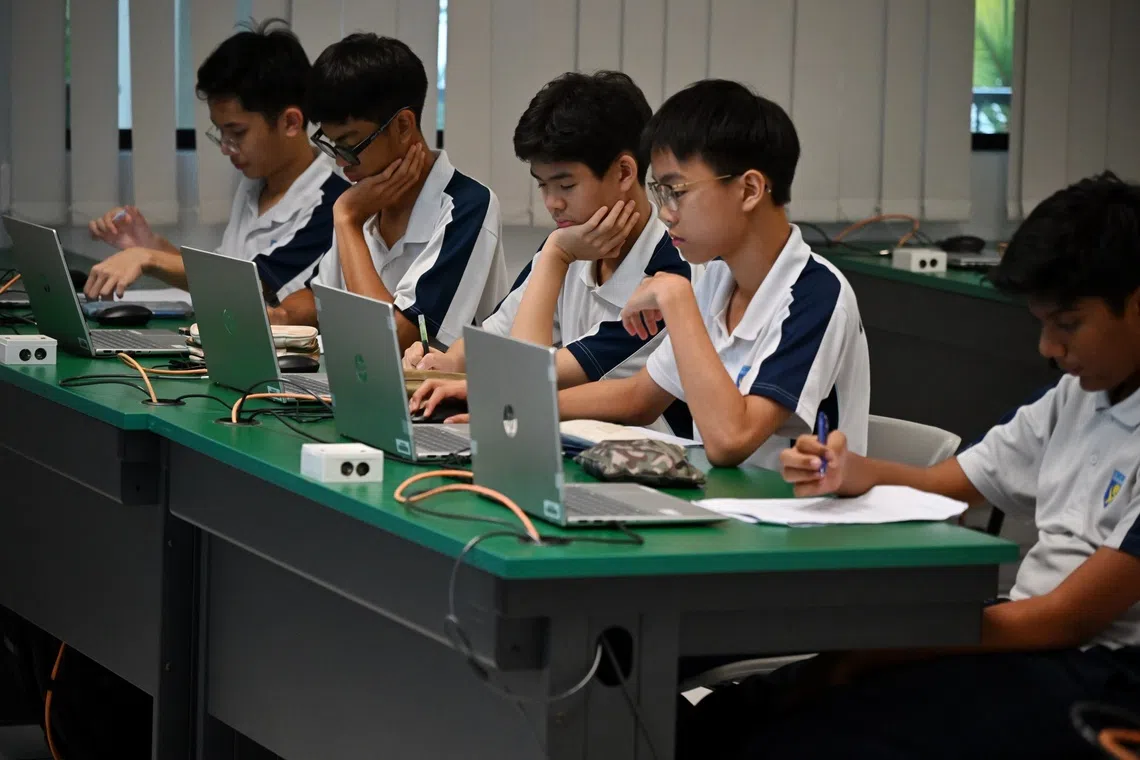
The Republic came in first for reading, and second for mathematics and science in the Programme for International Student Assessment 2025.
ST PHOTO: KUA CHEE SIONG
Published Sep 08, 2026, 03:30 PM
Updated Sep 08, 2026, 03:30 PM
Singapore’s 15-year-olds ranked first in reading and second in mathematics, science, and computational problem-solving in the OECD’s Pisa 2025 study.
The study assessed students in computational problem-solving skills for the first time, highlighting the value of such skills for logical reasoning and handling complex digital challenges.
MOE noted a widening achievement gap and is expanding support for weaker and disadvantaged students through programmes like ComLink+ and additional school resources.
SINGAPORE - Singapore’s 15-year-olds have emerged among the top performers in an international benchmarking study to measure how well education systems are preparing students for complex challenges and the future.
The Republic came in first for reading, and second for mathematics and science in the Programme for International Student Assessment (Pisa) 2025, based on the performance of 6,551 students across 157 schools here.
Singapore was ranked second in computational problem-solving, a new section that evaluated how 15-year-olds break down complex tasks and design algorithms to solve real-world challenges.
A record 91 countries and economies took part in the latest assessment, up from 81 in the previous test in 2022 . The latest study, which is done every three years by the Organisation for Economic Cooperation and Development (OECD), was released on Sept 8.
The Pisa 2025 survey focused on science, with mathematics and reading as minor areas. It also assessed for the first time learning in the digital world, measuring students’ capacities to build knowledge and solve problems using computational tools.
China and Singapore were the highest performers across science, mathematics and reading in 2025, with China leading in math and science, and Singapore emerging first in reading.
Estonia, Japan, Korea, Macau, Taiwan and Britain also ranked among the top 10 performing education systems in all three domains. Macau came out tops for computational problem solving , a new segment that assessed how well students can solve problems using computational practices such as analysing data.
The Pisa report noted that many parents still wrongly regard computer science as a specialist subject, useful mainly for aspiring software engineers.
“This is a mistake. The real value of computational problem solving lies not in coding itself, but in the habits it develops,” said the report, citing skills like logical reasoning, pattern recognition, and the ability to break complex challenges into manageable parts.
“These are becoming essential skills for a world increasingly shaped by technology and data.”
Test questions in this area examined students’ capacity to use modelling and programming tools, conduct experiments and build and debug computational artefacts - such as programming a robotic claw to sort objects.
Overall, Pisa 2025 recorded the lowest OECD-average performance observed so far in science, reading and mathematics. Science scores have declined gradually over the past decade, and mathematics scores fell especially sharply after 2018.
Reading performance saw the most significant drop over the past decade, after peaking around 2012.
In reading, Pisa saw a decline in the skills that matter most in the AI age: evaluating information, making connections across multiple sources, and thinking critically, said the latest report. Across countries , the share of “hasty readers” – students who rush through texts and give quick but incorrect answers – almost doubled between 2018 and 2025.
Compared with the 2022 results, students in Singapore recorded lower scores in mathematics and reading, and maintained their performance in science.
In a statement, t he Education Ministry said the results affirm the strengths of students here in applying knowledge to solve complex problems and being engaged with learning, “putting them in good stead for lifelong learning”.
“More than half of our students are top performers in computational problem solving, compared to a quarter of students in OECD countries on average.”
They are “highly effective” in conducting experiments, analysing data, and building and debugging computational artefacts to solve complex real-world problems, MOE added.
The ministry also noted how Singapore’s proportion of academic all-rounders (15%) - top performers who did well in reading, mathematics, and science - is the highest among all participating education systems, and five times that of the OECD average (3%).
Singapore also continues to have one of the highest proportions of top performers, and one of the lowest shares of low performers in Pisa 2025, across mathematics, reading and science , said MOE.
But the gap between students here with scores in the top and bottom 10 per cent widened across all three areas from 2022 to 2025. This underscores the importance of continuing to support students with different learning needs, said MOE.
The Pisa report noted that Singapore’s students in the top 25 per cent by socio-economic background outperformed those in the bottom 25 per cent by the equivalent of more than four years of learning in science.
MOE said it has been expanding efforts to support academically weaker students and those from more vulnerable backgrounds. It will continue to do so through ComLink+, and by providing additional manpower and resourcing to more schools .
Schools with a higher number of students from disadvantaged backgrounds receive additional manpower and resourcing to support students’ social-emotional and well-being. These efforts include strengthened after-school engagements and partnerships with the community to support students and their families.
ComLink+, a national programme, has family coaches and volunteer befrienders work with lower-income families with children on their plans to support their needs and aspirations.
Speaking to The Straits Times on the findings, OECD’s director for education and skills Dr Andreas Schleicher said reading is a “great strength” in Singapore. “Reading is the mother of all skills. If you can’t read, you’re not going to be successful in anything else.”
MOE’s director-general of education Liew Wei Li said the Pisa results provide useful insights about Singapore’s students as learners, showing that they are curious, perseverant, and care about the world. This is on top of having strong foundations in reading, mathematical and scientific literacies, and competencies essential for thriving in life and at work.
“The findings also show where we can do better. We will continue to help our children, regardless of their background or starting point, to thrive and learn confidently,” she said.
Are you as smart as Singapore’s 15-year-olds?
Try answering these four science and computational problem-solving questions.
1. Wind turbine farm: Explain phenomena scientifically
2. Fast fashion: Explain phenomena scientifically
3. Recycling claw: Build and debug computational artefacts
4. Fitness app: Conduct experiments and analyse data
Shermaine Ang is a journalist at The Straits Times, covering social issues in Singapore.
Ministry of Education
在2025年国际学生评估计划中,爱尔兰共和国的阅读成绩排名第一,数学和科学成绩排名第二。
《海峡时报》摄影:郭志雄
发布于 2026 年 9 月 8 日下午 3:30
更新于2026年9月8日下午3:30
在经合组织 PISA 2025 研究中,新加坡 15 岁学生的阅读能力排名第一,数学、科学和计算问题解决能力排名第二。
该研究首次对学生的计算问题解决能力进行了评估,突显了此类技能对于逻辑推理和应对复杂数字挑战的价值。
教育部注意到成绩差距不断扩大,正在通过 ComLink+ 等计划和增加学校资源来扩大对弱势学生和处境不利学生的支持。
新加坡——在一项衡量教育系统如何帮助学生应对复杂挑战和未来发展水平的国际基准研究中,新加坡 15 岁的学生名列前茅。
根据 2025 年国际学生评估计划 (PISA) 对 157 所学校的 6,551 名学生的评估结果,爱尔兰共和国在阅读方面排名第一,在数学和科学方面排名第二。
新加坡在计算问题解决能力方面排名第二,这是一个新设立的评估项目,旨在考察 15 岁青少年如何分解复杂任务并设计算法来解决现实世界的挑战。
参与最新评估的国家和地区数量创下历史新高,达到 91 个,高于 2022 年上次评估的 81 个。这项由经济合作与发展组织 (OECD) 每三年进行一次的最新研究于 9 月 8 日发布。
PISA 2025 调查主要侧重于科学,数学和阅读是次要领域。它还首次评估了学生在数字世界中的学习能力,衡量他们运用计算工具构建知识和解决问题的能力。
2025 年,中国和新加坡在科学、数学和阅读方面表现最佳,其中中国在数学和科学方面领先,新加坡在阅读方面名列第一。
爱沙尼亚、日本、韩国、澳门、台湾和英国在所有三个领域也都位列前十。澳门在计算问题解决能力方面名列榜首,这是一个新设立的评估项目,旨在评估学生运用数据分析等计算方法解决问题的能力。
PISA报告指出,许多家长仍然错误地认为计算机科学是一门专业学科,主要对有志成为软件工程师的人有用。
“这是一个错误。计算问题解决的真正价值不在于编码本身,而在于它所培养的习惯,”报告指出,并列举了逻辑推理、模式识别以及将复杂挑战分解成可管理部分的能力等技能。
“在当今这个日益被技术和数据塑造的世界里,这些技能正变得越来越重要。”
该领域的测试题考察了学生使用建模和编程工具、进行实验以及构建和调试计算产品的能力,例如对机器人爪进行编程以对物体进行分类。
总体而言,PISA 2025 在科学、阅读和数学方面均取得了经合组织成员国迄今为止最低的平均成绩。过去十年间,科学成绩持续下滑,而数学成绩在 2018 年后更是急剧下降。
阅读成绩在过去十年中出现了最显著的下降,此前在 2012 年左右达到顶峰。
最新报告指出,在阅读方面,PISA测试发现,人工智能时代最重要的几项技能正在下降,例如信息评估、跨信息源联系以及批判性思维。报告还显示,在2018年至2025年间,各国“草率阅读者”(即匆匆浏览文本并给出快速但错误答案的学生)的比例几乎翻了一番。
与 2022 年的成绩相比,新加坡学生的数学和阅读成绩有所下降,而科学成绩则保持稳定。
教育部在一份声明中表示,考试结果肯定了本地学生在运用知识解决复杂问题和积极参与学习方面的优势,“这将为他们终身学习奠定良好的基础”。
“我们超过一半的学生在计算问题解决方面表现出色,而经合组织国家的平均水平仅为四分之一。”
教育部补充说,他们在开展实验、分析数据以及构建和调试计算工具以解决复杂的现实世界问题方面“非常有效”。
教育部还指出,新加坡的全能型学生(15%)——即在阅读、数学和科学方面都表现优异的学生——在所有参与的教育系统中比例最高,是经合组织平均水平(3%)的五倍。
教育部表示,在2025年国际学生评估计划(PISA)中,新加坡在数学、阅读和科学三个科目中,优秀学生的比例仍然位居世界前列,而低分学生的比例则处于世界最低水平。
但教育部表示,从2022年到2025年,这三个领域中成绩排名前10%和后10%的学生之间的差距都在扩大。这凸显了继续支持有不同学习需求的学生的重要性。
PISA报告指出,新加坡社会经济背景排名前25%的学生在科学方面的表现比排名后25%的学生高出相当于四年多的学习水平。
教育部表示,已加大力度支持学业成绩较差的学生和来自弱势背景的学生。教育部将继续通过“ComLink+”项目,并向更多学校提供额外的人力和资源,来支持这些学生。
学生中来自弱势背景的比例较高的学校会获得额外的人力和资源,以支持学生的社交情感和身心健康。这些举措包括加强课后活动以及与社区建立伙伴关系,从而更好地支持学生及其家庭。
ComLink+ 是一项全国性计划,该计划由家庭辅导员和志愿者陪伴员与低收入家庭的孩子一起制定计划,以满足他们的需求和愿望。
经合组织教育与技能司司长安德烈亚斯·施莱歇尔博士在接受《海峡时报》采访时谈到调查结果,他表示阅读是新加坡的“一大优势”。“阅读是所有技能之母。如果你不会阅读,你在其他任何方面都无法取得成功。”
新加坡教育部总监刘伟利表示,PISA测试结果为了解新加坡学生的学习情况提供了有益的视角,表明他们充满好奇心、坚持不懈,并且关心世界。此外,他们还拥有扎实的阅读、数学和科学素养基础,以及在生活和工作中取得成功所必需的各项能力。
“调查结果也指出了我们有哪些方面可以做得更好。我们将继续帮助我们的孩子,无论他们的背景或起点如何,都能茁壮成长,自信学习,”她说道。
你和新加坡的15岁少年一样聪明吗?
试着回答以下四个科学和计算问题。
1. 风力发电场:用科学方法解释现象
2. 快时尚:用科学方法解释这种现象
3. 回收爪:构建和调试计算工件
4. 健身应用:开展实验并分析数据
Shermaine Ang是《海峡时报》的记者,负责报道新加坡的社会问题。
教育部