Congress avoids government shutdown, drops Ukraine aid国会避免政府停摆,但取消了对乌克兰的援助。
Congress passed a bipartisan short-term funding bill at the last minute after removing $6 billion in Ukraine assistance.
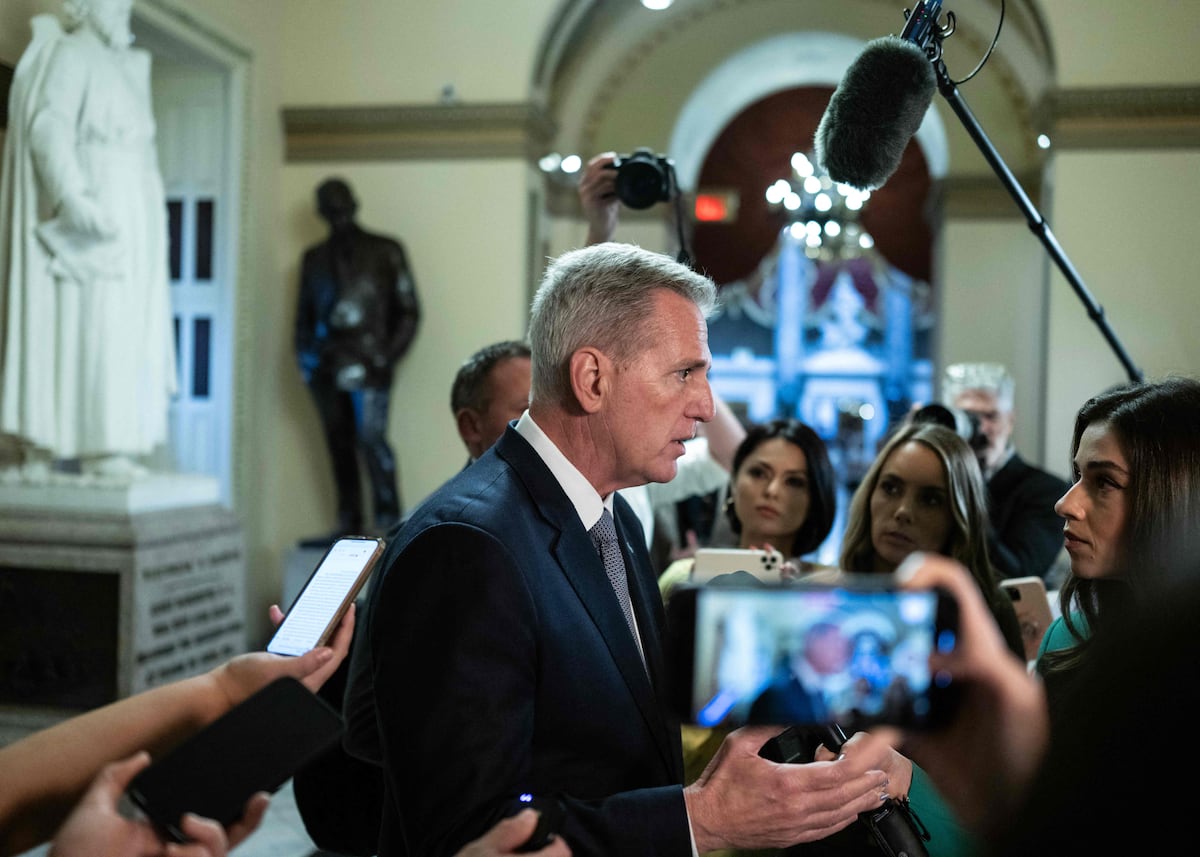
WASHINGTON ― Congress on Saturday passed a short-term funding bill to avoid a government shutdown mere hours before the deadline and after lawmakers dropped additional support for Ukraine from the bill.
After trying and failing to pass a Republican measure that would slash non-defense spending and enact strict immigration policies, House Speaker Kevin McCarthy, R-Calif., reversed course on early Saturday morning and offered a stopgap funding bill similar to the bipartisan Senate version – minus $6 billion in Ukraine aid.
This ensures troops and Defense Department employees will continue receiving their paychecks and avoids furloughing hundreds of thousands of the department’s civilian workers. However, it raises questions about Congress’ ability to pass additional Ukraine assistance only a week after President Volodymyr Zelenskyy visited Capitol Hill in a direct appeal to lawmakers, warning that his country would lose the war without more support.
The House passed the stopgap measure to fund the government through November 17 in a 335-91 vote. The Senate then passed it in an 88-9 vote.
The Defense Department no longer has funds for the Ukraine Security Assistance Initiative and the $1.5 billion it has left to backfill U.S. stockpiles of weapons that have been sent to Kyiv expires on September 30 . The Pentagon says that a previous accounting error means it has approximately $5.5 billion in funds to keep transferring weapons to Ukraine past the end of the fiscal year.
The White House in August asked Congress for an additional $24 billion in additional military and economic aid to Ukraine. But even in the Senate, where Ukraine enjoys broad bipartisan support, appropriators scaled that back to $6 billion.
That amount included $1.5 billion in replenishment funds to backfill U.S. stocks and another $1.5 billion for the Ukraine Security Assistance Initiative, which allows the Pentagon to place contracts for defense manufacturers to build weapons systems for Kyiv over the longer-term.
But even an extra $6 billion for Ukraine proved to be too high a bar for McCarthy. While a strong, bipartisan majority of the House still supports Ukraine aid, roughly half the House Republican caucus now opposes it.
House Republican leaders had to strip a separate $300 million in Ukraine Security Assistance Initiative funding from the defense spending bill on Thursday in order to pass that legislation largely along party lines. The House then voted 311-117 to send that $300 million in Ukraine funding separately to the Senate. Dozens more Republicans who had previously voted to preserve that funding in July reversed course and voted against it on Thursday.
Dropping the Ukraine aid also allowed the Senate to expeditiously pass the stopgap funding bill. Sen. Rand Paul, R-Ky., had spent the past week delaying votes on the bill to protest the Ukraine aid, but dropped his hold after its removal.
Congress has passed a cumulative $113 billion in economic and security assistance for Ukraine since Russia’s invasion last year.
While a shutdown would have been the worst-case scenario for the Defense Department, short-term funding bills still impose considerable constraints.
Vice Chief of Naval Operations Adm. Lisa Franchetti testified before Congress in September that the Navy will not be able to proceed with procurement on four of its six shipbuilding programs until Congress passes a full fiscal 2024 defense spending bill. Those programs are the Columbia-class ballistic missile submarine, the Virginia-class attack submarine, the Constellation-class frigate and a submarine tender replacement.
The stopgap funding bill includes a carveout that would allow the Navy to procure the Columbia-class submarine – but not the other ships – before Congress approves a full budget.
If Congress fails to pass a full budget by the next calendar year, the May debt ceiling agreement mandates that all federal agencies – including the Defense Department – operate on a one-year continuing resolution with a 1% cut for the rest of FY24.
Bryant Harris is the Congress reporter for Defense News. He has covered U.S. foreign policy, national security, international affairs and politics in Washington since 2014. He has also written for Foreign Policy, Al-Monitor, Al Jazeera English and IPS News.
华盛顿——国会周六通过了一项短期拨款法案,以避免政府停摆。而就在几个小时后,国会才从该法案中剔除了对乌克兰的额外支持。
在试图通过一项削减非国防开支并实施严格移民政策的共和党法案失败后,众议院议长、加州共和党人凯文·麦卡锡于周六清晨改变了立场,提出了一项与两党参议院版本类似的临时拨款法案——但其中削减了 60 亿美元的乌克兰援助。
这确保了部队和国防部雇员能够继续领取工资,避免了数十万国防部文职人员被迫休假。然而,这引发了人们的质疑:就在泽连斯基总统访问国会山,直接向议员们发出呼吁,警告乌克兰若得不到更多支持将输掉战争之后仅仅一周,国会是否有能力通过额外的乌克兰援助法案?
众议院以335票赞成、91票反对通过了这项临时拨款法案,为政府提供资金至11月17日。随后,参议院以88票赞成、9票反对通过了该法案。
美国国防部已无力继续为乌克兰安全援助计划提供资金,其剩余的15亿美元用于补充此前运往基辅的美国武器库存,这笔资金将于9月30日到期。五角大楼表示,由于之前的会计错误,目前仍有约55亿美元的资金可用于在财政年度结束后继续向乌克兰输送武器。
白宫8月份向国会申请追加240亿美元的对乌克兰军事和经济援助。但即便在乌克兰享有广泛两党支持的参议院,拨款委员会也只将援助金额削减至60亿美元。
该金额包括 15 亿美元的补充资金,用于补充美国库存;以及另外 15 亿美元用于乌克兰安全援助计划,该计划允许五角大楼与国防制造商签订合同,在长期内为基辅建造武器系统。
但即便额外向乌克兰提供60亿美元的援助,对麦卡锡来说也是难以逾越的门槛。尽管众议院两党的大多数议员仍然支持对乌克兰的援助,但大约一半的共和党众议员现在反对这项援助。
为了使国防开支法案基本按党派路线获得通过,众议院共和党领导人不得不于周四从该法案中剔除一项单独的3亿美元乌克兰安全援助计划拨款。随后,众议院以311票赞成、117票反对的投票结果,将这笔3亿美元的乌克兰援助资金单独提交参议院审议。数十名此前在7月份投票支持保留该项拨款的共和党议员,在周四改变了立场,投了反对票。
取消对乌克兰的援助也使得参议院得以迅速通过临时拨款法案。肯塔基州共和党参议员兰德·保罗此前一周一直在拖延对该法案的投票,以抗议对乌克兰的援助,但在援助取消后,他放弃了阻挠。
自去年俄罗斯入侵乌克兰以来,美国国会已累计通过了1130亿美元的经济和安全援助,用于援助乌克兰。
虽然政府停摆对国防部来说是最糟糕的情况,但短期拨款法案仍然造成了相当大的限制。
海军作战副部长丽莎·弗兰切蒂海军上将9月在国会作证时表示,在国会通过完整的2024财年国防开支法案之前,海军将无法推进其六个造船项目中的四个项目的采购工作。这四个项目分别是哥伦比亚级弹道导弹潜艇、弗吉尼亚级攻击型核潜艇、星座级护卫舰以及一艘潜艇补给舰的替代舰。
这项临时拨款法案包含一项例外条款,允许海军在国会批准全面预算之前采购哥伦比亚级潜艇,但不包括其他舰艇。
如果国会未能在下一个日历年通过完整的预算,5 月份的债务上限协议规定,所有联邦机构(包括国防部)都将按照为期一年的持续决议运作,并在 2024 财年剩余时间内削减 1% 的预算。
布莱恩特·哈里斯是《防务新闻》的国会记者。自2014年以来,他一直在华盛顿报道美国外交政策、国家安全、国际事务和政治。他还曾为《外交政策》、《Al-Monitor》、《半岛电视台英语频道》和IPS新闻撰稿。