At a NATO range in Latvia, hits and misses mark Europe’s counter-drone journey在拉脱维亚的一个北约靶场,命中与失误标志着欧洲反无人机征程的开始。
Drone technology is “a couple of steps ahead” of countermeasures, one officer said, with interceptors having to work every time to prevent losses.
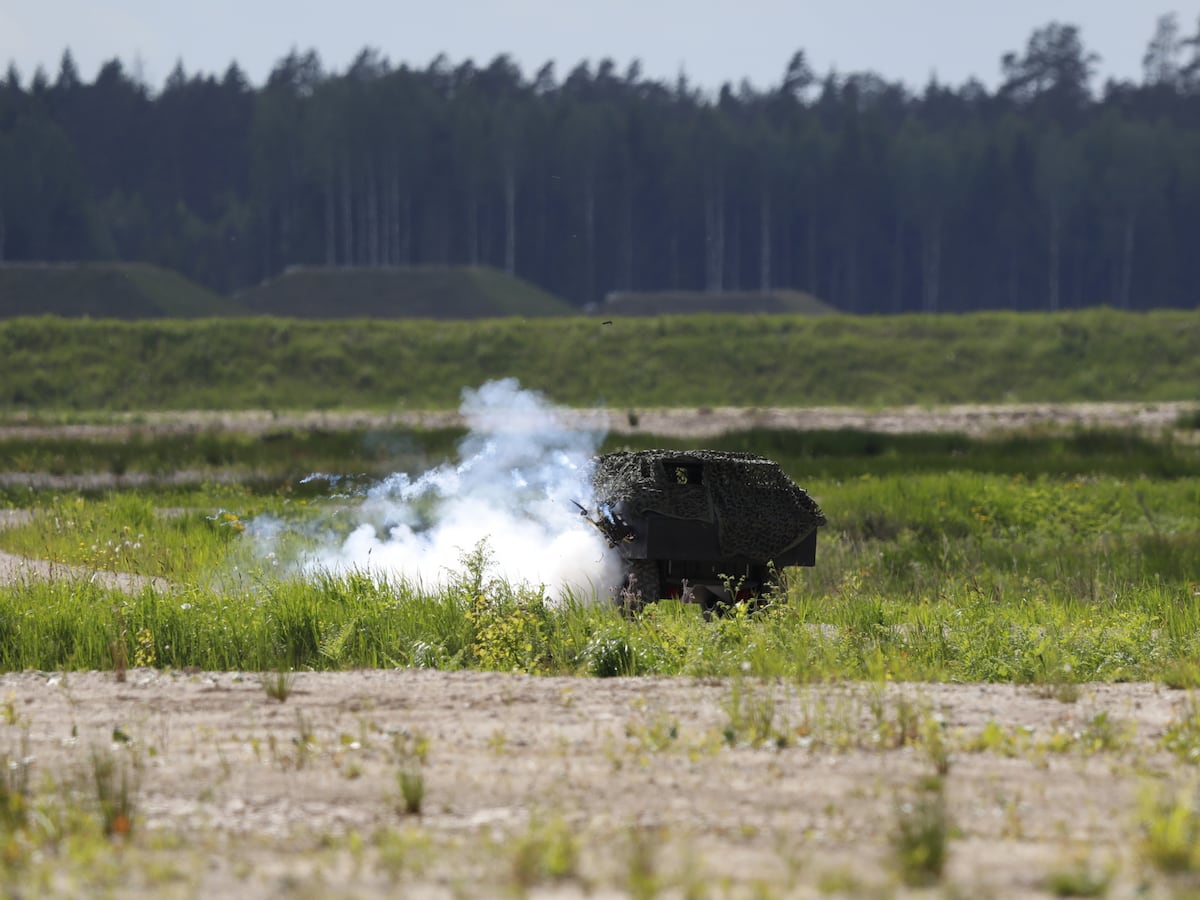
SĒLIJA, Latvia — As NATO military staff and officials greeted the booms of successful drone intercepts with polite applause, demonstrations at the Sēlija testing range in central Latvia last week showed both the progress European startups are making in counter-unmanned aerial systems as well as the difficulty to reliably take down flying drones.
After an initial intercept by local drone maker Eraser failed and the target returned unharmed, CEO Edgars Gauručs was so stressed in a later demonstration that he missed the details of the successful takedown. Nordic Air Defense’s Kreuger 100 interceptor hit its target on the first try, missed on a second attempt, before succeeding again in a third and final simulated attack.
Finding cost-effective drone counters has become urgent for NATO, as countries on its eastern flank have found themselves unable to fend off multiple drone incursions in recent months. Meanwhile, Russia uses thousands of drones in Ukraine every day, and Iranian drone attacks caused the United States to burn through years of interceptor production valued at billions of dollars in just weeks.
“We face serious problems, not only in Latvia,” said Maj. Modris Kairišs, head of Latvia’s Autonomous Systems Competence Center, at the testing range on May 26. Drone technology is “a couple of steps ahead” of C-UAS, he said, with interceptors having to be successful every time while only one attack drone needs to get through for damaging effect.
The threat felt particularly acute in Latvia last month after the country was unable to challenge repeated incursions by Ukrainian drones believed to have been diverted by Russian jamming. In response, the country is sending mobile teams equipped with interceptor drones from Latvia’s Origin Robotics and Eraser to its eastern border with Russia.
A team from Germany's JetDrones with two of the company's jet-powered interceptor drones at the Sēlija testing range in central Latvia on May 26, 2026. (Rudy Ruitenberg/staff)
The war in the Middle East exposed a cost-exchange problem for C-UAS, with Shahed-class threats costing $15,000 to $50,000 being shot down with interceptors costing anywhere from $1 million to $12 million, PitchBook senior research analyst Ali Javaheri wrote in a May 26 report. He said investors should look for solutions that cost less than $30,000 per engagement against such threats.
The demonstrations at Sēlija, which hosts NATO’s new uncrewed systems testing range, featured a range of approaches by European startups to the drone problem, from autonomous interceptors to a mothership drone and jet-powered systems to engage faster threats. Much of it inspired by the war in Ukraine, and in some cases battle-tested there.
Origin Robotics showed off the Blaze interceptor that will equip Latvia’s mobile teams and which the company hopes to deliver to Ukraine “soon.” The four-rotor drone is fully autonomous, with radar for initial target detection and computer-vision software to close in on and follow the target, with an operator deciding whether or not to trigger the interceptor’s fragmentation warhead.
Light rain complicated visibility across the testing range, a 2 by 2 kilometers square of cleared terrain of grass and sand hemmed in by pine forest, with military brass and officials following the action on a several meter-high video screen set up for the occasion.
“There was the big kaboom and the target is down,” said Maris Kuda, head of government relations at Origin Robotics, after the drone identified, approached and hit a target drone from Temeso , another Latvian company. “Hopefully soon those will be some Shaheds on the eastern border.”
Ukraine remains the reference for combat drone operations, and several companies at the Sēlija range noted their systems had already been tested there. While the concept of interceptor drones predates Russia’s 2022 invasion, Ukraine has turned them into a mass weapon, with production of 100,000 units in 2025 , according to the National Security and Defence Council of Ukraine.
“Ukraine has demonstrated with absolute clarity that drones, counter-drone systems, electronic warfare, autonomy and rapid innovation cycles are now central to the military efficiency,” said Maj. Gen. Andis Dilāns, undersecretary of state for logistics in Latvia’s Ministry of Defence.
Latvia aims to develop the Sēlija training area into a place where NATO allies and industry can test technologies, validate concepts and speed up development, which is especially important in counter-UAS due to constantly evolving threats, according to Dilāns.
The country signed a letter of intent with the Netherlands last week to let the Dutch armed forces use the range for drone and counter-drone exercises and testing.
NATO is setting up five innovation ranges as part of its Rapid Adoption Action Plan, including the one in Sēlija focused on unmanned aerial systems and their countermeasures. The goal is to make it easier for companies to test new systems and show they work, and make it less risky for countries to buy those systems because the capabilities are proven.
Sweden’s Nordic Air Defense demonstrated its first C-UAS product, a portable carbon-fiber drone called Kreuger 100, which it launched from a winged mothership that can additionally function as a communications relay or be equipped with a sensor gimbal to cue the interceptor.
The drone performed three simulated strikes on the target, with a first head-on hit counting as a kill as the Kreuger got within the 3-meter distance where its fragmentation head is effective. The interceptor, chasing the threat in intercept mode without manual control, didn’t get close enough in a second pass from a cornering angle, before success on a third attempt.
A mothership drone carries a Nordic Air Defense Kreuger 100 interceptor drone at the Sēlija testing range in central Latvia on May 26, 2026. (Rudy Ruitenberg/staff)
The company says it aims to reach a price point at which the interceptor can be used as a disposable air-defense tool.
With Russia adapting to Ukraine’s drone interceptors by switching to jet-powered attack UAVs, two German companies demonstrated high-speed drones for use against high-flying or faster targets, though neither demo included an interception.
Munich-based RDC Systems showcased a 3D-printed rotor-powered interceptor drone called Raven, with rocket-assisted launch to save battery life while climbing to operating height. The company says the drone was measured by NATO radars at the Sēlija range in March doing 450 kilometers per hour.
JetDrones , a startup from the same German city and only registered since February, demonstrated a jet-powered interceptor aimed at Shaheds flying at an altitude of four to eight kilometers, a range which the company said would typically require expensive interceptor missiles such as IRIS-T. The firm says its drone can operate fully autonomously or monitored by a human operator.
The company was flying the drone in FPV mode, and a company representative said adding a radar would double the price tag, when JetDrones has been told by Ukrainian operators that the cost needs to below that of a Shahed.
Eraser wrapped up the demonstrations at Sēlija with a successful takedown of the Temeso target using a faster version of its modular drone, after the earlier attempt with a slower version and a smaller target proved inconclusive.
“There is the target,” Gauručs said, tracking the interception on-screen, after just describing how cloudy skies and sun can complicate visual detection. “We think we… oh, no, we got it, the target is going down in the corner.”
The executive said he wasn’t sure whether the Eraser drone took down the target autonomously or in manual mode.
“To be fair, I was so stressed that I didn’t see the result.”
Rudy Ruitenberg is a Europe correspondent for Defense News. He started his career at Bloomberg News and has experience reporting on technology, commodity markets and politics.
拉脱维亚塞利亚——上周,在拉脱维亚中部塞利亚试验场举行的演示中,北约军事人员和官员对成功拦截无人机的轰鸣声报以礼貌的掌声,同时也展示了欧洲初创企业在反无人机系统方面取得的进展,以及可靠地击落飞行无人机的难度。
在本土无人机制造商Eraser的首次拦截失败,目标毫发无损地返回后,其首席执行官埃德加斯·高鲁奇斯(Edgars Gauručs)在随后的演示中因压力过大而错过了成功击落的细节。北欧防空公司的Kreuger 100拦截机在第一次尝试中击中目标,第二次尝试失败,但在第三次也是最后一次模拟攻击中再次成功。
对于北约而言,寻找经济有效的无人机反制手段已迫在眉睫,因为其东翼国家近几个月来已无力抵御多次无人机入侵。与此同时,俄罗斯每天在乌克兰使用数千架无人机,而伊朗的无人机袭击导致美国在短短几周内就消耗掉了价值数十亿美元、耗时数年的拦截器生产成果。
“我们面临着严峻的问题,不仅仅是在拉脱维亚,”拉脱维亚自主系统能力中心负责人莫德里斯·凯里什少校5月26日在测试场表示。他指出,无人机技术比反无人机系统“领先好几步”,拦截器必须每次都成功拦截,而攻击无人机只需要一架突破防线就能造成破坏性影响。
上个月,拉脱维亚未能有效应对乌克兰无人机的多次入侵,这些无人机据信受到了俄罗斯的干扰,这使得拉脱维亚感受到的威胁尤为严峻。作为应对措施,拉脱维亚正派遣配备拦截无人机的机动小组前往其与俄罗斯接壤的东部边境,这些无人机由拉脱维亚本土的Origin Robotics和Eraser公司生产。
2026年5月26日,德国JetDrones公司的一个团队在拉脱维亚中部的塞利亚试验场,展示了该公司的两架喷气式拦截无人机。(Rudy Ruitenberg/工作人员摄)
PitchBook高级研究分析师阿里·贾瓦赫里在5月26日的一份报告中写道,中东战争暴露了反无人机系统(C-UAS)的成本效益问题。击落一架“沙赫德”级无人机的成本在1.5万美元到5万美元之间,而拦截机的成本却在100万美元到1200万美元之间。他表示,投资者应该寻找每次拦截此类威胁成本低于3万美元的解决方案。
在北约新建无人系统测试场——塞利亚举行的演示活动中,欧洲初创企业展示了一系列针对无人机问题的方案,从自主拦截器到母舰无人机,再到用于应对高速威胁的喷气动力系统。其中许多方案都受到了乌克兰战争的启发,有些方案甚至在乌克兰战场上经过了实战检验。
Origin Robotics公司展示了其Blaze拦截无人机,该无人机将装备拉脱维亚的机动部队,该公司希望“尽快”将其交付给乌克兰。这款四旋翼无人机完全自主运行,配备雷达用于初始目标探测,并利用计算机视觉软件接近并跟踪目标,操作员可决定是否引爆拦截无人机的破片战斗部。
小雨使整个测试场的能见度变得复杂。测试场是一片 2 平方公里的空地,由草地和沙地组成,四周环绕着松树林。军方高层和官员们通过为此活动设置的几米高的视频屏幕关注着测试情况。
“一声巨响,目标被击落了,”Origin Robotics公司政府关系负责人马里斯·库达在无人机识别、接近并击中另一家拉脱维亚公司Temeso的靶机后说道。“希望不久之后,东部边境就会出现一些‘沙赫德’(Shahed,指印度武装分子或武装分子)。”
乌克兰仍然是作战无人机领域的标杆,塞利亚靶场的几家公司都表示,他们的系统已经在那里进行过测试。虽然拦截无人机的概念早于俄罗斯2022年的入侵,但乌克兰已将其发展成为一种大规模杀伤性武器,据乌克兰国家安全与国防委员会称,到2025年,乌克兰的无人机产量将达到10万架。
拉脱维亚国防部后勤国务秘书安迪斯·迪兰斯少将表示:“乌克兰已经非常清楚地表明,无人机、反无人机系统、电子战、自主性和快速创新周期现在是军事效率的核心。”
迪兰斯表示,拉脱维亚的目标是将塞利亚训练区发展成为北约盟国和工业界可以测试技术、验证概念和加快开发的地方,这对于应对不断变化的威胁而言,在反无人机系统领域尤为重要。
该国上周与荷兰签署了一份意向书,允许荷兰武装部队使用该靶场进行无人机和反无人机演习和测试。
北约正在设立五个创新试验场,作为其快速采纳行动计划的一部分,其中包括位于塞利亚的试验场,该试验场专注于无人机系统及其对抗措施。其目标是方便企业测试新系统并验证其有效性,同时降低各国购买这些系统的风险,因为这些系统的性能已经过验证。
瑞典北欧防空公司展示了其首款反无人机系统产品,这是一款名为 Kreuger 100 的便携式碳纤维无人机,它由一架带翼母舰发射,该母舰还可以用作通信中继,或配备传感器云台来引导拦截器。
无人机对目标进行了三次模拟打击,第一次正面命中即被判定为击落,因为克鲁格导弹进入了其碎片弹头有效射程的3米范围内。拦截机在拦截模式下追击目标,没有进行手动控制,第二次从拐角处尝试拦截但未能接近目标,第三次尝试才成功。
2026年5月26日,一架母舰无人机在拉脱维亚中部塞利亚试验场搭载一架北欧防空公司的克鲁格100型拦截无人机。(Rudy Ruitenberg/工作人员摄)
该公司表示,其目标是使拦截器的价格降至可作为一次性防空工具使用的水平。
俄罗斯通过改用喷气式攻击无人机来应对乌克兰的无人机拦截器,两家德国公司展示了用于攻击高空或高速目标的高速无人机,尽管两次演示都没有包括拦截。
总部位于慕尼黑的RDC Systems公司展示了一款名为“渡鸦”(Raven)的3D打印旋翼动力拦截无人机,该无人机采用火箭助推发射,可在爬升至作战高度的过程中节省电池电量。该公司称,今年3月,北约雷达在塞利亚靶场测得该无人机的飞行速度为每小时450公里。
JetDrones是一家来自德国同一城市的初创公司,今年2月才注册成立。该公司展示了一款喷气式拦截无人机,目标是飞行高度在4至8公里之间的沙赫德民兵。该公司表示,通常情况下,要达到这样的射程需要使用像IRIS-T这样昂贵的拦截导弹。JetDrones称,其无人机可以完全自主运行,也可以由人工操作员监控。
该公司当时正在以 FPV 模式操控无人机,一位公司代表表示,加装雷达将使价格翻倍,而 JetDrones 从乌克兰运营商那里得知,成本必须低于 Shahed 无人机。
在塞利亚的演示中,Eraser 使用速度更快的模块化无人机成功击落了 Temeso 目标,此前使用速度较慢的版本和较小的目标进行的尝试结果并不理想。
“目标就在那里,”高鲁奇斯一边说着,一边在屏幕上追踪拦截情况,此前他刚刚解释了阴天和阳光如何使视觉探测变得复杂。“我们以为我们……哦,不,我们找到了,目标正在角落里坠落。”
该高管表示,他不确定 Eraser 无人机是自主击落目标还是手动击落目标。
“说实话,我当时压力太大了,根本没看到结果。”
鲁迪·鲁伊滕贝格是《防务新闻》的欧洲记者。他的职业生涯始于彭博新闻社,拥有报道科技、大宗商品市场和政治方面的经验。