National Bonus targets for political salaries tightened, including unemployment, income growth国家收紧政治薪酬奖金目标,包括失业率和收入增长。
The salary range will be widened to cater to people joining political service at different career stages. Read more at straitstimes.com.
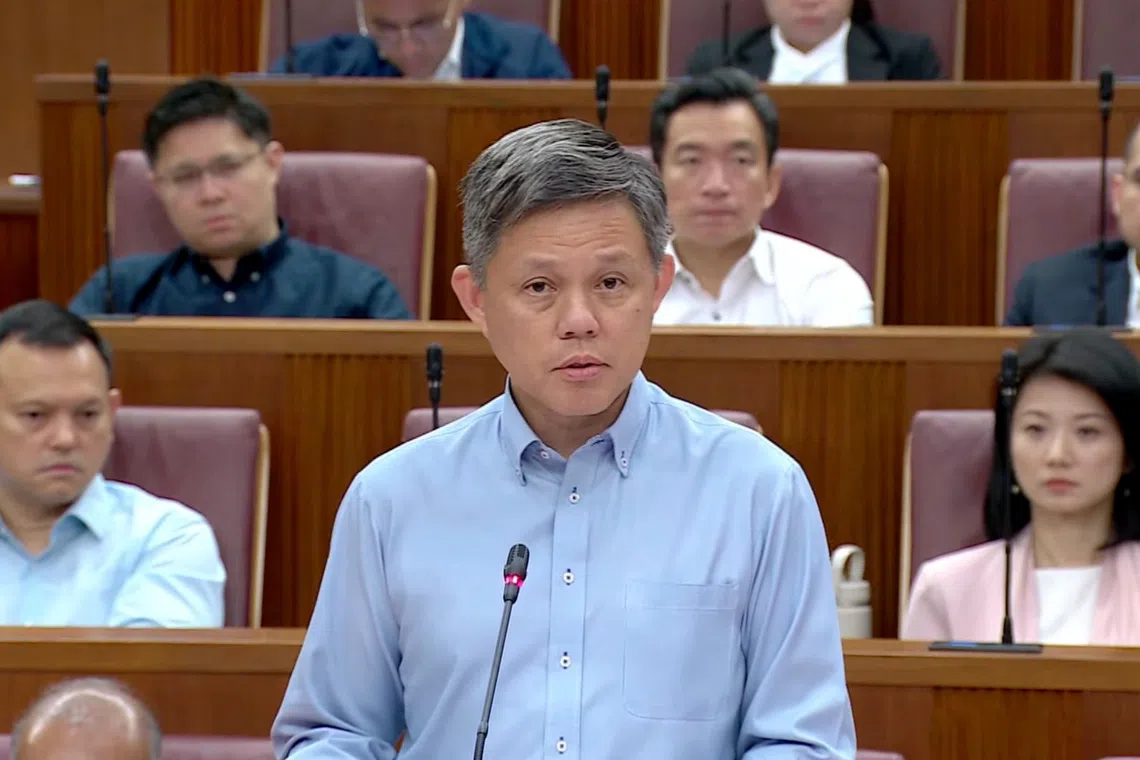
In adjusting the National Bonus targets, Coordinating Minister for Public Service Chan Chun Sing said the Government’s responsibility is to set targets that are ambitious, credible and sustainable.
Published Sep 08, 2026, 05:39 PM
Updated Sep 08, 2026, 05:39 PM
SINGAPORE — Several performance targets used to determine the National Bonus component of ministers’ pay will be tightened, as part of changes to the political salary framework.
Coordinating Minister for Public Services Chan Chun Sing on Sept 8 set out the Government’s response to the recommendations made by a committee reviewing the salaries of political appointment holders and MPs.
Besides making the changes to the National Bonus, he said the salary range will be widened to cater to people joining political service at different stages of their careers. The grade structure will also be streamlined for simplicity.
The National Bonus, which ranges from zero to six months of salary, is part of the variable component of ministers’ pay and is linked to four national indicators.
The four are unemployment rate, real income growth for the 20th-percentile Singaporean earner and for the median Singapore citizen, as well as real GDP growth.
The Government will tighten the targets for the three socioeconomic indicators, Chan said.
For unemployment rate, the target band will be tightened from the current 4 per cent to below 4.5 per cent, to 3 per cent to below 3.5 per cent – a tightening of one percentage point.
The target for real income growth of the median Singapore citizen will be raised from 2 per cent to below 3 per cent, to 2.5 per cent to below 3.5 per cent.
For the 20th-percentile Singaporean earner, the target will be raised from 2 per cent to below 3 per cent, to 3 per cent to below 4 per cent.
The target band for real GDP growth will be updated, from 3 per cent to 5 per cent, to 2 per cent to 4 per cent.
Chan said the GDP target is calibrated to Singapore’s longer-term growth potential rather than the unusually strong performance of recent years.
Over the past decade, Singapore’s average real GDP growth was about 2.6 per cent, he said. The Ministry of Trade and Industry has upgraded its growth forecast for 2026 to 4.5 per cent to 5.5 per cent, reflecting the strong performance of the economy.
But looking ahead, MTI expects real GDP growth to be around 2 per cent to 3 per cent a year over the next decade as Singapore’s economy matures, with an ageing population and slower workforce growth.
“Our responsibility is to set targets that are ambitious, credible and sustainable,” Chan said.
The Government has also agreed to explore including a robust Quality of Life measure in the National Bonus framework once such a measure becomes available, he said, in line with the committee’s recommendation.
Separately, the Government has accepted the committee’s proposal to raise the norm annual salary for the base MR4 ministerial grade, including bonuses, from $1.1 million to $1.8 million.
While the increase seems significant, this is because the level has not been updated for 15 years, Chan said.
Averaged across the period from 2011 to 2025, the adjustment works out to about 3.6 per cent per year, which is lower than the wage growth over the same period experienced by Singaporeans, he said.
Wage growth among Singaporeans over the period is about 4.3 per cent annually for the median earner, and 4.6 per cent for the lower‑income earner at the 20th percentile.
The new reference norm annual salary continues to incorporate a 40 per cent discount off the median income of the top 1,000 earners who are Singapore citizens.
Chan said this was a “deliberate reduction” that reflects the ethos and sacrifice expected of political service.
“Without that discount, the reference for the median 1,000 Singaporean earner would be slightly above $3 million,” he added.
Chan noted that over the same period, the Civil Service pay has been adjusted thrice – in 2014, 2022, and August this year – in quantums ranging from 2 per cent to 14 per cent to close market gaps.
He also dispelled the notion that the benchmark is a statement that only the top 1,000 earners can become leaders.
Instead, it is “a practical recognition that we must be able to recruit capable people who have other options”, he said.
“Our objective is simple – to allow Singaporeans from every background to step forward and serve, while recognising that political service involves sacrifices,” he added.
Chan also acknowledged that no formula will be perfect or able to satisfy everyone.
Noting that there is no universally ideal benchmark, he said: “The key question is this: what is a workable framework and range of figures that allow the prime minister, any prime minister, to reasonably assemble a team that Singapore deserves?”
In the 27-page report disseminated in Parliament on Sept 8, the salary review’s committee laid out that benchmarking to the top 1,000 earners across all professions serves to “reflect the calibre of the people Singapore needs for good government”.
The report also stated the median income rate is picked over the average income rate so the benchmark is more stable and not skewed upwards by outliers.
Wider salary ranges and merged grades
Chan also announced that the Government will simplify the grade structure by merging grades with fewer appointment holders, while using wider salary ranges to give greater flexibility in remuneration.
Currently, a new minister is appointed at the MR4 grade, and could be promoted to the more senior grades of MR3, MR2 or MR1 down the road.
Under the changes, the MR2 and MR3 grades will be combined into a single grade pegged at 1.3 times the MR4 reference salary, which is the midpoint between the current 1.2 and 1.4 times.
The grades for Mayors, Senior Parliamentary Secretaries and Parliamentary Secretaries will also be merged, with the new grade pegged at 0.45 times that of MR4. This is towards the lower end of the current range of 0.38 to 0.6 times the MR4 rate.
The merged grade will have a wider salary range of 70 per cent to 130 per cent of its reference salary, allowing greater flexibility to account for the diversity among junior appointment holders.
Chan said the Government will also widen salary ranges for political appointment holders, from the current 75 per cent to 125 per cent of the reference benchmark.
The wider range will give the Prime Minister greater flexibility to account for the different backgrounds and career stages of people entering political service, such as putting candidates who are already highly established in their careers at a higher point within the range, Chan said.
“The individual is still likely to have to take a pay cut to enter political service, but the wider range will help make the pay cut less steep,” Chan said.
Portions of the framework that would stay unchanged include the salary pegs for the statutory appointment holders, such as the President, Speaker and Deputy Speakers.
This means the President’s monthly salary will continue to be pegged to the Prime Minister’s monthly salary. The Speaker’s salary remains pegged at 50 per cent of the MR4 reference salary, while the Deputy Speaker’s is pegged at 15 per cent of the Speaker’s salary.
The current practice of paying all political appointment holders one salary package, even if they hold multiple appointments or portfolios, would also remain.
“The principle is simple – one person, one salary,” Chan said. “Holding more portfolios does not mean receiving more pay.
Singapore politicians
Singapore Parliament
在调整国民奖金目标时,公共服务统筹部长陈振声表示,政府的责任是制定有雄心、可信且可持续的目标。
发布于 2026 年 9 月 8 日下午 5:39
更新于2026年9月8日下午5:39
新加坡——作为政治薪酬体系改革的一部分,用于确定部长薪酬中国家奖金部分的几项绩效目标将收紧。
公共服务统筹部长陈振声于9月8日阐述了政府对检讨政治委任官员和国会议员薪酬委员会所提建议的回应。
除了调整国家奖金外,他还表示将扩大薪资范围,以满足不同职业阶段加入政界人士的需求。职级结构也将进行精简。
国家奖金的数额从零到六个月的工资不等,是部长薪酬中可变部分的一部分,与四个国家指标挂钩。
这四项指标分别是失业率、新加坡收入处于第 20 百分位人群和新加坡公民收入中位数人群的实际收入增长率,以及实际 GDP 增长率。
陈先生表示,政府将收紧三项社会经济指标的目标。
对于失业率,目标区间将从目前的 4% 至 4.5% 以下收紧至 3% 至 3.5% 以下——收紧一个百分点。
新加坡公民中位数实际收入增长目标将从 2% 至 3% 以下提高到 2.5% 至 3.5% 以下。
对于收入处于新加坡第 20 百分位的人群,目标将从 2% 到 3% 以下提高到 3% 到 4% 以下。
实际GDP增长目标区间将从3%至5%调整为2%至4%。
陈先生表示,GDP目标是根据新加坡的长期增长潜力来设定的,而不是根据近年来异常强劲的增长表现来设定的。
他表示,过去十年新加坡的平均实际GDP增长率约为2.6%。贸易与工业部已将2026年的增长预测上调至4.5%至5.5%,反映出新加坡经济的强劲表现。
但展望未来,随着新加坡经济走向成熟,人口老龄化和劳动力增长放缓,贸工部预计未来十年实际GDP年增长率将在2%至3%左右。
“我们的责任是制定雄心勃勃、可信且可持续的目标,”陈说。
他还表示,政府也已同意,一旦有强有力的生活质量衡量指标可用,就会考虑将其纳入国家奖金框架,这符合委员会的建议。
另外,政府已接受委员会的提议,将MR4部长级基本年薪(含奖金)从110万美元提高到180万美元。
陈先生表示,虽然增幅看起来很大,但这是因为该水平已经15年没有更新了。
他表示,从 2011 年到 2025 年的平均调整幅度约为每年 3.6%,低于新加坡人同期工资的增长幅度。
在此期间,新加坡人的工资增长率,中等收入者的年增长率约为 4.3%,而收入处于 20% 分位数的低收入者的年增长率约为 4.6%。
新的参考标准年薪继续沿用新加坡公民收入最高的 1000 人中位数收入的 40% 折扣。
陈先生表示,这是“刻意削减”,体现了政治服务应有的精神和牺牲精神。
“如果没有这项折扣,新加坡收入中位数 1000 人的收入参考值将略高于 300 万美元,”他补充道。
陈指出,在同一时期,公务员薪酬已经调整了三次——分别在 2014 年、2022 年和今年 8 月——调整幅度从 2% 到 14% 不等,以缩小市场差距。
他还驳斥了这样一种观点,即该基准表明只有收入最高的 1000 人才能成为领导者。
他表示,这“实际上是在承认我们必须能够招募那些有其他选择但能力出众的人才”。
“我们的目标很简单——让新加坡各界人士都能站出来服务,同时也要认识到政治服务需要做出牺牲,”他补充道。
陈也承认,没有任何方法能够做到完美,让每个人都满意。
他指出没有普遍适用的理想标准,并表示:“关键问题是:什么样的框架和数字范围能够让总理,任何一位总理,合理地组建一支新加坡应有的团队?”
在9月8日向国会分发的这份27页的报告中,薪酬审查委员会指出,以各行各业收入最高的1000人为基准,是为了“反映新加坡良好政府所需的人才素质”。
报告还指出,之所以选择中位数收入率而不是平均收入率,是为了使基准更加稳定,避免因异常值而向上扭曲。
更宽泛的薪资范围和合并的职级
陈先生还宣布,政府将简化职级结构,合并任职人数较少的职级,同时扩大薪酬范围,以提供更大的薪酬灵活性。
目前,新任部长的级别为 MR4,未来有可能晋升到更高级别的 MR3、MR2 或 MR1。
根据这些变化,MR2 和 MR3 等级将合并为一个等级,其薪资为 MR4 参考薪资的 1.3 倍,这是目前 1.2 倍和 1.4 倍之间的中间值。
市长、高级议会秘书和议会秘书的职级也将合并,新职级的薪级设定为MR4的0.45倍。这接近目前MR4薪级0.38倍至0.6倍范围的下限。
合并后的职级薪资范围将扩大至参考薪资的 70% 至 130%,从而能够更灵活地考虑初级职位持有者之间的多样性。
陈先生表示,政府还将扩大政治任命官员的薪酬范围,从目前的参考基准的75%提高到125%。
陈先生表示,更宽泛的薪级范围将使总理有更大的灵活性,可以考虑到进入政界人士的不同背景和职业阶段,例如将已经在职业生涯中取得很高成就的候选人放在薪级范围的较高位置。
陈先生表示:“个人进入政界仍可能需要接受降薪,但更广泛的薪资范围将有助于减轻降薪幅度。”
框架中保持不变的部分包括法定任命人员(如总统、议长和副议长)的薪资标准。
这意味着总统的月薪将继续与总理的月薪挂钩。议长的薪水仍为MR4参考薪水的50%,而副议长的薪水则为议长的15%。
目前所有政治任命人员领取统一薪酬的做法,即使他们身兼多个职务或职位,也将继续保留。
“原则很简单——一人一份薪水,”陈说。“持有更多投资组合并不意味着会获得更多报酬。”
新加坡政治家
新加坡国会