New book charts Lee Hsien Loong’s two decades of steering Singapore through change新书记录了李显龙二十年来带领新加坡经历变革的历程。
The 440-page publication brings together 23 essays from Singapore’s leading thinkers and policy practitioners. Read more at straitstimes.com.
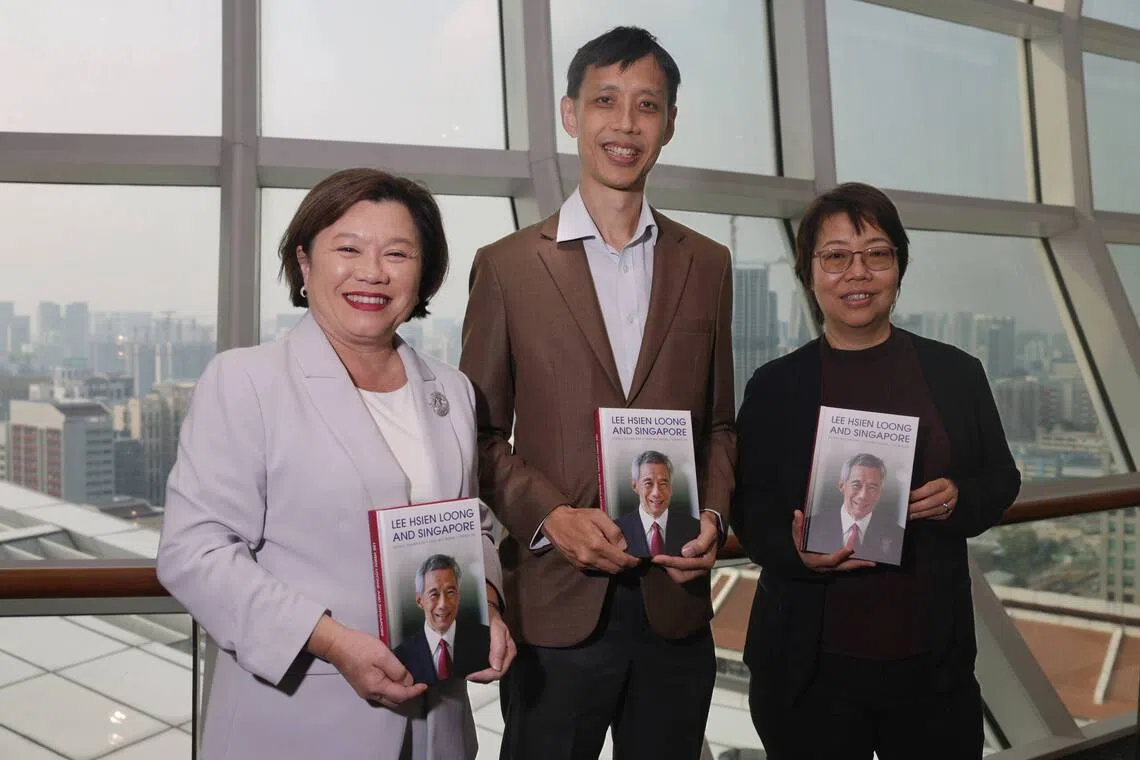
(From left) Dr Gillian Koh, Senior Research Fellow at the Institute of Policy Studies, Associate Professor Terence Ho, Associate Professor (Practice) from the Singapore University of Social Sciences, and Chua Mui Hoong, former Opinion Editor of The Straits Times at the launch of Lee Hsien Loong and Singapore on Sept 8.
Published Sep 08, 2026, 06:20 PM
Updated Sep 08, 2026, 06:20 PM
Lee Hsien Loong strengthened Singapore’s social support with universal health insurance and subsidies for pre-school, healthcare, and eldercare during his 20-year tenure.
The book highlights his adaptive leadership and diplomatic success with Malaysia and Indonesia.
Unfinished challenges include low fertility and AI’s impact on jobs, requiring fresh thinking from the current government.
SINGAPORE – Across Lee Hsien Loong’s two-decade premiership , Singapore became a wealthier country with a stronger and more diversified economy, despite having to weather several major crises.
Yet, his defining achievement may well be how the city state built a more comprehensive social safety net between 2004 and 2024, according to the editors of a new book launched on Sept 8 on Lee’s tenure as Singapore’s third prime minister.
Titled Lee Hsien Loong And Singapore, the 440-page publication brings together 23 essays from Singapore’s leading thinkers and policy practitioners.
The book is published by the Institute of Policy Studies (IPS) and edited by IPS senior research fellow Gillian Koh, former Straits Times opinion editor Chua Mui Hoong, and Nominated MP Terence Ho, who is also executive director and associate professor (practice) at the Institute for Adult Learning, Singapore University of Social Sciences.
Contributors include former Monetary Authority of Singapore managing director Ravi Menon, Professor Tommy Koh, Professor Chan Heng Chee and Manu Bhaskaran, an economist and expert on regional politics and geopolitics.
Chua said the biggest change in Singapore by 2024 was how people felt about dealing with the vicissitudes of life compared with in 2004, when the Republic’s social safety net covered largely only the very old or sick.
This was a direct result of changes in social policy brought about by Lee and his government, she said.
“While costs of living remain a perennial concern, the broadening of the social support structure means families are better able to access quality pre-school, healthcare and eldercare without feeling crippled financially,” she said, adding that this extended beyond family finances to shape people’s sense of safety and of home.
Ho noted that new levers such as the Workfare Income Supplement, Silver Support, the GST Voucher scheme, universal health and long-term care insurance, and the SkillsFuture Jobseeker Support scheme meant Singapore’s social support system was no longer the minimalist, residual model it was when Lee took over in 2004.
Adaptive leadership – the willingness to find new ways of doing things when circumstances change – was another key theme across the various policy areas covered in the book, said lead editor Koh.
That adaptability showed up in the SkillsFuture movement and the Progressive Wage Model to keep Singaporeans employable, new laws addressing the risks of social media, and expanded powers for Non-Constituency MPs to preserve diversity of views in Parliament, noted the book’s editors.
Koh also highlighted Lee’s resolution of longstanding bilateral issues with Indonesia and Malaysia as one of his major policy successes.
Lee Hsien Loong’s defining achievement may well be how the city state built a more comprehensive social safety net between 2004 and 2024, according to the editors of the new book. PHOTO: LIANHE ZAOBAO
Lee Hsien Loong’s defining achievement may well be how the city state built a more comprehensive social safety net between 2004 and 2024, according to the editors of the new book.
PHOTO: LIANHE ZAOBAO
“Mr Lee’s approach was not for Singapore to state a position and then to stick to its guns no matter what. Instead, there was negotiation, even reference to international law and adjudication, but in the end, he and his Malaysian and Indonesian counterparts were able to achieve win-win outcomes,” she said, adding that this opened new areas of cooperation between Singapore and its closest neighbours.
Most of the book’s contributors acknowledged Lee’s significant achievements across economic management, foreign policy and diplomacy, and environmental and social policy, the editors said.
Singapore’s persistently low total fertility rate was flagged as one of Lee’s “unfinished businesses” for his successor, Prime Minister Lawrence Wong.
Sociologist Paulin Tay Straughan wrote that this requires “a cultural reimagining of what it means to be a good parent, what constitutes success, and how we value diverse pathways in life”.
Ho said Wong will also have to grapple with artificial intelligence’s implications for jobs, fair opportunity and social mobility, and what that means for Singapore’s social compact.
Bhaskaran, while pointing to an impressive record of economic growth, highlighted ongoing challenges like Singapore’s high-cost structure, low total factor productivity, heavy reliance on foreign workers, and a weak equity market.
The editors said that while specific policies from the Lee era may need revision, his government’s instinct to adapt will matter even more in an age of uncertainty, with geopolitics in flux and where strategies for economic development and technological innovation are constantly being tested by factors such as AI.
“Most of all, (the essays) speak of the adaptive governance that Mr Lee, his cohorts of political leaders and civil servants exemplified in those years,” said Koh.
“That said, fresh thinking by the current administration is needed to address challenges such as online social harms, scams, the low fertility rate, the impact of AI on jobs, wealth inequality, social mobility and more,” Ho said.
The editors hope the book will whet readers’ appetite to learn and research more on the topic.
“We hope that this book sparks discussion, debate and disagreement, and that future scholars and writers will offer other, well-researched, nuanced, and similarly considered, analyses of the Lee Hsien Loong years,” they said. “It is not the final word by any means on the challenges, impact and legacy of his leadership.”
Lee Hsien Loong And Singapore is published by World Scientific and available at major bookstores and at https://doi.org/10.1142/14641
Chin Soo Fang is senior correspondent at The Straits Times, covering a wide range of topics including community, politics, social issues, consumer, culture and heritage.
IPS/Institute of Policy Studies
(从左至右)政策研究所高级研究员许嘉莲博士、新加坡社会科学大学副教授(实践)何德伦副教授和《海峡时报》前评论编辑蔡梅红于9月8日出席了《李显龙与新加坡》的发布会。
发布于2026年9月8日下午6:20
更新于2026年9月8日下午6:20
李显龙在20年的任期内,通过全民健康保险和对学前教育、医疗保健和老年护理的补贴,加强了新加坡的社会保障。
这本书重点介绍了他在与马来西亚和印度尼西亚的外交努力中所取得的适应性领导和成功经验。
尚未解决的挑战包括低生育率和人工智能对就业的影响,这需要现任政府提出新的思路。
新加坡——在李显龙执政的二十年间,尽管经历了数次重大危机,新加坡仍然成为了一个更加富裕、经济更加强大和多元化的国家。
然而,据一本于 9 月 8 日出版的关于李光耀担任新加坡第三任总理期间的新书的编辑称,他最主要的成就或许在于,新加坡在 2004 年至 2024 年间建立了一个更全面的社会保障网。
这本名为《李显龙与新加坡》的440页出版物汇集了新加坡顶尖思想家和政策实践者的23篇文章。
本书由政策研究所 (IPS) 出版,由 IPS 高级研究员许嘉莲 (Gillian Koh)、前《海峡时报》评论版编辑蔡梅凤 (Chua Mui Hoong) 和新加坡政府委任议员何志强 (Terence Ho) 编辑,何志强同时也是新加坡社会科学大学成人学习研究所的执行主任和副教授(实践)。
撰稿人包括新加坡金融管理局前总经理拉维·梅农、许通美教授、陈恒志教授以及经济学家、区域政治和地缘政治专家马努·巴斯卡兰。
蔡先生表示,到 2024 年新加坡最大的变化是人们应对人生变迁的感受与 2004 年相比发生了改变,当时新加坡的社会保障体系主要只覆盖了老年人或病人。
她说,这是李光耀及其政府推行的社会政策变革的直接结果。
“虽然生活成本仍然是一个长期令人担忧的问题,但社会支持体系的扩大意味着家庭能够更好地获得优质的学前教育、医疗保健和老年护理,而不会感到经济拮据,”她说道,并补充说,这不仅限于家庭财务,还会影响人们对安全感和家的感觉。
何先生指出,诸如就业收入补助、乐龄补助、消费税补助券计划、全民健康与长期护理保险以及技能创前程求职者支持计划等新措施,意味着新加坡的社会支持体系不再是李光耀2004年上任时那种极简的、残余式的模式。
主编 Koh 表示,适应性领导力——即在环境变化时寻找新的做事方法的意愿——是本书涵盖的各个政策领域中的另一个关键主题。
该书编辑指出,这种适应能力体现在“技能创前程”运动和“渐进式工资模式”中,旨在保持新加坡人的就业能力;体现在应对社交媒体风险的新法律中;体现在扩大非选区议员的权力中,以维护议会中观点的多样性。
Koh 还强调,李光耀解决了与印度尼西亚和马来西亚之间长期存在的双边问题,这是他的主要政策成就之一。
据新书编辑称,李显龙最显著的成就或许在于新加坡在2004年至2024年间构建了一个更为完善的社会保障体系。图片来源:联合早报
根据这本新书的编辑们的说法,李显龙最显著的成就或许在于新加坡在 2004 年至 2024 年间建立了一个更加全面的社会保障体系。
图片来源:联合早报
“李先生的做法并非新加坡表明立场后就一意孤行。相反,他采取了谈判策略,甚至援引国际法和相关裁决,最终与马来西亚和印尼的同行达成了双赢局面,”她说道,并补充说,这为新加坡与其近邻开辟了新的合作领域。
编辑们表示,该书的大多数撰稿人都承认李在经济管理、外交政策和外交以及环境和社会政策方面取得的重大成就。
新加坡持续偏低的总和生育率被认为是李光耀留给其继任者黄循财总理的“未竟之业”之一。
社会学家保琳·泰·斯特劳恩写道,这需要“对成为好父母的意义、成功的构成以及我们如何看待人生中不同的道路进行文化上的重新构想”。
何先生表示,黄先生还必须应对人工智能对就业、公平机会和社会流动性的影响,以及这对新加坡的社会契约意味着什么。
巴斯卡兰在指出新加坡经济增长取得了令人瞩目的成就的同时,也强调了新加坡目前面临的挑战,例如高成本结构、全要素生产率低、严重依赖外籍劳工以及疲软的股票市场。
编辑们表示,虽然李光耀时代的某些具体政策可能需要修改,但在地缘政治动荡不安、经济发展和技术创新战略不断受到人工智能等因素考验的不确定时代,他的政府的适应能力将更加重要。
“最重要的是,(这些文章)谈到了李光耀先生及其政治领袖和公务员同僚在那些年里所展现的适应性治理,”许先生说。
“话虽如此,本届政府仍需拿出新的思路来应对诸如网络社会危害、诈骗、低生育率、人工智能对就业的影响、财富不平等、社会流动性等挑战,”何先生说。
编辑们希望这本书能够激发读者对该主题进行更深入学习和研究的兴趣。
他们表示:“我们希望这本书能引发讨论、辩论和分歧,也希望未来的学者和作家能对李显龙执政时期进行更多研究充分、细致入微且同样深思熟虑的分析。但这绝不是对他领导所面临的挑战、影响和遗产的最终定论。”
《李显龙与新加坡》由世界科学出版社出版,可在各大书店购买,也可访问 https://doi.org/10.1142/14641 购买。
Chin Soo Fang 是《海峡时报》的资深记者,报道范围广泛,包括社区、政治、社会问题、消费者、文化和遗产等话题。
IPS/政策研究所